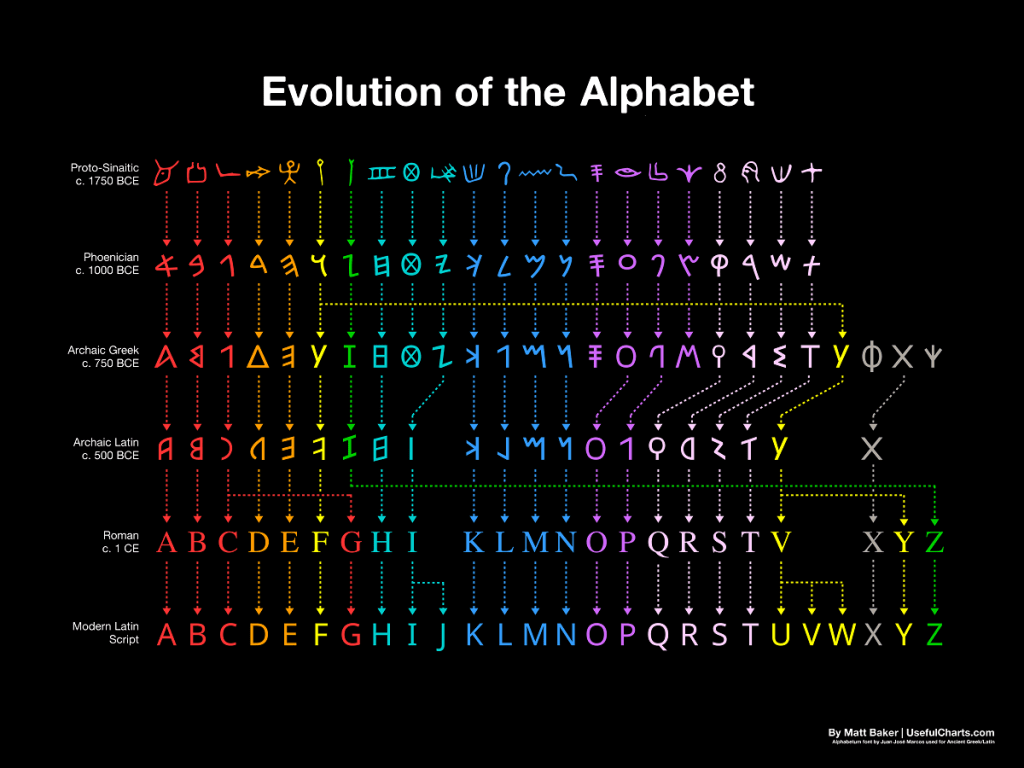
I recently came across this article discussing the historical development of our alphabet. I think it’s fascinating how little some of our letters have changed since 3,750 years ago, when the first known alphabet (Proto-Sinaitic) was written.
Take our letter A. This started as a picture of an ox head, an ox being called an ‘alp, and this symbol came to represent the sound Ah. This ancient Semitic word for ox came down to us through the Greek alpha and has found its way into our word, alphabet. If you turn our contemporary letter A upside down, you can still see how it is descended from a pictogram of a horned ox head.
Our letter B comes from an ancient Semitic word for house, bayt, which is basically still the same word in Hebrew and Arabic (As in Beth-lehem, house of bread/meat). The original symbol looks like the outline from a bird’s eye view of a house with an open door.
So while our compound word Alphabet now means the collection of letters used to write our language, it also historically translates as ox house – or could it be house ox?
And who knew that our capital E comes from a stick figure who has been tipped over and lost his head and legs? From now on when writing by hand, I may from time to time subtly restore some of his dignity by giving him back his head.
Some letters speak to the continuity of human experience through the millennia, such as dag, which is a symbol for a fish, and the ancestor of our letter D. Other letters, such as gaml (our letter C), remind us that the past really is a foreign land. It means throwstick, which apparently was an ancient hunting device.
Check out the chart at the top of this post to see if you can trace more modern letters and their ancient ancestors. The connections are fun to see and can even make learning some foreign alphabets somewhat easier, once you realize you are merely learning a cousin of the same letter you already know.
As this article states, “Like many things in the long arc of human culture, alphabets are not as far removed from each other as you might think.” In a world of over six thousand languages, it is remarkable that this language tool has been so adaptable to so many of them.
So, though he [an unnamed scribe] disapproved of its contents, he copied out the Tain. It is thanks to such scribes, however cranky their glosses may sometimes be, that we have the rich trove of early Irish literature, the earliest vernacular literature of Europe to survive – because it was taken seriously enough to be written down. Though these early Irish literates were intensely interested in the worlds opened up to them by the three sacred languages of Greek, Latin and – in a rudimentary form – Hebrew, they loved their own tongue too much ever to stop using it. Whereas elsewhere in Europe, no educated man would be caught dead speaking a vernacular, the Irish thought that all language was a game – and too much fun to be deprived of any part of it. They were still too childlike and playful to find and value in snobbery.
One way to distinguish Central Asia as a region is to say that it is the part of the world dominated by Turkic or Persian-related languages. When it comes to Persian-related languages, we’re talking groups like the Dari, Tajik, Kurdish, Luri, and Balochi. There are hundreds of millions of people who speak Persian itself (also known as Farsi) or languages closely related to it.
These hundreds of millions of people are overwhelmingly Muslim – and they might be surprised to hear that Jesus spoke a word from their ancestral language while on the cross.
That word is what we know as paradise. I won’t get into the details of the etymology, but this ancient Persian word for walled enclosure and garden came into many of the languages of the ancient world, including Greek, Hebrew, and Aramaic forms. No doubt the Jewish community living under Persian rule is where much of this linguistic influence came from. Plus, the Persians were the superpower of the region for quite some time. The vocab of the superpower tends to spread, just as here the local Central Asian form of laptop is, well, laptop (but said with an “ah” and an “oh”).
The old Persian term’s connection to a garden is what linked it with Eden, and thus with our concept of paradise – not only Eden lost, but heaven as well, and Eden one day restored.
And he said to him, “Truly, I say to you, today you will be with me in paradise.” (Luke 23:43 ESV)
These are the words Jesus spoke to the dying thief on the cross who simply asked to be remembered. In this saying Jesus uses the word paradise to refer to having died and being welcomed into the presence and rest of God – Abraham’s bosom as it were.
This is not the only Persian loan word in the Bible. There are dozens of them. Somewhere around eighty in the book of Daniel alone. Yet Jesus’ words on the cross are coming at the very climax of redemptive history. And one of them is Persian. I find this fascinating. Iranians I’ve shared this with are struck as well. It’s one more example of the capacity for any human tongue to be redeemed and used in the service of God.
And what a great opening to go on and share the gospel.
To support our family as we head back to the field, click here.
For my list of recommended books and travel gear, click here.
For it was Patrick’s Christian mission that nurtured Irish scholarship into blossom. Patrick, the incomplete Roman, nevertheless understood that, though Christianity was not inextricably wedded to Roman custom, it could not survive without Roman literacy. And so the first Irish Christians also became the first Irish literates.
Cahill, How the Irish Saved Civilization, pp. 150-151
And this continues to be the case. I remember my mother teaching literacy classes in the woven reed huts of Melanesia. Friends in Cameroon are teaching others to read and write for the first time. And even here in Central Asia, literacy and eventually scholarship goes hand in hand with gospel advance. Just this week I helped pay for some seminary books in one of our languages and wrote someone else asking them to consider coming and investing in one of our many unengaged minority language groups. They (or you) could be the first Christian and outsider ever to learn one of these tongues and preach the gospel in it.
Is it pragmatic to teach indigenous peoples how to read and write so that the faith might survive and advance? Sure, but I believe it’s more than that. Christians have always been people of the book. We are lovers of language who truly delight to see the worship of God breaking into more and more mother-tongues.
Likewise unquestioned is the fact that both Syriac languages and scripts developed out of the Aramaic dialect of Edessa [modern Urfa]. This language, which was widespread in Syria and Parthia and functioned as the lingua franca of Egypt and Asia Minor as far as India, was Jesus’ mother tongue and belongs to the Semitic language family. Beginning in the fifth century BCE, it replaced Hebrew as the colloquial language of the Jews. Its consonant alphabet is a further development of the Phoenician. Thanks to the Syriac Gospel harmony of Tatian (c. 170) and the Tetragospels called the Peshitta (c. 400), Syriac spread rapidly in Asian Christianity… Also belonging to the sphere of Aramaic script culture – in part because of the Nestorian mission to Asia – are the right-to-left and/or top-to-bottom scripts of the Sogdians, the Uigurs, the Mongols and the Manchurians.
This is the local equivalent of “It’s all Greek to me.” Local walnut sellers count walnuts by the handful. They know exactly how many walnuts are in each handful and are extremely fast at their arithmetic as their hands transfer walnuts lightning-quick out of their large sack and into the customer’s bag. For the uninitiated (like me) it’s very hard to follow. But apparently I’m not the only one. This speedy method of the walnut sellers has become a local idiom for any time information has simply been over your head, too complex to grasp.
“I’m sorry, I didn’t get any of that. It’s like your counting walnuts for me.”
“There is learning the culture so we can function well in the guest room, drinking chai and being polite. But then there is a whole deeper level to the culture when you are invited into the family spaces of the home.”
A colleague shared this wise advice with me the other day. His family had just been affirmed by a local brother as the best foreigners he had seen when it came to functioning well in local culture. So I passed on this feedback to my colleague – and asked for all his notes! But as is so often the case, this family’s progress in learning the culture had been a process more intuitive than systematic, more of an art than a science. Some are just natural artists. They sense their way forward, catching the culture as it were. But I have wondered for a long time if there are ways to make culture acquisition more visible for the benefit of all learners, whether we have a high CQ (cultural quotient) or not.
The truth is that culture acquisition is much harder to track than language acquisition. And language acquisition is itself a very subjective and slippery thing to measure. But culture? It’s everywhere and yet at the same time invisible. At least language has academic systems like the ACTFL scale that can provide some handles to know where a learner is at. To my knowledge, nothing like this exists to measure culture acquisition. Perhaps tools have been developed for specific cultures, but is there a universal tool that can be used to approach any culture and provide some kind of a systematic roadmap for studying it?
Sarah Lanier has charted helpful categories between “warm climate” and “cold climate” cultures in her book, Foreign to Familiar. Lingenfelter covers similar ground in his book, Ministering Cross-Culturally.
An anthropologist specific to our people group has opened my eyes to the importance of categories such as kinship, honor and shame, fear and gossip, the modern state, gender roles, the body, and fate.
I’ve also stumbled into some very different categories I haven’t heard discussed, but which impact our work greatly, such as how a people group is oriented towards institutions and formal organization.
On a practical level, beyond these underlying worldview categories are the important life ceremonies. How does a culture recognize pregnancies, births, birthdays, circumcisions, coming of age, graduations, engagements, marriages, new homes, sicknesses, deaths, etc?
In spite of all of these important areas of culture (and so many more) running in the background, most of us merely acquire just enough of the target culture to become functional. Then we plateau. It mirrors language acquisition in this way. Without a conscious effort to keep intentionally learning, the mind naturally settles in to a level that is merely workable for daily life. This might work well for a season, but it’s often not sufficient for navigating conflict and crises, and it can prevent us from doing deeper contextualization that might lead to breakthroughs.
This post is a call for careful thinking that leads to an accessible method of measuring culture acquisition. If it already exists, it is obscure and not known to the broader missions community (at least my circles). If it does not exist, then it would greatly serve the global church for one to be developed.
We need to fight the tendency to plateau – especially those of us working in cross-cultural contexts. To do this, we could use a map whereby we are able to have some better handles on this whole idea of culture acquisition. If I could give my family and my colleagues a tool like this that could give them some idea of where to focus next, that would be a very practical help for our work.
No one’s ever told us about circumcision rites before? Let’s cover that next. The local culture’s understanding of circumcision (if they practice it as ours does – tragically on girls as well) is bound to be imposed upon the scriptures that speak of it. We would be wise to know what context locals are bringing to that Bible study. But without a map or a tool prompting us to ask about things like this, we could miss it entirely. Plateauing might not seem that serious, but examples like this help illustrate why pressing on in a comprehensive understanding of the culture can make all the difference.
Turns out it’s a bit more complicated to define the region of Central Asia than one might initially think. Geographically, I appreciate how this map divides the political states between homeland areas and those areas where some CA peoples are present, but not dominant. Notice all the countries that you might not think of as Central Asian where the darker homeland blue spills over into a predominantly white or light blue nation-state: Russia, Georgia, Armenia, Syria, Iraq, Pakistan, and China.
Culturally, the best shorthand for summarizing this region is to organize it around two primary language and culture groups: Persian and Turkic. The largest people groups and the vast majority of the groups in this area are either Persian-related or Turkic-related. That helps bring some clarity to an otherwise messy situation. Someone working in Pakistan is clearly working in what’s normally politically and geographically called South Asia. But if they are working with Pashtuns (Persian-related) in the West of the country, then they are culturally and linguistically (and even geographically) very much in Central Asia. Part of the issue is the huge Eurasian landmass itself and the fact that the the cultural-linguistic spheres don’t necessary match the political and geographic borders. And then of course if you get into the mountains you will always find minority people groups and languages that will add more complexity to whatever principle of organization is used to label things.
Want to get a sense of what this region of the world feels like? Take a look at this intro video below. Parts of this video were filmed in the area where we serve, but yes, for security’s sake I’m going to have to keep you guessing as to which part of this very big region we ourselves live in.
A peculiarity of pronunciation, behavior, mode of dress, etc., that distinguishes a particular class or set of persons. (Dictionary.com)
A shibboleth has come to mean a type of signal, usually verbal, that betrays what group someone actually belongs to. Having spent some years in the Philadelphia, PA, area, I know that locals pronounce water as wooder and call sub sandwiches hoagies. These verbal cues betray that they have been shaped by the dialect of a particular city. My wife being originally from the Rochester, NY, area, means that she happens to add and “L” sound into the word both, pronouncing it as bolth. Arabs usually can’t say the letter “P” and instead of Pepsi, they say bibsi. And Americans have an awfully hard time with the “Q” sound of Arabic, often mispronouncing the name of the country Qatar as kataar or gutter.
The term shibboleth itself comes from the book of Judges, from one of the many tribal conflicts that takes place in that book of uniquely highlighted human depravity.
Then Jephthah gathered all the men of Gilead and fought with Ephraim. And the men of Gilead struck Ephraim, because they said, “You are fugitives of Ephraim, you Gileadites, in the midst of Ephraim and Manasseh.” And the Gileadites captured the fords of the Jordan against the Ephraimites. And when any of the fugitives of Ephraim said, “Let me go over,” the men of Gilead said to him, “Are you an Ephraimite?” When he said, “No,” they said to him, “Then say Shibboleth,” and he said, “Sibboleth,” for he could not pronounce it right. Then they seized him and slaughtered him at the fords of the Jordan. At that time 42,000 of the Ephraimites fell. (Judges 12:4–6 ESV)
Alas, the dialect of the Ephraimites had lost the sh sound and so their tongues gave them away when they were asked to reproduce shibboleth, the Hebrew word for ear of grain. As one who struggled even as a six-year-old to pronounce the tricky American “R” sound, I feel their pain. But I only had to go to speech class and miss my 2nd grade Thursday afternoon movie. Once their lie was exposed and they were found out to be Ephraimites, they were promptly killed.
I was surprised to hear a very similar account echoed by my Muslim neighbors here in our corner of Central Asia. Our region, like many tribal and mountainous areas worldwide, has many diverse dialects. These dialects are supposedly all part of the same language (though linguists debate at what point a dialect becomes its own language). The dialect of our new city is surprisingly different from the dialect of our previous city, for being geographically as close as they are. We are currently in the throes of learning a whole new set of vocab that we thought we had already mastered. Turns out many of the words that are commonplace in our previous city are just not used here, and vice versa. I’m talking about words you use every day like spoon, nose, neighbor, y’all, and cow. Well, maybe we don’t use cow every day, but it would have been a word used daily until the very recent past. But the term for cow used in our city and our previous city are as different as the English words mail and saunter. In other words, there is no connection between them whatsoever.
Not too long ago there was a civil war between these two cities and they unknowingly performed a live-action remake of Judges 12. As they say, those who don’t learn from history are doomed to repeat it. But instead using shibboleth as a shibboleth, they used the words for cow instead. When someone was caught at a checkpoint professing to be a friendly member of the soldiers’ side, they were put to a linguistic test.
“Say cow.”
Their answer, at least until word got out, determined their fate. Their chosen word for cow, of all things, was the difference between life and death. Though civil war is always tragic, locals do find humor in this tale of their recent conflict. It seems to somehow appropriately highlight the absurdity of conflicts that really boil down to the basic competition between two tribes, and nothing deeper than that. “It was a stupid war,” locals will say. “To this day we really don’t know why it even happened.”
Stupid and inexplicable. Like most human conflict. In the new heavens and new earth, if we still have shibboleths, I’m sure they’ll only be used for fun. “So, you’re a Philly boy, eh? I caught that usage of wooder.” Thankfully, the age where shibboleths are used for evil will then have finally passed away.
Is there evidence that other ancient civilizations believed in a past where the world had one language, as Genesis 11 teaches? Yes, apparently.
11:1 one language. A text from Mesopotamia called the Enmerkar Epic indicates that the people in that culture also believed that the earth had previously had a single language. The tablet reads in part:
“Man had no rival.
In those days the lands of Shubar (and) Hamazi,
Harmony-tongued (?) Sumer,
the great land of the decrees of princeship,
Uri, the land having all that all is appropriate (?),
the land Martu, resting in security,
The whole universe, the people in unison (?),
To Enlil in one tongue…”
ESV Archaeology Study Bible, p. 27
Like the better-known parallels to the great flood (e.g. Gilgamesh), it appears that language disaster of Babel was also remembered and passed down in other Ancient Near Eastern traditions. Fascinating.









 Entrusted to the Dirt
#/media/File:Tomb_of_Nebamun.jpg)