…or trousers for my commonwealth friends. One of the lesser known, yet wonderfully practical, historical consequences of the barbarian victory.
We look out across the river to the barbarian hosts… Their hair (both of head and face) is uncut, vilely dressed with oil, braided into abhorrent shapes. Their bodies are distorted by ornaments and discolored by paint. Some of the men are huge and muscular to the point of deformity, their legs wrapped comically in the garments called braccae – breeches.
Cahill, How the Irish Saved Civilization, pp. 15-16
That Rome should ever fall was unthinkable to Romans: its foundations were unassailable, sturdily sunk in a storied past and steadily built on for eleven centuries and more. There was, of course, the prophecy. Someone, usually someone in his cups, could always be counted on to bring up that old saw: the Prophecy of the Twelve Eagles, each eagle representing a century, leaving us with – stubby fingers counting out the decades in a puddle of wine – only seventy years remaining! Give or take a decade! Predictable laughter at the silliness of the whole idea. But in seventy years exactly, the empire would be gone.
Identity in Roman Spain was fluid, and inscriptions attest that in the countryside many locals retained Iberian/Celtic names. For the first time, Paul was reaching outside of the Hellenistic world to found a church. Although it would have been a difficult mission field for Paul, he would have heard Greek in the cities and could have made himself understood in the large villas of the first-century countryside.
ESV Archeology Study Bible, p. 1688
Paul was bilingual (at least) and bicultural. He grew up as a Jew in the Greek/Hellenistic world, speaking Greek and Aramaic fluently. In the synagogues and in the Greek-speaking cities of the eastern mediterranean, Paul would have been functioning mostly in languages he was fluent in and in cultures where he knew the rules. Likely the dialectical and cultural differences were still greater than we tend to think between cities like Jerusalem and Antioch, Corinth and Tarsus. The mayhem in Acts 14 caused in part by Paul and Barnabas healing a man but not understanding the local Lycaonian language shows he was functioning at times in missionary settings where he was crossing true culture and language divides. Still, most of Paul’s ministry happened in areas where it’s unclear if he fits the more conservative definition of a missionary, “one who crosses language and culture barriers to proclaim the gospel.” Yes, the eastern mediterranean was a diverse world, but Paul was native to that diversity. So I found this note above on Roman Spain interesting to chew on. Spain probably represented the most cross-cultural season of Paul’s apostolic ministry. Paul likely found a few Greek expats and even some Jewish residents, but the culture and language of Spain at that time, a fusion of Celtic and Latin, would have been largely foreign. “For the first time, Paul was reaching outside of the Hellenistic world.”
As a missionary practitioner in a foreign language and culture, I wish we had more information available on Paul’s work in Spain. Did Paul follow the same strategy he did elsewhere? Did his work proceed at the same remarkable pace? Did he pick up any Celtic?
The Acts of Paul in Spain. Once we’re in the New Jerusalem, I’m adding that book to the big stack of hidden histories I’m planning to check out of the library.
We’re not supposed to be the best-kept secret around.
Greg Livingstone, founder of Frontiers
A landmark study was conducted in 2008, collecting and interpreting the global data of those seeking to plant churches in Muslim contexts. The study was published in a book by J. Dudley Woodberry called, From Seed to Fruit: Global Trends, Fruitful Practices, and Emerging Issues Among Muslims. One of the surprising results of the research showed that church-planting teams that are suspected by the locals of being missionaries are actually better at church planting than those teams whose tent-making identity is so seamless they’re never suspected. It makes sense. Someone wrestling with spiritual questions is more likely to approach the English teacher with a reputation for talking about Jesus than the business consultant who just seems busy with business like everyone else. Being suspected by locals of being a missionary also likely means that the church planting team has been sowing the gospel seed more broadly. If you sow generously, you reap the same.
The identity issues of church planters in Muslim contexts where proselytization is illegal are complex. I don’t intend to get into too much detail on these issues in this post. I’ll merely mention two points, one theological and the other historical. First, we simply must find a way to obey God rather than men any time that a government makes a law that disagrees with God’s higher law (Acts 5:29). Christ has commanded us to make disciples to the ends of the earth, so that law supersedes the human law of my host country that prohibits missionary activity among Muslims. Second, the global church has a long tradition of leveraging trade and business in order to make it through difficult political barriers to the gospel. Cristoph Baumer writes about the first and century spread of the gospel beyond the Roman Empire and into enemy Parthian territory, “Although the Roman-Parthian border was generally tightly maintained, traders or missionaries disguised as traders could cross it unhindered. In fact, the missionizing of Mesopotamia, which moved from Edessa to Nisibis, Arbil, Seleucia-Ctesiphon and Maishan, followed the land routes of the Silk Road” (The Church of the East, p. 25).
The political barriers to doing church planting among most Muslim people groups are intense. To obey God we will need to use business and other avenues to gain sustained access, just like the early church did. But as we do this, we must be careful not to be the best-kept secret around.
What is one of the more frustrating aspects of working in Central Asia? Conspiracy theories. Yes, every westerner on social media has that one relative relative or friend given to indulging in, spreading, and defending conspiracy theories. But in the West these conspiratorial types appear to be the minority (at least for now). There seems to be a general belief in the principle of Occam’s Razor, that when faced with a simple vs. complex explanation, the simple is most often the truth of the matter. Unfortunately, the Central Asian/Middle Eastern mindset is the exact opposite. When faced with a simple vs. complex explanation, most from our region believe that greater complexity means greater plausibility. By way of example, the vast majority of locals from our region believe that the US created ISIS for the completion of its own finely-crafted schemes. Very intelligent and otherwise thoughtful people chuckle at the perceived naïveté of anyone (like me) who believes that America actually wants to destroy ISIS. This can lead to some very interesting conversations. Now it seems that this regional preference for the complex over the simple has gone global as arguments over Covid-19 conspiracy take over social media.
The frightening thing about those given to conspiracy theories is that so many of them are smart people. The line between those who give credence to such theories and those who don’t is not mere intelligence. Sometimes it seems like it’s actually those with the more active minds that are the more easily entrapped. I have had to think long and hard about this reality as relatives and good friends have been sucked into the whirlpool of conspiracy theory and pulled away from steady Christian faithfulness. Rather than intelligence, the dividing line seems to fall somewhere along the mind’s ability to recognize which patterns are real and which patterns are of its own creation. Let me explain.
The human mind is incredible at recognizing patterns. The mind is so strongly wired to recognize patterns that it can even find them in places where they don’t exist. The mind can in this way impose patterns and connections onto things where there is no pattern and where there are no connections. It is at this point the mind must perform another crucial function – it must differentiate between the true pattern and the pattern of its own creation. I believe this is where conspiracy theorists and others part ways. The wise are able to see when a pattern is not really there.
Anyone who has read C.S. Lewis’ Out of the Silent Planet will know that much of the story takes place on the planet Mars, within large canal-canyons, populated by various alien species. The presence of these canals was no product of fantasy writing, but an aspect of Lewis’ foray into science fiction. In the 1940s, the possibility of extraterrestrial-built canals on Mars was accepted science by many. Early astronomers claimed to see these canals criss-crossing the planet. Others, as they looked through their own telescopes, went on to back up these claims. They saw straight lines scarring the surface of Mars. They saw canals. However, later telescopes improved such that astronomers could clearly see that the canals were not present on Mars and had never been. What happened? The human mind, powerful pattern factory that it is, created or imposed these lines as it sought to interpret the diverse surface of Mars through telescopic lenses. Shadows, canyons, and craters were connected by the mind and eye and paired with the power of suggestion to create an idea that was accepted as scientific fact by many. But it wasn’t real. The connections were imposed, and not actually there. If this can happen with Mars, where else might it be happening?
It is relatively easy to spin a convincing tale of supposed connections. I remember messing around with some of my English students not too long ago as we discussed the connections between their Central Asian language and English. “Do you know that the English word business comes from your language? Take the word for goat in your language, bizin, and add the English noun suffix for a female, -ess, and you can clearly see how long ago you had a woman who sold goats, a bizin-ess, and that’s where the term business comes from in modern English!” My students thought the connections I had just spun quite convincing until I went on to tell them that I was just joking and asked them to please not share this as legitimate English etymology.
Our world is chock-full of true patterns and connections, but also full of spurious patterns and connections (Hence the proverbial “correlation does equal causation”). The ability to distinguish between the two is a crucial part of living in reality. Yes, it is that serious. Those who believe false conspiracy narratives are partially living in a world that is not the real one. And that is a terribly unchristian way to live. Christians are those who live in the real universe, having had their minds enlightened to the truth and their hearts realigned with God’s eternal wisdom. Yes, we imperfectly labor to daily fight off the twisting of reality by the world, flesh, and devil, but we are a people characterized by walking in the light – seeing and living in the patterns of the real world.
It is dangerous for a Christian to flirt with conspiracy theories since they are things that “promote speculations, rather than the stewardship of God that is by faith” (1 Tim 1:4). Like a drug or a good story, our mind enjoys conspiracy theories for the stimulation they provide. But they can grow mutant and even take over. I have seen it happen to one of my best friends. The best evangelist I’ve ever known among our people group is now a wild-eyed laughingstock, convinced he is the true king of a nation that does not exist and that the spies of the UK and New World Order constantly tail him. He once gathered dozens and dozens to hear the good news of Jesus, packing them into a vibrant house church where they renounced Islam and professed allegiance to Jesus. He now wanders the city, dropping in on his few remaining friends to see if they have any secret intel on Trump and Boris Johnson’s next moves. He played with the conspiracy theories. Over time they came to seem more plausible. Then they took over his mind. He does not know that he does not live in the real world.
Will everyone who continues to entertain conspiracy theories end up like my friend? No, but some will. Playing with reality is a dangerous game, especially since we often have underlying motives such as guilt, shame, and trauma that might nudge us to believe a meta-narrative that we prefer to the real one. Conspiracy theories make us feel important, they get us off the hook, they tap into our desire to see meaning in everything, to see a sovereign hand behind all the events of our lives. Sometimes we are duped into believing a false pattern. Other times we want to.
What can we do to grow in wisdom so that we are able to better recognize true patterns and connections from false ones? Here is one crucial part of the answer: We must immerse ourselves in the biblical wisdom literature and its worldview. The wisdom literature of scripture (Psalms, Proverbs, Job, Ecclesiastes, Sermon on the Mount, James, etc.) aggressively pursue the answers to hard questions about reality, cause and effect, and the eternal wisdom of God present in creation and revelation. Many conspiracy theories are dependent upon a view of man that is frankly incompatible with what we see in the wisdom literature. The Bible teaches that a wicked man might have his way for a time, might seem to flaunt all justice and still prosper, but sooner or later he will come to a sudden and terrible end. Sin is self-destructive by its very nature. This means that many theories that are dependent on vast multi-generational organized networks of secret power simply can’t be true. Sin always implodes things before it can get that far. Someone makes a run for the money. Someone sells his birthright for fleeting moment of illicit pleasure. Someone loses his temper and people get killed. It’s the end of The Godfather over and over again. Men are just too broken to be able to pull off what the conspiracy theories often demand – not to mention divine justice, that will sooner or later intervene and bring Babel crashing down. At the root of many conspiracy theories seem to lie an inflated anthropology and an underdeveloped theology of the justice of God. A proper anthropology and theology of God’s justice are built from soaking in the poetry and wisdom of the scriptures.
I’m not saying that all conspiracy theories are bunk. Sometimes those with money and power manage to sin secretly on an elaborate scale. The CIA really did topple the government of Mohammad Mosadegh in Iran. There is also the influence of the enemy spiritual realm to consider, a la Screwtape Letters. They might have the ability to pull of something on a scale mere humans don’t with our short-sighted sinful desires. But I am saying that most conspiracy theories are bunk. And there are far better ways for Christians to spend their time than entertaining them. All Christians need to be able to distinguish between real patterns and patterns projected. This is one important way we can fight for truth in a very confusing world.
This ancient Irish prayer was written either by Patrick or by one of his early Irish disciples. Notice how Trinitarian this prayer is. Notice how Christ-centered it is. Notice also how holistic it is – there is no sense in which the spiritual realm and the physical creation are against one another. Both belong to God and are on the side of the Christian. Notice the clues that show how real the persecution and danger still were when this prayer was written. The author reminds himself that he is not alone, but that he stands in a long and honorable line of spiritual beings and faithful believers. He constantly reminds himself that the true reward that matters is that which comes on the last day. As he preaches God’s word, he calls on all the power of God to protect him from enemies within and enemies without, among whom were the still-dangerous Celtic druids. The author doesn’t pretend their power isn’t real, but contends that the power of God is greater. Ultimately, the author trusts in the presence of Christ in the midst of the many dangers he faces. This is the kind of prayer we need to be writing in today’s contexts of persecution.
I arise today; Through a mighty strength, the invocation of the Trinity; Through a belief in the threeness; Through confession of the oneness; Of the Creator of Creation.
I arise today; Through the strength of Christ’s birth with his baptism; Through the strength of his crucifixion with his burial; Through the strength of his resurrection and his ascension; Through the strength of his descent for the judgment of Doom.
I arise today; Through the strength of the love of Cherubim; The obedience of angels; In the service of archangels; In hope of resurrection to meet with reward; In prayers of patriarch; In predictions of prophets; In preaching of apostles; In faith of confessors; In innocence of holy virgins; In deeds of righteous men.
I arise today; Through the strength of heaven: Light of sun; Radiance of moon; Splendor of fire; Speed of lightning; Swiftness of wind; Depth of Sea; Stability of earth; Firmness of rock.
I arise today; Through God’s strength to pilot me; God’s might to uphold me; God’s wisdom to guide me; God’s eye to look before me; God’s ear to hear me; God’s word to speak for me; God’s hand to guard me; God’s way to lie before me; God’s shield to protect me; God’s host to save us; From snares of devils; From temptation of vices; From everyone who shall wish me ill; Afar and near; Alone and in multitude.
I summon today all these powers between me and those evils; Against every cruel merciless power that may oppose my body and soul; Against incantations of false prophets; Against black laws of pagandom; Against false laws of heretics; Against craft of idolatry; Against spells of witches and smiths and wizards; Against every knowledge that corrupts man’s body and soul.
Christ to shield me today; Against poison, against burning; Against drowning, against wounding; So that there may come to me abundance of reward. Christ with me, Christ before me, Christ behind me; Christ in me, Christ beneath me, Christ above me; Christ on my right, Christ on my left; Christ when I lie down, Christ when I sit down, Christ when I arise; Christ in the heart of every man who thinks of me; Christ in the mouth of everyone who speaks of me; Christ in the eye that sees me; Christ in the ear that hears me.
I arise today; Through a mighty strength, the invocation of the Trinity; Through belief in the threeness; Through confession of the oneness; Of the Creator of Creation.
Patrick or one of his spiritual descendants; Cahill, How the Irish Saved Civilization, pp. 116-119
We wound our way slowly up the mountain’s dirt road, carefully choosing tracks for the tires that avoided the worst of the ruts caused by the spring rains. It was only the two of us taking this outing to the top of the mountain, myself and my peculiar friend, a village Sufi mystic who was missing many teeth and who was at least twenty years my senior. My friend, a mullah (teacher) of sorts, had aggressively befriended me in the way only a villager in an honor-shame culture can, hoping, I later found out, that I would be his ticket to America. But on this day all I knew was that he wanted to take me somewhere special.
Sufism is the experiential ‘denomination’ of Islam, roughly analogous to Pentecostalism within Christianity. The focus of Sufi Islam is on achieving a mystical union with God, thereby experiencing his power and his love. But this is accomplished through good works, prayers, mantras, etc. It’s my opinion that the Sufis borrowed heavily from mystical Middle Eastern Christianity and that they came the closest to the Christian idea of God as they strayed further from orthodox Islam and into “heretical” ideas, such as the belief that God could become a man incarnate. The Sufis reached their zenith in medieval Islam, but in the last hundred years or so have lost much of their influence as Saudi-funded Wahabiism seeks to return Islam to its own interpretation of the faith’s original form and sources. If you’ve ever heard of the whirling dervishes, then you’ve heard of one expression of Sufi Islam. Sufism is declining, but it holds on in contexts like ours, where it once ruled.
As we traveled up the mountain we passed a few shepherds with their sheepdogs, goats, and sheep, as well as a man on an ambling tractor. The temporary vibrant green grass and flowers of spring complimented the view as we climbed higher and higher above the village, its valley, and its flashing lake. Many other mountain peaks were now in view and I soaked in the beauty of this ancient region. After about twenty minutes of driving we arrived at the end of the road. On our left, we could now look down over the other side of the mountain where we could see a large town and the soaring peaks beyond it, home to local guerrilla fighters who are, of course, regularly bombed by neighboring countries. The town in the valley below us had its own tragic history of genocidal bombing at the hand of a former dictator. Just in front of us was a shepherd’s hut, but we turned and walked up the slope to our right toward a small grove of wild gum trees.
My friend reached for a cut made in the trunk of one of these gum trees and handed me a glob of cloudy white sap, encouraging me to chew it. Its consistency was surprisingly like chewing gum, but the only flavor was bitter pine needle, without any sweetness whatsoever. I forced a smile and kept chewing it for politeness, but looked for a good opportunity to discretely spit it out. In spite of my deep desire to “go native,” I just haven’t been able to understand the delights of chewing on Pine Sol-flavored sticky tack. Next, we came to a natural spring, from which I was genuinely happy to have a drink. The way that God causes springs of water to gush up out of the tops of mountains is simply magical and delightful, especially in a land that turns into a desert for nine months of the year.
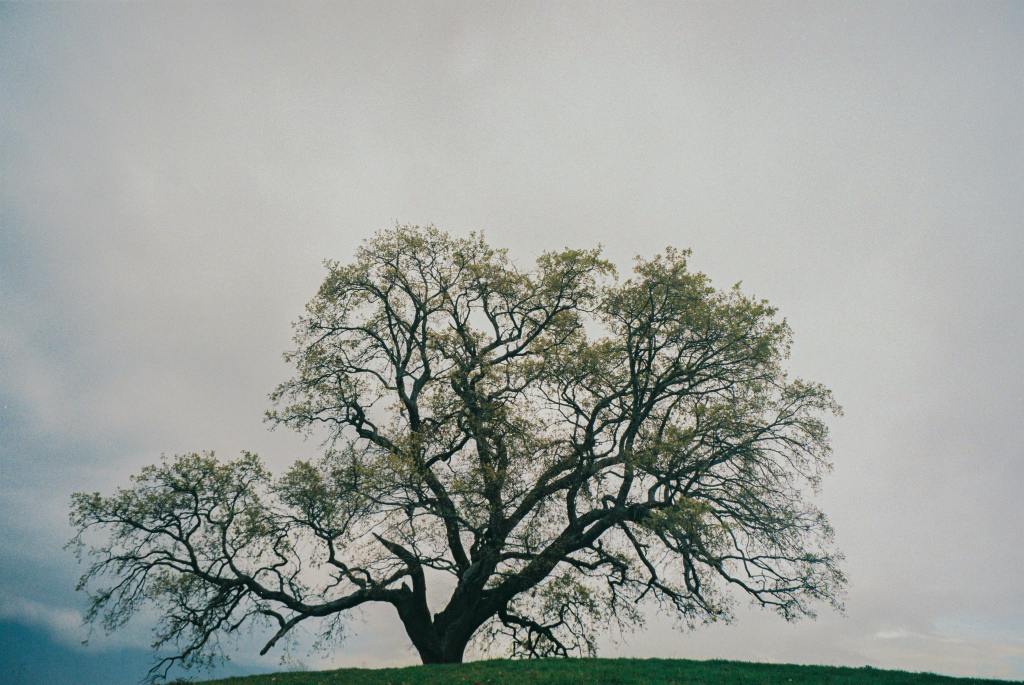
Now we came to the main attraction, an ancient oak tree, squat and bordered by a small fence. Hundreds of small colored cloths hung from its branches and swayed in the wind. And in the middle of the fenced area was a grave.
“This man was the son of the caliph, Umar,” my friend announced. “They came here with their armies and my ancestors gave them a bloody resistance. We killed so many of the invading Arabs that they still call those of us from this area ‘The Killers of the Disciples.’ Ha!”
“This man,” he went on, “killed thousands upon thousands of my people.”
It was a poignant scene. In front of us was the grave of a man who took part in religiously motivated genocide. In the valley below us lay a town where thousands of the same people group had died by genocide, once again, but as recently as the year I was born. Just beyond that town lay the mountains where jets continue to drop their bombs to this day. What came out of my friend’s mouth next left me speechless.
“This is a holy man. This is a holy place. We should pray here.”
It was then I fully understood the horrific irony of this place. The locals understood this man’s grave to be a shrine. That’s why the little colored cloths were tied to the branches of the old gnarled oak, Asian-style, to represent a prayer. Somehow my friend could not see the awful contradictions of his words, his ethnicity, his history, and his religious beliefs. Two plus two did not equal four. The son of the caliph of Islam could kill thousands of his ancestors in the name of Islam and his grave could still be considered a holy shrine. And just that morning my friend had reassured me that ISIS’ violent actions did not represent true Islam. Yet here we were.
My friend entered the enclosure and lifted his hands to pray, in Arabic, the language of his people’s conquerors.
For my part, I turned and walked away. I did pray, but not to the shrine of a killer. Rather, I prayed to the God who made the mountains, the wild gum trees, and the mountain springs, the only one who hears prayer, the one who has called us to love our enemies, and the one who alone can open the eyes of the blind. Even one so blind as my friend.
If you have been helped or encouraged by the content on this blog, would you consider supporting this writing and our family while we serve in Central Asia? You can do so here.
For my list of recommended books and travel gear, click here.
It is not that the Lion has been excluded from the history of art, but rather that he has been presented badly – and he never wins. When the Lion had finished his tour of the mansion, continues Newman, “his entertainer asked him what he thought of the splendours it contained; and he in reply did full justice to the riches of its owner and the skill of its decorators, but he added, ‘Lions would have fared better, had lions been the artists.'”
In this time of global pandemic it’s worth recalling that the English language would likely have gone the way of the wooly mammoth had it not been for a pandemic, specifically, the Black Death. In the year 1066, William the conqueror of Normandy and his fellow francophone viking descendants (Norman = Northman = Viking) successfully invaded Britain. The linguistic effect of this conquest was that Norman French became the language of the ruling class of society for the next several hundred years. The Old English (Anglo-Saxon) of Beowulf steadily lost ground to the language of the conquerors, only holding on in the countryside and among the lower classes. The English that remained absorbed an incredible amount of French vocabulary in this period, leading to a distinct stage in the language called Middle English. As the influence of French grew among the upper and middle classes, taking over the cities and all literary endeavors, the future of English was in danger.
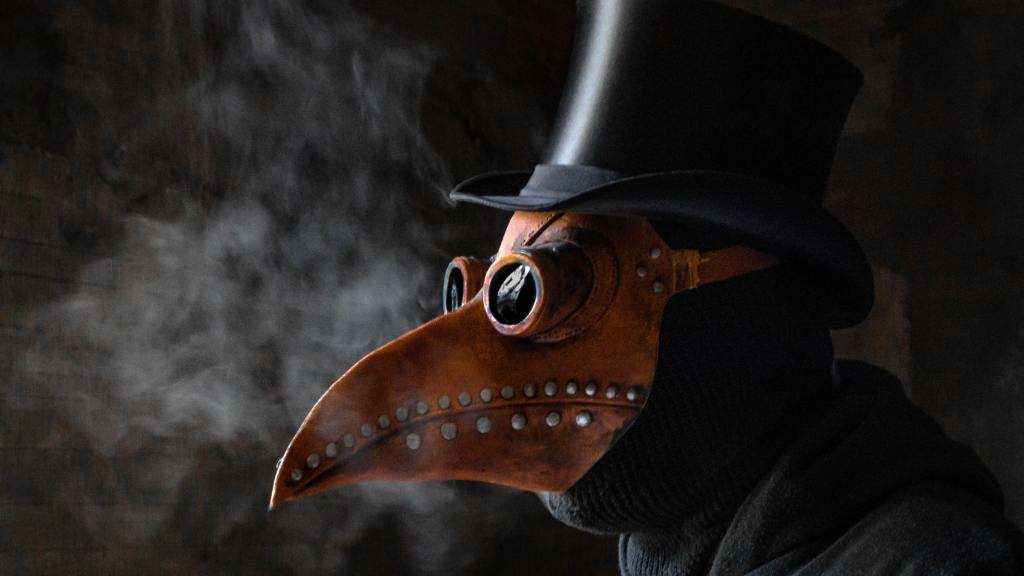
Enter the Black Death. This plague which attacked the lymphatic system was spread by fleas, rats, and also by airborne transmission. The Black Death devastated the cities of Europe in the mid-1300s, killing as many as 1/3 of the population. This meant that many of the urbanite French speakers who would have continued to advance the victory of French in Britain were instead killed by the plague. The literati and political class were decimated. This aftermath of the plague gave the English language the chance to not only survive, but to regain prominence in Britain, and eventually, to emerge as the first truly global language. Well, first since Babel anyway.
What might be the linguistic effects of this current Covid-19 pandemic? Certainly it will mean the creation of new vocabulary as concepts such as quarantine and social distancing are translated into the official languages of every country. Our local Central Asian language has coined a new verb: “karantîn” + verb form of make/do. Will the pandemic save an endangered language that will one day go on to rule the world? Unlikely, but as history demonstrates, by no means impossible.
*I’m indebted to Nicholas Ostler’s Empires of the Word and John McWhorter’s Words on the Move for the information in this post – great books if you enjoy the combination of language and history.
They have known it then, I know not how, and so have it by some sort of knowledge, what, I know not, and am perplexed whether it be in the memory, which if it be, then we have been happy once; whether all severally, or in that man who first sinned, in whom also we all died, and from whom we are all born with misery, I now enquire not; but only, whether the happy life be in the memory? For neither should we love it, did we not know it. We hear the name, and we all confess that we desire the thing; for we are not delighted with the mere sound. For when a Greek hears it in Latin, he is not delighted, not knowing what is spoken; but we Latins are delighted, as would he too, if he heard it in Greek; because the thing itself is neither Greek nor Latin, which Greeks and Latins, and men of all other tongues, long for so earnestly. Known therefore it is to all, for they with one voice be asked, “would they be happy?” they would answer without doubt, “they would.” And this could not be, unless the thing itself whereof it is the name were retained in their memory.
Augustine, Confessions, Book 10.29
How do we all have some sort of inner knowledge of the happy life, enough to know that we do not have it and are always secretly longing for it? Perhaps, Augustine says, we have all inherited the memory of true happiness, the memory of Eden, from Adam. I have read that research shows the effects of trauma can be passed on to generations of those who have not themselves experienced that trauma. What a powerful thing then, Eden, and its loss, must have been such that seven billion humans, when they are honest with themselves, still feel it in their bones.






 Entrusted to the Dirt