From its earliest manifestations literacy had a decorative aspect. How could it be otherwise, since implicit in all pictograms, hieroglyphics, and letters is some cultural esthetic, some answer to the question, What is most beautiful? The Meso-american answer lies in looped and bulbous rock carvings, the Chinese answer in vibrantly minimalist brush strokes, the ancient Egyptian answer in stately picture puzzles. Even alphabets, those most abstract and frozen forms of communication, embody an esthetic, which changes depending on the the culture of its user. How unlike one another the carved, unyielding Roman alphabet of Augustus’s triumphal arches and the idiosyncratically homely Romano-Germanic alphabet of Gutenberg’s Bible.
For their part, the Irish combined the stately letters of the Greek and Roman alphabets with the talismanic, spellbinding simplicity of Ogham to produce initial capitals and headings that rivet one’s eyes to the page and hold the reader in awe.
Cahill, How the Irish Saved Civilization, p. 165
Here is an interesting thought. Our alphabets and scripts are actually clues to what we find beautiful.
These various waves of immigration of Christian refugees help account for the fact that, although at the start of the seventh century Christians constituted nearly half the population of the Iranian Empire, about 75 per cent of these were Nestorians, 20 percent Miaphysite Jacobites and 5 per cent Melkites faithful to Chalcedon.
In retrospect, three factors contributed to the rapid success of the missionary efforts in the east: First, significant Jewish exile communities were living in Mesopotamia. Second, Aramaic served as the lingua franca from Antioch to Central Asia, enabling Aramaic-speaking missionaries to communicate easily with both Jews and non-Jewish merchants and members of the upper classes. Third, the close-meshed net formed by the various routes of the Silk Road eased the spread of the new religions. Although the Roman-Parthian border was generally tightly maintained, traders or missionaries disguised as traders could cross it unhindered. In fact, the missionizing of Mesopotamia, which moved from Edessa to Nisibis, Arbil, Seleucia-Ctesephon and Maishan, followed the land routes of the Silk Road. The sea routes then enabled the expansion of missionary activity to the islands of Kharg and Socotra, as well as – presumably – South India.
Baumer, The Church of the East, p. 25
I was just sharing with a local believer the other day that it was only as recent as the 1500s that the number of Christians in Europe outnumbered the number of Christians outside it. In line with this, Baumer here shares a remarkable statistic, that while never having government control, Christians in the Zoroastrian Persian (Sassanian) empire at one point made up nearly half the population.
Also, take note that business as mission is not a novel concept at all, but a tried and true method of the early church as they sought to bring the gospel to the Middle East and Central Asia.
When words get adopted from one language into another, unpredictable things happen to them. There’s almost always some correlation between its new meaning and its former one, though sometimes even this can be almost completely lost in adaptation.
The Melanesian language I grew up speaking had adopted the English words for break and screw, but had come to apply these terms to the concepts of bend and bodily joints, respectively. Thus, to pray was to brukim skru, “break your screws,” i.e. bend your knees in prayer. The English words for turn and belly had also been adopted, but while turn mostly kept its original meaning, belly came to mean the soul. Thus, to tanim bel was to “turn the soul,” i.e. to repent and believe in Jesus. It was not uncommon to hear testimonies where people would say that they “broke their screws and turned their bellies,” – meaning simply that they prayed and believed.
This morphing can also happen to place names and the different things associated with them. I am originally from Philadelphia, but Kentucky has been our home base in the U.S. for a good many years now. However, these names in our Central Asian language have become solely associated with certain foods which each location is famous for in other places. Locally, kantaki has come to mean fried chicken and fladelfia means an elongated beef sandwich – the foreign relative of the famous Philly cheesesteak. Pat’s and Gino’s have come a long way. So has Colonel Sanders. They have taken up residence not only in the diet of a far-flung people, but also in their language.
The problem with this is that no one here knows that Kentucky and Philadelphia are actually places, not merely foods. Why is this a problem? Because I am often asked what part of the US I am from. Being a third culture kid (TCK), this is already a complicated question even without the complexities of inter-language morphology. But when I answer with the truth, “I live in Kentucky but I am from Philadelphia originally,” it gets understood as, “I live in fried chicken and my people are those of elongated beef sandwich.” This, understandably, leads to some bemusement. It gets even worse if I explain that I was raised in a Melanesian country famous for its former cannibalism.
Why does this foreign guy have a background so strangely intertwined with food?
Sadly, neither Philadelphia nor Kentucky are famous enough as places yet for most locals to know about them – unlike Texas, which everyone knows and constantly compares to a nearby tribal town famous for having more AK-47s than people. Come to think of it, I’m not sure that’s any better.
These word connections are relatively recent. But some connections exist that are ancient, proof that many thousands of years ago, the ancestor of the Persian-related tongue that we have learned is the same ancestor of English – Proto-Indo-European. The local compound word for a deep trust or faith is an ancient relative of our English words for back and fasten. To trust someone completely is to be fastened to their back, metaphorically carried by them. Thus, to “trust in the Lord with all your heart” is rendered in our translated Proverbs as, “Full-hearted, be strapped onto the Lord’s back.” Not a bad way at all to communicate complete trust. After all, a child riding on his parent’s shoulders is exercising a high degree of faith that he will not be dropped. His safety is entirely in the power of the one carrying him.
These kinds of word connections – new or old – can be fascinating, fun, and even frustrating. Language is a remarkable thing and our human ability to borrow, to shape, and to poetically turn a phrase is almost infinite.
That must be because God’s capacity to play with language is infinite.
The Irish received literacy in their own way, as something to play with. The only alphabet they’d ever known was prehistoric Ogham, a cumbersome set of lines based on the Roman alphabet, which they incised laboriously into the corners of standing stones to turn them into memorials. These rune-like inscriptions, which continued to appear in the early years of the Christian period, hardly suggested what would happen next, for within a generation the Irish had mastered Latin and even Greek and, as best they could, were picking up some Hebrew. As we have seen already, they devised Irish grammars, and copied out the whole of their native oral literature. All this was fairly straightforward, too straightforward once they’d got the hang of it. They began to make up languages. The members of a far-flung secret society, formed as early as the late fifth century (barely a generation after the Irish had become literate), could write to one another in impenetrably erudite, never-before-spoken patterns of Latin, called Hisperica Famina, not unlike the dream-language of Finnegans Wake or even the languages J.R.R. Tolkien would one day make up for his hobbits and elves.
Cahill, How the Irish Saved Civilization, p. 144
It’s interesting to note this explosion of linguistic energy among the newly-literate Irish. Humans are remarkably creative when it comes to language. We can’t seem to help it, we just keep on inventing new languages, whether on purpose or not.
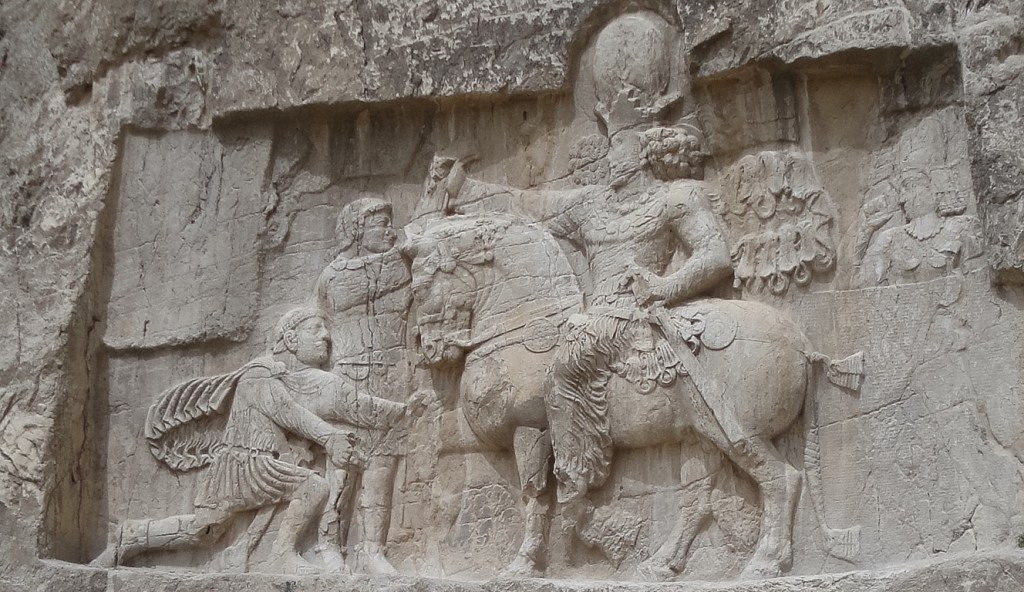
A Depiction of Shapur I’s Victory over Roman Emperor Valerian
In considering the question of among whom Christianity first found acceptance in Mesopotamia, four groups of people are relevant: first, the numerically significant Jewish Diaspora; and, second, the native Arameans, Assyrians, and Chaldeans of northern Mesopotamia, to whom the Persians came towards the end of the third century. Beginning in the mid-third century additional Christian refugees streamed into the empire of the Sassanians, as they fled the persecutions of of the Roman emperors Decius in 250, Valerian in 257-258 and Diocletian in 303-304. The fourth numerically important group were the Roman and later Byzantine prisoners of war and deportees, whom the Sassanian kings resettled in their empire, again beginning in the mid-third century. For instance, in 260 Shapur I (ruled 240-272) laid waste to Syria, Cilicia, and Cappadocia and conquered Antioch, from which he deported tens of thousands of Christians, including Bishop Demetrius, and resettled them in Mesopotamia and the ancient province of Susiana.
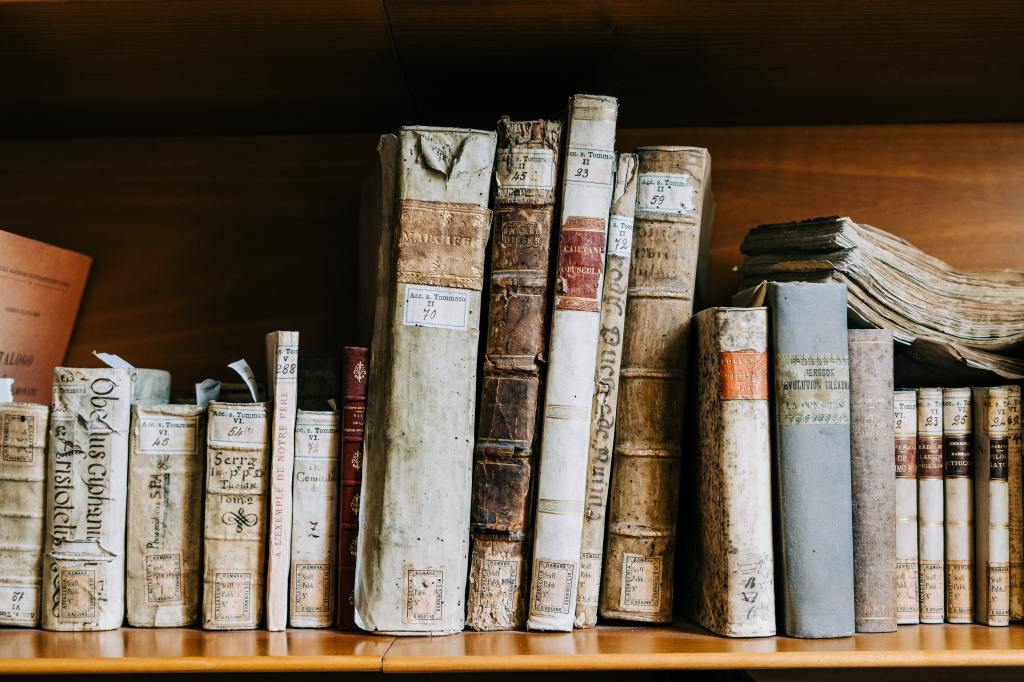
One scribe will complain of the backbreaking work of book-copying, another of a sloppy fellow scribe: “It is easy to spot Gabrial’s work here” is written in a beautiful hand at the margin of an undistinguished page. A third will grind his teeth about the difficulty of the tortured ancient Greek that he is copying: “There’s an end to that – and seven curses with it!”
But for the most part they enjoy their work and find themselves engrossed in the stories they are copying. Beneath a description of the death of Hector on the Plain of Troy, one scribe, completely absorbed in the words he is copying, has written most sincerely: “I am greatly grieved at the above-mentioned death.” Another, measuring the endurance of his beloved art against his own brief life span, concludes: “Sad it is, little parti-colored white book, for a day will surely come when someone will say over your page: ‘The hand that wrote this is no more.'”
Perhaps the clearest picture we possess of what it was like to be a scribal scholar is contained in a four-stanza Irish poem slipped into a ninth-century manuscript, which otherwise contains such learned material as a Latin commentary on Virgil and a list of Greek paradigms:
I and Pangur Ban my cat,
‘Tis a like task we are at:
Hunting mice is his delight,
Hunting words I sit all night.
‘Tis a merry thing to see
At our tasks how glad are we,
When at home we sit and find
Entertainment to our mind.
‘Gainst the wall he sets his eye,
Full and fierce and sharp and sly;
‘Gainst the wall of knowledge I
All my little wisdom try.
So in peace our task we ply,
Pangur Ban my cat and I:
In our arts we find our bliss,
I have mine and he has his
Cahill, How The Irish Saved Civilization, pp. 161-162
In honor of this anonymous ancient Irish scribe, if I ever have a cat I just may name him Pangur Ban.
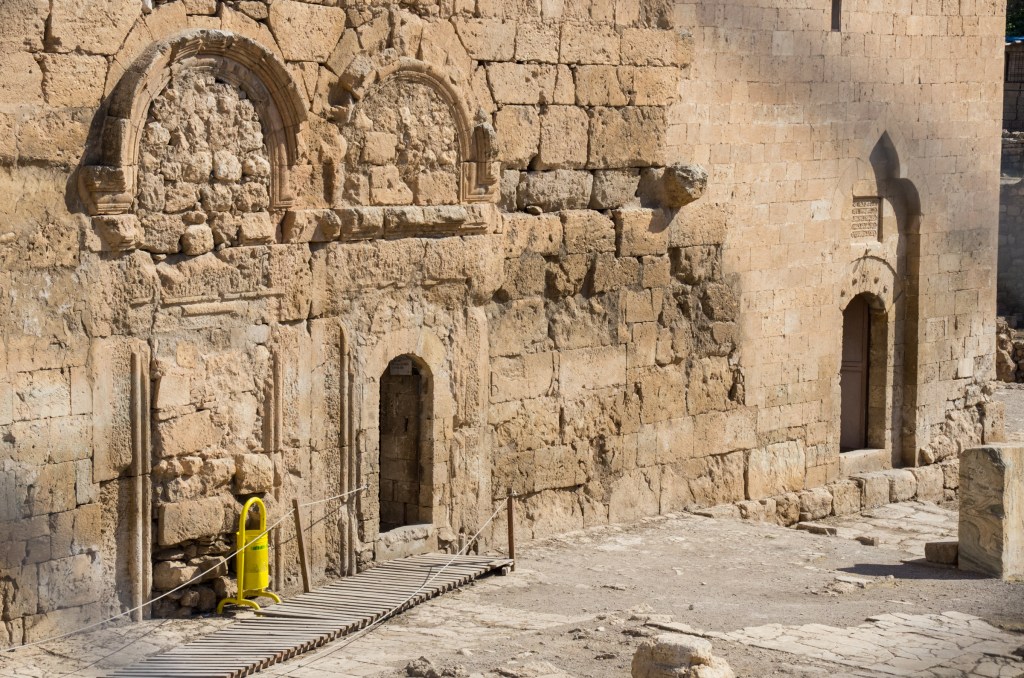
Nisibis’s reputation was founded not only on the monasteries of the Izla mountains, however, but also on the School of Nisibis, which was likewise traced back to Bishop Jacob, who wanted to fight Arianism, which had been condemned at the Council of Nicea in 325. In any case, we know that he employed Ephrem the Syrian as a biblical exegete. When the city was handed over to the Sassanian king Shapur II in 363, Christian instruction ceased, and Ephrem fled to Roman Edessa, where he taught until his death and supported his bishop in the fight against Arianism.
Baumer, The Church of the East, p. 22
Ancient Nisibis is modern Nusaybin, Turkey. And Edessa is now called Sanliurfa. I’ve often heard of the battles over Arianism that took place in major cities like Alexandria, Egypt. Fascinating then to hear what was also happening in these eastern border cities often fought over by the Romans and the Persians.
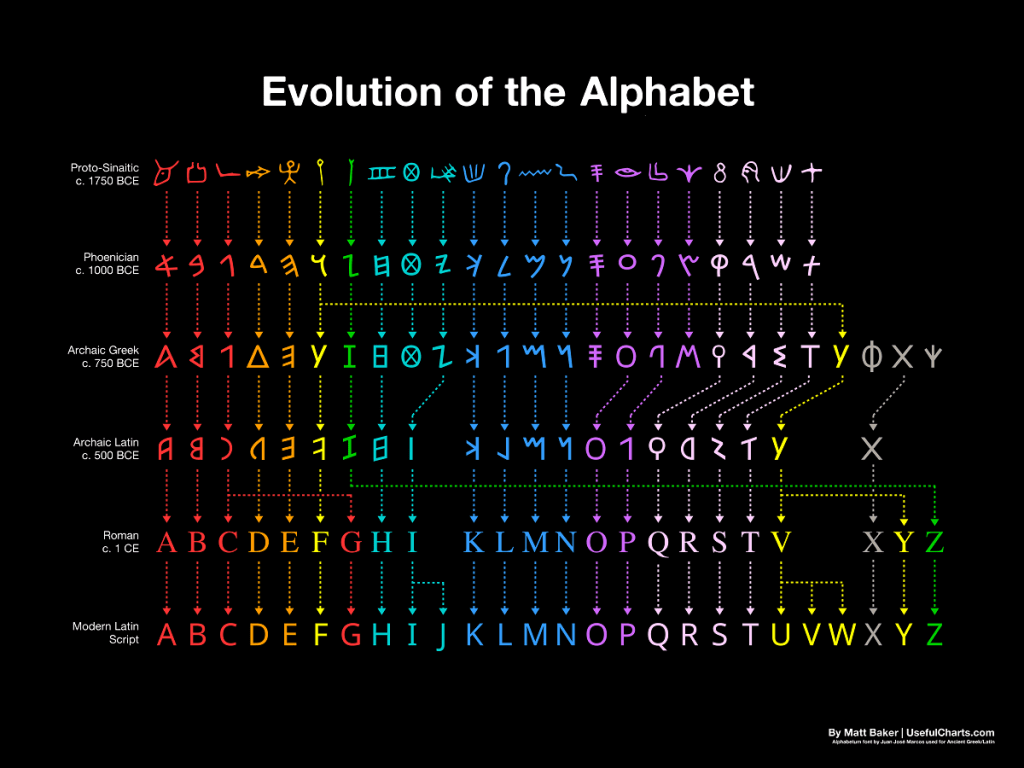
I recently came across this article discussing the historical development of our alphabet. I think it’s fascinating how little some of our letters have changed since 3,750 years ago, when the first known alphabet (Proto-Sinaitic) was written.
Take our letter A. This started as a picture of an ox head, an ox being called an ‘alp, and this symbol came to represent the sound Ah. This ancient Semitic word for ox came down to us through the Greek alpha and has found its way into our word, alphabet. If you turn our contemporary letter A upside down, you can still see how it is descended from a pictogram of a horned ox head.
Our letter B comes from an ancient Semitic word for house, bayt, which is basically still the same word in Hebrew and Arabic (As in Beth-lehem, house of bread/meat). The original symbol looks like the outline from a bird’s eye view of a house with an open door.
So while our compound word Alphabet now means the collection of letters used to write our language, it also historically translates as ox house – or could it be house ox?
And who knew that our capital E comes from a stick figure who has been tipped over and lost his head and legs? From now on when writing by hand, I may from time to time subtly restore some of his dignity by giving him back his head.
Some letters speak to the continuity of human experience through the millennia, such as dag, which is a symbol for a fish, and the ancestor of our letter D. Other letters, such as gaml (our letter C), remind us that the past really is a foreign land. It means throwstick, which apparently was an ancient hunting device.
Check out the chart at the top of this post to see if you can trace more modern letters and their ancient ancestors. The connections are fun to see and can even make learning some foreign alphabets somewhat easier, once you realize you are merely learning a cousin of the same letter you already know.
As this article states, “Like many things in the long arc of human culture, alphabets are not as far removed from each other as you might think.” In a world of over six thousand languages, it is remarkable that this language tool has been so adaptable to so many of them.
So, though he [an unnamed scribe] disapproved of its contents, he copied out the Tain. It is thanks to such scribes, however cranky their glosses may sometimes be, that we have the rich trove of early Irish literature, the earliest vernacular literature of Europe to survive – because it was taken seriously enough to be written down. Though these early Irish literates were intensely interested in the worlds opened up to them by the three sacred languages of Greek, Latin and – in a rudimentary form – Hebrew, they loved their own tongue too much ever to stop using it. Whereas elsewhere in Europe, no educated man would be caught dead speaking a vernacular, the Irish thought that all language was a game – and too much fun to be deprived of any part of it. They were still too childlike and playful to find and value in snobbery.
I recently had the opportunity to speak to a number of my colleagues on the importance of sustainable sacrifice (a term borrowed from author Christopher Ash in his book, Zeal Without Burnout). Together, we looked at 2nd Timothy 2:1-7, and specifically, Paul’s examples of the soldier, the athlete, and the farmer. Each example would have communicated to the original audience a lifestyle of sacrifice, as well a lifestyle of disciplined pace – long-term labor that requires a long-term posture.
While preparing for this talk I decided to include a historical illustration from Roman military history. Julius Caesar conquered the Gauls (or Celts) of modern day France between the years 58 and 50 BC. These now famous battles, called the Gallic wars, made the Gauls of western Europe (relatives of those Galatians down in Asia minor) Roman subjects. Eventually they would become models of Roman assimilation, more Roman than the Romans as it were. But in the beginning they were something terrifying to behold – particularly in battle.
The warriors of Gaul tended to be much taller than Roman soldiers, with blonde hair (often bleached even blonder) and long mustaches. Sources say they would charge into battle naked – save for a metal band around their neck – and painted in blue war paint. Their preferred way to fight was to charge the enemy line, fearless and screaming, caught up in some kind of battle rage. This would have been a terrifying thing to behold and try to withstand, and much discipline would have been required to hold the line. In the back of a Roman soldier’s mind, they might also be thinking about how the Gauls liked to collect the heads of their defeated enemies and decorate their houses with them. The Roman consciousness was also haunted by the memory of the Gauls who had sacked Rome hundreds of years earlier.
No doubt many a Roman line did not hold in response to a charging hoard of Gauls (You can’t blame them). But Julius Caesar learned one valuable secret. That secret was the importance of pace. The Gauls were using massive amounts of energy in their fanatical charge at the Roman line. If the legions could just hold the line for a little while and save their strength, then the majority of the Gallic warriors’ strength would be spent, and the Romans would be able to get the upper hand – by simply having enough energy left to finish the battle.
Of course, the Romans also employed advanced military tactics and discipline, and no doubt these all played their part. But I was struck by the fact that battles could be won simply by the power of pace.
We have not been very good at pacing ourselves here in our corner of Central Asia. Many limp to the end of their first term and beginning of furlough. Most long-term cross-cultural workers leave here after 4-6 years. Everyone with high-school age kids leaves. We come in with an immense amount of energy, throw ourselves at language learning, evangelism, and discipleship, burn into sleep and family time, and justify it all because it’s ministry. Then one day we wake up realizing there’s suddenly nothing more in the tank.
In short, we have been fighting like Gauls.
My encouragement to my colleagues (and myself) is that we need to learn to fight more like Romans. Let the short-term teams fight like Gauls (but clothed, please). This is because their battle is much briefer, more like a sprint. But for those of us who hope to be here for decades, we need to learn the kind of posture and pace that enables us to endure a very long war full of very long engagements. To jump historical eras, we are in WWII Stalingrad, not in the fall of Paris.
Borrowing categories from Christopher Ash, this means we need to be serious about sleep, sabbaths, friendship, and inner renewal. It also means we need to embrace a posture of grace toward our teammates, so that we might prevent and mitigate the devastating effects of team conflict.
Ultimately, we don’t know how long we will be able to stay on the field. Some factors are beyond our ability to influence, such as geopolitical changes or getting cancer. But we can and should seek a wise, long-term posture, one where we do not fight like Gauls, but instead fight like soldiers who know there’s a lot of battle still to come – and who want to actually be there to see the victory.








 Entrusted to the Dirt


#/media/File:Tomb_of_Nebamun.jpg)
