However blind his British contemporaries may have been to it, the greatness of Patrick is beyond dispute: the first human being in the history of the world to speak out unequivocally against slavery, Nor will any voice as strong as his be heard again till the seventeenth century. In his own time, only Irish appreciated him for who he was; beyond their borders he was as little known as Augustine was in Ireland. Patrick himself probably never heard of Augustine, who died two years before Patrick set sail as bishop; and if he did hear of him he undoubtedly never read him. In those days, news could take a year to travel from one end of the crumbling empire to the other; books could take a decade or two – or even half a century. But Patrick shows us that he understood the dual concept of the City of Man and the City of God as well as Augustine himself when he derides Coroticus and his men as “dogs and sorcerers and murderers, and liars and false swearers… who distribute baptized girls for a price, and that for the sake of a miserable temporal kingdom which truly passes away in a moment like a cloud or smoke that is scattered by the wind.” But of his beloved, slaughtered warrior children: “O most dear ones… I can see you, beginning the journey to the land where there is no night nor sorrow nor death… You shall reign with the apostles and prophets and martyrs. You shall seize the everlasting kingdoms, as he himself promised, when he said: ‘they shall come from the east and the west and shall sit down with Abraham and Isaac and Jacob in the kingdom of heaven.”
Cahill, How the Irish Saved Civilization, pp. 114-115
Our region of Central Asia was, until recently, quite isolated. Middle-aged men can still remember clearly the first time they ever saw a banana, for example. One of our close believing friends grew up in a rural village outside of our previous city. He told us a story once of the first ever radio to come to the village, probably in his grandfather’s time.
A man from the village who worked in the city returned one day, bearing an amazing gift. He had bought a radio in the big city and now proudly presented it to the village.
“Now you can listen to news from all over the world!” he proudly announced as the village elderly and children crowded around the radio, listening in amazement.
The villagers listened to the radio all day, exclaiming to one another how amazing it was that there was a small man inside that little box who was able to so enthusiastically read out the world news to them. “What will those city people think of next?” The man who had brought the radio had to return to the city, so he left the radio in the care of a village elder, the power still turned on and the box chattering away.
When night came, the village elder was faced with a dilemma. He did not know how to get the little man in the radio box to be quiet and go to sleep. He tried to tell the man it was time to sleep. No luck. He tried shouting into the box. Still no response. He tried putting the radio under a blanket. Nothing. Eventually the elder rounded up others from the village and presented them with his dilemma. What was to be done? The little man in the radio box showed no sign of getting sleepy or of stopping talking any time soon. None of them would be able to get any sleep if they could not convince the little man to shut up.
Finally, one villager had an idea. “I know what we should try!” And he promptly took the small radio to a barrel full of water and immersed it. Sure enough, when he pulled the radio out of the water, the man inside had stopped talking.
The villagers congratulated themselves. “Our clever relative who works in the city neglected to tell us this important piece of information. How embarrassing for him! Won’t he be impressed when he sees that all on our own we figured out the trick of putting the little man to sleep!”
And with grateful congratulations all around, the villagers happily settled into a quiet night of sleep.
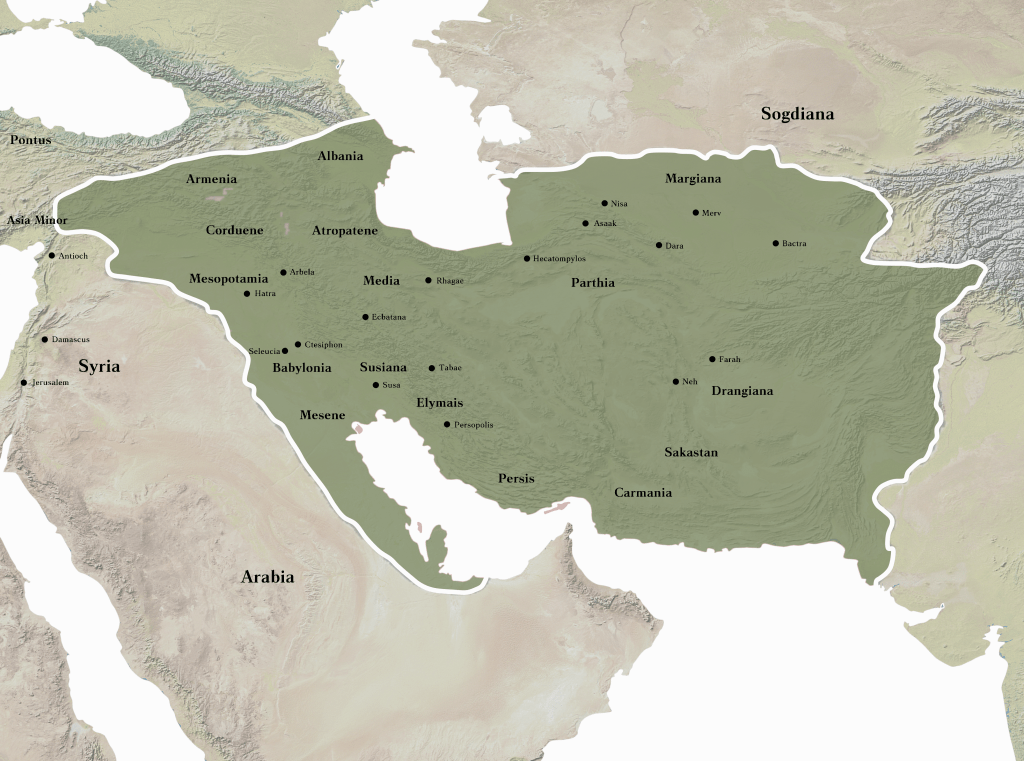
About one hundred years after Alexander the Great led the Greeks to the edge of the world known to the West, a powerful opposing force of Iranian people advanced from Asia. One of these was the Parthians, relatives of the Indo-European Scythians, whose homeland extended from the Aral Sea to the Caspian Sea. Around 247 BCE they conquered north-eastern Iran and advanced gradually to the west, until they captured the city of Seleucia on the Tigris in 141 BCE. Around 55 BCE King Orodes II reinforced the military camp of Ctesiphon, on the opposite bank of the river from Seleucia, thus forming the double city of Seleucia-Ctesiphon, the future see of the Church of the East. Since the Parthian expansion to the west occurred simultaneously with the Roman advance towards the east, a clash between the two ambitious powers was unavoidable. In 92 BCE they agreed to the Euphrates as a shared border. The Parthian initiation of diplomatic relations with Rome, as well as with China, helped foster trade along the Silk Road, which included a 1600-kilometre stretch through Parthia.
After first-generation Irish Christians are kidnapped and made slaves by a British warlord:
“In sadness and grief, shall I cry aloud. O most lovely and loving brethren and sons whom I have begotten in Christ (I cannot number them), what shall I do for you? I am not worthy to come to the aid of either God or men. The wickedness of the wicked has prevailed against us. We are become as it were strangers. Can it be that they do not believe that we have received one baptism or that we have one God and Father? Is it a shameful thing in their eyes that we have been born in Ireland?”
The British Christians did not recognize the Irish Christians either as full-fledged Christians or as human beings – because they were not Roman. Patrick, whose awkward foreignness on his return to Britain had been the cause of numerous rebuffs, knows in his bones the snobbery of the educated Roman, who by the mid-fifth century had every right to assume that Roman and Christian were interchangeable identities. Patrick, operating at the margins of European geography and of human consciousness, has traveled even further from his birthright than we might expect. He is no longer British or Roman, at all. When he cries out in his pain, “Is it a shameful thing … that we have been born in Ireland?” we know that he has left the old civilization behind forever and has identified himself completely with the Irish.
Cahill, How the Irish Saved Civilization, pp. 112-113
Could the split between Paul and Mark on their first missionary journey have been related to missions strategy? Here’s an interesting take that relies on the history of the region.
…recent scholarship on Cyprus suggests a difference over mission strategy may have been at the heart of the disagreement. In Acts 11:20, Jewish believers from Cyprus and Cyrene are credited with founding the Antioch church. Cyprus and Cyrene were the “overseas” possessions of the former Ptolemaic kingdom, centered at Alexandria in Egypt. Even after Rome annexed the kingdom, cultural commercial ties to Egypt remained intact. Perhaps the first missionary outreach of the Antioch church was to be a “thank you” to their spiritual parents in these two provinces. According to this model, Paul, Barnabas, and Mark were to sail from Cyprus to Cyrene in North Africa, rather than to Asia Minor. It is possible that sailing to Perga was a last-minute decision influenced by the conversion of the. governor of Cyprus, Sergius Paulus (who had family contacts in Pisidian Antioch; see note on Acts 13:7) This possibility is strengthened by the fact that if the missionaries wanted to sail to Perga in Pamphylia, they normally would have sailed from the north coast of Cyprus at Lapethos, not from Paphos on the southwest coast. From Paphos, ships normally sailed west to Rome or south to Alexandria and North Africa. Mark may have felt that Paul and Barnabas betrayed the wishes of the church at Antioch by going to Galatia. However, by the time Paul wrote Colossians, he and Mark were fully reconciled (Col 4:10). Such a reconciliation would have been much easier (and more likely) if the disagreement between them was merely strategic, not theological.
ESV Archaeology Study Bible, p. 1773
Arguments over strategy among missionaries can get surprisingly heated. Thankfully, as the text notes, they aren’t usually as serious as theological differences – depending on the strategy. Some methods can undermine the gospel message. But the hope is that theologically like-minded missionaries who clash over strategy will, like Paul and Mark, eventually remember they’re on the same team and find a way to work together again. Ironically, in an evangelicalism that has played down the importance of doctrine for so long, many missionaries end up more likely to put strategy in the primary place now vacated by doctrine, thus making splits over strategy more likely to be bitter and final.
Nestorian translators and scholars built the bridge linking the knowledge of classical antiquity with the European Middle Ages.
During the ‘Age of the Translators’ (sixth to ninth centuries), Nestorian and Jacobite physicians and scholars translated the Greek classics of philosophy, mathematics, geometry, medicine and astrology from Greek into Syriac and then into Arabic. The greatness of their reputation can be seen in the fact that Caliph al-Ma’mun (ruled 813-833) appointed the Nestorian philosopher and physician Yuhanna Ibn Massawah as head of the state library and university that had been founded in 832 and was called the ‘House of Knowledge’, and paid in gold for the translations of the most renowned Nestorian scholar, Hunayn Ibn Ishaq (808-873). Thanks to these translation projects, the Arab-Iranian culture preserved the treasures of Greek knowledge and, through the University of Toledo, offered them to Europe, which had lost them in the darkness of the early Middle Ages. Finally, the revival of Aristotle and the starting points of the work of Thomas Aquinas would have remained unthinkable without this Nestorian-Arab bridge.
Baumer, The Church of the East, p. 6
After the fall of the Western Roman Empire, classical and biblical manuscripts were preserved by two unlikely sources, the newly-Christian Irish scribes and the minority Christian scholars of Mesopotamia, living under Zoroastrian and then Muslim rule. Both preserved the written treasures of the West, with the Irish preserving mainly the Latin texts and the Eastern Christians preserving the Greek. Thus, it wouldn’t be inaccurate to say that some of Western Civilization’s most forgotten and unlikely heroes turn out to be the ancient monks of Eire and Baghdad.
With the Irish – even with the kings – [Patrick] succeeded beyond measure. Within his lifetime or soon after his death, the Irish slave trade came to a halt, and other forms of violence such as murder and intertribal warfare, decreased. In reforming Irish sexual mores, he was rather less successful, though he established indigenous monasteries and convents, whose inmates by their way of life reminded the Irish that the virtues of lifelong faithfulness, courage, and generosity were actually attainable by ordinary human beings and that the sword was not the only instrument for structuring a society.
Patrick’s relations with his British brothers were less than happy. Rising petty kings along the western coasts of Britain, rushing to fill the power vacuum left by the departure of the Roman legions, began to carve out new territories for themselves and to take up piracy, an activity the Christian Britons had long ago abandoned.
Cahill, How the Irish Saved Civilization, p. 110
One important piece usually missing from contemporary discussions about slavery – ancient Christians abolished slavery in the Roman empire and even in territories beyond. Thus the modern abolition movement was the second time Western Christianity had ended slavery in its domains.
Instead of a revitalization of Mesopotamian and Iranian Christianity, the devastation of the fanatical Muslim Tamerlane (ruled 1370-1405) greatly intensified the destruction wrought by Ghazan and Oljaitu. After the loss of their churches and monasteries, the surviving Nestorians sought refuge in the remote mountains of Kurdistan (in northern Iraq) and Hakkari (in south-eastern Turkey), for only in the shadows of rugged mountains can a persecuted spirit live on in freedom. And so the one-time ‘Christian sea’ of Mesopotamia and Iran was transformed into a small, inaccessible island, surrounded by the wide ocean of Islam.
Baumer, The Church of the East, p. 6
If you are looking for ethnic, linguistic, and religious diversity, always look to the mountains. Groups survive there that tend to disappear down on the plains. They are a sort of time capsule, preserving ways of life that most have assumed are long gone.
I’ve written previously about the tendency of conspiracy theories to take too high a view of human potential. Many conspiracy theories depend on multi-generational secret global coordination that’s just not possible with for humans to pull off. The biblical worldview paints the successes of sin and power as temporary and illusory. Sooner or later everything falls apart as the inevitable destructiveness and selfishness of sin brings even the best diabolical schemes toppling down.
But there is another kind of conspiracy theory, one which takes too low a view of human nature. In this kind of apocalyptic theory, everything collapses. “Get some land in the mountains, stockpile food, and get a gun” is one earnest encouragement I received from another Christian some years ago. “The global food supply is right about to collapse. For your family’s sake, you need to be ready.” The brother who encouraged me to do this was no nut-job living in some kind of bunker. He was the manager of the coffeeshop where my wife worked and himself preparing to be on an international church planting team. Needless to say, his dire predictions a decade ago were wrong.
In that conversation I remember pushing back on several fronts. First, church history informs us that Christians largely stayed and served when calamity befell cities, often giving their lives to serve plague victims and thereby earning an incredible reputation for their faith. They did not run to the hills en masse with their families and weapons in tow (though fleeing can of course sometimes be a faithful option). Second, my friend’s dire warnings did not seem to take into account the incredible creativity, ingenuity, and adaptability that humans have for survival, profit, and system-creation.
I have lived in some extreme places and have visited others. Many of my coworkers have lived in even more extreme places than I have. One of the surprises of visiting these kind of areas? Life keeps on humming. People manage to eat, to have homes and jobs, to have systems of transportation and communication, and to have collective governance and defense. I’m not saying that life in places like failed states, conflict zones, or poverty-stricken areas is easy. But I am saying that humans are remarkably resilient and creative. If one structure collapses, five others rise up to fill the void almost overnight. And someone has figured out how to monetize it. Just look at the ways the world is currently innovating. We are living in a global pandemic, after all.
I live in an area of Central Asia that has experienced an incredible amount of conflict over the last couple hundred years. All of my local friends have incredible trauma in their background. Yet some of our local systems are more efficient and affordable than what we can get in the US. Here’s a brief list:
Fresh bread daily from local neighborhood bakeries, ten small steaming-hot loaves for a dollar
Simple, pay-as-you-go mobile phone systems. Buy a card at a neighborhood shop with credit on it, load it on your phone, no complicated contracts or fine print.
Neighborhood fruit and veggie trucks. These trucks are loaded up with fresh produce and make the rounds through every neighborhood, selling fresh and affordable fruits and veggies and announcing their arrival via loudspeakers.
Taxis and buses. Get anywhere in the city via taxi for $3 or take a bus on established routes for $0.20.
Pharmacy delivery. Stuck at home under a Covid-19 quarantine? No problem, local pharmacies will take your order via Facebook messenger and send a delivery man (for free) to your house with your needed meds.
Womens Saving Clubs. Having a hard time actually saving money for that new appliance? Join a group of 12 local women where everyone contributes $100 a month and when it’s your turn once a year you get “paid” your saved $1200.
You see, though we live in a place that raises eyebrows among outsiders and frightens off volunteers, locals manage to have some pretty efficient and creative systems for technically living in a war zone. I just learned this week that we have a new local service which will deliver flowers, novels, or locally-tailored men’s formal wear to your front door. Not bad, Central Asia, not bad at all.
To those who are given to the global-system-collapse conspiracies, I would encourage them to take a deeper view of history and a wider view of the current world. Yes, big collapses have happened. The transition from the Bronze Age economy to the Iron Age was devastating as everyone’s stockpiled bronze suddenly lost its value. Later, in the middle ages, global cooling caused crop failures on a massive scale, leading to widespread famine. The Great Depression one hundred years ago was real. It’s not the existence of crises like this I take issue with, but with the implied extent. The assumption is that a post-apocalyptic world will result, when history just doesn’t bear that out. Humans are too resourceful for that.
I believe this creativity and resourcefulness is rooted in our creation in the image of God and in the creation mandate.
So God created man in his own image,
in the image of God he created him;
male and female he created them.

And God blessed them.
And God said to them,
“Be fruitful and multiply and fill the earth and subdue it,
and have dominion over the fish of the sea
and over the birds of the heavens
and over every living thing that moves on the earth.” (Genesis 1:27-28 ESV)
Humanity’s incredible ingenuity and ability to bounce back and build societies comes from being created in the image of God. We can’t help but create, even when we don’t mean to. It’s in our very DNA. As we were commissioned to do in the beginning, we bring order in small ways to the rest of creation. Yes, all of this has been affected by the fall and our attempts at re-creation and bringing order are marred, transient, and imperfect. They are infected now with greed and a thousand other sins. And yet the image of God must have been so powerful in its unblemished form that it continues to shine forth even in the darkest parts of the globe and following the biggest calamities.
Why don’t I give much time of day to the global collapse conspiracy theories? It’s not because I have so much faith in humanity. I believe in total depravity. Rather, it’s because I have such faith in the remnant image of God within humanity. Even with our brokenness, we are an awfully creative bunch.
His love for his adopted people shines through his writings, and it is not just a generalized “Christian” benevolence, but a love for individuals as they are. He tells us of a “blessed woman, Irish by birth, noble, extraordinarily beautiful (pulcherrima) – a true adult – whom I baptized.” Who could imagine such a frank admiration of a woman from the pen of Augustine? Who could imagine such particularity of observation from most of those listed in the calendar of saints?
He worries constantly for his people, not just for their spiritual, but also for their physical welfare. The horror of slavery never lost on him: “But it is the women kept in slavery who suffer the most – and who keep their spirits up despite the menacing and terrorizing they must endure. The Lord gives grace to his many handmaids; and though they are forbidden to do so, they follow him with backbone.” Patrick has become an Irishman, a man who can give far more credibility to a woman’s strength and fortitude than could any classically educated man.
In his last years, he could probably look out over an Ireland transformed by his teaching. According to tradition, at least, he established bishops throughout northern, central, and eastern Ireland.





 Entrusted to the Dirt
