It is certain that Edessa [Urfa] had a church very early, and the city chronicle reports that it was destroyed by the great flood of 201. Thus the church of Edessa would have been the first historically verified Christian house of worship, even earlier than the chapel of the border city of Dura Europas, on the Euphrates, which was built between 232 and 256.
My wife and I were out for our anniversary date this past week at a very fancy and very quiet restaurant. All of the sudden, the sound system started blaring the local dance floor version of the “Happy Birthday” song. Yes, our local musicians have taken their line-dancing Central Asian techno-folk music and applied it to the traditional Western birthday medley. The result is a surprisingly catchy song that does indeed make you want to link pinkies and bounce your shoulders while wearing a birthday tiara. And if this doesn’t happen, there will at least be dozens of selfies around perfectly arranged birthday decor. Our locals take birthdays very seriously.
We commented that it was nice to have some music, although by now that particular line-dance rendition of “Happy Birthday To You” is getting a little old. I was reminded again of the surprising power of this Western tradition. This little song has truly conquered the world. And while locals in many cultures have made it their own, the basic message, structure, and melody of the original has remained recognizable.
A few years ago I was driving around south Louisville, KY, when I noticed a historical marker. History nerd that I am, I stopped to read it. It said that the wooded hill it was placed next to – Kenwood Hill – was the place where the “Happy Birthday” song was originally written by a pair of songwriter sisters in 1893. This quiet corner of Louisville, Kentucky, unassuming though it is, has musically infiltrated nearly every corner of the globe. Strange and fascinating. Take heart, music and kindergarten teachers everywhere. Mildred and Patty had a far greater influence than they could have ever dreamed.
I have often written about the deep differences in culture and worldview that still persist in spite of the reality of globalization. And yet there are many things that, like the “Happy Birthday” song, have begun in a small corner of one culture and have now become part of global culture. They are present almost everywhere you go. Blue jeans. Coffee of some sort. Smart phones. Wedding dresses. I find it interesting that these things are so globally ubiquitous and yet themselves still not quite unaffected by local cultures. Everything that has gone global has been inescapably localized – even if only in some small way. They are, like Alexander the Great, conquerors who have themselves willingly taken on somewhat the dress and customs of their new subjects.
This dynamic encourages me not to get too bent out shape when cultural applications of Western Christianity get exported overseas. These forms, if they take root in another culture, simply cannot remain completely the same. It’s impossible. The laws of crossing cultures forbid it. They will always be localized in some way. This is simply what humans do. The old missionary hymns sung in English still in Melanesia are in fact sung to a different tempo and pronunciation than they are in the homeland – they have been Melanesianized. In this sense they were not a complete failure of contextualization. Rather, they are an opportunity to observe both the transferability of forms from one culture to another and the resiliance of local culture in the face of foreign forms.
It is impossible to do missionary work in some kind of a cultural vacuum. Global forms have already begun infiltrating every corner of the world and they will continue to do so. The world has always been this way. Statues of Athena influenced the way Buddhist sculptors did their own craft. In this way ancient Greek culture affected the religious imagery of medieval Japan. Globalization is not a new phenomenon. Rather than living in some kind of delusion that we can and should keep out all foreign cultural forms in our missionary work, we would be wiser to recognize which ones are already here to stay – and which ones would be appropriate and strategic for local culture. Yes, while we also encourage the development of as many local forms as possible.
Our local believers love the translated version of the song, “I Have Decided to Follow Jesus.” Initially, I lamented this, carrying the cultural baggage that I do with that song from Bible camp altar calls that were dragged out for way too long. But the locals don’t have that baggage. And turns out it’s not even a Western song. It was written by an Indian believer. After that at some point it took over Western Christianity. In that sense, the song is actually indigenous to Asia. But it became so common in the West that someone like me had no idea of its Asian origin until I was enlightened by a colleague that grew up in South Asia. So there is a hefty dose of irony in my original disappointment that this “Western” song is so beloved here.
I am frankly impressed that the “Happy Birthday” tune has taken over the world. Who could have seen that coming? Now, which creations culture go viral will always be impossible to predict. And yet that is an encouragement to be creators of culture ourselves – songwriters, authors, craftsmen, inventors. If we create cultural forms that serve our local context, then that’s a win. But who knows? Like the little song written on Kenwood Hill, our creation just may go farther then we ever could have dreamed.
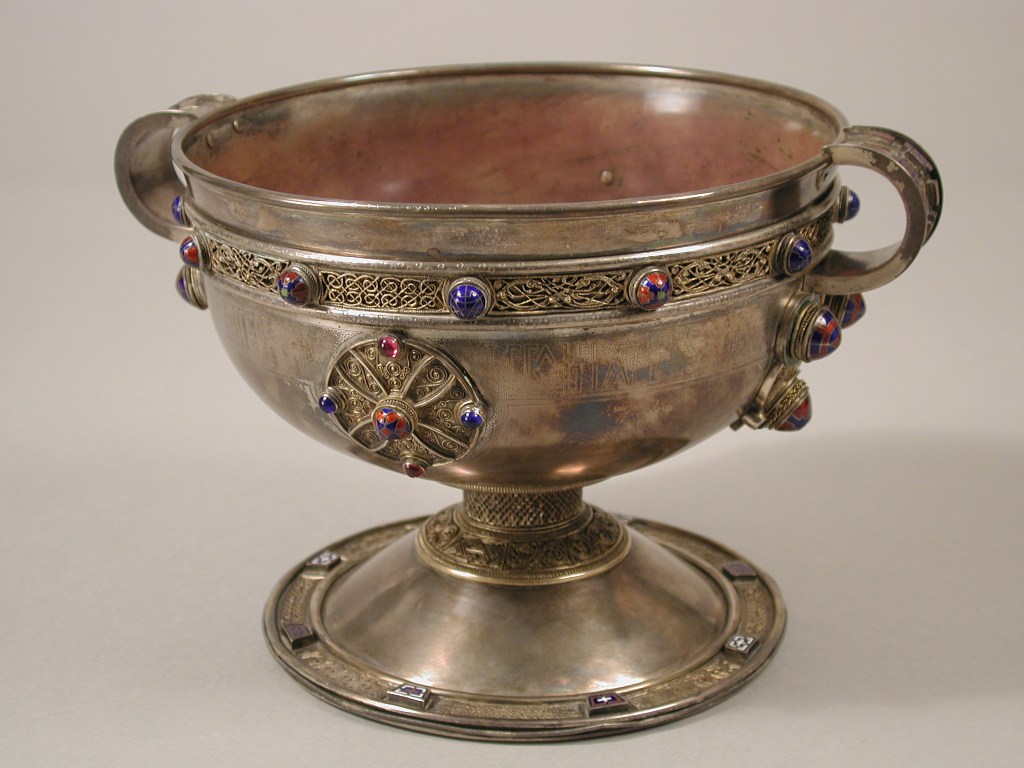
Like the cauldron, it was forged for ritual, bit it makes a happier statement about sacrifice, for the God to whom it is dedicated no longer demands that we nourish him and thus become one with his godhead. The transaction has been reversed: he offers himself to us as heavenly nourishment. In this new “economy,” we drink the Blood of God, and all become one by partaking of the one cup, the one destiny. The silver Cauldron was made in thanksgiving for some great favor: it was not meant to be seen by human eyes but was made for the sole delight of the swamp god. The silver Chalice, on the other hand, was meant to delight and refresh the humans who drained its mystical contents. Its elegant balance, its delicate gold filigree interlacings, its blue and ruby enamels beckoned from afar. As the communicant approached the Chalice, he could admire more fully its subtle workmanship; and as he lifted it to his lips, he would be startled to see, debossed in a band beneath the handles, the almost invisible names of the Twelve Apostles. As he drank the wine – at the very moment of communion – he could briefly upturn the base toward heaven and there would flash skyward the Chalice’s most thrilling aspect: the intricate underside of its base, meant to be seen by God alone. This secret pleasure connects the Chalice to the Cauldron and to all the pagan ancestors of the Irish. But the pagan act of pleasuring the god is now absorbed completely into the New Imagination and to all that will follow. The smith is still a “man of art,” a poet or druid, but he is no longer one of those whose evil craft and power Patrick had to protect himself against:
“Against craft of idolatry,
Against spells of witches and smiths and wizards,
Against every knowledge that corrupts man’s body and soul.”
For God’s pleasure and man’s are reunited, and earth is shot through with flashes of heaven, and the Chalice has become the druidic Christian smith’s thanksgiving, his deo gratias.
And that is how the Irish became Christians.
Cahill, How the Irish Saved Civilization, pp. 143-144
The most conclusive evidence that the bogmen were sacrificed is the story their bodies tell of the manner of their deaths. Each submitted himself naked to an elaborate, ritualized Triple Death. In the case of Lindow Man, for instance, his skull was flattened by three blows of an ax, this throat garroted by a thrice-knotted sinew cord, his blood emptied quickly through the precise slitting of his jugular. Here is the ancient victim of sacrifice, the offering made out of deep human need. Unblemished, raised to die, possibly firstborn, set aside, gift to the god, food of the god, balm for the people, purification, reparation for all – for sins known and unknown, intended and inadvertent. Behold god’s lamb, behold him who takes away the sins of all.
Patrick declared that such sacrifices were no longer needed. Christ had died once for all.
Two distinct traditions exist regarding the apostle Thomas, and these appear, at first glance, mutually exclusive. According to Eusebius of Caesarea and later Nestorian sources, the apostle brought the Gospel to the Parthians. By contrast, acording to the apocryphal Acts of Thomas and the Syrian DidascaliaApostolorum, the Doctrine of the Apostles, of the same age, he traveled to the court of King Gondophares in India… The two Thomas traditions can, in fact, be harmonized, since historical evidence, in the form of coins bearing his name and a stone inscription, proves the existence of the Indo-Parthian king Gondophares. He ruled over the region now encompassing south-eastern Iran and Pakistan, from c. 19 to 50 CE. It is thus conceivable that Eusebuis could have characterized his empire as ‘Parthian’. While nothing has been conclusively determined regarding the historical veracity of the Thomas mission, the possibility of his journey to India cannot be excluded, especially since regular maritime traffic took place between Rome and India.
Ever wondered why Rachel stole her father Laban’s household gods in Genesis 31? Was she really that devoted to these idols? Perhaps something else was going on. See this note from Gen 31:19.
household gods. One of the purposes of these idols was to obtain oracles (Ezek. 21:21). It may be that Rachel stole them to prevent Laban from using them to divine Jacob’s route of escape. In addition, possession of family gods symbolized title to family property in the ancient Near East, so Rachel may have stolen them to safeguard her inheritance rights.
ESV Archaeology Study Bible
This is another example of why it can be so helpful to understand the culture and context of biblical narratives. Here are two possibilities for Rachel’s motives in this story that I never would have known nor guessed without this background info. Divination or inheritance rights being tied to household gods is simply not self-apparent to me, given my own cultural and historical context. Interestingly, if the second possibility is what was going on here, then we see in Rachel an echo of her husband’s particular sin – seeking to wrest her inheritance rights in her own strength, rather than trusting in the promises of YHWH. As is usually the case, this backfires. And Rachel comes awfully close to losing her life because of her deception.
This magical world, though full of adventure and surprise, is no longer full of dread. Rather, Christ has trodden all pathways before us, and at every crossroads and by every tree the Word of God speaks out. We have only to be quiet and listen, as Patrick learned to do during the silence of his “novitiate” as a shepherd on the slopes of Sliabh Mis.
This sense of the world as holy, as the Book of God – as a healing mystery, fraught with divine messages – could never have risen out of Greco-Roman civilization, threaded with the profound pessimism of the ancients and their Platonic suspicion of the body as unholy and the world as devoid of meaning.
“With the way most plant churches among Muslims, we end up attracting only the rejects and the freaks,” said my friend with a scowl. “You’ll never start a movement that way.”
While spoken with some concerning overstatement, my friend’s comments were coming out of observations made within contemporary missiology, noting the largely ineffective traditional methods of church planting among Muslims. The shoe often fits. The congregations started by evangelical missionaries among Muslims have often attracted mostly the poor, the outcasts, and the mentally unstable. As the theory goes, most evangelical missionaries among Muslims have not focused enough on reaching the honorable leaders of the community – the patriarchs, chiefs, mullahs, and others. When these leaders are bypassed and the majority of attention is shown to those on the fringes of society, joining a movement to Jesus is prevented from being viewed as a real possibility by those in the mainstream of the culture – and especially by the leaders. And as I wrote in my previous post, these mental categories of “Not an option for people like me” or “It’s an option for people like me” really can make a practical difference in the mysterious interplay of God’s sovereignty and human responsibility.
I feel this critique. It is true that those of us coming from the West often bypass the societal leaders of an honor-shame community. We often do this even without thinking about it. “Why should I go visit the mullah or the neighborhood strongman? Can’t I just move in and get to work building relationships?” I myself have not done the best job of honoring the community’s leaders through preemptive visits of respect. I am wired as a grassroots, bottom-up reform kind of guy. And sometimes I just forget. Other times, a part of me wants to ignore these domineering leader types just to mess with their sense of self-importance. Perhaps this is the red-blooded American in me that has inherited some distaste for hierarchy and classism? Yet there is wisdom in considering how showing honor to those in positions of authority helps us to have a good testimony (Rom 13:7), creates space for us to cause some trouble, and may even open the door for these leaders to embrace a costly belief in Jesus – and perhaps for others to follow them. I need to be more balanced in this area.
And yet whenever this conversation comes up, I hear this line from church history echo in my mind, “These are the true treasures of the church.” This sentence was spoken by Lawrence (Lorenzo – from Spain), archdeacon of Rome in the year 258. Emperor Valerian had issued an order to have all the leaders in the Roman church killed. And as the one in charge of the church finances, he had ordered Lawrence to turn over the church’s treasure, and he would be spared. Lawrence asked for three days and then slyly distributed all the church’s money to the poor. He then marched the poor, the crippled, and widows into the presence of the emperor and when asked about the church’s treasure, proclaimed, “Come out and see the wondrous riches of God.” He was, of course, then put to death. Tradition says that he was roasted on a fire and that he also had a witty sense of humor. “I’m well done, turn me over!” he is alleged to have said while being killed (thereby becoming the patron saint of the poor and of chefs at the same time). I like this guy.
When Deacon Lawrence proclaimed the poor and the broken as the true treasures of the church, he was echoing Paul.
For consider your calling, brothers: not many of you were wise according to worldly standards, not many were powerful, not many were of noble birth. But God chose what is foolish in the world to shame the wise; God chose what is weak in the world to shame the strong; God chose what is low and despised in the world, even things that are not, to bring to nothing things that are, so that no human being might boast in the presence of God. And because of him you are in Christ Jesus, who became to us wisdom from God, righteousness and sanctification and redemption, so that, as it is written, “Let the one who boasts, boast in the Lord.” (1 Corinthians 1:26-31 ESV)
And he was echoing Jesus, who proclaimed that the kingdom of heaven belongs to the poor, and who scandalously befriended the sinners, tax collectors, and the demonized rejects.
This area is yet another tension we face as missionaries. We do attract the outcasts. And some of them are remarkably broken. Broken people take a lot of time and investment and while on the slow road of healing can wound many others around them. They are not always the most stable foundation for a new church. I often beg God to bring us stable locals who will not implode our fledgling groups because of their deep trauma and broken pasts. Yes, we are all broken to some degree. And yet we live in a region of the world with very recent (and ancient) scars from war, dictators, genocide, sanctions, and other horrific experiences. It seems as if everyone here is traumatized in one way or another. And this makes church planting in this place at times seem utterly impossible.
What are we to do? An ideal approach would seek to minister to both the outcasts and the leaders, improbable as that initially seems. This much is clear – In the end, we must not hinder the “little children” from coming to Jesus. The kingdom of God belongs to them. It would be just like God to build the foundation of the church among my focus people group on the nobodies and rejects, just like Jesus did 2,000 years ago with his group of motley Galileans. Does this openness to the “rejects and freaks” hinder a movement from taking place? The research may claim this, but I doubt it. That’s just not how the kingdom of God works. If it does prove a hindrance to multiplication, then so be it. It’s a risk I’m willing to take. What genuine believer, after all, could actually choose a movement of Christians that is mainstream and respectable, but not open to the broken and the outcasts? Is this really a better alternative? If I have to choose, I will opt to gather with those who repulse the respectable.
On the last day I would rather stand with the orphans and the widows than with those this world honors. This simply seems to be the route more consistent with the heart of God as displayed in the ministry of Jesus. That may mean we end up less “effective” in the metrics of missiology. But does that really matter when the king returns? Rather, we would be wise to pay attention to how he characterizes the ministry of his true, known, followers: “As you did it to one of the least of these my brothers, you did it unto me” (Matt 20:40).
The question of when the Church of the East began, defined as the start of missionary activity east of the Euphrates, leads directly to the conflict between Nestorian tradition and the testimony of textual criticism. No fewer than ten names appear among those who claim to have been the first to carry the Good News to the east. Tradition and scholarship do concur, at least, regarding where Christianity first took hold, namely in Edessa (Urfa) and Adiabene (northern Iraq). Reports that the Three Kings or the pilgrims who had been in Jerusalem at Pentecost were the first missionaries to the Parthian Empire clearly belong in the realm of myth. Likewise, we must not concern ourselves with the traditions about Peter, Benjamin and Bartholomew, who are associated with India, as well as Lycaonia, Ethiopia, and Arabia and Armenia. Abha was, for his part, simply a companion of Mar Mari. The names of St Thomas, Mar Addai, Mar Aggai and Mar Mari however, ought to be taken seriously, especially since they occupy the first four places in the official chronology of the patriarchs of the Church of the East.
Baumer, the Church of the East, pp. 14-15
I actually disagree with the author here about the pilgrims from Pentecost being only a possibility in the realm of myth. We have a precedent in Acts in the example of Antioch for normal believers leading the way in witness, with apostolic leaders being called for once a community of Christian faith has taken root. If it happened that way for Syrian Antioch, why not for the two of the major cities on the highway East of Antioch, Edessa and Adiabene (Arbela)?
But there does seem to be some evidence for the early arrival and work of Thomas, Mar Addai (St. Thaddeus), Mar Aggai (St. Haggai), and Mar Mari (St. Mares). Notice how the Aramaic-ization (is that a word?) of these names and titles makes them feel a little foreign to the Greek-icized names of the New Testament – and how, at least for me, seeing the familiar forms of the names makes them feel more at home as the successors of what we read about in the book of Acts. These language shifts are actually a fitting example of what was likely the gospel’s first departure from the Greco-Roman world into a neighboring cultural and linguistic sphere. Not that Greek wouldn’t have had some speakers in Mesopotamia, but it was definitely majority Aramaic-speaking. It’s not surprising then that the first evidence we have of the gospels being translated out of Greek and into another language takes place in Adiabene.
The difference between Patrick’s magic and the magic of the druids is that in Patrick’s world all beings and events come from the hand of a good God, who loves human beings and wishes them success. And though that success is of an ultimate kind – and, therefore, does not preclude suffering – all nature, indeed the whole of the created universe, conspires to mankind’s good, teaching, succoring, and saving.
Patrick could speak convincingly of these things. He could assure you that all suffering, however dull and desperate, would come to its conclusion and would show itself to have been worthwhile. He could insist that, in the end, you too would hear the words “Your hungers are rewarded: you are going home. Look, your ship is ready.”









 Entrusted to the Dirt

