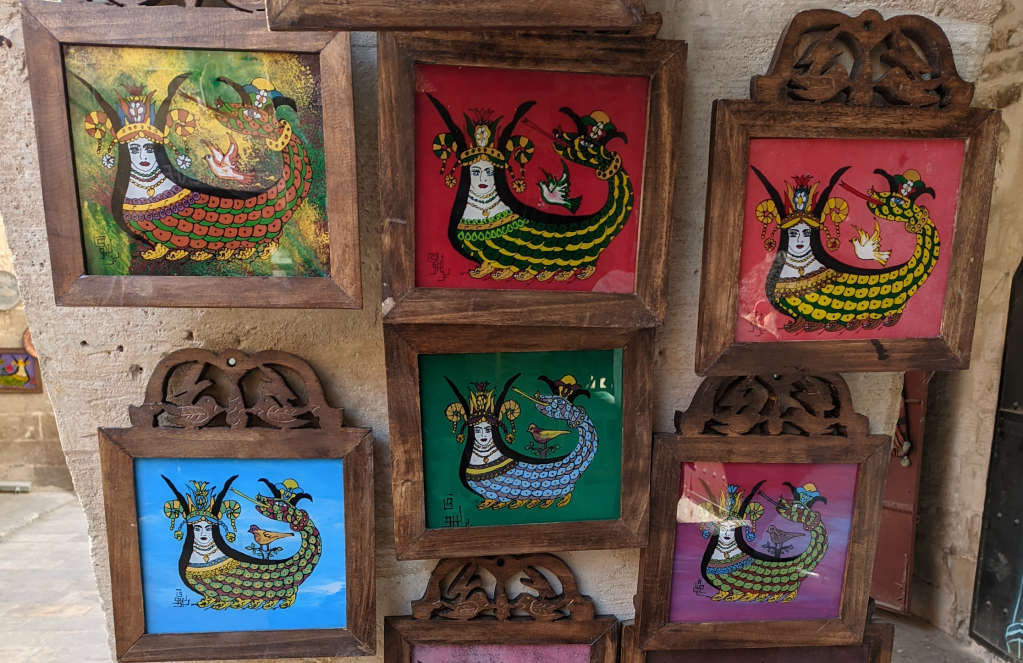
The first time I remember noticing her was when visiting local museums. The exhibits that showed what the inside of local houses used to look like regularly featured wooden chests. Inside these colorfully painted chests were usually blankets and cushions for guests. But on the outside of the chests were mirror fragments – and a painting of a strange woman-snake hybrid. I’ve also seen her hung up on walls as part of a tapestry or framed painting. In the local languages, she is called the Queen of Snakes. And I’m beginning to suspect that she has played a dark role in the historical beliefs of our people group.
The Queen of Snakes was never quite prominent enough for me to pay her much attention. Far more prominent were the evil eye pendants that seemed to show up everywhere. But listening to the Haunted Cosmos podcast got me thinking more deeply about the folk mythology of our people. Turns out there are some disturbing similarities between the Queen of Snakes and the strategies the enemy has used to deceive the nations from the very beginning. First, the story.
The tale of the Queen of Snakes often begins with a young man who is hunting for honey in caves. While exploring deep in a cave, he comes across a massive snake-like creature that has the body and head of a snake on one end and the torso and head of a woman on the other. He is terrified, but the creature tells him that she is not evil, but benevolent. She says that she is able to give him secret knowledge. The young man decides to stay with her and they eventually fall in love. After a long season of happiness, the young man must return to the city. But the Queen of Snakes warns him to tell no one about her, and that living with her has changed him. Now, if his skin gets wet, it will appear as the scaly skin of a snake.
After the young man returns to the city, the king becomes deathly ill. His viziers tell him that the only thing that can save him now is if he can eat the flesh of the mythical Queen of Snakes. No one, however, knows how to find her. But they do know that water can expose anyone who has been in her presence. So, the soldiers of the king go around pouring water on all the citizens of the city. Eventually, they find the young man when his skin betrays him. Under torture, he reveals the location of the Queen of Snakes.
The king’s men then bring the Queen of Snakes to the city. Right before they kill and cook her so that the king can eat her flesh and live, she gives a warning. She says that anyone who eats her head will be poisoned and will die. But if anyone eats her tail (presumably the snake head, but some allege it’s the other way around), they will live. The king, of course, orders that the Queen of Snakes be killed and cooked so that he can eat the tail. The young man, despairing in the death of his lover, eats flesh from the head. But it was a trick. In reality, the tail contained the poison while the head contained secret knowledge from time immemorial. The king dies, but the young man becomes the wisest man in the land and a great sheikh.
Okay, so this is a weird and creepy story. But is that all it is? How has the story of the Queen of Snakes affected the day-to-day spiritual practices of our people group? Well, more research here is needed. But this is what I’ve been able to figure out so far.
First, the image of the Queen of Snakes is believed to bring good luck and protection in general. This follows the theme from the story that she was a source of hidden wisdom. More specifically, the Snake Queen’s image has been used as a talisman to ward off sickness. This makes sense given the power of the Queen of Snakes in the story to provide healing. But the image of the Queen of Snakes has also been used to promote fertility. A picture of her is a very important part of a woman’s dowry – and that picture is then hung in the bridal chamber. In summary, the grandparents of my Central Asian friends believe that the talisman of this chimera provides protection, good fortune, wisdom, and fertility. And they want to make sure that this image is looking down on the marriage bed.
Yep, this sounds Satanic. First, there’s the twisting of the image of the serpent so that what is naturally repulsive and the enemy of the woman is instead believed to be a benevolent being. The most common position on the internet regarding the Snake Queen has her functioning as a symbol and even a patron saint of sorts for the women of our region. Second, there’s the whole theme of secret knowledge that this being promises. A friendly serpent being that offers hidden knowledge gives off some pretty serious Genesis 3 vibes.
But this is not the only way in which the lore around this creature is attempting to usurp power that belongs to God alone. The Queen of Snakes is also held up as giver and restorer of life. She gives fertility and she gives healing. And how does she do this? Well, in the story you have to eat her flesh. Some versions of the story even have successive serpentine offspring incarnating the Queen of Snakes after each of her deaths, meaning that she also possesses the key to new birth and immortality.
Now, in a disturbing – though honestly predictable – twist, the image of the Queen of Snakes has been adopted by LGBTQ activists in our region to promote their agenda.
Once we are back on the ground I need to do more research to see how this demonic element of folk religion is actually functioning among our people group. I need to ask my friends and their sisters, “What do you believe about the Queen of Snakes – and what did your grandma believe such that she put pictures of her up in even the most intimate parts of the home?” But even from the little bit that I know already, certain steps for local believers seem clear.
First, get rid of any Queen of Snakes images that you might have in your house. Sure, it might make your great aunt upset if you burn that talisman painting she gave you, but you really should chuck it – even if it’s only out of an abundance of caution. Yes, the presence of the Holy Spirit protects believers, but this shouldn’t make us cocky. In the mysteries of the spiritual realm, sometimes even objects can be used by the enemy to cause some serious trouble. You may be immune, but Christian history and common sense would indicate that you really don’t want something like that in your house while you’ve got kids who haven’t yet come to faith. Take dominion over your space, and just like Hama and Tara who took down their Islamic paraphernalia during the saga of plastic Jesus, get rid of the snake woman too.
Second, no longer believe and speak of the Queen of Snakes as some benevolent pro-woman character that’s a positive part of your heritage. All the evidence indicates that there’s at least some level of demonic deception involved in this creature. Christians will need a new posture toward this part of their traditional folk art.
Third, proclaim that the things the Queen of Snakes claims power to do are the territory of God alone. He alone is protector, healer, giver of children, and source of true wisdom. In all of these areas, the Queen of Snakes was a liar, a deceiver, and a usurper.
Finally, celebrate the victory that Christ has accomplished over not just Islam, but also over all the dark things of folk religion that clutter up the metaphorical basement of your worldview. Christ “disarmed the rulers and authorities and put them to open shame, by triumphing over them in him” (Col 2:15). When Jesus on the cross crushed the head of the serpent’s seed, he also crushed the power of the Queen of Snakes. Through the open proclamation of that good news in your language, she will no longer able to deceive you, your grandma, or your future bride. And that is very good news.
We will be fully funded and headed back to the field when 43 more friends become monthly or annual supporters. If you would like to join our support team, reach out here. Many thanks!
For my list of recommended books and travel gear, click here.
Photo by Wikimedia Commons







 Entrusted to the Dirt
