Pride is such a slippery sin, one that often masquerades as wisdom, sound strategy, or simply holding to the “correct” position. For so much of the contemporary missions world, the right position, the strategic thing, is to avoid transmitting our own culture to those we are leading at all costs – even if that means not leading, not preaching, and not modeling crucial aspects of the Christian life for indigenous believers. This kind of posture often feels like humility, but its assumptions about local believers prove to be anything but humble.
For example, missionaries who long to see exponential growth and even movements among their focus people group will often refuse to preach sermons directly to locals. They believe that this is a Western Christian form that will be foreign to the locals and bad for church multiplication. Many will persist in this posture even when local believers repeatedly request that they preach to them and even when the local culture is one steeped in Islam, where a mullah or imam (checks notes) preaches a sermon in the local mosque every Friday. No, the missionary persists in what he maintains is the humble thing to do, refusing all opportunities to preach the Bible to local believers. He might tell himself that by doing this, he is humbly refusing to build his own kingdom, and he is saving the indigenous church from the pollution of Western forms. In reality, he is pridefully elevating his own opinion or training over the good desires of local believers and the clear commands of scripture.
In previous posts, we’ve noted how the Bible’s emphases and cross-cultural common sense help to guard the missionary from this powerful fear of cultural contamination, from the specter of their culture being passed on to their disciples and thereby wrecking indigeneity. This current post adds personal humility to the list of guardrails that keep us from being frozen or misled by inflated fears of cultural transmission.
The first point of personal humility that missionaries must embrace is that local believers are not inferior to us (Col 11:3). Everyone is equal at the foot of the cross, both in our sinfulness as well as in our new nature as believers (1 Pet 2:9). Local believers are our equals in Christ, even as we seek to mentor them in the faith. This spiritual equality means that local believers are indeed increasingly able to sift their own culture and borrow from other cultures as a means of reforming their own. Should they be trained in discernment so that they don’t believe that everything Western is also Christian? Absolutely. We don’t need a hands-off posture that gives local believers no guidance at all. But neither do we need a posture that desperately tries to shut the door to any possible cultural transmission. As we have previously noted, this is not a real-world option.
I remember the first time I realized that “I Have Decided to Follow Jesus” had been translated into our Central Asian language and was a regular part of house church services. I was so disappointed. My personal feelings about this song were connected with Bible camp altar calls that felt manipulative, with a fundamentalist Christianity that was decisionistic and fixated on secondary issues. Yet here it was, being sung from the heart by persecuted local believers.
My bubble of indignation burst when a fellow missionary who had grown up in India told me that the song wasn’t actually American, but originally from a first-generation Christian of tribal north India. This information served as a very helpful rebuke. As it turns out, my culture had also borrowed this song from another, and the Lord had used it in the testimony of countless thousands. Even though I felt that the song’s value was largely gone for my generation, I knew enough about its history to know that it had been used mightily in American generations past. Yet here I was, upset that some unthinking missionary had translated this song into the local language. Even if that had been the case, who was I to say that the local believers shouldn’t even be exposed to a Christian song that had been mightily used of the Spirit elsewhere? Did I really believe them to be my equal when it came to discerning what would and would not edify the church? Proper biblical humility moves us away from this kind of “cultural appraisal for me, not for thee” posture.
Second, embracing humility can remind us that culture is often a deeply entrenched, stubborn thing and that we should not over-inflate our own ability to change it. The locals in Papua New Guinea may now wear T-shirts, jeans, and flip-flops, but they still take their children to the witch doctor if they fall seriously ill. The culture has only been Westernized at a surface level, but not where it counts. Similarly, Western missionaries might lament that Central Asian Christians now sit in chairs instead of on the floor in their services. However, they should be lamenting that local believers still believe that a lone, strongman pastor is the only kind of leadership that is “real.” Proper humility recognizes that it takes the work of God to change these deeper core levels of culture; thus, it’s not something we have the power to do accidentally. Remember, Jesus says that we do not have the power to even make one hair of our heads black or white (Matt 5:36).
Local believers are our equals in Christ, who become increasingly wise to appraise aspects of foreign Christian cultures as they grow in their faith. It is not our job to work so hard to shelter them from our Western culture that we refuse to do direct, lead-by-example ministry. Furthermore, we are, apart from the Spirit, impotent to change the deeper layers of culture. We need to stop assuming that we are so influential and so popular that we might turn everyone into Westerners without ever meaning to.
Rather than postures that reflect hidden pride, we need to embrace a biblical humility, one that focuses primarily on doing the Lord’s work. A posture of true humility will, in the end, be the most effective for preventing the wrong kind of cultural transmission, and bringing about healthy indigenous churches.
This post is part of a series. Total series posts are:
Want to know one of the deepest fears of contemporary missionaries? Being labeled a colonialist. Missions books and pre-field trainings are full of examples of how previous generations of missionaries got it wrong, exported their culture along with the gospel, and thereby hamstrung the growth or even existence of the indigenous church. The average well-educated Westerner will go to great lengths to avoid the shame of being labeled a racist or a –phobe of any sort. The average Western missionary will go just as far – perhaps even further – to make sure the dreaded colonialist label never sticks.
This deeply-imbedded cultural fear often works its way out in a missiology of reaction. What ends up crystal-clear for the average missionary going to the field is what he should not be like – those old-school colonial missionary types. So, when missions methods are proposed that keep the missionary always in the background, never leading from the front, the missionary becomes an easy convert. In these methodologies (also chock full of promises of exponential success), the missionary has found a compelling philosophy that keeps him from leading groups in Bible study, from preaching, from baptizing locals, and even from calling out the darkness of local culture when necessary. In his zeal to not be a colonialist missionary, the gospel worker focuses overtime on preventing any of his culture from being transmitted through his ministry.
In a previous post, we’ve seen how the Bible’s strong emphases on direct gospel ministry and protection against false gospels provide a helpful response to this kind of missions thinking. How might the experience of seasoned cross-cultural missionaries also inform this fear of being a cultural colonialist, a cultural contaminator?
Thankfully, cross-cultural wisdom and common sense also bring some needed correction to the missionary mortified at the thought of passing on some of his culture to his local friends. To start with, those with long-standing cross-cultural relationships will tell you that cultural transmission is, in fact, inevitable.
When we love someone, we are shaped by them.
Spouses’ personalities and body language become more like one another as they age. Likewise, friends from different cultures slowly absorb traits from one another’s lives. This is simply how human relationships work. When cross-cultural relationships exist, culture will be transmitted whether we want it to or not. This is because group as well as personal cultures are porous and dynamic, constantly flowing back and forth and naturally interacting with the other cultures around them. Naivete says we can stop cultural transmission entirely. Wisdom and experience say it will happen, so let’s seek to notice it and be intentional about it.
Similarly, culture can never be transmitted without being changed in some way, localized as it were. No one can emulate another in one hundred percent the same way. No, even the sincerest emulation still gets colored by the unique traits and personality of the individual or group that has been influenced. Once again, experience shows us that cultures never receive anything without putting their own spin on it. Yes, the Melanesian church of my adolescent years sang “Rock of Ages” in English in their services. But the timing, the pitch, and the fact that every single verse of the song was sung was most definitely not Western, but more akin in style to the tribal dirges of their ancestors. When this kind of exchange occurs, does it represent a coercive act of culture invasion or a consensual act of culture adoption? Must we insist that the former category is the only possibility? Or can we admit that indigenous cultures – not just our own – possess enough agency to adopt and transform foreign forms willingly?
One more point of cross-cultural common sense is that cultural transmission can be either good or bad. This much should be plain to the Christian, even if it’s not to the secular academy. Strangely, even among Christians, it is assumed to be bad when a Western missionary’s culture influences local believers. But why is this the default assumption when an unreached culture is influenced by a missionary who is 1) steeped in and shaped by God’s word, and 2) who comes from a culture that has had widespread exposure to God’s word for hundreds of years? In most cases, the cultures of the unreached have either been cut off from God’s word for hundreds or thousands of years or have never had access at all. This isolation from God’s truth always means the presence of areas of horrendous darkness in these cultures – strongholds of evil such as female circumcision, cannibalism, honor killings, or witchcraft. Regarding areas such as these, Western missionaries should be actively trying to change the culture. Yes, some cultural transmission can be good, even godly.
For a global missions culture dominated by the fear of being called colonialist, cross-cultural common sense and wisdom bring a welcome correction. Cultural transmission is inevitable inhuman relationships, and therefore calls for intentionality. Culture transmitted is always localized in some way. And some forms of cultural transmission are necessary in order to combat the works of the enemy. When considered alongside the Bible’s ministry emphases, personal humility, and a deep trust in the sovereignty of God, this common sense wisdom can help free the missionary from a fear-based missiology – and lead to one built on a better foundation.
This post is part of a series. Total series posts are:
Among the many forces that shape contemporary missions, fear of cultural contamination looms large. Missionaries, and Western missionaries in particular, often feel and express a deep aversion to passing on aspects of their own culture to those that they reach through their ministry. Suppose Western missionaries of the past falsely equated Western culture with Christianity. In that case, the pendulum has now swung to the far extreme, where cultural transmission, “contamination,” is now felt to be one of the worst things a missionary could ever do.
This fear is not without warrant. Some churches around the world, planted in previous eras of missions, have failed to take root as truly indigenous because of their Western trappings. The country of Japan comes to mind as one example where the indigenous population has not accepted Christianity as genuinely belonging to the Japanese – at least not in the modern era. In societies like this, Christianity is held at arms’ length, viewed as belonging to the foreigner, and not truly an option for those who identify with their own people group.
Yet an overcorrection to this danger in modern missions has led to an even worse situation. Missionaries are refusing to obey clear commands and examples in scripture out of a professed desire not to export Western culture. Following popular methodologies -themselves driven partly by this fear of cultural contamination – they shrink back from biblical ministry, necessary roles, and spiritual authority. These missionaries convince themselves that by not preaching, not baptizing, not modeling, and not leading church plants, western culture will not influence the locals, the locals will take ownership of the faith, and the Church will be set free to reproduce. All kinds of concerning methods emerge out of this sort of posture. One egregious example would be a mission leader recently forbidding his team members from reading the Bible in indigenous homes due to a commitment to orality and a fear of “Western” literate methods making inroads.
Yes, a desire to keep the Gospel – and not culture – as the only stumbling block is biblically warranted (1 Cor 9:22). The Jew/Gentile divide among the Romans was rife with issues of conscience and culture, such as which days were to be considered holy, and what foods should or should not be eaten (Rom 15). Church history also shows us that these concerns can have real historical validity. In an era where China was repeatedly humiliated by foreign powers, Hudson Taylor rightly understood that many of his Chinese hearers were stumbling not only over his message, but also over his explicitly foreign appearance. However, in the centuries since Taylor became the first missionary to wear the Chinese hair queue, the pendulum has swung far indeed – into territory that Taylor, a committed cross-cultural preacher, would hardly recognize.
What is to be done to course-correct? Our obsession with avoiding cultural transmission must be corrected by the clear commands and warnings of scripture. A survey of scripture’s commands regarding the missionary task shows that the overwhelming emphasis of these passages is not on the need for the minister to check himself in order to protect his cross-cultural disciples from adopting his culture (Matt 28:18-20, Matt 24:14, Rom 10:14-17, Rom 15:20, 2 Tim4:11-16). Rather, the emphasis falls on the importance of direct gospel ministry – the kind of ministry that can be seen, caught, and followed. In other words, the Bible emphasizes ministry by direct example. Consider the weight that Paul – a self-professed Hebrew of Hebrews – gives to emulating his own manner of life when writing to the Gentile Macedonians in Philippi. “Brothers, join in imitating me, and keep your eyes on those who walk according to the example you have in us. (Phil 3:17 ESV).” Apparently, Paul did not seem to think that if Macedonian believers imitated the life of a Jewish Cilician, they would no longer be able to reach their pagan neighbors effectively.
What of scripture’s warnings? Far from emphasizing the evils of cultural contamination, scripture instead highlights the dangers of false-gospel contamination (Gal1:6-8, 2 Cor 11:4, 1 Tim 1:3). This danger comes through things like false teaching, wolves in sheep’s clothing, a lack of holy living, or even a loss of love (Rev 2). Once again, the weight of biblical emphasis indicates that these dangers are far more of a threat to the spread of the Church than missionary cultural transmission.
In future posts, we will consider how a good dose of cross-cultural common sense, personal humility, and a deep trust in God’s sovereignty all help to guard the Church and its missionaries from falling into this pitfall of modern missions. Nevertheless, it is appropriate that any missionary who finds himself frozen by the fear of contaminating the indigenous Church first wrestle with the Word of God and its dominant emphases: Do direct ministry by example and watch out for false-gospels. With these emphases in place, the guard rails are set, and the missionary is now free and ready to keep a wise eye out for where cultural preference might indeed be causing barriers to the gospel.
Any return to a more biblical missiology must be shaped primarily by the Bible’s emphases, and not dominated by our modern fear of cultural contamination.
This post is part of a series. Total series posts are:
This Central Asian proverb speaks to the danger of friends going into debt with one another. Borrow money from your friend, this wisdom claims, and risk the love between you getting cut up.
I’ve experienced the great strain that friendships can come under when money I’ve loaned out to friends in Central Asia isn’t returned or acknowledged in an honorable way. Even though our family tried to be very cautious in loaning out money, it is still an expected practice in a patron-client society where the foreigners are often much wealthier than the locals. Some foreigners take a “never loan money” approach to the culture. But over the years we’ve developed more of a practice of conservatively lending money the first time, and then letting that experience determine if the door is still open or not for future requests. For those who repay their debts, this can greatly increase the trust in the relationship. And it is a wonderful thing to have friends you know you can trust with money, especially between believers who must function as a new household for one another. For those who don’t repay, we know not to extend the same trust in the future, at least when it comes to money. The money may be lost, but wisdom in the relationship is gained. But even with this general approach, we tried to spare our dearest friendships this debt/trust test whenever possible. It’s stunning how money can so quickly come to divide people.
In general, Central Asians are much more comfortable than Westerners with having money be a part of their close relationships. So much so that many feel they can’t honorably say no to a friend asking for a loan. So it’s curious that this proverb also exists in the culture, standing as a wise warning, even if many will struggle to feel they are free to heed its advice.
Some local believers are seeking to change this culture. Harry* once told me his response to requests for loans. “I’m honored that you would ask me this, my respected brother. But I value your friendship so much that I dare not risk it by getting money involved.” This kind of response takes an action viewed as shameful – saying no to a loan – but explains it by appealing to the value of the relationship, something very honorable and close to the heart of the culture. To me, this seems like a very wise way to say no. The goal is to communicate that my refusal is not a rejection of our relationship, but rather a statement of just how important it is to me. So important, I would protect us from the money that might cut our bonds of friendship.
To support our family as we head back to the field, click here.
For my list of recommended books and travel gear, click here.
When modern dictators fall the societies they ruled tend to flounder and splinter. This is because they have previously been gutted. A dictator, in order to increase and maintain his power, needs to systematically weaken all other institutions of civil society that might serve as independent centers of power and organization. So he goes after religious institutions, the media, voluntary societies, other branches of government, etc. He will often permit a shell of these institutions to continue, but will appoint loyal cronies to head them up so that they no longer pose any legitimate challenge. The longer this goes on, the more a society is gutted of healthy systems and structures that it could use to organize and unify itself once the dictator is removed. Like some kind of ravenous fungus, a strongman consumes and replaces healthy systems and institutions as he feeds off his people, slowly choking the organizational life out of society.
This explains why certain Middle Eastern countries have done so poorly since the removal of their dictators in recent decades. During long decades of dictatorship, true civil society was turned into a zombie of its former self or driven underground. Often, the only network of institutions strong enough to endure the long stranglehold has been the conservative mosques, buttressed as they are by their religious ideology. Thus, when a dictator of a Muslim country falls, the West’s hopes for the emergence of a unifying liberal coalition are disappointed again and again. They liberals can’t seem to organize effectively, and it’s no wonder. All the institutions of the liberals and moderates were practically destroyed ages ago. Into this power vacuum then steps the Islamist fundamentalists, the only ones placed to organize and take over the uprising – even if said uprising began as a majority liberal movement.
An interesting parallel exists here between these political realities and the state of many churches in the Middle East and Central Asia – indeed, anywhere in the world where the culture tends to reward domineering leaders. As in society as a whole, a strongman over the church tends to take the rightful place of other legitimate systems and structures. Look at the few churches that exist in these areas, and you will notice a curious absence of things like healthy membership, responsible giving and finances, congregational accountability and discipline, and plurality of leadership. Instead of covenanted members, belonging to the church is equated with those who are loyal to the strongman. Instead of transparent finances, the pastor controls all the money. In the place of congregational discipline for its own members, you have the favor or displeasure of the leader. And there is no healthy plurality, just one charismatic, domineering personality that leaves no room for any legitimate pushback or accountability.
If we return to my preferred napkin diagram of a healthy church (described in a previous post), we see that a strongman completely replaces all of the characteristics of a healthy church that we would see in stage two, in what I’ve called an organized church.
Now, this diagram is simply a tool I’ve used to quickly summarize the characteristics of a healthy church as they relate to the typical stages a church plant goes through. Not all of the characteristics are rigidly sequential, but I would contend that the three stages of Formative, Organized, and Sending are a common pattern in how church plants develop – and, for our purposes today, that there is a qualitative difference between what is present in a formative church and what is there in an organized church. That difference lies in the intentional organization and systematization of what had previously been a gathering of believers functioning more organically.
A bible study that has really taken off might gather regularly for fellowship, worship, teaching, prayer, and discipleship. They might share the gospel regularly with their friends and neighbors. All of these things are biblical and good. And while they can be organized into systems, they don’t have to be organized in order to be done well. They don’t demand careful planning and organization. They can exist in an organic fashion for a very long time with only basic plans put in place. The same cannot really be said for the characteristics in stage two. These require careful thought and planning and implementation if they are to even exist in a church plant. And they will not ever exist in a healthy way without great intentionality that leads to the birth of good systems. In fact, to simply wing the structures of stage two is to play with deadly fire that will burn many.
This required intentionality and creation of systems and structures explains why the elements of the organized church stage are absent or so underdeveloped in many house churches. These characteristics are complicated and time-consuming to figure out and it’s simply easier to keep punting their development until some future date. Often, there is a great deal of ignorance about how to actually begin to teach and then roll out things like membership, plural leadership, and discipline. This is why groups like 9 Marks focus so heavily on reviving both the knowledge and the practical details of good ecclesiology for the Church. Even those committed to these things in principle can often botch the implementation. I’ve often heard it said that the number one mistake of reformed church planters and church revitalizers is appointing elders too quickly.
However, this is so far assuming that the church planters, missionaries, and members want to see these systems developed. But often, past experience and current methodology commitments mean that the preference is for things to stay organic and natural (And this often has roots in Westerners’ own cultural moment of being post-institutional). Stage two will just happen naturally, it is claimed, as the Spirit eventually gets around to leading the locals into how to be a biblical church. Missionaries can live in a fantasy where the kinds of intentionality and organization required in their own culture for the church to function well are actually considered bad, or at least not really necessary in the more pristine cultures of foreign lands. Some even view focusing on the characteristics of stage two as bad for church multiplication, the kind of thing that leads to the terrible “I” word that is alleged to kill movements of the Spirit, institutionalization.
When you pair these Western postures with cultures already prone to domineering leadership, you get a lethal cocktail. The missionaries aren’t interested in pushing for organized church characteristics in their church plants. They want things to stay organic and rapidly multiplying. Locals, never having before known the power of a spiritual family organized in a healthy way, default to how their families, mosques, and government are run – strongman rule. Soon, a strongman does emerge who then goes on to make the church his own little fiefdom. The missionaries become perplexed and discouraged at what has happened, and either fall in line themselves or are eventually run off when the strongman feels they are a threat to his monopoly. The end result is a sick church, one without biblical membership, giving, leadership, or discipline. Biblical mission, often the final characteristic to be developed, will also never happen through this kind of church where a spiritual dictator has settled down to feed on the sheep.
If we do not plant churches with a willingness ourselves to lead in the development of stage two characteristics, we do a great disservice to the local believers we are claiming to serve. Like a society naively asked to go vote after decades of dictator rule, we set them up for failure. A power vacuum will always be filled. And in strongman societies, little dictators spring out of the ground like so many narcissus flowers in the Central Asian fields of spring. Local churches all over the world desperately need systems of healthy giving, leadership, discipline, and membership. How will they know what these structures look like if we do not intentionally teach and model them? Or do we really believe that these systems will somehow contaminate indigenous churches more so than the inevitable strongman who will take over in their absence?
Should stage two characteristics of a healthy church be contextualized? Absolutely. And yet here we must not let the perfect become the enemy of the good. An imperfect effort to contextualize a system of membership is far better than never initiating formal membership because we are afraid of some kind of Western contamination taking place. Covenants can be modified for the pressing needs of specific contexts. Membership lists and vows can be oral rather than written and signed. Leadership can be chosen and honored in ways that are locally sensitive. The Scriptures provide ample room to carefully apply the principles of church organization to a given culture. “All things should be done decently and in order,” (1 Cor 14:40) does not mean you should simply copy/paste the systems of First Baptist Church back home. But it does mean we should give serious attention to the right ordering (organizing) of the church. As Paul said to one church planting team member, “This is why I left you in Crete, so that you might put what remained into order, and appoint elders in every town as I directed you” (Titus 1:5). What was asked of Titus in his cross-cultural setting is still asked of us today.
Strongmen will never coexist peacefully with healthy systems that can hold them to account. They will always seek to prevent their emergence or to choke the life out of them if they are present. On the other hand, the best way to prevent the people of God being ruled by these domineering men is to order the church wisely, even if this involves great intentionality and careful organization. Protecting the church means organizing it so that it might fully display the glory of God – not only in its organic love and obedience, but also in its wise systems and structures.
I was twenty, sitting in a tea house in a far-flung desert town. It was summer, so the temperature hovered around 120 degrees (48 C) in the dusty bazaar. My friend suggested that we stop for some tea as he gave me a tour of the marketplace of his hometown, famous for its castle, its hard workers, and its heat. “Welcome to hell,” another local friend had quipped earlier as we drove into town, wiping the sweat off his brow.
Always one to prefer heat to cold, I had been eager to see if the summer weather in this town was as bad as everyone made it out to be. Rising early our first morning, shortly after sunrise, I had stepped out of the house and into the sunlight. Immediately, I was hit by a rush of blasting, hot wind, and oppressive radiant heat, as if the entire sky were a giant hair dryer aimed right at me. Mind you, it was only 6:30 am. I quickly stepped back into the protective shade of the cement house. If I had ever doubted before why so many desert cultures wore so much protective fabric, now I understood. At a certain level of heat, you do whatever you can to keep the sun’s rays off your skin, even if it means going around covered in many folds of cloth.
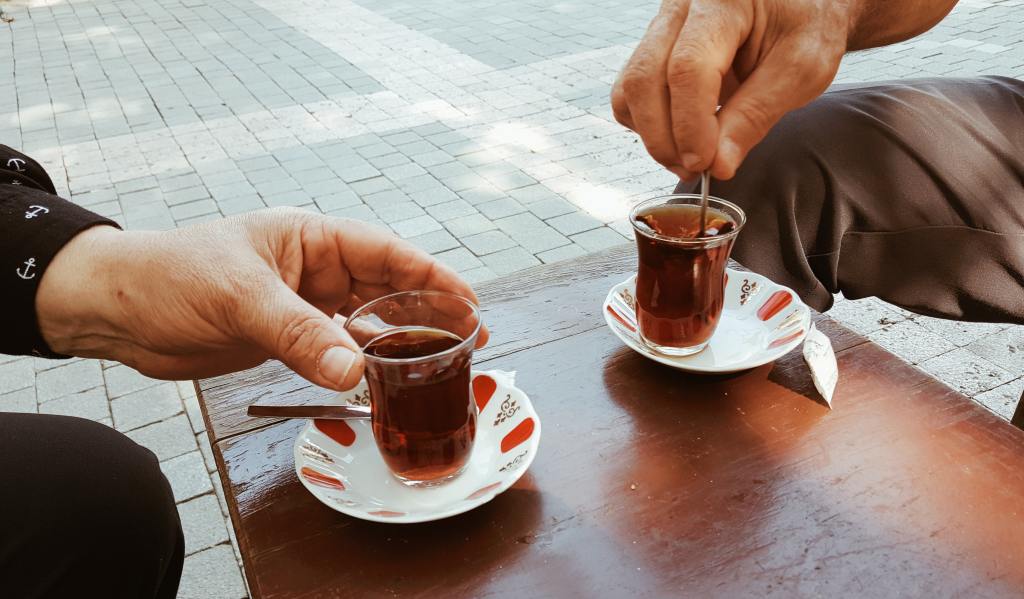
As we later made our way through the bazaar and then found our seats at the tea house, I was beginning to adjust somewhat to the constant feelings of living in an oven and clothing always soggy from sweat. I gratefully received a bottle of cold water alongside my scalding black chai. I chugged the water eagerly.
“Are you hot, my son?” asked a mustachioed older man, sitting across from me and smiling in his turban and flowy local robes.
“Yes, I’ve been told about the summer heat here, but now I see how true it is!” I responded, gulping.
“You know how we stay cool?” he asked me, raising his small steaming chai cup and saucer. “We drink this all day!” he said, laughing.
I looked at him, a little puzzled, wondering if he was joking or serious. He picked up on my expression and explained further.
“We drink the hot chai and it makes us sweat. And our sweat cools us down. That is how it works,” he said, seemingly satisfied that he had just handed down an important life lesson to this young foreigner.
I could tell he believed what he was telling me, but I wasn’t sure if I believed him or not. My love for local chai was intense, and so I was willing to drink it all year round, even in the fever heat of summer. But surely hot chai doesn’t actually cool you down in the desert. Maybe it was just a trick of the mind, a placebo of sorts that these desert men had learned to tell themselves in order to justify downing so many cups of sugary caffeinated goodness seasoned with cardamom and cinnamon. The logical thing to believe is that hot drinks raise your core body temperature and cold drinks cool it down. I left our interaction mostly sure that I was right and the locals mistaken. But a part of me has always wondered if there was something to what the old man was saying.
Then this week I came across an article in The Smithsonian that would make the old desert man crack a big smile, exposing all of the teeth he’s missing because of his chai habit. Turns out that a hot drink on a hot day really does cool you down. And this has now been scientifically verified with the help of a bunch of scientists and cyclists. Somehow, the cooling effect of the sweat produced by a hot drink on a hot dry day is actually greater than the warming effect the drink has on the body, making it a net win for a cooling effect. The article gets into the likely biological process for those interested.
So now I know. Hot drinks warm you up in the winter. They also cool you down in summer. How strange and wonderful. No wonder I like them so much.
There is one big caveat in all of this, however. In order for a hot drink to cool you down, you must be in an area of dry heat, not one of humidity. Since a humid environment prevents sweat from evaporating, the hot drink will actually raise your body temp, not decrease it. But as long as you are in some kind of desert or low-humidity setting (and able to sweat), the trick should work.
All of this reminded me of what a tricky thing it is to interact with local lore and tradition. By default, we want to dismiss local knowledge that seems bizarre to us as superstition or old wives tales. But quite often there is something to it after all. Not in every case, but often enough that we ought to reserve judgment on local claims until we’ve looked into them somewhat. As Tolkien wrote in The Lord of the Rings, “Pay heed to the tales of old wives. It may well be that they alone keep in memory what it was once needful for the wise to know.” Oral tradition should not be dismissed out of hand, simply because it initially strikes us as absurd.
A missionary friend in Cameroon shared with me this past week about a volcanic lake in that country. At some point in the 80s, large amounts of toxic gas were released from the lake, killing all who lived in the villages around its shores. However, all of those villages had been founded and populated by newcomers to the area. The long-time residents did not live close to the lake, since they had an oral tradition that it was spiritually deadly to dwell too close to the water. Apparently, this lake is prone to this kind of toxic gas release every 150 years or so, meaning that the indigenous villagers had an oral tradition that preserved a deadly historical event from the distant past, although it had become clothed in their animistic worldview.
I remember another story from my childhood in Melanesia, where a village pastor, eager to prove the local traditions wrong, had decided to cook and eat a bird locally believed to be poisonous and used in witchcraft. The pastor ate the bird – and almost died as a result. Turns out this black and orange bird is the only poisonous bird known in all of nature. Local oral tradition wins again.
Why do we so often assume that local tradition is untrustworthy and bogus? Because sometimes it really is, and it keeps locals in bondage to empty and dangerous lies. Consider the Middle Eastern and Central Asian belief in patrogenesis, the idea that offspring one hundred percent comes from the father, and the mother is merely a carrier, a vessel. All kinds of bad stuff have come from this cultural belief, including laws that disadvantage the mother when it comes to custody of her children – even if the man is abusive. Or, the cultural belief that the honor of the extended family is most dependent upon the sexual purity of the women in the household, resulting in honor killings that almost exclusively target erring female family members. In Melanesia, tribes until recently believed that if your enemy was strong in something, you could kill them and eat their corresponding body part for that ability, thereby getting stronger in that ability yourself. This local tradition led to widespread cannibalism and all of the dark effects associated with it.
However, what often happens is that Christians of the reformed camp approach culture with eyes only for these cultural lies. We often have a default posture of Christ-against-culture when it comes to local knowledge and traditions. We know that all cultures, like all people, are fallen and under the curse of sin. We know that this affects every aspect of a person, and every aspect of the culture – that total depravity is not just individual, but corporate as well. The mirror that once reflected the image of God so well has been shattered, and gross distortion has resulted. And yet a shattered mirror has not ceased reflecting entirely. No, if you lean in close and focus on small individual shards, a somewhat accurate, limited reflection can sometimes be found. The fact that the fall has damaged every aspect of a culture does not mean that the image of God is no longer present at all, shining out – sometimes dim, sometimes bright – through the distortion. Just as the restoration of the image of God in believers will not be perfected until the age to come, so the utter loss of that image in unbelievers and their cultures will not be complete until that same coming age.
This means that we cannot approach the culture of an unreached people group only prepared for the gospel to begin rejecting and discarding local beliefs and culture. We must be prepared for much of this, but not only this. We must also be ready to discover local beliefs and customs that fit quite well with a biblical worldview – that at times fit even better than those of our own culture. In these cases, the local cultural practice or belief is to be retained, but filled with a new motive, that of the glory of God and love for neighbor.
Few contemporary missionaries are at much risk of the kind of overt cultural pride present in the colonial era. In fact, we are more often at risk of the opposite, an unbiblical open denigration of our own cultures as we seek to embrace the local one. But pride is a slippery thing, and if our only setting is Christ-against-culture, then we will find ourselves prematurely scoffing at local wisdom that will eventually prove to be just that – wisdom. And scoffers don’t win trust. Those who sneer at local methods of chai drinking are less likely to find a hearing when it comes to the bigger questions of life and death and eternity.
Such is the challenge of engaging local lore and tradition. You may find lies straight from the pit of hell. Or, you may find truth that has been marvelously preserved, against all odds. We must learn to anticipate both and to humble ourselves when we get it wrong. We should listen carefully to the old men of the desert, ready both to learn and to stubbornly upend the traditions of ancestors when needed. We are tasked with this great untangling, with the laborious task of seeking to glue the shattered mirror back together. It will take a long time and countless conversations. And hopefully, lots of cups of chai. Even when it’s hot outside.
To support our family as we head back to the field, click here.
For my list of recommended books and travel gear, click here.
“Now that I have have this comprehensive power of attorney for you, I can legally get you a second wife – even without you knowing. Better watch out, when you come back from out of the country you may have a second wife, ha!”
Mr. Talent* conveniently dropped this news after several of us on the team had finished the POA process with him, meaning that he could now hold this over each of our heads. Thankfully, being a believer, Mr. Talent understands now that polygamy is a sin, despite his joking. Even before coming to faith, his first marriage had been difficult and had fallen apart, and he is also of the local demographic that would resonate with the ancestral proverb that “a man with two wives has a liver full of holes,” i.e. become a polygamist and embrace a life of pain.
And yet polygamy continues in our corner of Central Asia as a relatively normal thing among a sizeable minority of the population. Why does it still happen when polygamy is technically illegal in our area and when the culture itself has proverbs that speak to its danger? For something that is so foreign to us in the West (at least for now), it’s helpful to understand the justifications used by other societies for polygamy so that we can more skillfully oppose it with biblical truth.
The overwhelming majority of locals in our area are Muslims, and this means that a religious motivation is ready at hand for anyone who desires to marry an additional wife – even if this religious reason serves as a thin veneer for the true motivation. After all, the founding figure of Islam, Muhammad, had around twelve wives (there’s some disagreement about the actual number, and our local imams say thirteen). Being the supposed prophet and founder, Muhammad is held up as the ideal Muslim. So if a Muslim man wants to live like the prophet, and thereby be blessed, he will traditionally consider polygamy as a logical way to do this. However, only the prophet is allowed a dozen wives. Normal Muslims are limited to four.
Justifications in Islam for this polygamy in Muhammad’s life vary, but the most common one that I’ve heard is that it was an act of social justice, since so many wives had become widows in the holy wars that led to Islam’s founding. This doesn’t explain why Muhammad married seven-year-old Aisha, his favorite wife. Nor does it explain why he took his adopted son’s wife to be his own, conveniently receiving a divine revelation declaring adoption an un-Islamic concept in order to make it seem like he was not actually marrying his son’s wife (thereby making adoption among most Muslims a shameful thing to this day). But I digress, the logic for this first reason for polygamy among Muslims skirts these issues and simply maintains that Allah has blessed polygamy in the life of the prophet, and thereby in the life of faithful Muslims who commit to caring for each wife equally.
This Islamic sanctioning of polygamy means it often takes place in spite of the laws of the country where the couple resides – laws often viewed as Western and infidel-influenced. Polygamy is illegal only in the region of the country where we’ve been residing, but it is legal in other regions. So, local men who desire an additional wife will travel down south and work things out there, often with a wink from their local Islamic authorities, who are supposed to be abiding by the law and not encouraging polygamy at all. This dynamic is also present among some Islamic refugees in the West, where a man might fill out his paperwork as having one wife and one “sister” in order to bring both his wives with him to the West. He’ll set up two households in his new country, and live as a polygamist under the radar.
Another very common reason for polygamy among the Muslims in our area is infertility. Similar to stories of the Old Testament patriarchs, a man will often take a second wife if his first wife has proven unable to conceive after a given length of time. This is because children, and male heirs specifically, are so highly prized in the culture. We knew a village family in this situation, where a new wife had recently been acquired because the first wife seemed to be infertile. Again, similar to the stories of Rachel or Hannah, the public shame the first wife experiences in this kind of situation is almost unbearable. The presence of the second wife would serve as an excruciating daily reminder of her shame and and failure. If the medical issue resides with the man, he may keep taking on new wives, blaming each one in turn for what is actually his biological problem. Thankfully, modern medicine is making this kind of situation less common, as long as the man isn’t too proud to accept what the doctors are saying.
Surprisingly, it can sometimes be the first wife who pushes for the husband to take a second. This is because the first wife is often given a promotion of sorts when a second wife is taken on. The veteran wife will often get to hand off the more difficult housework and cooking to the second wife. Or the first and second wives give the hard labor to the third, etc. This could be viewed as compensation of sorts for the embarrassment of the husband taking on another wife, but can also be pursued in a sadly practical way for a marriage that’s unhealthy anyway. If the relationship is already cold and practical, why not get some help around the house? Similarly, one of my wife’s close friends desires her husband to take on a second wife primarily so that she can be free of his sexual demands. Having an additional wife might even provide some relational connection for a lonely wife who is disliked by her husband and his extended family. Just as the wives of a polygamist can often be bitter rivals, they can also become friends who support one another when both are stuck in the same situation, married to a bad man.
Polygamy can also be pursued by extended families in order to increase the standing of each. A poorer family might want one of their daughters to marry a wealthy or powerful patron. The patron’s standing as a holy, powerful, and apparently desirable man is thus increased, and the family of the girl gets a boost in honor and the brideprice money, which would be considerably more in this situation than if she were the sole wife of a man with less status. For example, one aged mullah in our country recently took on a third wife who is thirty-four years his junior. This kind of family status arrangement is likely what is going on here.
A final category of justification for polygamy is often simply the whims and desires of the man. If he is unhappy with how things are going sexually, or in terms of the cooking, or even if he just wants to flaunt his power as the domestic strongman, he might take on another wife. The first wife (or wives) cannot stop him from doing this, though in their own ways they can make him pay for it, hence the proverb about having a liver full of holes. Sadly, much polygamy takes place for no other reason than an already-married man takes a liking to another woman he has seen and decides that he simply must have her. I had to cut off contact with one village friend because he kept calling me, insisting that I translate for him as he flirted with a migrant worker, trying make her his second wife without the knowledge of the rest of his family.
The Bible is not silent on polygamy, though the case made against it is an indirect one. The first polygamist we see in Genesis is Lamech, a domineering and violent man. Then, in the stories of the patriarchs, both Abraham and Jacob become polygamists because of sin – Abraham’s doubting God’s promise and Laban’s deception of the inebriated Jacob. What ensues is a terrific mess, with rival wives, warring children, and men who must repeatedly eat the bitter fruit of their polygamous households. The kings of Israel are then expressly forbidden from taking on many wives in the style of the harems of the other nations, and we see the destruction of polygamy in both David’s and Solomon’s stories, even turning their hearts away from God. As the Old Testament period winds on, it becomes clear that God shows grace to polygamous households in spite of the institution, not because of it. The narratives of scripture are all consistent in their painting polygamy in a negative, worldly light.
At last, in the New Testament, Jesus calls the religious leaders back to God’s creation pattern for marriage – a man shall leave his father and mother and hold fast to his wife, and they shall become one flesh. Two become one, just like Adam and Eve in the beginning. In this passage as well as Paul’s insistence upon leaders being one-women men, monogamy is clearly assumed and polygamy thereby understood to be out of bounds. It may have been tolerated under the Old Covenant, but the New Covenant has come, where Christ has one holy bride, not multiple. And this relationship now serves as the pattern for all Christian marriages.
Whatever the justifications of polygamists, God’s word has come to silence them with its indirect yet forceful case. To have multiple wives is to lie about the nature of God’s covenant-keeping love, to lie about the nature of God himself. Believers in Christ are to live in such a way that their marriages are imperfect yet genuine metaphors of Christ and the Church – and as in the recent Western order, to influence society such that the injustice of polygamy is no longer tolerated.
For polygamy is unjust, both to the women whose dignity and agency are violated in polygamous marriage, as well as to poorer and younger and even average men, for whom marriage in a polygamous society becomes less and less attainable. A case could even be made that polygamous societies lead to greater violent conflict, as there is a clear connection in history between nations with a shortage of brides and nations that try to conquer their neighbors. And polygamous societies will always lead to many more available single men than available single women. How can it be otherwise when having multiple wives becomes a status symbol of the religious, the wealthy, and the powerful?
The justifications of polygamists are mixed. Some are good desires, such as the desire to have children, or to get some relief from the never-ending household labor. Christians can recognize the good in these desires and point toward better ways to pursue these goals and to respond when they are denied. Other, selfish, desires that lead to polygamy are to be rejected outright. Hence, knowing what the underlying motivation is for taking on another wife will be key to responding both biblically and skillfully. Why skillfully? Because in polygamous societies, you are the crazy one who thinks that monogamy is the only way to go. For them, polygamy is simply normal, perhaps even good, the way the world is. Helping locals to turn against their own polygamous heritage will be no easy task, but speaking to their underlying motivations will only help in this effort. I’ve laid out here the main motivations for polygamy in our context, but other polygamous contexts will bring with them their own unique justifications that will require understanding and appropriate response.
Polygamy has been around an awfully long time, and no doubt it will continue to pop up various human societies into the future. As it decreases in Central Asia, it may stage a comeback in the post-Christian West. The Church will need to confront it wherever it finds polygamy, lovingly but boldly calling men and women to a faithful monogamy that points back to Eden, and forward to the coming marriage supper of the Lamb.
To support our family as we head back to the field, click here.
For my list of recommended books and travel gear, click here.
We had been living in Central Asia as a family for seven months. At last, I was hanging out regularly again with my dear friends from my gap year, Hama* and Tara*. This fun-loving couple had come to faith back in 2008 as we studied the book of Matthew, saw God miraculously answer prayer, and as they experienced God’s faithfulness during their six month ostracism from their family. When their son was born at the end of that year, they had named him Memory, so that they would never forget all that God had done for them.
I had done my best to try to hand off my relationship with them to others when I had returned to the States for seven years, but this can be a tricky thing. While one believing European friend stayed close with Tara, no one had been able to regular invest in discipling this couple, in spite of the fact that a believing husband and wife are a rare and wonderful thing in a people group where nine out of ten believers are single men. This lack of steady discipleship meant they had never been baptized, something I was eager for them to pursue.
Somehow, on that summer evening in their apartment the topic of baptism came up. As I shared how important it is, and showed them passages like Matthew 28 and Romans 6, Hama and Tara were suddenly convinced.
“Let’s do it then!” said Hama, “How about tomorrow?” Tara was beaming as well.
I was a bit taken aback by this spontaneous decision, and observed that when it comes to areas of difficult obedience, our people group have an interesting long-term resistance that suddenly breaks into a desire for immediate action – which often catches us westerners a little unprepared. Given all of the hesitancy around baptism and its costs in an Islamic society, my sense was to try to help Hama and Tara move fast, now that they were at last ready to move. I did not want the spiritual clarity and excitement for obedience they were currently experiencing to fade away again. Plus, this was a long time coming, seven years without taking that first crucial step of discipleship. This was an answer to prayer.
“Can we do it at your house?” they asked.
“Well,” I replied, “I’d have to figure some things out for that to work. Are you sure you don’t want to drive to a lake or river? The weather is nice and hot.”
“No, somewhere like your house makes sense. It would be private and clean. And we could do it fast, without having to plan a whole picnic.”
Our locals take their picnics very seriously. And no baptism outing to a lake or river would be permitted without some kind of a half day or full day picnic program also happening, which takes a lot of work and planning. There are picnic sites to argue over, food responsibilities to be debated, and logistics to be hammered out. Knowing how exhausting even just planning these local picnics could be, and that it was still too early for the cooler autumn picnic weather, I was happy to agree to something simpler and within the city. Plus, at that point we didn’t have a natural location that we knew could work well for baptism, and this would take some research.
“Right, then,” I continued, wanting to make sure they were OK with some other believers (my teammates) being present, “Let me see if I can make it work for tomorrow evening, and connect with some of my colleagues that you know. I’ll text you in the morning if it will work.”
This plan agreed to, I left Hama and Tara’s apartment full of excitement. My dear friends were ready to follow Jesus in costly obedience. And our team would get to experience their first baptisms with locals. I couldn’t wait to tell them. But first, I had to figure out if we could even pull this off in the living room of our second floor duplex home.
I had seen inflatable kiddie pools for sale on the sides of the road in recent weeks. I had also seen cheap hand-pumped siphons for sale in most neighborhood stores. A plan began to come together. I would buy a kiddie pool, inflate it in our spacious living room, fill it up with water from the porch hose, then afterward be able to drain it out to the porch drain with that same house and a siphon. We had no bathtub, something that is quite rare in our area, and I had read that some Muslim cultures have negative reactions to something representing cleanliness, baptism, happening in an area of the house that also has a toilet, or a squatty potty. No, I thought to myself, to get both privacy and respectability something like a kiddie pool is the way to go.
The next morning I embarked on a mission to find my needed supplies. Not too far from my house I bought a large inflatable rectangular pool, long enough for an adult to lay down in and deep enough to make sure they could get fully immersed, if they began by sitting down. I took the pool home and used my wife’s hair dryer to inflate it. So far so good. It fit perfectly in our living room alcove, backed by windows that looked out on the southern mountain range. It felt like it a took a very long time to fill the pool up with the slow stream of water from the porch hose, and it was early afternoon before I had achieved proof of concept. But there it was, a functional baptismal in my living room. This could actually work.
Now it was time to share the good news with the team. I sent them a picture of the pool and a pecked out a message with my thumbs.
“Last night Hama and Tara told me they are finally ready to be baptized! And they asked if we could do it at my house. I wasn’t sure if it would work, so I got a pool to test it out. But look, it works, and they said they’d be ready as soon as tonight! What do you think?”
The message I got from our team leader was not at all what I was expecting.
“We need to talk. This is not happening. I’m coming over.”
I was stunned. What was going on? Where did this kind of response come from? Clearly I was missing something big.
My team leader came over to our place and we proceeded to have a pretty tense conversation, one where I was scrambling to figure out where I had gone wrong. I had clearly stepped in something. It had all seemed so simple to me. We were there to make disciples, baptize them, and form churches in a city where there was no healthy church. What was the holdup? Why the resistance?
It quickly became clear that I had to contact Hama and Tara and tell them that we couldn’t move forward with their baptism. Our team, for some reason, was not on board. Over the proceeding weeks I began to figure out what gone wrong. The issues really boiled down to a failure of contextualization, both me toward my team and my team toward our local context. By contextualization here I mean using methods that are both faithful and appropriate for a given context and culture, taking universal biblical principles and implementing them skillfully with particular people and in particular places.
My team had responded to me so negatively because I had failed to operate within our culture as a team and organization, which was still very new to me. When I had been in the same city on my gap year, I had served with a different organization, and on a very disjointed team where we more-or-less coordinated on platform projects, but had a lot of autonomy as far as ministry decisions. But the new team and organization I was with was very different. Leadership of the team and strategy in church-planting were taken much more seriously. Ministry decisions were not rushed or autonomous, but approved by the team leader and hammered out over a long period of (hopefully) consensus-building conversations.
Comparing things to my previous season serving as a church elder in the States, I remembered once hearing the principle of “never surprise your fellow elders.” But this is exactly what I had done. I had very much surprised my teammates and my team leader, and not in a good way. In fact, they felt that the timing of my communication, after having set everything up, was somewhat manipulative, put them in a bind, and was at the very least out of order. They were stunned that I would proceed in this manner. For my part, I was struggling to understand why this kind of decision would be controversial at all.
Turns out our team had been at an impasse regarding local baptisms for a year or more before we had even arrived. A few single men had come to faith and desired baptism, but the team couldn’t agree on whether or not it was appropriate to baptize these men if they were not yet ready to tell their immediate families about their faith. Nor could the team decide on how to baptize them into a church if no healthy local church yet existed. They were also committed to westerners not doing the baptisms. Tensions had run very high around these conversations, unbeknownst to us. And into the simmering tension surrounding these ongoing debates, I, the new guy, had quite suddenly inserted myself and Hama and Tara.
Understanding this context wisely, both of team culture and of team conflict, should have led to a very different process as far as how I approached the whole baptism conversation. But in my excitement for my local friends, I had failed to contextualize well toward my team.
But there was an unintentional upside to my mistakes. I had forced the conversation. Two local believers were eager and ready to go under the water. A baptismal kiddie pool was sitting there in my living room. Nothing was stopping us from moving forward other than our own inability to agree with one another as a team. And so we found ourselves in the unfortunate position of delaying locals from obeying Jesus until we could get our stuff together. Though sometimes necessary, this is the kind of place any missionary should want to avoid. When the locals are ready to obey Jesus, we need to make sure that we are ready to facilitate this – though this is often easier said than done.
But the team, still all pretty new to Central Asia, had also failed to contextualize well to our specific situation.
The team was committed to no missionaries doing baptisms, because missionaries in Somalia had found this could result in baptisms performed by locals being viewed as second-rate by local believers. And missionaries in Latin America had found that barring foreigners from doing baptisms was an important principle in what is called shadow-pastoring. In shadow-pastoring, the missionary is never seen actually leading, but is always coaching a local leader from the background. But we weren’t in Somalia or Latin America. We were our unique city in Central Asia – which had no mature local believers able to do these baptisms. And where we had no local data yet to suggest that locals would elevate baptisms by foreigners as somehow superior, or that they would respond negatively to a foreigner directly modeling local church leadership in this way.
The team was also committed to baptism being done into the local church, a sound biblical principle. But once again, in our particular unreached context we had no local church for Hama and Tara to be baptized into. They would have to be the first local believers that would become the church for others to be baptized into it in the future.
Finally, the team was committed to baptisms not happening in kiddie pools in our homes, but in more idyllic natural settings. This final commitment seemed to be more of a personal preference or idealism, one which curiously went directly against the desires of the actual local believers we were working with. The sense among the team was really that it would be a bit of a tacky precedent to set.
In all of these things, it was not merely the biblical principles, but also their foreign applications and expressions that were being asked of our local friends. In this sense, things were backwards. Yes, good contextualization should be informed by how the global and historical church has expressed biblical principles, but it must also ask the important questions of what certain choices and expressions mean in their unique, local focus culture and people group. As far too often happens, our team was taking expressions and methodologies developed elsewhere, and imposing them upon our locals as some kind of inflexible missiological law. Hama and Tara were excited about being baptized in a kiddie pool, by me, in my living room. We were saying no to this. Why? Because of Somalia, Latin America, and our own personal baggage with indoor baptismals. Just as I was failing to contextualize to my team, my team was failing to contextualize to our local believers.
Biblically, there is nothing wrong with a foreign missionary baptizing local believers in a kiddie pool in their living room, in a private setting with a small crowd of believing witnesses. There is nothing wrong with those who are the first baptized becoming the church that others will be baptized into because no church yet exists. In fact, there is no way around this latter reality when planting the first church in what is sometimes called a zero-to-one context. But methodological commitments were prematurely denying us some of our biblical options – and doing this without any local evidence for it.
Thankfully, the ensuing conversations as a team were fruitful, and we were able to find a good compromise for Hama and Tara. The team had come around to us baptizing Hama, as long as he joined us to baptize his wife afterward. But the kiddie pool in the living room was still something they couldn’t bring themselves to agree to. It just felt tacky, and it would take many more local believers insisting that it was fine and respectable for it to become an option that all of us were OK with. Hama and Tara humbly decided to go ahead and plan a half-day picnic and for our sake to be baptized in a slow-moving greenish stream.
“The Bible says I need to go under the water, but does it say it has to be such dirty water?” Hama joked with me at one point as we surveyed the slime at the edge of the stream. I smiled at him sympathetically, wishing I could tell him about all the dynamics that had led us finally to be permitted to dunk them in that lazy stream in late summer.
As for the kiddie pool, it remained filled up in our living room for the next several weeks. “Might as well let the kids enjoy it!” I said to my wife. Plus, having the kids use it actually helped us deflect our language tutor’s repeated questions as to why exactly we had a pool set up in our living room (The picture at the top of this article is of two of our kiddos very much enjoying a splash on a summer afternoon with no electricity).
Though it quickly developed leaks, we actually got to use the same controversial kiddie pool for several baptisms the following year, one in a local’s courtyard and one in a local’s garage. It was still too soon for the whole team to be comfortable doing it in our houses. But by the end of our first term, Darius* was being baptized in a kiddie pool in our team leader’s kitchen, dunked by a local on one side and a foreigner on the other, and into what was now a fledgling local church. Considering the level of tension around baptism a few years earlier, the symbolism of this event was not lost on me.
What had changed? I had learned how to contextualize to our team, and all of us on the team had learned how to better contextualize to the locals. God had answered a lot of prayer, and all of us had shifted significantly in how we understood what methods were both biblically faithful and locally appropriate. We were more committed than ever to biblical principles, but some very good adjusting had taken place as we sought to wisely express them for the unique people and culture around us. We were still informed by missiology from the outside, but it had become the servant to local contextualization, not the law.
Study your unique team and leadership. Study your unique local friends and their culture. You’ll likely find you have to make some significant adjustments in your assumptions, approaches, and your methods. But this is what good missions work looks like. One hand holding on tightly to fixed, unchanging biblical principles. The other hand with a looser grip, tweaking, prodding, and poking at your methods, striving for the best way to apply and express those principles in a way that is faithful, wise, clear, and compelling.
This Central Asian proverb is used of someone who has been appointed to a position they’re not qualified for. In Central Asia, this almost always takes place because the person appointed is a relative or client of the one making the appointment. This sort of nepotism is rampant, holding back all kinds of effectiveness in the public and private sectors, and leading to lots of bitterness on the street as locals eventually lose hope that a qualified person could ever be chosen over a patron’s relative or yes-man. Turns out that even in patronage cultures, the human heart knows that character and experience are what really qualifies someone for a job, not the mere bestowing of a title. You can change the saddle, but the donkey is still a donkey.
This proverb is not only a statement of lamentable reality, but also serves as a humorous dig – donkey being a very common way to insult someone in Central Asia, where donkeys are a favorite butt of all kinds of jokes. This leads to many proverbs that speak of donkeys (examples here, here, and here), and to the rule that you should never mention a donkey in your sermon, lest you want to lose the local believers in fits of suppressed laughter. Which makes one wonder, what would happen to the preacher who has to preach on Balaam?
Before we moved overseas we lived in an apartment complex full of refugees, immigrants, and low-income Americans. By that point I had become aware of the power of proverbs among those from the Middle East and Central Asia. What surprised us was finding that proverbs and truisms also functioned centrally in the speech and relationships of the low-income Americans around us.
While proverbs didn’t really feature much in the speech of my middle class, highly-literate peers, or only functioned in an ironic way, I found that my black or white Kentuckian neighbors from difficult backgrounds dropped them on the regular. They were not always helpful proverbs. I can’t tell you how many times we tried to engage someone with the gospel and were met with opaque responses such as someone’s commitment to “let go and let God” or insistence that “God helps those who help themselves.” But other times they contained biblical wisdom, such as “Y’all reap what y’all sow.”
What we were experiencing was a curious similarity between the cultures of our Arab and Sudanese neighbors fleeing war and our American neighbors trying not to get arrested for dealing drugs. It seemed that every culture in our apartment complex – other than ours – was considerably more oral in its ways of thinking and speaking. Being primarily oral might mean that someone is illiterate, but it often means that someone knows how to read and write, but only does so when necessary, and not for pleasure or for organizing their life. It means that someone’s use of language is largely independent of the written word, and the corresponding ways that the written word shapes how we think and speak. Instead, it is the memorized and spoken word that come to dominate an oral person’s use of language. This has nothing to do with degrees of intelligence, though it can often reflect a person’s level of education.
There is a significant communication barrier between those who are highly literate and those who are from an oral culture, even if they are from the same country and speak the same language. This is because the ways we use language and the ways our brains have been shaped by that usage are so very different from one another – and this is a reality that is often invisible. An oral communicator relies heavily on stories and proverbs. They end up with a kind of language that is less direct and more full of symbolism and concrete metaphor. A highly-literate communicator relies more on argument and logic and ends up with speech that is more direct and abstract.
Often this communication barrier can result in a situation such as highly-literate communicator asking an oral communicator about a concept such as sin. The oral communicator responds to the question by telling a winding story, one which might be interspersed with several proverbs or truisms. When the story is finally over, the highly-literate communicator is left unable to discern what kind of point or answer has just been made. So he tries to get back to the abstract concept he was asking about, only to be met by another confusing story. Both leave the interaction not confident that they have been heard or understood.
For about ten years I have been chewing on this communication barrier between those who are highly literate and those who are oral communicators. This is one reason I have been on my long-term experiment to learn and employ Central Asian proverbs as we’ve ministered overseas. The challenge of orality is a serious one, since it limits our effectiveness in communicating the gospel cross-culturally or to huge portions of our own societies that are poor or working-class. This is likely one reason why reformed evangelicalism is so homogeneous when it comes to our socioeconomic status and educational backgrounds. We are, if anything, an extremely literate tribe of Christianity. There are amazing strengths that come along with this, but one weakness is that we are no longer naturals in communicating with those who are oral thinkers and speakers. It’s as if we speak a different dialect than huge chunks of our own fellow countrymen, especially those who are working class or coming out of backgrounds of poverty.
If this is true, then what can we do to become better oral communicators of the gospel? First, we need to recognize that this communication barrier exists. It does us no good to continue thinking that the rest of society is just as literate as we are. If you are reading this post, that likely means you are in the top literacy bracket of your nation (for the US, this is only 12 percent of the population). This means that the vast majority of our neighbors are less literate than we are. And literacy profoundly impacts how we think, speak, and comprehend others. Have we been assuming that our communication with others is being truly understood? Perhaps it’s time to reexamine that assumption. As George Bernard Shaw wrote, “the problem with communication is the illusion that it has been accomplished.”
Second, let’s learn how to employ proverbs and truisms. We might feel like those that are still in circulation in English are cliche or unhelpful. But let’s redeem what we can and set about crafting some new ones if we have to. The key to a good proverb is its ability to condense complex truth into a short, catchy statement that can easily be memorized. For oral communicators, these memorized moral statements provide a ready framework for navigating the complexities of life. What would it look like to build a discipleship curriculum around key biblical proverbs? Or an evangelism strategy? Just as you would give a literate friend a good book, consider how to give away a good proverb to a friend who is an oral communicator.
Third, let’s not be afraid to tell stories. Sometimes those of us in the reformed camp can complain about illustrations, as if this part of the sermon is really only fluff. But a good illustration or story may be one of the most important components of a sermon for oral communicators. Even for those who are highly-literate, the illustration often remains in our brains long after the outline has faded. In a sermon that is largely abstract language, a good illustration provides some helpful concrete imagery. Stories also engage our affections in important ways. And after all, our Bible is three-fourths narrative, so we should think seriously about how story functions in our own efforts to communicate God’s truth.
Music also has a huge part to play in engaging and discipling oral learners. Again, the idea is to have truth that can be memorized and carried around, ready to be engaged without the help of a written resource. To serve oral communicators, some of our songs need to be of the sort that can be memorized and sung without any instrumentation, much as was the case with the great hymns of the past. Good songs can be an incredible tool for oral cultures.
Finally, let’s stay curious about the communication breakdowns that are happening around us. I am not saying that we abandon our highly-literate forms of communication, as if we should replace all outline-based preaching and bible studies with stories, proverbs, and songs. But rather, what can we do to meet oral communicators half-way? Can we learn to become bilingual as it were, able to communicate the same truth orally to those with only an 8th grade education as well as in highly-literate fashion to someone with a PhD? These are complex, invisible dynamics. It will take some chewing and curiosity to make any changes here and to not just revert to our defaults.
Proverbs still matter. In fact, most of the world’s population still employ them as a key part of their primarily oral engagement with reality. Actually using them may seem strange, or cliche, to us. And yet learning how to use these and other oral tools may allow our churches to break out of our highly-educated, middle-class strata, and finally communicate well with the poor, the immigrant, and the hard-working laborer. And that seems a goal worth striving toward.










 Entrusted to the Dirt