A Fruitful Tree – A Local Believer’s Poem

Here’s another poem I’ve translated, written in our local language by Shepherd*, likely the first Christian poet among our people group.

In this poem, Shepherd starts with a very Central Asian image – that of ripe berry trees generously dropping their fruit when kids throw rocks up into the branches. Shepherd uses this picture to allude to how even when believers are attacked, what comes out of us is the fruit of the Spirit. What a helpful image to illustrate how believers are now able to love even their enemies. The rest of the poem is a walk-through of the remarkable effects in the life of a believer that come from knowing Jesus, the Bible, the Holy Spirit, and the Father’s kingdom and calling.

As with the previous poem of Shepherd’s that I posted, my aim has been to try to do as direct a translation as possible while also seeking to keep the original rhyme scheme and some sense of meter. To read this as a Central Asian would, be sure to slow down and emphasize the last word of each line.

A Fruitful Tree
by Shepherd H

We must be like a tree where fruit is gleaned when stone is cast
We’ve followed Jesus, are assured we will not die in spirit at the last
This body weak, which cannot a virus even forestall
By light of Christ alone can on its shoulders mountains haul
In scheme of life, the Bible is the only true way and artery
The light of the earth and heaven, full of joy and humility
May Jesus’ Holy Spirit be to us as a shield, our protection
If not for the Father’s kingdom, we would not know embrace or affection
Hallelujah for the joy you have given us in these, our lives
You call us as your children, not as strangers, nor as slaves

We need to raise 22k to be fully funded for our second year back on the field. If you have been helped or encouraged by the content on this blog, would you consider supporting this writing and our family while we serve in Central Asia? You can do so here through the blog or contact me to find out how to give through our organization. 

Two international churches in our region are in need of pastors, one needs a lead pastor and one an associate pastor. Our kids’ TCK school is also in need of a math and a science teacher for middle school and high school. If you have a good lead, shoot me a note here.

For my list of recommended books and travel gear, click here.

*Names changed for security

Photo from Unsplash.com

Bedbugs in The Bowels of The City

The plan was simple. And at no point was it supposed to involve bedbugs or mafia-style van transfers.

I was carrying luggage needed for two single gals from our church who were headed to Western China for six months. They were flying out from a different part of the US, so we would meet up in the Beijing airport, then take the final flight together to the city where our missionary friends were living. On the way, my route had me spending the night in Guangzhou. Since the airport hotel had looked like it might break the trip budget, and I was at the time a youthful 26-year-old missions pastor, I just planned on sleeping in the airport.

Shortly before midnight, I had just got the bags from baggage claim and was scanning the airport for good spots to camp out, when the light started turning off. Airport staff then started shooing people out of the buliding. It didn’t seem like I would be able to sleep in the airport after all.

The airport emptied remarkably quickly, and I found myself following the signs for the airport hotel. What else was to be done? Close to the external doors, I was approached by a kind-looking middle-aged Chinese woman holding a laminated paper that said ‘Airport Hotel.’ She didn’t speak English, and I didn’t know any Chinese, but we nodded enthusiastically at one another to indicate that I was looking for the thing her sign advertised. She then motioned for me to follow.

True, the picture on her sign didn’t have any branding on it or necessarily look like the airport hotel I had seen online, but perhaps it was another one nearby. After all, major airports tend to have multiple airport hotels. If it were a different hotel, chances were good it would be more affordable.

We walked out to the curb and got into a small white van, where the big bags were lugged into the back. I settled in for what I assumed would be a short transfer. Sure enough, after only a few turns, we pulled into the parking lot of a big, shiny hotel.

This was where things started to get weird. Rather than dropping me off at the door, they pulled up next to an identical small white van in the parking lot. Then, they transferred the bags from one van to the other, indicating that they wanted me to also get into the back of the second van.

I didn’t know any Chinese, and they didn’t know any English, so I motioned questioningly toward the airport hotel fifty or so yards away. The two men driving the second van shook their heads and pointed at the back of the van. At this point, the first van with the woman drove off. I tried to ask if they were taking me to another airport hotel, and it seemed like maybe-possibly-hopefully that’s what they were trying to tell me in Chinese.

So, in what was not my soundest of travel decisions, I got in the back of the second van, hoping for the best. As soon as we started driving away from the hotel, I realized I may have made a serious mistake. I had no international data on my cell phone. I had no way of contacting anyone as I, and the bags I was supposed to be safeguarding, were driven away from the airport and into a strange and foreign city.

As the next half hour passed, I became increasingly concerned. We had left the major roads and had entered what I can only describe as the bowels of the city. We drove through tight alleyways full of wires, puddles, and humming neon signs advertising local establishments that had clearly seen better days. I am typically quite good at problem-solving in a pinch, but as we drove deeper and deeper into the dark maze of alleyways, I was utterly at a loss for what I should do next. I decided I might as well sit tight until we reached our destination, and simply try to make the best of things once we arrived – even if that meant I was soon to find myself robbed, stranded, or hostage to the Chinese mafia.

As I chewed on how my poor wife and toddlers might never know what became of me, I made a promise to myself, one I have largely kept to this day, to never travel again without some kind of way to contact others, some kind of working mobile data. And to keep an eye out for kind-looking middle-aged foreign women holding signs who turn out to have nefarious intentions. I chewed on this last one, especially. If it had been a young, attractive woman, I would have been more on guard. But her appearance, like that of a friendly 3rd grade teacher who just wants to tell you about the book fair, had been remarkably disarming.

At last, the van came to a stop. I leaned over and glanced up out the window. To my surprise and relief, I saw a faded hanging sign, one with the unmistakable shape of a plane on it. The building we stopped in front of was the sketchiest, smallest, and dirtiest airport hotel I had ever seen. But it was, in fact, some kind of lodging establishment. It was only fifteen feet wide or so, and three or four stories up, sandwiched in a row of other similar establishments that dripped and smoked and bulged and sprouted blackened wires and old AC compressors.

My erstwhile captors groaned and complained as they heaved the girls’ very heavy and very bulky suitcases up to the half room that functioned as the lobby and front desk. Then, they simply drove off into the darkness, leaving me with an older, jaded-looking man who seemed the proprietor. He was very unhappy that all I had on me was a credit card and gave me some kind of a talking-to, which, of course, I understood none of. When he was done, I simply smiled and shrugged and motioned that I had no cash on me whatsoever.

Resigned, the man muttered and walked me back out into the alley, where he pointed up the street toward a dilapidated ATM. To my great surprise, one of my cards worked. The clerk took something like $15 from me in Chinese yuan and then took me up to my room.

By this point, I was exhausted and more than ready to pass out on the little bed. But even though disarming middle-aged Chinese school teachers had not been on my threat radar, bedbugs definitely were. My wife and I had already faced them a couple of times, an unfortunate but common outcome of living in refugee communities in Louisville’s South End. I had learned the hard way the vital importance of always checking the sheets and seams of the mattress near the head of the bed for the tell-tale black spotting and little shiny bumps that indicate an infestation.

As soon as I knelt down and pulled back the sheet, I knew it was bad. There was not only widespread black spotting, but lots of the little reddish-brown bumps as well, evidence that baby bedbugs were growing. That meant the grown-up ones were also nearby, ready to munch on my Yankee blood as soon as I fell asleep.

By the grace of God, my main concern in that moment was not how to avoid being a midnight snack for bedbugs, but how to avoid accidentally infesting the home of the missionaries we were on our way to stay with. They’d had such a rough go of it already and were currently alone, the only missionaries in their city of several million. The last thing they needed was their missions pastor to bless them with a stubborn infestation of Guangzhou bloodsuckers.

So, I hatched a plan. I remembered that bedbugs don’t travel on bodies. They travel on clothes and luggage. So, I piled the bags up high on a table in the far corner. Then, I made the decision that the most loving thing to do was to sleep naked with my clothes for morning safely hung up in the shower. The bugs may get a free meal, but they would not get a free ride to Western China.

I fell asleep remembering a Korean friend from Bible college who was petrified of spiders and had to sleep on an old mattress on the dorm floor one night. Terrified, she poured out her heart to God in prayer, asking for angelic protection from the bugs – and awoke in the morning to see a dozen nighttime arachnids and insects seemingly struck dead by the angel of the Lord, legs up in the air, forming a little ring around the mattress where she had slept. Perhaps the deliverer of Hezekiah and my Korean friend would guard me as well from my own little army of six-legged foes.

I slept remarkably well considering these bleak surroundings, and woke up downright refreshed. I didn’t notice any dead bugs in a ring around me, but neither did I notice any bites or blood streaks on the sheets. I scanned my body for bugs, hopped in the shower, dressed, and went downstairs to greet the same grumpy man who had welcomed me the night before. He offered me some pork bawza dumplings. Anytime you get to have some form of pork for breakfast, things are on the upswing.

From there, things were remarkably smooth. Back to the airport. On to Beijing, where I met up with the two gals from my church. Then, on to our destination in Western China. The girls got their stuff there safely, I got to visit a family on the field who had not had anyone come to visit them yet, and – God be praised – I did not infest their apartment with bedbugs.

On a later trip, we visited some Chinese friends in Guangzhou and had a wonderful time, seeing a very different side of the city and the culture than I had on that fateful night when I was traveling solo. But my wife and I still laugh (and shudder) as we think about that night when I rode that sketchy second van down into the bowels of the city, thinking I was getting kidnapped by some kind of East Asian mafia.

Thankfully, it was not a kidnapping, only a relatively modest con job, one where the disarming lunch lady and her associates duped unwitting passengers into staying somewhere they’d never have chosen to stay willingly. It had that slimy deceptive feel to it, you know the one, like when that free breakfast suddenly turns into a wild eyed attempt to sell you a timeshare. Except that even timeshare presentations don’t mean you have to sleep as naked sacrificial tribute to the bugs.

And yet, considering the various pieces that could have gone very wrong, overall I felt I had escaped relatively unscathed. I determined that next time I’m stuck in an airport quickly shutting down, I’ll just pay the outrageous rate to stay in the legit airport hotel. That day would, in fact, come, many years later, far away in frozen Munich, dragging my exhausted kids in tow. But that is a tale for another post and another day.

For now, good night, sleep tight, and well, you know the rest…


If you have been helped or encouraged by the content on this blog, would you consider supporting this writing and our family while we serve in Central Asia? We need to raise 23k to be fully funded for our second year back on the field. You can help us with this here through the blog or contact me to find out how to give through our organization. 

Two international churches in our region are in need of pastors, one needs a lead pastor and one an associate pastor. Our kids’ TCK school is also in need of a math and a science teacher for middle school and high school. If you have a good lead, shoot me a note here.

For my list of recommended books and travel gear, click here.

*Names changed for security

Photo from Unsplash.com

Should I Keep Sharing the Gospel With Someone Who Has Repeatedly Rejected It?

Every believer who shares the gospel has a relationship or two with unbelievers that they don’t quite know what to do with. This might be a family member, a friend, or a coworker, someone who has heard the gospel many times, yet has not embraced it. Their bearing toward the gospel can run the spectrum from super friendly to somewhat hostile, but for whatever reason, they still want to be in regular contact with you. Or, in the case of family or coworkers, they are somewhat stuck in a relationship with you.

For my American readers, today is July 4th, Independence Day. That means you may even today find yourself at a cookout with just the sort of person I’m describing.

The question is, what should our posture be toward these sorts of people? Should we go on sharing the gospel when they seem so, well, hardened? Should we keep investing precious time and relational energy into those who have rejected the gospel so many times, especially when there are others who have never heard?

The answer, I believe, is a nuanced yes. In this post, I want to share how I have tried to navigate this over the years, in hopes that these principles and practical suggestions might prove helpful to others also wrestling with this.

First, we should aim to be sure that the gospel these individuals have rejected is actually the gospel, and not a misunderstanding of it. Far too often, we think someone has rejected the gospel when they’re actually rejecting a caricature of it. Remember, lost people are spiritually dead. Dead people do not naturally and easily comprehend the meaning of the good news you are sharing with them. They misconstrue what we are saying constantly. It often takes a lot of repetition before it becomes clear that they are rejecting the gospel from a place of having firmly grasped its message. Even Paul asks for prayer that he might make his gospel message clear (Col 4:4). But lost people can reach a place of rejection from understanding. As one of my Central Asian friends recently said to me when discussing how Jesus takes our curse upon himself, “I’m a Muslim and not a Christian, but wow, I can see how this is the heart of the Bible right here.”

He sees and understands the heart of the Bible. But he doesn’t believe it. Since that’s the case, what do I do with him?

This brings me to my second point. If this person is still open to spiritual conversation, then from here, I’m still going to aim to regularly seed my conversation with biblical truth. If, at this point, my friend has heard the message of the gospel clearly a good number of times, I will often back off from repeatedly pressing to the center of the gospel itself, instead looking for opportunities to inject all kinds of other aspects of the truth into our conversations. My hope in doing this is to impress upon my friend how the gospel affects and transforms everything else. I want to focus on the fruit of the gospel, the power and change that the gospel and the rest of God’s truth bring, in hopes that my friend will then want to revisit the gospel itself from one of these different angles.

Paul reminds the Romans that God’s kindness is meant to lead them to repentance (Rom 2:4). It may be that some simple but genuine remarks upon God’s kindness in a conversation are what lead to breakthrough. Or, it may be talking about how the faith transforms marriage and parenting. Or, how eternity and resurrection give us an answer for the countless desires we have that in this life will never be fulfilled. Sometimes it feels unnatural or redundant to revisit God, Man, Christ, Response yet again, but there are a thousand other angles of truth I can touch on in conversation that can strengthen and support that central refrain.

Injecting my conversation with spiritual truth also gives me a sense of whether or not my friend or relative wants to get into the claims of the gospel in this particular moment or setting. Believers can, with practice, learn how to naturally and tactfully fold spiritual truth into our everyday conversations. And every time we do that, it functions like an indirect invitation. If we are continually and graciously opening the door like this, there is no need to force unbelievers through it. If they are ready and willing, they will often take the conversation to the next step – and sometimes even reveal the specific questions they are wrestling with. This approach is a great way to not only see if unbelievers are open to spiritual conversation but also to keep the conversations in a place where our friend or relative feels that they consented to once again discussing these weighty and personal things.

For long-term relationships, this sense of consenting to the spiritual conversation is very important. We want to avoid being seen as the person at work or family gatherings who forces gospel conversation on others against their will. In the long run, this type of posture will serve more to close doors than open them. Rather, we want others to see us as those who genuinely care for them, genuinely believe the gospel, and truly enjoy speaking about Jesus.

Third, when someone has repeatedly rejected the gospel through my words, I want to double down on winning them with my life. As Peter says about wives married to unbelievers,

Likewise, wives, be subject to your own husbands, so that even if some do not obey the word, they may be won without a word by the conduct of their wives, when they see your respectful and pure conduct.

1 Peter 3:1-2

We must use words to make sure that the unbelievers in our lives have clearly understood the gospel. But after that point, there are times when it is not only appropriate, but even faithful to focus on displaying the gospel to them ‘without a word.’ Similar to seeding our conversations with other aspects of biblical truth, we can show by our lives and actions the power and the difference that the gospel makes.

One refugee friend who came to faith when I was a newlywed told me that observing my marriage was a big part of how the gospel came to make sense for him. I was surprised by this, since we were so new at the whole marriage thing, but I praised God for it nonetheless. This brother and I had argued about the gospel for months on end. At times, I was convinced we were getting nowhere. But the whole time, he was not just arguing, but also watching.

This point helps us know what to focus on when we’re not sure what to do next with an unbelieving friend who has rejected the gospel. But it’s also particularly helpful for family and friends who have made it clear to us that the door is closed for any conversation about spiritual things. What do we do with that kind of relationship? In spite of all the pushback against that “preach the gospel, when necessary use words,” quote, the fact is that our lives do, in fact, ‘preach’ something. At least in the fact that they powerfully illustrate, apply, and argue for what we’ve already verbalized and would like to verbalize again.

Fourth, we should consider how to stay in relationship with unbelievers who have rejected the gospel, even while we prioritize others who are more open. We are called to redeem the time and untold numbers Jesus’ sheep are out there, just waiting to hear his voice (Col 4:3, John 10:16). We should not be spending all our time on those who have clearly heard and clearly rejected the gospel. At the same time, we do not want to cut off those who have heard and rejected and who are still open to relationship with us. How should we thread this needle?

One practical way to do this is to have regular gatherings that are open to all. These sorts of gatherings are places where you can always invite that stubborn or seemingly hard-hearted unbelieving friend, even if most of your time is spent elsewhere investing in those who are showing a genuine openness. When we were doing refugee ministry in the US, we hosted weekly community meals together with our community group. This was a time when we could invite all of our unbelieving friends for a no-expectations gathering of food and community. Similarly, when I was an English teacher in Central Asia, we had a weekly conversation cafe. If I didn’t feel I should prioritize a certain friend who had heard and rejected the gospel, I nevertheless had a time when the relationship could be maintained, and we could see each other.

Because the Holy Spirit is sovereign over salvation, not me, I want to keep the relationship going in the chance that, defying expectations, this person really is seeking the truth. Regular gatherings of this sort mean I have a place to invite all of them to, even while the bulk of my time goes to prioritizing those friends who are responsive to the truth.

The other advantage of having regular ‘bucket times’ like this is that unbelievers can, in this way, be exposed to believing community. This could have been a point by itself, since there is great power and wisdom in getting our unbelieving friends and family into places where they can see Christian friendships displayed. The Bible says our love for one another proves the incarnation and proves that we are Jesus’ disciples (John 13:35, 17:21). That’s one powerful apologetic. Also, we never know if exposure to some other believer with very different gifts than we have might be the key that leads to breakthrough for that unbeliever we’ve made so little progress with.

Fifth, we can continue to pray for those unbelievers who have repeatedly rejected the gospel, those whom we just don’t know what to do with. I remember reading how George Müller prayed for decades for one of his friends’ sons to believe. He didn’t give up praying for this young man, even after so many years had passed. Decades later, he repented and believed. There is great power in persistent prayer, even for those for whom we see no hope that they will ever believe. Spiritually, they are no harder to the gospel than we were before we believed. One sovereign word from God is all that is needed to break their resistance and to flood their hearts with the love of Christ. We might not know if we can or should say another word about the gospel to certain individuals. But we can keep praying for them. If they are still alive, the verdict is not yet out on their soul.

Sixth, and last, there is a category in scripture for unbelievers who reject the gospel and are therefore to be cut off by us, though still in hopes that they might be open at some point in the future. Jesus calls them ‘pigs’ and ‘dogs’ and in other places commands the disciples to wipe the dust off their feet in protest against their rejection (Matt 7:6, 10:14). It seems that there is a kind of evil and violent rejection of the gospel message that can occur, one that responds to pearls of gospel glory with fangs and violence or scandalously shameful rejection. The points I’ve made above are not for this kind of person, perhaps with the exception of persevering prayer. No, the purpose of this post has been to help us with those unbelievers who want to or have to stay in some kind of peaceful relationship with us.

For long-term relationships with unbelievers, seek to make sure the gospel is clearly understood. Seek to saturate your conversations with all kinds of spiritual truth. Seek to win them with your lives. Seek to invite them into community even when you can’t prioritize them. And pray for them with perseverance.

I am deeply troubled about my unbelieving friends who have heard the gospel so many times yet have not bowed the knee to Jesus. Like my Central friend who can pinpoint the heart of the Bible, I know that their situation is a very dangerous one. They have been exposed to so much light, and if they ultimately reject it, their fate will be worse than that of Sodom and Gomorrah. And I will have been to them the aroma of death (2 Cor 2:15-16).

And yet, at the same time, I’m so thankful for my unbelieving friends who keep coming back around, even though they’ve rejected the gospel so many times. I desperately hope that if they are still open to friendship with me, then there may be some part of them that is also open to friendship with Jesus. The verdict on their soul is not out yet.

No, if they’re still living, there’s still hope.


If you have been helped or encouraged by the content on this blog, would you consider supporting this writing and our family while we serve in Central Asia? We need to raise 26k to be fully funded for our second year back on the field. You can help us with this here through the blog or contact me to find out how to give through our organization. 

Two international churches in our region are in need of pastors, one needs a lead pastor and one an associate pastor. Our kids’ TCK school is also in need of a math and a science teacher for middle school and high school. If you have a good lead, shoot me a note here.

For my list of recommended books and travel gear, click here.

*Names changed for security

Photo from Unsplash.com

The Earliest Painting of a Biblical Scene

The earliest known painting of a biblical scene comes from a house in Pompeii, the Roman vacation town destroyed in a volcanic eruption in A.D. 79. Just as wisdom is one of the emphases of this blog, this first known biblical painting also focuses on wisdom, depicting one of the most well-known scenes where its power is put on display. The painting (which you can see here) is unmistakable to anyone who knows their Old Testament. It shows King Solomon discovering the identity of the true mother by shrewdly calling for the baby in dispute to be cut in two, which is recounted in 1st Kings 3:16-28.

In an unexpected addition, it seems the artist also painted Socrates and Aristotle into the bottom left-hand corner of the painting. These two foundational Greek philosophers are observing the scene from the margins, looking on in admiration or astonishment as the elevated Solomon dispenses his wise judgment.

What this curious painting seems to tell us is that the Bible and its teaching were present even in this holiday town beloved by the Empire’s rich and influential citizens. The fact that it was painted on the wall of a home like this likely means that there were well-to-do Jews, proselytes, or God-fearers who lived in Pompeii, perhaps even early Christians. I think it likely that whoever commissioned this painting was from a Greek or Roman gentile background, hence the inclusion of Socrates and Aristotle. Viewed in this light, the painting is a kind of apologetic, arguing that the apex of Greco-Roman philosophy points, from the margins as it were, to the superior wisdom found in the revealed Word of the God. This would echo the kind of approach that Paul takes when preaching in Athens at the Areopagus – “As some of your own poets have said” (Acts 17:28).

If a gentile was the one who had this scene painted so prominently in his home, it could be a way of him arguing that his believing in the God of the Jews was not, in fact, a betrayal of the Western pursuit of wisdom, but rather, its unexpected and true fulfilment.

You can read more about this fascinating painting here at Biblical Archaelogy Society.


If you have been helped or encouraged by the content on this blog, would you consider supporting this writing and our family while we serve in Central Asia? We need to raise 26k to be fully funded for our second year back on the field. You can help us with this here through the blog or contact me to find out how to give through our organization. 

Two international churches in our region are in need of pastors, one needs a lead pastor and one an associate pastor. Our kids’ TCK school is also in need of a math and a science teacher for middle school and high school. If you have a good lead, shoot me a note here.

For my list of recommended books and travel gear, click here.

Photo from Wikimedia Commons

First Flight Into Central Asia

Long ago, in late 2007, I took my first flight into Central Asia. I expected it to be significant. All first flights into a new place bring their own excitement and anticipation. But I did not expect it would turn out to be quite as colorful as it turned out to be.

Our motley crew of a team had been sitting on the floor of the old Dubai regional airport, which was not at all like the shiny new international airport we had just flown into. Most of us were signed up for six months of serving in Central Asia. Another couple of single guys and I were considering staying a full year. Our mission was to do relief and development work, along with evangelism and discipleship, hopefully laying the groundwork for a long-term church planting team. However, our coworkers on the ground had recently been chased out of the city we were supposed to serve in, escaping only by hiding underneath a car in a gun battle between terrorist assassins and local security forces. So, we were to land in another city, Poet City* in fact, and to be an ‘office in exile’ as it were. The idea seemed to be to figure it out as we went, and to do our best not to cause problems for the long-term personnel who were already living there.

The year that followed was to be a wild one. I would almost get blown up by tutoring next to a car bomb. Another teammate would almost get blown up by peeing next to a landmine. My friend Hama* would come to faith in part because of bad beer and a Jesus action figure that he got from a Samaritan’s Purse shoebox. It was one of the best years of my life.

However, at this point, we were still sitting on a dirty airport floor, camped out near what was (hopefully this time) our actual gate. Near us was a crowd of men from Bangladesh, also sitting and lying on the tile floor. They looked like they had been there for a while. It also looked like we were going to be on the same flight. In fact, these twenty or thirty men had been stuck in the airport for several days, caught in a deceptive migrant labor scheme. We later learned that they had been told they would be traveling to Mediterranean Greece to work in restaurants. Instead, they were being flown to the deserts of Central Asia to be street sweepers, and their passports by this point had already been confiscated, trapping them into doing a job they had never signed up for. In God’s strange sovereignty, some of these men would later come to faith through the faithful work of another missionary.

After what seemed like a very long time and not a little confusion, our plane was finally ready to be boarded.  

Walking out onto the blazing tarmac, I caught the faded name on the side of the aircraft – the national carrier of a faraway former Soviet Republic. Must be a rental. The inside of the plane did little to reassure me. The plane itself was an older craft. The cream walls were stained brown, and the flimsy legs of the seats seemed like they might snap off if you leaned too strongly to one side. Even the paint on the lit no-smoking signs was cracking, creating an interesting glowing web design that sprawled outward.  

This seemed to be only the second time for many of the Bangladeshi men to be on a plane.  And they were still quite giddy at this new experience – the lights, the seats, and the free snacks.  They kept pushing all the buttons, apparently just to see what they did. The Russian stewardesses, for their part, mostly ignored them. Some of the men, like the guy next to me from Dhaka, were obviously nervous. He didn’t know how to fasten his seat belt, so I leaned over and helped him, asking him questions about his homeland to try and put him at ease.

Soon, the intercom crackled, and the captain came on. But instead of the usual message of welcome and flight information, he informed us that there was something wrong with the plane’s landing gear. For our safety, we would need to disembark and get on another plane. 

Everyone groaned. Our flight was already hours late. 

Ten minutes later, we were still sitting on the plane when our captain came on the intercom again, announcing to everyone that he had, in fact, been mistaken.  

“Ladies and gentlemen, we will be taking off shortly. There is nothing wrong with the plane’s landing gear. Really. There is nothing wrong with the aircraft. Let me just say one more time that everything is perfectly OK. There are no problems with our aircraft… so… don’t be worried… again, our landing gear is… fine. [crackle, crackle, silence].”  

After this very reassuring speech, we all joined the man from Dhaka in being more worried than ever. One Central Asian businessman in the front stood up and demanded to be let off the plane, but it was too late. We had already started taxiing to the runway, and the flight attendants forced him to sit back down. 

The engines roared, and soon we were airborne. We were all in this together now, Americans, Central Asians, Bangladeshis, and even our stern Slavic flight attendants. Scenes flashed in my mind of what it might mean to land on a Central Asian mountain runway with our “perfectly OK” landing gear. But being somewhat accustomed to flying in sketchy aircraft overseas, these thoughts soon faded from my mind.  

Before long, the air in the plane took on a distinct odor, just as the regional flights in Melanesia would, the inevitable result of air travelers whose culture pays no mind to deodorant, and who have been stuck in an airport for several days. This pungent yet natural smell was especially pronounced in the area where I was sitting. At some point mid-flight, our stewardess had had enough.  Stopping in our area, she started shouting in a Russian accent, to no one in particular, that the shoes should be put back on.  

“Poott shooz ohnn! Poott sshhoozz ohnn!”

I stared at my feet. I stared at my neighbors’.  Everyone’s shoes were on… so we all just stared back at the stewardess.  Met with these dozens of blank stares, she let out a frustrated huff, gave up on her remonstrating, and got back to serving drinks. The man from Dhaka and I had some tea. Unlike airplane coffee, surprisingly horrid stuff, I have always found tea at 36,000 feet truly delightful.

Eventually, we began seeing lights dotting the blackness below.  We began our descent, neared the runway, prayed for our landing gear, and then breathed a sigh of relief as the landing gear did indeed perform “perfectly OK.” Praise the Lord. 

To top it all off, upon landing, all of our Bangladeshi friends broke out in rapturous applause. Even the grumpy stewardesses couldn’t help but crack a smile.

Soon, we were off the plane into the chilly air of a Central Asian November night. We got through customs surprisingly quickly, grabbed our bags, and most of the team hopped in a car. This left me and the two other college-age guys standing on a curb, alone, in the dark.  Over to one side, we noticed a man chilling with an AK-47 and a cup of chai.  

Welcome to Central Asia. What had we gotten ourselves into?


If you have been helped or encouraged by the content on this blog, would you consider supporting this writing and our family while we serve in Central Asia? We need to raise 26k to be fully funded for our second year back on the field. You can help us with this here through the blog or contact me to find out how to give through our organization. 

Two international churches in our region are in need of pastors, one needs a lead pastor and one an associate pastor. Our kids’ TCK school is also in need of a math and a science teacher for middle school and high school. If you have a good lead, shoot me a note here.

For my list of recommended books and travel gear, click here.

*Names changed for security

Photo from Unsplash.com

Why The Bible Is Against Bad Calendars and Time Travel

Humans are not the only rulers or vice-regents created by God in Genesis chapter one. This fact jumped out at me this year when rereading Genesis again – more proof that no matter how well I might think I know a text, there are almost always things that I’ve missed. No, there are rulers other than humans in Genesis 1 that are created and given authority. These rulers are none other than the sun, moon, and stars.

[14] And God said, “Let there be lights in the expanse of the heavens to separate the day from the night. And let them be for signs and for seasons, and for days and years, [15] and let them be lights in the expanse of the heavens to give light upon the earth.” And it was so. [16] And God made the two great lights—the greater light to rule the day and the lesser light to rule the night—and the stars. [17] And God set them in the expanse of the heavens to give light on the earth, [18] to rule over the day and over the night, and to separate the light from the darkness. And God saw that it was good. [19] And there was evening and there was morning, the fourth day. 

Gen 1:14-19

This text says that God created the sun, moon, and stars to:

  1. Separate the day from the night, the light from the darkness
  2. Be for signs and for seasons, and for days and years
  3. Give light upon the earth
  4. Rule the day and rule the night

These entities in the heavens are created to be separators, signs, givers, and rulers. These roles that God himself carries out directly in the first verses of chapter one, he will now do vicariously through his appointed rulers, similar to how he will rule through mankind.

As an aside, this shows the silliness of the objection that holds that Genesis 1 is in error because the creation of light comes before the creation of the sun and stars. Of course, the God who is able to create a light-giving star is also able to create and give light directly without that star. The order of events simply shows a logical movement from direct ruling and giving to mediated ruling and giving. Throughout history, great emperors in Central Asia tended to rule our mountain peoples through emirates, client kingdoms that ruled in the name of the great shah or pasha far away. To govern well, any emperor who conquered our area would, for a period, rule directly, but then quickly raise up representative kings who would exercise his rule locally. This is a helpful metaphor for what we see going on in the Genesis creation account.

Also, what a fascinating window this account gives us into what the sun, moon, and stars actually are, as opposed to merely what they are made of.

“In our world,” said Eustace, “a star is a huge ball of flaming gas.”
Even in your world, my son, that is not what a star is, but only what it is made of.”

-CS Lewis, The Dawn Treader

The sun is a separator, a sign, a giver, a ruler – one in the form of a giant ball of flaming gas.

The necessary implication of all of this is that there are things that fall under the creation mandate of the sun, moon, and stars that do not fall under the creation mandate of mankind. Yes, humans are tasked with multiplying and filling the earth, subduing it, and having dominion over the plants and animals (Gen 1:26-30). We are charged with tending and guarding Eden (2:15), and through it, eventually the whole earth. But it seems that this dominion does not trespass into the dominion given to the heavenly lights. They have rightful rule over some parts of creation. We have rightful rule over others. We have neighboring, yet distinct, client kingdoms.

Fallen man is, of course, going to attempt to usurp their rightful place and to take dominion in ways and spheres which do not belong to them, just like our first parents did. And this will somehow lead to disaster, just like it always does. In light of this, it seems like it would be helpful to have a better understanding of what those areas of creation are that are not part of our rightful dominion. True humility and freedom so often come down to simply being honest about what God has or has not given, and then seeking to live within those good, sovereign lines.

First, it seems that we must not attempt to rule the separation of day and night, their light and their darkness. This is one we are actually flirting with, at least in one direction. Advances in technology and the unprecedented affordability of artificial light in our modern age mean that humans are increasingly chipping away at the natural darkness, the nightness of night. This is allegedly resulting in greater economic productivity and physical safety, but it’s also playing havoc with our sleep, health, and happiness. No, the darkness of night is a good part of creation from before the fall. We ignore its importance or set out to conquer it at our own peril.

I have often thought about the fact that the generations living today are likely the first in the history of the world to be largely unable to see the stars in the night sky. Humanity is overwhelmingly an urban race now, living in cities and towns where light pollution means that, when we look up, we simply do not see what every other age of humans before us has seen – stars too many to number. What kind of effect might this be having on us? What happens to a humanity unable to feel how small it is because, when it looks up, all it sees is the haze created by its own electric creations? Does this mean we are losing one of the primary ‘preachers’ of the glory of God in creation (Psalm 19:1)?

To live wisely in this created world, we need to submit to the sun, moon, and stars’ separation of day and night.

Second, we must not attempt to usurp the sun, moon, and stars’ roles as the primary signs of the passage of seasons, days, and years. They set the rhythms of time, and we (and our calendars) are wise to honor that. Civilizations that have attempted to organize their time in different ways, which to them seem more convenient or efficient, have discovered this to be either impossible, illogical, or at least extremely inconvenient. Thus, the Soviet Union’s attempts to replace the seven-day week with a ten-day week, the Nepreryvka, ended in abject failure. Similarly, in order to better ambush his enemies, Mohammad did away with the sacred days that served every year to sync the Arab lunar calendar with the solar year. By doing this, he foolishly untethered the Islamic calendar from the solar year, meaning calendar dates were no longer reliably fixed to agricultural seasons, and events like Ramadan rotate through the entire year on a confusing 33-year cycle. In the opposite direction, our modern Western calendars contain evidence of a time when our months needed to be changed so that the West could better align with the rule of the celestial spheres. September, October, November, and December originally meant “seven, eight, nine, ten,” but the Romans had to insert July and August in there because they found their harvest festivals increasingly taking place further and further away from the actual harvest – something they correctly felt to be foolish and unsound. These ancient Westerners wisely sought to align their annual calendar with absolutely crucial things like harvest time.

In contrast to the annual calendar, one of the odd things about being a Westerner living in Central Asia is realizing that my Central Asian friends are still living in daily rhythms closer to the patterns of creation than I am. Their closing up shop and family dinner times are still attached to sunset, not to a fixed 24-hour clock. They know that the appearance of a certain star on the horizon means the hottest part of summer has come to an end. All of the mothers sense at once when the weather is saying it’s time to bring out the rugs for the annual autumn cleaning. In all of this, I can’t help feeling like they know and sense things about the heavens that I should also know and sense, were it not for the culture I hail from, with its relentless impulse to act like nature is irrelevant.

To live wisely in this created world, we need to submit to the sun, moon, and stars’ signs regarding the seasons, days, and years.

Third, it seems we must not attempt to usurp the heavenly bodies’ role as the primary givers of light. This is related to the first point, but it’s worth restating that even though cheap, artificial light is a great blessing, it needs to be stewarded carefully. It is not a good replacement for natural sunlight. Things like vitamin D deficiency, poor sleep, and depression are some of the more obvious consequences that come from pretending like LEDs or fluorescent lighting can replace the good old-fashioned light of our patron star. Our teams in Central Asia learned this the hard way as many of the houses we rented early on were like dark cement caves that only increased the mental health challenges otherwise faced on the mission field.

To live wisely in this created world, we need to submit to the sun, moon, and stars as the primary givers of light on the earth.

Fourth, we must not attempt to rule day and night, to rule time itself. What might this look like? Well, I like a time travel story as much as the next guy, but it would seem that Genesis 1 makes a case against humans seeking to manipulate time in ways like this. We may not be as far along in invading the heavenly lights’ dominion of time as we are invading their dominion of light and darkness, but stories of time travel continue to captivate our popular culture just as stories of artificial intelligence captivated it half a century ago – and look what’s happening with AI. No, it’s only a matter of time before humanity figures out how to mess with time itself. And when that happens, Christians will need to know and maintain that this is out of bounds, not a part of our creation mandate, the kind of thing that is sure to get very bad, very fast.

Just to clarify, I’m not speaking here about human efforts to organize time and to seek to redeem and steward it well. That is very much a part of our mandate (Col 4:4). But those efforts are attempts to measure and record and live according to something that is governed by another (see point 2). They are not efforts to take over its governance, to mess with the fabric of time itself. Governance of that fabric belongs to God and to some of his other vice regents, the heavenly lights.

No, to live wisely in this created world, we need to submit to the sun, moon, and stars as the primary rulers of time.

Strange as it may seem, and should Christ tarry, we may increasingly face ethical dilemmas that involve invading the rightful domain of the sun, moon, and stars. It seems, therefore, to face this kind of future, we will need to go back to the beginning, back to Genesis 1, to think carefully about what exactly is part of our mandate, and what is not. Yes, we are client kings, vice regents of creation – but so are those shining rulers in the sky.


If you have been helped or encouraged by the content on this blog, would you consider supporting this writing and our family while we serve in Central Asia? We need to raise 27k to be fully funded for our second year back on the field. You can help us with this here through the blog or contact me to find out how to give through our organization. 

Two international churches in our region are in need of pastors, one needs a lead pastor and one an associate pastor. Our kids’ TCK school is also in need of a math and a science teacher for middle school and high school. If you have a good lead, shoot me a note here.

For my list of recommended books and travel gear, click here.

Photo from Unsplash.com

A Song on The Good Life

“Good Life” by Audio Adrenaline

We’ve recently started introducing our kids to some of the Christian bands that we listened to when we were kids and teenagers. In this, I’ve been reminded of just how good some of those ’90s Christian groups really were.

At some point in the late 90s, one of my older brothers came home with an Audio Adrenaline CD from the Christian bookstore, and then played it a lot. Their album, Underdog, will always remind me of that season of life. And this song in particular, “Good Life,” reminds me of the power of good music accompanied by unexpected lyrics. I remember being a 10-year-old and being struck by the surprising turn the lyrics make in the chorus, “This is the good life; I lost everything; I could ever want, ever dream of.”

For a Christian, life is only found by losing it. Our definition of “the good life” is wildly different from that of the world. It involves dying to self and, in that way, finding something so much better in Jesus. This song helped me to chew on that as a 10-year-old and for many years afterward. For that, I’m very grateful.


If you have been helped or encouraged by the content on this blog, would you consider supporting this writing and our family while we serve in Central Asia? We need to raise 28k to be fully funded for our second year back on the field. You can help us with this here through the blog or contact me to find out how to give through our organization. 

Two international churches in our region are in need of pastors, one needs a lead pastor and one an associate pastor. Our kids’ TCK school is also in need of a math and a science teacher for middle school and high school. If you have a good lead, shoot me a note here.

For my list of recommended books and travel gear, click here.

Honoring Those We’ve Fallen Out With

A photo of Stalin and Nikolai Yezhov (right)
The same photo, but with Nikolai Yezhov later edited out after a purge

The very human temptation after falling out with other Christians is to attempt to memory hole them. We try to speak and live as if they were not a significant part of our story. This is true even of church leaders and missionaries, who are, sadly, not at all immune to serious conflicts that lead to parting ways with formerly close friends and colleagues.

I have often heard Christian friends describe feeling completely cut off from dear friends after making a difficult and costly departure from their previous church or organization. “It feels as if we’re dead to them now.”

Even when Christians have a falling out with one another and serious conflict, why do we treat one another in this way? Why the attempt to sever the relationship, to memory hole or erase others from our past? Perhaps it’s a strategy of self-protection. It’s painful to open up that hurt part of ourselves again by bringing them up in conversation, or by giving them their proper place in the story of our church or missionary team. It may simply feel too complicated to know how to relate to them or to speak about them, given the fact that the story is no longer a simple, encouraging one with a happy ending. Even worse, perhaps it is the sin of bitterness and unforgiveness that causes us to treat one another this way.

This attempt to erase other Christians from our lives is not, however, what we see modeled by Paul. In the book of Acts, we see Paul and Barnabas have a very serious falling out over whether or not to partner with John Mark again after he had abandoned them on a previous missionary journey. We’re told by Luke, the author of Acts, that the disagreement became so sharp that Paul and Barnabas parted ways, with Paul and Silas heading one direction and Mark and Barnabas heading the other (Acts 15:36-41).

The book of Acts is honest, though careful, in its treatment of this conflict. Luke, the author, is writing this second volume with Paul as one of his primary sources. And there’s no evidence that, at the time of this writing, Paul had reconciled yet with John Mark, something we see hints of in later New Testament books (2 Tim 4:11). No, the book of Acts ends with Paul and his team seemingly still separated from Barnabas and his team. And yet, pay attention to how honorably the book of Acts speaks of Barnabas and his crucial role in the early church and in the early ministry of Paul himself.

Acts 11:24 says of Barnabas, “he was a good man, full of the Holy Spirit and of faith.” The awkward conflict between Barnabas and Paul doesn’t cause Paul and Luke in the writing of Acts to retcon Barnabas’ generosity (Acts 4), his key role in defending Paul in Jerusalm (Acts 9), his bringing Paul to Antioch (Acts 12), or how he accompanied Paul on the first missionary journey and stood with him at the Jerusalem Council (Acts 13-15). No, despite their eventual parting of ways, in the book of Acts, Barnabas is honored and given his proper place in the story.

Consider what this kind of truthful and generous telling of the story might have done in the heart of Barnabas were he ever able to read an early manuscript of Acts. How much healthier the cultures of our churches and organizations would be if we were to similarly honor those we’ve fallen out with. How much healthier our own hearts would be.

What do we lose if we speak honestly and respectfully of brothers and sisters who made significant investments in us, in our churches, and in our ministries, even if we must also honestly say that they later left because of conflict? What do we lose if we remember them, not just as individuals, but even corporately as churches or organizations? Doesn’t this better honor God’s mysterious sovereignty and how he writes our stories to include these glorious and messy relationships? Doesn’t this better point forward to the coming resurrection, when each of us will delight in one another once again and every relationship will be reconciled?

Yes, there are a minority of conflicts in which it is right and proper to cut someone off and to avoid speaking of them. This would be for divisive Titus 3 wolf-type figures, those who have proven to be exceptionally dangerous or false brothers. But the vast majority of Christian conflicts are not with these sorts of threats to the church. No, they are with other saints, sinners saved by grace, just like us.

The coming resurrection means that all Christian relationships will, in fact, outlive our local churches and our ministry organizations. Thus, seeking to maintain Christian friendships even with those who have left our particular temporary community is an appropriate pointer to this coming future reality.

The resurrection, the new heavens and new earth, means that every relationship story between genuine believers will have a happy ending. Paul and Barnabas may or may not have reconciled in this life. But I can guarantee that they are reconciled now, in the presence of Christ. And that reconciliation will only grow stronger and more beautiful for all eternity.

This is also true of us, brothers and sisters. So, let us honor one another, even those we’ve fallen out with.


If you have been helped or encouraged by the content on this blog, would you consider supporting this writing and our family while we serve in Central Asia? We need to raise 28k to be fully funded for our second year back on the field. You can help us with this here through the blog or contact me to find out how to give through our organization. 

Two international churches in our region are in need of pastors, one needs a lead pastor and one an associate pastor. Our kids’ TCK school is also in need of a math and a science teacher for middle school and high school. If you have a good lead, shoot me a note here.

For my list of recommended books and travel gear, click here.

Photo from Wikimedia Commons 

The Hairy Hot Tub Santa Claus

My kids love hot tubs, as do I, for that matter. Whenever we get to stay somewhere that has a pool, that’s a big deal. But if the pool also has a hot tub, and they allow kids in it, well, that’s an even bigger deal.

If we’re in Central Asia and find a place like this, then one more thing has to line up for it to truly be the jackpot. It needs to be a pool that allows for a mixed swimming time, where families and both genders can be in the pool area together. Many of the pools in our region reserve the majority of their time for men exclusively, with some less convenient hours set aside for ladies-only swimming times. But some, especially at nicer hotels, also have one window per week where families can swim together.

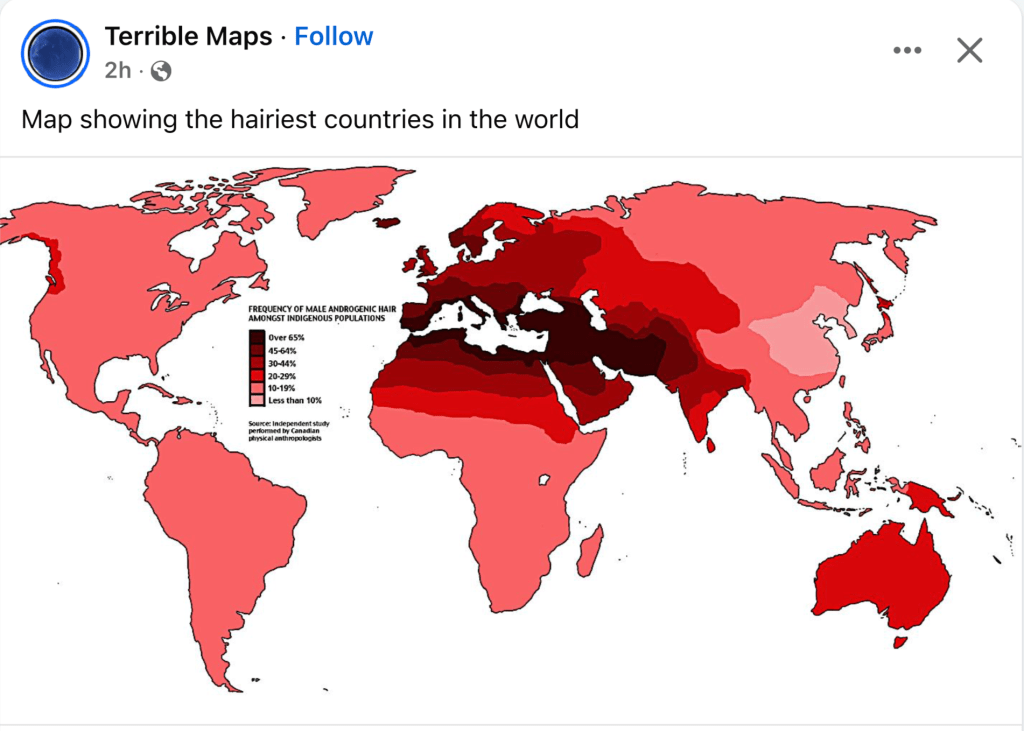
The hotel that features in this story was just such a place. So, on the weekend our family was staying there, we excitedly made our way down to the pool area together. We knew that it would probably still be overwhelmingly men, so my wife was wearing her modest Central Asia swimming outfit, basically an Islamic burkini without the head covering. Unfortunately, this pool was the kind of place where the staff were very insistent on women buying and wearing swim caps to cover their hair. This, even though men with very hairy, carpet-like torsos and backs were paddling around shirtless in the pool without being made to wear anything for their copious amounts of hair (see map below for reference). Alas, all we could do was acknowledge this hairy inconsistency to one another, buy the swim caps, and try to make the best of it.

Credit to ‘Terrible Maps’ on FB for this, um, unique infographic

My wife went off to swim in a part of the pool with fewer men, and my kids and I had fun swimming and horsing around for a while in the pool. But it didn’t take long for the offspring to start asking if we could make our way over to the hot tub. I agreed (it’s almost never too early to hit the hot tub), and we dripped and waddled over toward the inground jacuzzi.

There, sitting in the hot tub, was a hairy giant of a Central Asian man, large stomach protruding out of the water and arms spread out as he reclined like a sultan of old in his royal hamam. He eyed us, expressionless, as the four of us scooted into the hot tub across from him. I couldn’t tell if he was from our people group or from one of the other main ethnicities of the region, and he didn’t engage, so I did my best to politely ignore him and to keep my kids over on our side. I was, after all, no stranger to odd hot tub companions, such as that one seminarian who slid into a hot tub next to my wife and me during a date night, strangely determined to share with us why he was really more of a Thomist rather than a Van Tillian presuppositionalist.

Anyway, our corner of Central Asia has changed drastically in recent decades, such that fancy modern things like hotels and hot tubs paint a deceptive picture over cities that, until recently, were literal war zones. A scruffy middle-aged man, just like the one sitting across from us in the hot tub, might be someone who was once a guerrilla fighter, a military interrogator for a dictator, a prisoner, an exile, or even someone wanted for participating in war crimes. You really never know.

My kids did a good job trying not to make things awkward, but they did shoot the occasional glance at our furry fellow bather, who continued to observe us with his dark eyes and a hard-to-read expression on his face.

Suddenly, he leaned forward, holding up a finger in the universal gesture meaning, “one minute.” He then stood up and lumbered out of the hot tub, the water level of the hot tub decreasing by a truly impressive amount. He walked over toward the showers and quickly returned, hands overflowing with shampoo.

As he eased back into the hot tub (raising the water again by a good six inches), he dumped all of the shampoo he’d collected into a side compartment that fed into the bubbling water. Before long, we were surrounded by small mountains of soap suds as our large friend smiled and chuckled mischievously. My kids also cackled, loving the fact that the hot tub had just been transformed into a giant bubble bath, and following the man’s example of picking up handfuls of the suds and blowing them at each other.

But the best part was when this large, imposing Central Asian man grabbed a bunch of suds, put them on his face to make a big white bubbly beard, and called out to the kiddos,

“Look, Babba Noel!

Babba Noel is, of course, our local name for Santa Claus. My kids were downright belly laughing now, as was ‘Santa.’

I am sure that it was against the rules to put the shampoo into the hot tub like that. But the young pool staff seemed intent on looking the other way. Perhaps they knew better than to confront this burly sasquatch of a man with their little rules. Or, perhaps they knew he really was some kind of general for a former regime, and decided it was best to let him have a little bit of fun with his bubbles.

Whatever the case, for my kids and me, we will always know him as the hairy hot tub Santa Claus, proof that even under the most intimidating of exteriors, there might simply be a man who likes to make kids laugh and play with bubbles.


If you have been helped or encouraged by the content on this blog, would you consider supporting this writing and our family while we serve in Central Asia? We need to raise 28k to be fully funded for our second year back on the field. You can help us with this here through the blog or contact me to find out how to give through our organization. 

Two international churches in our region are in need of pastors, one needs a lead pastor and one an associate pastor. Our kids’ TCK school is also in need of a math and a science teacher for middle school and high school. If you have a good lead, shoot me a note here.

For my list of recommended books and travel gear, click here.

Photo from Unsplash.com

A Proverb On Something Simply Impossible

I’m sayin’ it’s a male, he still says to milk it.

– local oral tradition

This local proverb is used when someone insists that you must do something, but that thing simply can’t be done. The farm/nomad logic here is straightforward. You can’t milk male animals, only females. Perhaps a similar saying in English would be “trying to fit a square peg into a round hole.” It can’t be done.

Our Central Asian locals can be quite persistant when they believe you can and should do something for them, but are perhaps holding out on them. This proverb seems like the kind that comes out after multiple rounds of trying to explain that you really are not able to oblige a given request. It’s a sort of appeal to a third party to side with you in the impossibility of the request.

I haven’t had the pleasure of using this particular local proverb yet, but am hoping that I will have the chance to do so at some point.

“No, elder brother, I’m telling you the truth. There is no way I can possibly acquire an American wife for you. Seriously. It can’t be done!”

“But dear teacher, I’m sure you know someone. Does your wife have any unmarried sisters?”

“Mud of the world upon my head. No. I’m saying it’s a male, he still says to milk it!”


If you have been helped or encouraged by the content on this blog, would you consider supporting this writing and our family while we serve in Central Asia? We need to raise 28k to be fully funded for our second year back on the field. You can help us with this here through the blog or contact me to find out how to give through our organization. 

Two international churches in our region are in need of pastors, one needs a lead pastor and one an associate pastor. Our kids’ TCK school is also in need of a math and a science teacher for middle school and high school. If you have a good lead, shoot me a note here.

For my list of recommended books and travel gear, click here.

Photo from Unsplash.com