We all long for [Eden], and we are constantly glimpsing it: our whole nature at its best and least corrupted, its gentlest and most humane, is still soaked with the sense of ‘exile’. If you come to think of it, your (very just) horror at the stupid murder of the hawk, and your obstinate memory of this ‘home’ of yours in an idyllic hour (when often there is an illusion of the stay of time and decay and a sense of gentle peace) are derived from Eden.
J.R.R. Tolkien, The Letters of J.R.R. Tolkien, 110.
“it is difficult to define hiraeth, but to me it means the consciousness of man being out of his home area and that which is dear to him. That is why it can be felt even among a host of peoples amidst nature’s beauty; like a Christian yearning for heaven.”
Many missionaries in the 10/40 window live in what’s been called creative-access countries. In these countries there are no missionary or religious visas available to cross-cultural workers, so they need to have “platforms,” whether business or non-profit, in order to maintain legitimate access. I’ve written in the past about the importance of doing tent-maker/platform work that 1) results in an excellent product that brings value to the community and gives God glory and 2) leads to gospel opportunities and relationships with locals.
You want your platform to be strong and valuable enough to provide some cover when locals start coming to faith and others potentially start complaining about you. Of course, we can’t guarantee we won’t get kicked out even if we have the ideal platform, but we should still do the best we can so as to protect access to the unreached.
Now that I’m some years into the creative-access gig and working under my fourth platform, one other very important principle is emerging – that of a platform’s scalability. This principle is important not because of dynamics among locals, but because of dynamics among us foreign workers.
Ours is a lifestyle of high and costly transition. We’ve recently been joking that we should give up on annual goals in favor of quarterly ones due to the sheer amount of transition that we experience. It feels like we are always saying goodbye to workers leaving the field, or welcoming new ones, adjusting to others who have left for furlough, or taking in the news that others will be significantly delayed in getting back to the field. This can make maintaining a solid core of platform workers quite difficult.
The goal of our platforms is to serve the church planting strategy, not the other way around. But we have also experienced seasons where the needs of the platform are so demanding, often due to staffing shortages, that it very much feels like we are serving the platform – and the church planting work is taking a back seat. This is a tension we live in, hoping that a season of investing in a solid platform can later result in greater freedom for ministry. Sometimes you just have to hold the beachhead until reinforcements arrive.
However, what would happen if we built the reality of worker transience into our platforms from the very beginning? Rather than being blindsided by the next unexpected departure of our staff, what if we anticipated it and planned accordingly? For several years now I have been chewing on the idea of a platform designed to be scalable. On the one hand, one person working part-time could keep it running if he had to. On the other hand, it could scale up to accommodate a raft of new personnel who arrive in need of visas and a legitimate work identity. What kind of businesses and non-profit models might be this flexible?
My current non-profit platform serves as a potential example of this. For the past year, we’ve been providing training several times a week to a small group of students. The teaching load is manageable because we have several staff who share the load. But it would be a lot for only one teacher. On the other hand, the group is too small to justify bringing on many more staff. However, this group of students recently graduated from the program and since then we’ve started experimenting with modular trainings in partnership with other organizations.
Now that we only have a few modular (1-3 day) trainings per month, we are finding ourselves really enjoying the increased time in our schedules for relationships and ministry. We have also stumbled into a model that is unusually scalable. If we have more colleagues join us, we can always increase the number and kind of modular trainings available. If everyone is gone or on furlough and only one worker is left, he can scale the trainings back to a pace that is realistic. This gives us hope for greater sustainability, even as the modular trainings give us access to a broader scope of the community.
Now, the content we are providing is masters-level stuff and our partners are able to gather decent crowds for our modular trainings, so that makes a pared-down schedule doable yet still very respectable. Not everyone will find themselves in this kind of situation.
Yet the transience factor is not going away. As missionaries, churches, and organizations wrestle with how to keep workers in creative-access contexts for the long haul, the scalability of platforms should be considered. Scalability means sustainability because the worker remaining on the field doesn’t have to be crushed by the platform work created by that recently departed or arrived coworker. The platform can grow or shrink according to the needs of personnel and the ministry.
That kind of flexibility may sound idealistic, but the potential is worthy of some experimentation. If platforms became more scalable, that would help assure that they are truly serving the missionaries, and not the other way around.
To support our family as we head back to the field, click here.
For my list of recommended books and travel gear, click here.
This local proverb warns against trusting the untrustworthy. It reminds me of Proverbs 26:6, “Whoever sends a message by the hand of a fool cuts off his own feet and drinks violence.” Trust is good, but trust without wisdom is dangerous. We need to know the character and the ability of the person we are extending trust to. Historically, to cross a bridge is to take a risk. A bridge usually crosses some kind of dangerous water or gap. Will its construction hold? A bridge is also a chokepoint. Could it lead to an ambush? In local wisdom, to cross the bridge of man known to be dishonorable is to invite harm. Of course, as followers of Jesus we will at times violate this principle for the sake of the gospel (such as in Zacchaeus’ case), sometimes to powerful effect, but we still live in a universe where we are foolish to trust the untrustworthy naively.
This is one of the stronger local proverbs I’ve heard recently, and one which must be used with caution. That word dishonorable is so loaded in this honor/shame culture, that you would never want the one you use it for to hear about it. If they do, you will at least have broken the relationship, if not have also invited threats of violence.
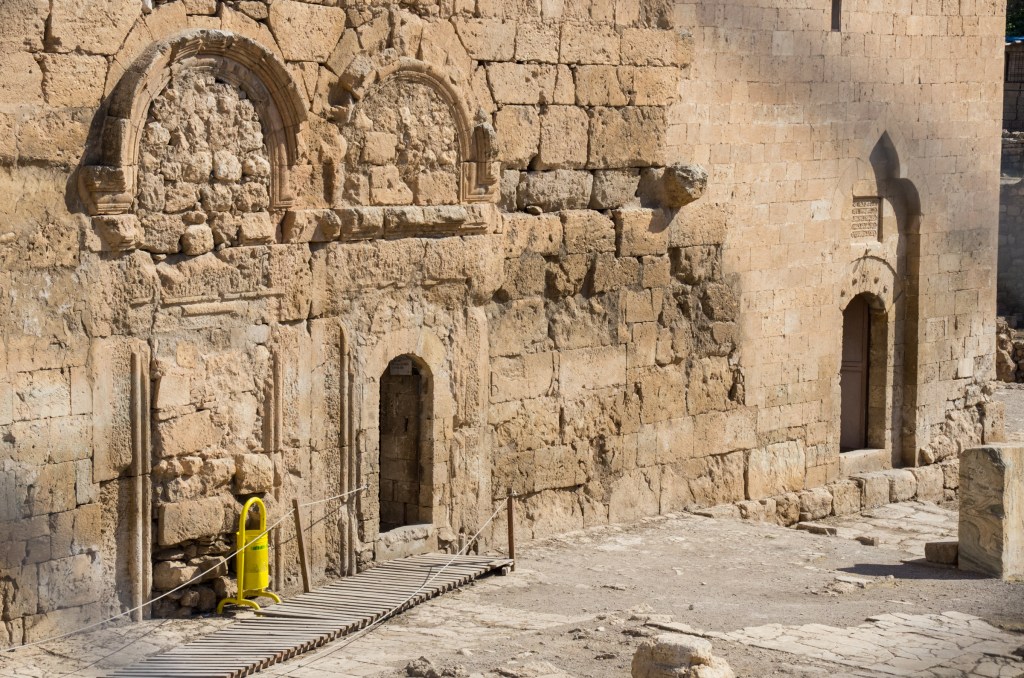
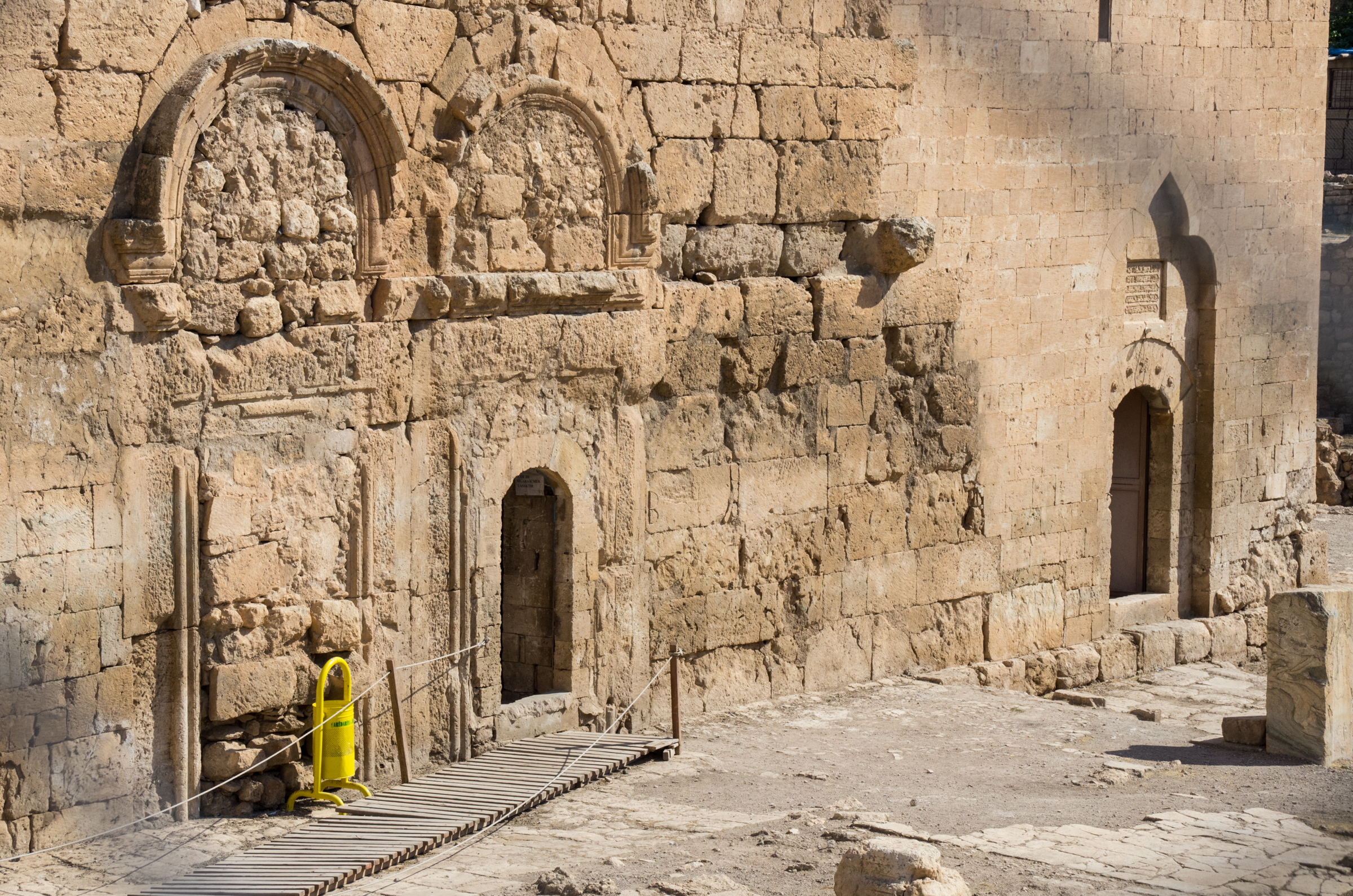
Nisibis’s reputation was founded not only on the monasteries of the Izla mountains, however, but also on the School of Nisibis, which was likewise traced back to Bishop Jacob, who wanted to fight Arianism, which had been condemned at the Council of Nicea in 325. In any case, we know that he employed Ephrem the Syrian as a biblical exegete. When the city was handed over to the Sassanian king Shapur II in 363, Christian instruction ceased, and Ephrem fled to Roman Edessa, where he taught until his death and supported his bishop in the fight against Arianism.
Baumer, The Church of the East, p. 22
Ancient Nisibis is modern Nusaybin, Turkey. And Edessa is now called Sanliurfa. I’ve often heard of the battles over Arianism that took place in major cities like Alexandria, Egypt. Fascinating then to hear what was also happening in these eastern border cities often fought over by the Romans and the Persians.
We leaned over the railing, watching a group of ducks and geese in the park’s man-made lake. It was a warm winter afternoon. Some of the fowl lazily swam around, others took one-legged naps, and one goose attempted to intimidate us by hissing and exposing his strange tongue. My friend and I just laughed at him. *Harry, having grown up in a village, is no city boy, and is quite comfortable with animals and their strange ways.
“You know what we say for liquid soap like this?” he had asked me earlier when we stopped into a mosque to use the facilities (all mosques here offer public restrooms). “We call it cow drool, ha! You know how cows are always drooling, right? See the resemblance when I push the dispenser button?” Apparently the next time I’m in need of someone to hand me some soap from a push wall dispenser, I can simply say, “give me some cow drool, please.”
Harry is the one believer still a part of our church plant that was there at the very beginning, six years ago, when it all started with a Christmas party. For the first few years of the church plant, he was the most promising potential leader. Humble, teachable, and wise, Harry blended a rough tribal village upbringing with an engineer’s education and a surprising array of experiences traveling abroad via couchsurfing. He’s also from the most conservative and violent tribe of our city, but had managed to live out his faith carefully and faithfully.
However, when we were on our first furlough the church suffered its second major implosion at the same time that major persecution ramped up from Harry’s tribe and coworkers. In danger and experiencing severe discouragement, Harry isolated himself, vowing to never gather again with other local believers, only with foreigners (and even that a maybe). His departure was a severe blow to all of us. It took him two and half years to come back around – a return that was one of the miraculous answers to prayer we saw over this past year.
To be honest, both of us are still pursuing healing after the difficulty of the past few years. Another leader in training had betrayed us both during the first implosion. Others we had looked up to and depended on had left. When we had gone on furlough and committed to moving to a different city, we had only done so because we believed we could depend on Harry to persevere in his track of being our first local elder. Trust had been broken, on both sides. But the desire to rebuild is mutual, and we’ve been making some steady strides.
Our long walk together on this particular day through the bazaar and the park was our first chance in a while to deeply invest in each other and reaffirm our friendship.
“Harry,” I said to him, “Can you promise me something?”
Harry looked at me expectantly and nodded.
“The next time you are in trouble, would you tell us right away?”
Harry made a cautious grin. He knew what I was getting at. The fact that we had not done more to help him during his season of intense persecution still stung for him. For our part, we were not told right away what was actually happening, and every time we had asked to help, he had told us to keep our distance so as to not make things worse. We all look back on that season with regrets, though no one is sure what else could have been done.
Harry’s instincts are still to go quiet and isolate when things are hard, and to reemerge when he’s got them under control again. It had happened again with a recent car accident. So my question was to try and help him see the need for him to depend more on the body of Christ when he has problems – a nonnegotiable posture for a healthy church member, let alone a potential leader.
Harry shared some of the reasons he’s afraid to depend on other believers, reasons which are very understandable given his story. He also expressed to me the need for us to have a plan in place before the persecution ramps up. I agreed. This ideal is one we keep bringing up, but given its complexity it has proven remarkably difficult to put any legs to it. I suggested a monthly meeting where we get together to work on it. Harry seemed encouraged by this idea.
“Do you remember what you told me years ago about what your father said about the wolves?” I said, referencing a story Harry had once relayed to me about his upbringing. “He told you that if you were out with the sheep and a wolf came, you were not to run for help. Why?”
“Because by the time I got back with help all the sheep would be dead.”
“Yes, so he told you that you had to stay and fight the wolf alone.”
Harry nodded.
“Well,” I continued, “I want you to know that’s not your situation anymore. Now, it’s like you have a mobile phone on you. When the wolf comes, you can call right away, and we will come and help you fight him. You don’t have to face your difficulties alone anymore.”
Harry looked out at the lake and thought about what I said. I prayed that he would actually believe me.
“You know,” he said, “I have friends who sometimes buy ducks and geese in the market and bring them here. They save them from slaughter and give them freedom.”
“And no one comes and steals them from this park?”
“No, they are safe here,” Harry said.
We turned away from the lake and walked on in the warm winter afternoon sun. I thought of all the difficulties Harry has faced – and will face – as a persecuted believer. His future looks bleak from a human perspective. Who will he marry? Will his tribe let him continue to be publicly known as an infidel? Will he be able to keep his government job? I know he longs to follow Jesus, but he also longs for safety, for marriage, for stability and a life without a crisis always threatened just around the corner.
Yet when Harry has been offered the chance to live in Europe, he has refused to do so. In spite of opportunities to marry Muslim girls, he is still single. In spite of failing and others failing him, he is still persevering in his faith, sharing the gospel, and following Jesus. The new heart in him and the presence of the Spirit keep him coming back, risking again for the sake of Jesus and in the hope of healthy churches someday taking root here.
I am sure that the wolf will come again for Harry. Yet Christ will stand with him, just as he did last time. We know that without a doubt. Our vision is that, somehow, the body of Christ will stand with him also. And that Harry would let us. Pray to this end.
Today I preached to our local church plant from John 12:44-50, a passage often titled “Jesus Has Come to Save the World.” Preaching today meant that yesterday I sat down with a local believer, *Harry, to go over the sermon manuscript, checking for language mistakes and smoothing out the grammar. For the dozens and dozens of times that I have now preached in the local language, God has never failed to provide me a local brother to help with this important prep work – and every time that local brother manages to save me from at least a couple proverbial foot-in-mouth situations. Last night was no exception.
“Jesus teaches us here that it is his words that will judge us on the last day,” I read out loud.
“When?” my friend asked, raising an eyebrow.
“The last day,” I repeated.
“A.W.,” Harry continued, “in our language ‘the last day’ means Friday, not the final day of judgement. To communicate your meaning you have to say ‘at the final age.'”
“Ohhh, thank you. I’m definitely not trying to say that Jesus’ words will judge us on Friday!”
“And when you say ‘the final age’ don’t forget that short vowel in the first syllable of ‘age.’ If you forget it you will be saying ‘at the final tongue!'”
We laughed, sipped our hot drinks, and continued. A little later my friend put up his hand again for me to pause.
“Stop,” he said, “Read ‘Jesus Messiah’ out loud for me again.”
“Jesus Messiah,” I repeated.
Harry shook his head. You are saying it too fast and skipping over the final throaty H in Messiah. When you said it just now, it sounded like you were instead saying ‘Jesus of the squeegee.'”
I chuckled. This was not the first time I had made this kind of mistake. Preaching through Ephesians years ago I had publicly proclaimed, “The Squeegee is our peace!” instead of my intended meaning, which was “The Messiah is our peace.” That tricky throaty H is one of the old nemeses of us English speakers attempting to learn this particular Central Asian tongue.
Idioms especially can be like hidden bombs, ambushing the innocent speaker who is merely attempting to speak in literal and clear ways. Just a couple weeks ago I was doing sermon checking with *Darius when I learned that I can’t say “the person and work of Christ” in that simple form.
“‘Person and work of’ together like that,” he told me, “is always an idiom for someone’s closest circle of relatives. You don’t mean to say that we are saved by the relatives of Jesus Christ, am I right?” He laughed. “That sounds kind of Catholic!”
Then there’s those tricky words that are spelled the same and sound the same, but differ in meaning based on the context and construction of the sentence. This kind of similarity between the local words for canary and shore led to one of my more famous blunders, when teaching through the parables of the Kingdom in Matthew.
“And then Jesus sat down in the boat, next to the canary, and began to teach about the kingdom of God.”
The local believers leaned into their Bibles trying to figure out where the song bird I was referencing had suddenly come into the text.
Last night Harry and I finished our editing work together around 9 p.m. I thanked him sincerely for his help, knowing that his investment of a couple hours with me would mean greater clarity for the rest of the church on the following day, Friday, when our church plant is able to meet.
As we parted ways I shook his hand and said to him, “See you on the last day, brother!”
“What?” he said back.
“Tomorrow is Friday. You know, thelast day.”
Harry laughed and shook his head. “Right! See you on the last day indeed.”
I recently came across this article discussing the historical development of our alphabet. I think it’s fascinating how little some of our letters have changed since 3,750 years ago, when the first known alphabet (Proto-Sinaitic) was written.
Take our letter A. This started as a picture of an ox head, an ox being called an ‘alp, and this symbol came to represent the sound Ah. This ancient Semitic word for ox came down to us through the Greek alpha and has found its way into our word, alphabet. If you turn our contemporary letter A upside down, you can still see how it is descended from a pictogram of a horned ox head.
Our letter B comes from an ancient Semitic word for house, bayt, which is basically still the same word in Hebrew and Arabic (As in Beth-lehem, house of bread/meat). The original symbol looks like the outline from a bird’s eye view of a house with an open door.
So while our compound word Alphabet now means the collection of letters used to write our language, it also historically translates as ox house – or could it be house ox?
And who knew that our capital E comes from a stick figure who has been tipped over and lost his head and legs? From now on when writing by hand, I may from time to time subtly restore some of his dignity by giving him back his head.
Some letters speak to the continuity of human experience through the millennia, such as dag, which is a symbol for a fish, and the ancestor of our letter D. Other letters, such as gaml (our letter C), remind us that the past really is a foreign land. It means throwstick, which apparently was an ancient hunting device.
Check out the chart at the top of this post to see if you can trace more modern letters and their ancient ancestors. The connections are fun to see and can even make learning some foreign alphabets somewhat easier, once you realize you are merely learning a cousin of the same letter you already know.
As this article states, “Like many things in the long arc of human culture, alphabets are not as far removed from each other as you might think.” In a world of over six thousand languages, it is remarkable that this language tool has been so adaptable to so many of them.
“But you have not answered my question,” the workman said as he ate the lunch we had provided of takeout kabab (It’s expected in this culture to provide lunch when workmen are at your house all day). “What do you think of Islam? Is it good or bad?”
I had just concluded sharing how Islam teaches salvation by works – salvation through the scale of good deeds – while the Bible teaches salvation by faith in the sacrifice of Jesus alone. But my friend wasn’t going to let me get away with indirectly pointing out how my faith directly contradicts Islam. The workman and his colleague looked at me expectantly.
“Islam teaches that a man can save himself by his good works,” I said, “so it is bad. Because it is impossible for a man to save himself in this way. It sets men up for despair, or worse.”
It’s rare that I drop that bomb so early in a conversation. Usually if I attack Islam directly early on, then the honor/shame defense mechanisms kick in and the conversation stops being productive. I’ve learned that most of our locals will let me critique Islam in a hundred indirect ways and keep talking with me, all the while increasingly understanding my position that what they believe about ultimate reality is wrong. However, the response from the head workman to my blunt reply was more positive than I had been expecting.
“Good job!” he said. “I think Islam is bad too. For me, humanity is everything. And I can’t stand how we mix Islam with politics all over this region.”
I hadn’t seen this coming. These workmen were from a town four hours to our south, members of one of our unengaged people groups. An unreached unengaged people group (UUPG) is a people group that has no known Christians working to reach it with the gospel. The particular group these men belonged to may be around one million strong, with its own distinct language and identity – and zero known believers or churches. They live in a politically tense area that is hard to access and are so obscure as to barely show up on the unreached people group mapping sites.
Given this background, my assumption was that these men would be rather devout. I had assumed wrong. Sitting in front of me were men whose people group have never had a Christian missionary, but who had already been “converted” away from their native religion and into the lure of an easy humanism. They were Muslims in name only, but in reality would share much in common with progressive Westerners. The difficulty in these kinds of conversations is helping these locals see that the gospel is not just an equivalent religious system to Islam (and therefore to be dismissed as outdated), but to show them that many of the values they so admire in Western humanism – such as human rights and freedom of religion – come from biblical principles – and that these values alone are not enough.
I was encouraged over the course of two lunches to get to share the gospel, the goodness of religious liberty, and a biblical sexual ethic. We agreed to meet up for dinner soon where we’d have lots of time to talk at length about these things.
These lunch break conversations were an encouraging providence in a tough week of frozen pipes, gas shortages, sickness, and below freezing temperatures. Some weeks we spend so much time just staying functional that it can feel like we have nothing left over for the actual work of the ministry. It is especially encouraging then, when the life maintenance brings the ministry conversations to us.
This time we got to share the gospel with UUPG men who have never heard it before. That’s worth some frozen pipes.
This is our local equivalent of “You can’t have your cake and eat it too.” In this local proverb, you can’t want God (a spiritual life) while also wanting to eat dates (a pleasurable life). You can’t have it both ways, local wisdom says.
It seems that locals use this proverb for someone struggling with doublemindedness. I learned it from a local friend whose mom had just used it on him as he lamented about not knowing which of multiple good options he should pursue for his future. He was stuck, knowing that to choose one good was to deny another. “I shall be telling this with a sigh, somewhere ages and ages hence!” wrote Robert Frost, recalling a friend who regularly lamented the roads not taken.
Central Asian mamas don’t have any time for that kind of stuff, busy as they are serving their family (including adult sons) hand and foot. “Listen, son, you want God and you want dates? Pick one and quit your drama …and here’s some more chai, sweety.”
So, though he [an unnamed scribe] disapproved of its contents, he copied out the Tain. It is thanks to such scribes, however cranky their glosses may sometimes be, that we have the rich trove of early Irish literature, the earliest vernacular literature of Europe to survive – because it was taken seriously enough to be written down. Though these early Irish literates were intensely interested in the worlds opened up to them by the three sacred languages of Greek, Latin and – in a rudimentary form – Hebrew, they loved their own tongue too much ever to stop using it. Whereas elsewhere in Europe, no educated man would be caught dead speaking a vernacular, the Irish thought that all language was a game – and too much fun to be deprived of any part of it. They were still too childlike and playful to find and value in snobbery.










 Entrusted to the Dirt
#/media/File:Tomb_of_Nebamun.jpg)