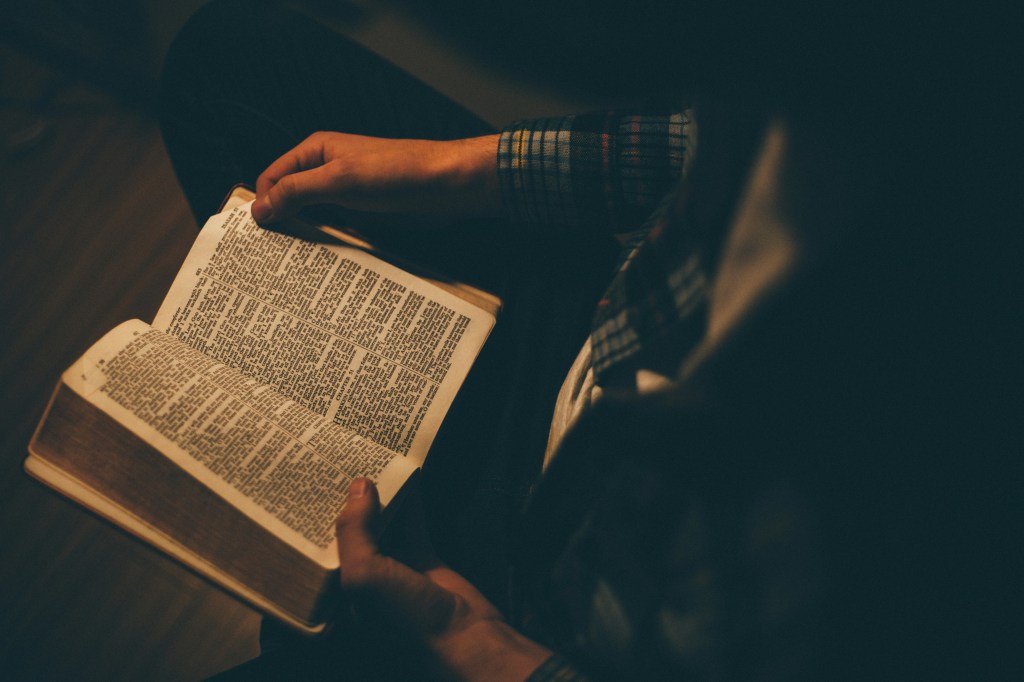
Since 2011, our people group have had the complete Bible in their language – both Old and New Testaments. This is an amazing thing. The translation and publication of the Bible into any language is usually a long tale with many different players. Someday, I’d like to put that more detailed story together. For now, this is the summarized version that I’ve managed to piece together through various conversations over the years. So, consider this a rough draft of the tale, not yet history in the carefully-researched sense.
The story begins with Kamal*, a prolific writer and educator among our people group during the turbulent 1970s. Kamal was a short man who always wore a distinctive floppy scarf-hat and had a passion for his people group’s suppressed language. In spite of this politically dangerous interest, Kamal’s reputation as a scholar and writer was so strong that he was put in charge of the education department of his province. However, it didn’t take much to fall foul of the ever-changing governments of the country during that era. Kamal seems to have written something or to have held a position that put him in hot water with whichever military dictator was in charge at that point. He was imprisoned in the south of the country, far away from the mountainous homeland of his people.
Many years later, when I attended his memorial service, I learned that it was while he was imprisoned and not yet a believer that he first committed to translating the Bible for his people. Apparently, Kamal had a dream where Jesus straight up told him to translate the Bible into his language. Kamal, wisely, agreed that he would. But he was in prison. How was he to accomplish this enormous project? God provided the means through a new cellmate, a Syriac priest – who had an old Syriac Bible with him. Kamal and the priest could communicate in the trade language of the country, so it seems that the priest would translate from Syriac into the trade language and then Kamal would craft each verse into his native tongue.
By the time he was let out of prison, Kamal seems to have come to faith and to have written a manuscript of the gospel of Luke, made up of loose papers. He moved back to his home city and neighborhood, just a few alleyways down from where my family recently lived in our old stone stone. There, he continued to write and teach, unsure of what to do with the Gospel of Luke manuscript that he kept in secret. Given the political and religious climate of the time, it was much too dangerous to attempt to work on it or publish it openly.
Just a few weeks ago at Cross Con ’24, I learned that this is where a Lebanese ministry leader enters the story. This now elderly leader told me that he had come to visit Kamal’s country, having independently developed a desire to see the Bible translated into Kamal’s language. This was a time of political intrigue, assassinations, and guerrilla warfare, so this ministry leader had to be very cautious as he asked around to see if there were any believers who would help him begin the translation. Somehow, he was directed to Teacher Kamal’s house, where a relieved Kamal handed him his precious stack of papers and told him to take them back to Lebanon to keep the translation moving along. At least at that point, the project was too dangerous to conduct inside the country.
Over the next couple decades, an international coalition of believers worked on the New Testament translation together. From what I understand, these were believers in Lebanon, Germany, France, and eventually back in Kamal’s country also. At this point much of the translation was being done from German, though later work was to be done directly from Greek and Hebrew. By the time the 90’s came, a British Bible translator, Alex* was living in a different city of Kamal’s region, and took on leadership of the project. Alex put together a translation team, including Kamal, and in the late 1990’s the New Testament was published. Although there were many revisions to come, the involvement of writers and poets like Kamal from the beginning gave the text a rich literary beauty in the local tongue.
By the time I was on the ground in 2007 as a green 19-year-old, this New Testament had been updated and had been eagerly adopted by the the community of local believers. The next year, Hama*, one of my close friends and a new believer, also managed to get his hands on one of the few early drafts of the complete Old Testament. I remember opening the massive three-ring binder with him and gazing together for the first time on Genesis and Psalms in his mother tongue. Hama treasured and studied this early text for years to come.
In 2011, the complete Bible was published for the first time. Decades of work by Alex, Kamal, the ministry leader from Lebanon, and others had led to the complete word of God now being available in our people’s heart language. Some communities of believers loved this 2011 text so much that they flat-out refused to use later revised editions, and started circulating illegally printed 2011 Bibles for their house churches – thus proving that KJV-only-style controversies are unfortunately not unique to the west.
The political and religious climate, while never calm, had grown much calmer since the 70’s. This has meant long stretches when this complete Bible can be spotted for sale in the bazaar’s book shops. To this day, someone on our teams might snap a picture when we see one prominently on display and send it to each other, “Look what I spotted in the bazaar today.” The government has even allowed a local church to set up at a huge annual book fair to sell these Bibles and other Christian books.
In spite of this measure of freedom, we still have many locals who don’t know that the Bible exists in their language. I’ve always loved asking if a given local knew that God’s word was available in their language. When they said no (as they often did) I would pull a print Bible out of my bag or open up a Bible app on my phone and show them a text like John 1:1, one of my favorite texts for explaining the divinity of Jesus. “You believe the eternal word of God became a physical book, right? Well, this verse says that the eternal word of God became a man.”
As I referred to earlier, I got to attend the memorial service for Kamal a few years ago, led by Alex and others. This was a public event, where hundreds of locals came out to honor the great writer. Few, however, knew of his role as the first Bible translator of their people. To my great delight, this part of Kamal’s story was told publicly, and a plea made for the attendees to read this book to which Kamal had devoted so many years of his life.
Kamal was obedient to the work that God gave him to do. So was the leader from Lebanon, and Alex, and many others. This has meant that as a church planter I have had the most important of all tools available to me – a Bible in the local tongue. It has meant that when I find a verse that seems a bit off in the word choice or grammar I have the privilege of simply emailing Alex for it to be considered for a future update. Sadly, most of the feedback these men get these days is suggestions and complaints from foreigners and locals for places where the the text needs to be revised!
Yet when we come to our senses we all realize what a great debt we owe these men. They have done something that is foundational for everything workers like myself try to accomplish. Cliche as it might seem, we really do stand on their shoulders. Many are aging fast and looking to hand off their work. Some of them are no longer with us, like Kamal. But I thank God for each of them, and someday I hope to write more of their stories.
Because of Kamal, the prisoner-scholar, his people now have a Bible. And that changes everything.
To support our family as we head back to the field, click here.
For my list of recommended books and travel gear, click here.
*names changed for security
Photos are from Unsplash.com

 Entrusted to the Dirt
Dear A.W.:
And to think that every language that has a Bible has a story that is similar to this one. Amazing. God is awesome in that He repeatedly use one man/one women (of His choice) to impact an entire nation for generations to come.
Thanks for writing your blog again. God uses you to encourage me, brother.
IHS,
Jim
LikeLiked by 1 person
I can’t wait to hear each one of those stories in eternity, and hopefully a few more of them before then. Great to hear from you, Jim. We miss you guys.
LikeLike