He Thinks the World is Round!

When I was a tenth grader my family visited some dear friends working among a very remote tribe. This tribe lived on the tops and sides of several remote jungle ridges which sloped down to the roaring convergence of two major rivers. It is one of the more beautiful and remote places I’ve ever seen. As it would have taken three days to walk to this tribe from the nearest road, we were flown in on a missionary Cessna to the airstrip that the villagers had recently built.

Because of lack of space, this airstrip was built on a short slope, complete with a steeper slope and drop-off at the end. When landing, the upward slope would help the plane slow down. When taking off downhill, the pilot had to make sure he had enough speed once he reached the end of the dirt and grass airstrip. If not, his plane would be smashed into the canopy of trees far below. This had already happened to one plane belonging to someone trying to fly out sacks of coffee beans. Surprisingly, this wasn’t the greatest danger to the pilots. Their worst nemesis turned out to be the village pigs that would tear up the airstrip in their search for edible roots and sometimes run out in front of a plane, causing a collision that could be fatal for all parties involved. It may have been at this same airstrip that this type of collision took place in following years. The plane and the pig were totaled, but the pilot was miraculously spared.

The older Korean missionary couple that we were visiting (Papa S and Mama M) had become like grandparents to us. So this visit to their tribal location was a very sweet time. I learned a lot from their wisdom about how to live a lifestyle that was closer to that of the villagers and how to think more communally about our belongings (like tools) for the sake of the gospel. As they worked to translate the Bible with their local teammates from a neighboring tribe, they truly modeled relationships of equality and dignity, even given the vast education, cultural, and material differences.

My older brother and I spent the days sitting outside in the sunny ridge-top yard of their modest tribal house, reading (my first of several attempts at reading Desiring God took place here), having fun with the hornbill bird that had adopted our friends, and telling stories with the small crowd of villagers that were almost always present. While we didn’t know the tribal language, enough of the tribesmen knew the trade language for us to be able to communicate easily. However, most of the elderly and the children did not know the trade language, so our conversations took place with a constant background hum of the tribal tongue as they interpreted and remarked and made jokes. I’ve often characterized my Melanesian tribal friends as quick to laugh, quick to joke, and quick to fight – a fascinating combination of playful and dangerous, honor-bound yet always wearing their hearts on their sleeves. As is also true of so many of my Central Asian friends, they make the most wonderful of friends and the most daunting of enemies.

Friendly hornbills make for pleasant, if goofy, companions.

One afternoon my mom had decided to bake some chocolate chip cookies in a wood-fired stove Papa S had made from a metal barrel, the kind of barrel that gasoline for the generator came in. Her hippy-missionary skills would prove to be remarkably successful, but as we waited we got into a fun conversation with a group of villagers about distances from their village to other places, such as where we lived, and how far it was to other countries. We were struggling to explain to them just how far away America was when I remembered that there was an inflatable globe inside the house. I went and retrieved it.

I sat down on a split-log bench. With my impromptu geography class huddled around me, I began to show them their country, the countries next door, and all the way on the other side of the globe, the country my parents were from. Confusion followed. This may have been the first time they had ever seen distances displayed on any kind of a map, let along one shaped like a ball. We talked about what their village would look like to a bird or a plane (the same word in the trade language), what their province would look like if they went higher up, and then what the round planet earth would look like if someone were able to go even higher. It began to sink in. Or so I thought.

Then, someone shouted something in the tribal language and the distinctive communal laugh burst forth. I’ve never seen this anywhere else in the world, but in that Melanesian country, when crowds laugh, they laugh in unison with a climax of a joyful and high-pitched whoop, something like dozens of voices all together exclaiming, “Hahahahaaha…Ha wheeeeee!” This would happen when someone did something funny or embarrassing in front of church, or when a rugby player got taken down in a particularly epic tackle. But this time apparently I was the joke!

I was finally able to get a translation of what was going on. “He thinks the world is round! The skinny white boy thinks the world is round! This is too much!” My short-lived geography class was falling apart as villagers, still laughing, began to make their way back to their huts to tell the story.

“But,” I protested to the few who remained, “It’s true! The world is round like a ball!” To no avail.

“Son,” One man said to me, “Look around you. Are we not on top of a mountain? Look at the horizon. Is it not flat? The world is definitely flat. We simply cannot believe what you are saying when we see this with our own eyes.”

My geography lesson had been an educational failure, however much comedic relief it may have brought to the village that week. I left scratching my head at the whole thing. Munching on a cookie and trying to place myself in their shoes, I began to realize just how outlandish my claims must have seemed to them. If the oral tradition of your ancestors, the only human source of wisdom and education you’ve ever had, claimed the world was flat, it was going to take a lot more than a random sixteen-year-old foreigner with a ball to convince you otherwise. Such is the power of a community’s self-evident truth.

I’ve often thought of that tribe in the years since as I’ve spoken with those in the West or in Central Asia, challenging the accepted truths of their culture with the universe as the Bible presents it. Incredulity sounds remarkably similar, regardless of language or culture. “What? You actually think homosexuality is a sin?” “What? You don’t believe that Islam is the fulfillment of Christianity? Everyone knows that.”

Group-think is universal. We are each limited in our perspective by our own unique cultural-historical time-slice, just like my village friends who thought I was crazy for suggesting the earth is round like a ball. Hence why we need a God who is outside of creation and yet who speaks his truth into it (props here to F. Schaeffer) – an eternally unchanging source of stable truth that takes things we feel (or learn) are absurd and helps us see that they are in fact true, wise, and beautiful. This is why missions is necessary. Yes, so that we can learn things that are true about geography – all truth is God’s truth, as they say. But even more important, so that we will be able to actually respond to the remnant whispers of conscience and stop trying in futility to save ourselves through appeasing and manipulating the spirits (as in Melanesia), through hoping our good deeds outweigh our bad (as in Islam), and through trying to be true to our authentic selves (as in the West).

The world, the earth, is round. And man cannot save himself through animism, religion, or whatever pop morality is dominating Twitter today. Rather, he must be saved by the Son of God, who became a man, lived a perfect life, died a sacrificial death on the cross, rose from the dead, and ascended to be at God the Father’s right hand. The God who is outside of creation and yet speaks into it has told us that this is the only way to be reconciled to him. Perhaps the way in which we’ve heard that message conflicts with the prevailing wisdom of our tribe – but so be it. The path toward truth often begins with a terrifying realization that our tribe has been woefully wrong about many, many things.

Photos by ActionVance and Axel Blanchard on Unsplash

Please Don’t Call It An Interview

For seven years we did outreach to Muslim refugees in our city in the US. At one stage, two of my Iranian friends were interested in pursuing membership at our church. One of them, *Saul, had come to faith in Iran and had even spent time in prison for being a house church leader-in-training. The other, *Reza, was a new believer, having come to faith after a couple years in the US. The process of pursuing church membership with them – in our diverse but still majority-American Baptist church – was a rocky one. Interview after interview was canceled by these Iranian brothers. Yes, there were theological questions that we needed to work through, and those discussions sometimes got pretty intense (I’m not angry, I’m just Iranian!), but there were also some hidden cultural roadblocks that also emerged. Turns out it was not just our doctrine that was causing concern, but some of our systems and forms.

“Hey brother, can you help me understand why Saul keeps canceling his membership interview?” I asked.

“Well, you know how we grew up in a police state, right?” My friend Reza responded.

“Yes…”

“This upbringing has affected us in some deep ways,” Reza continued.

“How so?”

“Well, we are (especially Saul) having a hard time with the idea of a membership interview. We don’t like interviews. They make us really anxious.”

I furrowed my brow, “Why exactly do interviews make you anxious?”

Reza looked at me like I should have known the answer to that question. “An interview is what the secret police does to you. They call you in to an interview. Then you get tortured. Then you go to jail. We have baggage with that term and with that kind of meeting. It happened to my dad a number of times. It happened to Saul. Does that make sense?”

I nodded, processing this new info. “So if we call it something else…”

Reza jumped in, “Call it anything else! Just for Iranians, don’t call it an interview (said with a shiver). Set it up in a different kind of way also… Do you think that would be possible?”

“I don’t know,” I said, “I’ll have to ask the elders, but I think we could find something else that could work. Would you guys be comfortable if we asked the same kinds of questions, but in the context of a meal in a home?”

“Yes!” said Reza, “That would be perfect. And there’s one other thing… Saul and I won’t sign our names on the membership covenant.”

“Really? Why?”

Again the look that implied I should be smart enough to figure this one out. “The secret police always make you sign a confession statement, even if you didn’t do what they accuse you of. We Iranians tend to be allergic to signing things. We’ve learned our signature can often be used against us.”

“But, brother, we’re not in Iran anymore. The government here doesn’t care if your signature is on a membership list. And what else could be done to seal your commitment other than signing? I’m not sure there’s an alternative. Membership requires that you promise to be committed in a serious way to this spiritual family.”

“We’ll more readily raise our right hand and swear orally. That feels safer to us. We really don’t like signing things. I know it might not make sense to you…”

“Well, OK, I can ask the elders about these tweaks to the process and let you know. Honestly, I never thought about these things being an issue or a roadblock in you guys becoming members.”

“I appreciate it, brother Workman.”

I took these unique questions about the membership process to the elders of the church. After discussing it, they indeed decided that these forms (a meal and orally swearing) could serve as acceptable substitutes for the normal interview and covenant signing. I was really encouraged by this outcome. While I wouldn’t have had these categories clear at that time, what the elders had done was to hold onto their biblical principles of church membership, while giving some wiggle room in the cultural expressions of that process. It might seem like a small thing, but a vibrant, growing church has to lean heavily on agreed upon and steady processes. Changing them can be costly, and can’t always fit with the practical needs of a busy church body. And yet sometimes tweaking things like church processes so that they’re less culturally difficult can make a big difference in practically loving believers from other cultures. It may not seem glamorous, but it can feel an awful lot like honor and kindness if you are on the receiving end.

Reza met us half-way. He surprised me by signing the covenant after we in turn had set up a membership meal. Saul never made it through the process. He wasn’t able to overcome his skepticism toward healthy church accountability nor the pride that he carried at having gone to prison for Jesus. Persecution, in his case, ended up planting poisonous self-righteousness in his heart. These things and the distractions of life in America gradually pulled him out of fellowship with us. But Reza shared his testimony publicly and joyfully went under the water, events which would lead to the salvation of one the pastors’ sons. “Reza tried all these religions like Islam, Communism, and Hinduism and found them all empty, eventually finding the truth in Jesus. So what am I waiting for?”

Reza’s baptism would also lead to his father cutting off his rent money. So once again, the church made a timely exception and allowed him to move into the intern house. He went on to lead others to faith, include a man who is now a deacon at that same church.

For churches who are reaching out cross-culturally to immigrants, refugees, or international students, don’t be surprised if your expressions of biblical principles cause some roadblocks, not to mention the offense caused by the gospel itself. But make sure you keep in mind the crucial difference between principles and expressions. We can’t change our principles – but expressions? There’s often more room for adjusting these than we might expect, accustomed as we are to the way things are done around here. Even when changing certain expressions is costly, it may be one very important way in which you can serve those coming to faith from other cultures.

And with the current crises facing the Western Church, any movement toward more skillfully serving and welcoming in those from other cultures is movement in the right direction.

*names changed for security

Photo by Daniel McCullough on Unsplash

An Unexpected Calling

I never wanted to work among Muslims. Having grown up in Melanesia, I had always assumed that if God called me to be a missionary, I would work with tribal animists. That would seem to make the most sense. Then, when I was an eighth grader on furlough in the US, the attacks of September 11th, 2001 took place. Living in the Northeast at the time, my school was directly affected by the attacks as a few students’ parents commuted to Manhattan for work every day. This and the ensuing War on Terror were my only real exposure to Islam. I knew that there were many Melanesian tribes asking for missionaries to come and live among them. And I knew that most Muslim countries were busy kicking missionaries out. Deep down, I think I didn’t want to work with Muslims because of these negative impressions. Why would anyone want to work with those who don’t want them to come? I wondered.

I have now been doing Muslim ministry for about thirteen years. So what changed? In brief, Muslims became real people to me, I became passionate about the overwhelming need, and God told me to go.

My first Muslim friend was a Somali refugee in Minneapolis named Uncle Abdi. I had volunteered for an English tutoring program where students would come a few times a week and help Somali refugees with basic English. It was in this context, sipping clove-heavy Somali chai and celebrating with students the fact that the English word finger is actually pronounced fingar in Somali (An easy one! Fingarrr!), that I came to really care about these dear people. They were very devout in their Islam, probably the most devout group of Muslims I’ve ever encountered. They were fiercely defensive of Islam and critical of Christianity. They had seen some terrible things happen in their homeland. They had interesting habits like dyeing their hair red with henna to show they had gone on hajj, or pilgrimage. They struggled, as I did, to adjust to the realities of the Minneapolis winter. We were a long way from the Somali desert and the warm Melanesian valleys. So we shivered together and became friends. And for the first time, Muslims were not some intimidating category. They were real people.

Around this time I began to also learn about the dire need for Christians to share the gospel with Muslims and to plant churches among them. I remember hearing that in 2006 there was only one missionary for every one million Muslims in the world, that the majority of those living in poverty worldwide were Muslims, and that the Muslim world had historically been one of the hardest and most neglected places for church planting. I heard of one Bedouin group who had only received two missionaries. One had died and the other had converted to Islam. I wrestled with a Somali camel herder’s quote, “If you can put your church on the back of my camel, then I will believe Christianity is for us.” I scrolled through the Joshua Project’s list of least-reached people groups. The vast majority? Muslim. What was to be done so that Jesus would get the glory he is due among the world’s 1.2 billion Muslims? I sat under John Piper’s preaching, coming alive to the glory of God and the joy of the nations. A passion in my soul was growing.

Finally, while listening to a presentation about about the state of the church in a certain Middle Eastern country, I felt an unmistakable “Go” from the Holy Spirit. Not sure what that meant since I was only part-way through my freshman year, I reached out to the speaker’s organization and was surprisingly accepted for a gap year in the Middle East.

The ways that God calls his people to serve as cross-cultural missionaries are as diverse and varied as the missionaries themselves are. For some, it’s simple biblical logic that compels them. “Jesus commanded us to go, did he not?” For others, a particular moment of spiritual clarity, hearing the leading of the Spirit. For others, they join in their spouse’s calling, as my dad did. In church history, many were called through dreams. I find it strange that many of us tend to assume most others were initially called to missions in the same way we were.

For me, God called me to work with Muslims through Muslim friends like uncle Abdi the Somali, through a growing passion for the great need, and through a moment of unusual spiritual force and clarity. Go to the Muslims. That call continues to be confirmed every time I’m sitting down with a Muslim friend, drinking chai, and sharing about Jesus. There is a particular joy, freedom, and empowering that I experience in that kind of setting that has come to be my personal definition of calling. Eric Liddell said, “When I run, I feel his pleasure.” Well, I keenly feel his pleasure walking through passages of the Word with Muslims for the very first time, watching as the Spirit gives them spiritual eyes to see the beauty of Christ and how it is so much better than works-based religion. What is the kind of ministry or service in which you feel the greatest freedom, joy, and empowering of the Spirit? It may be that that’s where you’re supposed to focus in serving the Church.

It’s good for me to recall these things in this season of plodding ministry. The call to prayer is blaring outside my windows. My heart is tired from friends leaving and the good but heavy costs of team leadership. We have not seen all that we had hoped to in these thirteen years. And yet it’s good to be reminded again of how this all came about. An unexpected calling, yes. But a good one, the one the Lord knew that I needed. I would never have thought that the coffee gardens and mountains of Melanesia (plus the arctic winter of Minneapolis) would have prepared me to be working in Central Asia. But here I am. And here I hope to be for a good many decades.

Photo by K15 Photos on Unsplash

How To Get the Little Man in the Radio to Go to Sleep

Our region of Central Asia was, until recently, quite isolated. Middle-aged men can still remember clearly the first time they ever saw a banana, for example. One of our close believing friends grew up in a rural village outside of our previous city. He told us a story once of the first ever radio to come to the village, probably in his grandfather’s time.

A man from the village who worked in the city returned one day, bearing an amazing gift. He had bought a radio in the big city and now proudly presented it to the village.

“Now you can listen to news from all over the world!” he proudly announced as the village elderly and children crowded around the radio, listening in amazement.

The villagers listened to the radio all day, exclaiming to one another how amazing it was that there was a small man inside that little box who was able to so enthusiastically read out the world news to them. “What will those city people think of next?” The man who had brought the radio had to return to the city, so he left the radio in the care of a village elder, the power still turned on and the box chattering away.

When night came, the village elder was faced with a dilemma. He did not know how to get the little man in the radio box to be quiet and go to sleep. He tried to tell the man it was time to sleep. No luck. He tried shouting into the box. Still no response. He tried putting the radio under a blanket. Nothing. Eventually the elder rounded up others from the village and presented them with his dilemma. What was to be done? The little man in the radio box showed no sign of getting sleepy or of stopping talking any time soon. None of them would be able to get any sleep if they could not convince the little man to shut up.

Finally, one villager had an idea. “I know what we should try!” And he promptly took the small radio to a barrel full of water and immersed it. Sure enough, when he pulled the radio out of the water, the man inside had stopped talking.

The villagers congratulated themselves. “Our clever relative who works in the city neglected to tell us this important piece of information. How embarrassing for him! Won’t he be impressed when he sees that all on our own we figured out the trick of putting the little man to sleep!”

And with grateful congratulations all around, the villagers happily settled into a quiet night of sleep.

Photo by Michal Balog on Unsplash

So You Really Believe Your Daughter’s Disease Will Result in Good?

Since returning to Central Asia we have been talking about the phrase once said of J.I. Packer, that he lived slowly enough to think deeply about God. What an aim. Connected to this we have also been trying to live slowly enough to see “normal” interactions with locals as opportunities for eternal impact. This might seem like a basic concept, but it’s amazing how easy it is to slip into a mindset where certain types of relationships are ministry and others are just business. Some are very gifted at turning everyday interactions into spiritual conversations – with gas station attendants, neighbors, restaurant servers, etc. That has never been me. I’ve been prone to mostly dismiss many necessary and brief interactions as not really fertile ground for spiritual conversation. We’re hoping to change this orientation of ours toward relationships. It will require leaving enough margin in our days to be able to stop, slow down, visit, and converse in-depth when God opens that door. But so far we have been very encouraged by the conversations God has given through our initial attempts at this more relational pace. In a city where we have struggled to find our “fishing holes” for evangelistic conversations, this has been doubly encouraging.

One surprising outcome has been a new friendship with our local lawyer. I’ve always had difficult interactions with the various local lawyers that help us foreigners acquire our visas. Their task is an unenviable one, navigating a labyrinthine bureaucracy of forms, numbered windows, and changing policies. We are deeply indebted to their tireless efforts to make sure that we can live here legally. And yet most of the local lawyers I’ve interacted with have seemed self-important suited men, hurried and shady individuals who weren’t always completely honest with us and the government. We have been left stranded at times because of faulty legal advice given – not to mention struggling to adjust to the crazy and unpredictable schedules they keep. “Hello? Mister? Were you sleeping? Good morning. I’m on my way to your house with an officer of the secret police. He needs to see your documents. We’ll be there in five minutes.”

But this time around we were set up to show some basic hospitality to our local lawyer during each step of the process. It’s amazing what a small table and chairs in a courtyard with a little bit of chai can do. It’s as if these basic elements (married to a genuine invitation to sit down) snuck past the lawyer identity of this man and tapped into his deeper Central Asian wiring. We’ve actually had a really good time getting to know one another and working together. He came by the other night to drop off the successfully acquired new visas and once again accepted the offer to take a seat. Eventually the conversation turned to our daughter’s type-1 diabetes because of an emergency travel exception he had acquired for us.

“You know,” I said, “we believe that even this kind of illness and suffering is a gift from God, because he loves us.”

“Wait,” responded the lawyer. “What do you mean? Don’t you think that people suffer because they do wrong?”

“Yes,” that is also a common cause of suffering, according to the Bible. “And yet for those who love God and walk with him faithfully, the suffering in their lives is given for a different reason – so that they would know the love of God more deeply. God will teach us more deeply about his love through this suffering and will do many things through my daughter’s illness.”

“So you really believe your daughter’s disease will result in good?”

“Yes! Do you know about the prophet Joseph?” I asked. The lawyer nodded. “After being sold into slavery (by his brothers no less), he became the prime minister of Egypt. In that role he was able to save the whole Middle East from a terrible famine. God used something terrible to do something very good. Joseph says so himself.”

I opened up my phone to show my friend Genesis 50:20 in parallel English and the local language, “you meant evil against me, but God meant it for good.” We then went on to talk about the story of Lazarus, how Jesus had denied a good request – Lazarus’ healing – in order to bring about something better, a resurrection from the dead. I shared with my lawyer friend how this idea is actually at the very heart of Christianity, since the murder of Jesus was meant for evil, but through his death on the cross he made a way for someone like me two thousand years later to have all my sins forgiven.

My lawyer didn’t push back on my claim that Jesus had died on the cross and risen three days later. Instead he listened intently, pulling his face mask up and down as he sipped his chai.

“We trust that God is going to do so many good things through my daughter’s diabetes. We don’t know what they are yet, but we are waiting, like excited children, to see all the good he is going to accomplish.”

I continued in this vein for a little while longer, sharing some more examples, then paused.

As if catching himself, my friend quickly blurted out, “We believe the same thing too.” But it was clear he was thinking deeply about the conversation, perhaps wondering about the suffering in his own life.

In my mind I thought to myself, and here’s one good purpose already, getting to share the gospel with you for the first timea member of an unengaged people group no less! I had recently learned that despite seeming like a member of my focus people group, our lawyer was actually a member of another minority group, four million strong, with zero confirmed believers among them. (This is one reason these groups remain unreached. They get good at blending in and remain “hidden.”)

The visit wrapped up and we said farewell. It was an encouraging conversation. My wife and daughter lit up when I later told them about it. This kind of deep and practical trust in God’s sovereignty doesn’t lessen the reality of the suffering. We still shudder when we look at pictures from seven months ago, when the undetected diabetic ketoacidosis was wreaking quiet havoc on my daughter’s body, bringing her right up to the brink of a diabetic coma and possibly even death. We caught it just in time. After rushing to the hospital, she and I spent a surreal week there together during the first local Covid-19 lockdown as her body was slowly stabilizing. Seeing the same kind of ambulance the other day brought it all rushing back. Most of the time she’s remarkably strong for a six year old going through something like this. Other days, well, that favorite food she’s no longer allowed to have or the jab of yet another needle is just too much for her heart and she breaks down.

A thousand good things. That is what we strive to trust that God is doing through her illness. Like getting to share the gospel with our lawyer. Like teaching us as a family how to add one more weakness to our growing collection, learning once again to lean on God’s power and not our own. Like pointing our kids to the reality of a new heavens and a new earth, where the ever so practical hope of unbroken bodies awaits us if we will love and trust in Jesus. One way or another, glory.

This illness does not lead to death. It is for the glory of God, that the Son of God may be glorified through it.

-John 11:4

Photo by Matt Chesin on Unsplash

The Scale Versus the Sacrifice

Today a painter friend is doing some touch up work in our house. Leaking water and life with three kids has left their mark on our white on plaster walls. I found out that he hadn’t eaten breakfast before he came, so my wonderfully hospitable wife set us up in the courtyard with some fresh chai, hot bread, walnuts, honey, tahini, cream cheese, and fried eggs. “Your wife is just like a local!” my painter friend proclaimed. Moments like this this missionary husband’s heart glows warm with pride. She has also surpassed me in her knowledge of the local language. Not bad for a homeschooling mom of three! A wife of noble character I have found.

Over breakfast my painter friend asked me if I have read the Qur’an. I shared with him that I have read most of it and am working through a good English translation to finally finish it (I highly recommend The Qur’an by A.J. Droge – so much more readable with lots of helpful footnotes). I was able to share with him the importance of reading the primary sources for ourselves and not just trusting what experts say. Most locals will not even read a translation of the Qur’an for themselves, cannot read the Arabic original, and simply trust that what they’re hearing from their local teachers and the internet apologists is accurate.

“Sometime I will introduce you to my mullah friend,” the painter said. “He is brilliant and can explain everything to you. I’m not a smart book person, just a practicing Muslim.”

I responded, “But every religion and religion and philosophy has brilliant scholars. And they don’t agree with one another! We can’t trust only in what the smart people say. We need to humbly read these books for ourselves and search for the truth.”

Walking inside, my friend stopped at our bookcase to take a look at my Bibles and my Qur’an. He has read some verses from the Bible in his language in the past, thanks to the faithful witness my colleagues. But I also hope to later have the chance to help him download the new audio bible that has been made available in his language on the YouVersion Bible app. So many of our local friends struggle to read books, being functionally but not truly literate in their preferences and ability. Audio can be a real help for the functionally literate like my Central Asia painter friend or my working class relatives in the US. I love audio learning as well, perhaps a side effect of growing up in primarily oral cultures.

Talking about the written sources led to the opportunity to clarify a crucial difference between the Qur’an and the Bible – the way of salvation. I tried to use a sentence that I learned from the Qur’an to summarize its philosophy, “Good deeds take away bad deeds” (Sura 11:114 Hūd). But for some reason my friend wasn’t quite understanding my meaning. So I switched to the image of the scale. Here he nodded with understanding. “That’s right, Islam teaches that there is a scale that weighs your good deeds and your bad deeds.” If the bad outweigh the good, most likely you’ll go to paradise (after a possible time in purgatory). With this image of the scale in mind, we then shifted to talking about how the way of salvation in the Bible is through faith in God’s sacrifice. This was foreshadowed by all of the Old Testament animal sacrifices and fulfilled through Jesus’ death as a substitute on the cross. Instead of being saved by our deeds, we are saved by faith alone in the sacrifice of Jesus. All our sins can be forgiven, pardoned by God if we will trust alone in the blood of his provided sacrifice.

“You can see this difference and understand this, right?” I asked.

“Yes, I can see that they are very different,” my friend responded.

This alone is a small victory. So many of my local friends stubbornly insist that the Bible and the Qur’an have the same message, even after we’ve spent an hour explaining their contradictory messages. My friend ended our conversation by encouraging me to read the Qur’an several more times. He told me that he knows the day of judgment is coming and he’s concerned about me and my family being safe on that day. So he’s not exactly ready to give his life to Jesus. But I do hope that another chance to hear the gospel contrasted with what he is currently trusting in will eventually have its effect. Put another pebble in his shoe, I told myself.

Once again I’m grateful for the contrasting images of the scale and the sacrifice. They consistently help to paint the contrast between true Christianity and Islam (and all works-based religion) in a vibrant yet simple way. My local friends currently treat the scale as a simple, matter-of-fact way that God runs the universe. My hope is that someday they will come to view the scales of God’s justice as a terrifying thing, something that only offers condemnation and death – and that they will on that day remember Jesus and flee to the sacrifice.

Photo by Flavio Gasperini on Unsplash

His Joy in Suffering Overcame Her Fear

My best friend, *Hama, had come to faith. On a mountain picnic overlooking the city, he had professed to me his love for Jesus, his brokenness over his own sin, and his desire to live and die for Jesus. Several months of Bible study in the book of Matthew, many long discussions, a near-death experience, and a dramatic answer to prayer had led him to this point. Really, it was more like decades of preparation as the Holy Spirit used even events in Hama’s childhood to make him ready for the gospel when he finally had a friend to explain it to him. An elderly ethnic Christian woman in his neighborhood had modeled a heartfelt love and respect. Italian Christians had sheltered him in a church when he was making his way through Europe as a desperate refugee. The Muslim taxi drivers in the UK had begun to unwittingly reveal to him his own hypocrisy in his professed Islamic faith.

It had been a long journey for Hama to be ready to give his life to Jesus. But, like many new believers, Hama immediately began aggressively sharing his faith with his family and friends as if they should be able to see the truth immediately. His passion was admirable. His methods, well, I often had to encourage him to talk about Jesus more and spend less time bashing Mohammad and Islam. He was in what he and his wife *Tara would later call the “attack helicopter” phase. He quickly got into heated arguments with his mother and sisters and he and his pregnant wife were kicked out of the family home. Work as a wedding musician was already slim for Hama and now they were practically homeless, heading into the hottest months of the summer.

Hama had a nephew who invited him to stay with him in his house. It’s not typical for young men to have their own house, but Hama’s nephew had been gifted one by a very powerful patron, the wife of the president. In a previous era this nephew’s father had served as a bodyguard for this powerful woman and had died in the line of duty – at the hand of Islamic extremists, if I remember correctly. Because of his father’s loyalty, Hama’s nephew was taken care of. He later went on to become a famous television personality who regularly got into trouble for taking shots at Islam while on air. He had a house, he was close to Hama, and he was no sympathizer with conservative Islam, so it made sense that Hama and Tara would end up staying with him. He was utterly confused by Hama’s new faith, in spite of our attempts to explain it to him. But it was a good temporary solution until Hama’s family cooled down and accepted his new identity, which they did, several months later.

Tara, however, felt as if her world were collapsing. Her first pregnancy had ended in a traumatic miscarriage. Her new husband had now apostatized. Midway through her second pregnancy, they had been kicked out of their home. She was terrified that God would punish them for Hama’s apostasy by causing the second child to die also. We began to pray specifically that God’s protection for this baby would soften Tara to the faith of her husband. I would still spend the night at their place once a week, often studying English and the Bible late into the night with Hama. Tara was still as respectful a hostess toward me as ever. But every time the Bibles came out, Tara would get agitated and leave the room. Hama insisted that we keep going because he noticed that sometimes she would do chores just close enough to be able to overhear our discussion.

This went on for the next couple months. Hama’s family refused to talk to them. Tara’s pregnancy got more uncomfortable. The summer heat reached its worst stretch. And Hama’s work almost completely dried up. It was 2008 and the financial crisis had brought the local economy to a standstill, leaving precious little money to spend on live wedding musicians like Hama. Tara’s stress and anxiety has reached the boiling point.

One evening she couldn’t take it anymore. After yelling and arguing with Hama about how all this had been his fault, she broke down in tears. Hama tried to comfort her and to help her calm down. In spite of everything, their love for one another was deep and strong, enduring the kind of season that has destroyed many other local marriages. When a little while had passed, Tara asked Hama how, in contrast to her, he could possibly have peace and joy in the midst of such a terrible season.

“It’s Jesus,” Hama had replied. “Jesus has filled me with such joy. Even though this is the hardest time of our lives, it is the best time of my life because I now know Him.”

Tara chewed on Hama’s response. Then she replied that whatever Hama had, she wanted it. From that point on she began sitting in on our Bible study together, listening intently. Hama soon began reading the scriptures to her when she had trouble getting to sleep because of pregnancy pain or fear. Soon she started devouring the Bible on her own, surpassing Hama in her passion for reading. Their suffering had brought Tara to a point of desperation. But it was Hama’s joy in the midst of suffering that had overcome her fear. She had seen that deep peace and joy in the midst of suffering were possible – and the power of that sight overcame her fear of studying the Bible. She was not yet a sister in the faith, but she was well on her way.

*names changed for security

Photo by Kristine Weilert on Unsplash

Churches Like Tequila Plants

Not only did she survive, she has since planted three offshoots.

My corner of Central Asia has long, brutally hot summers. Temperatures get up to 120 degrees Fahrenheit/49 degrees Celsius. This tends to kill most house plants. If, like me, and you’re not naturally gifted with a green thumb, then it’s even more bad news. The majority of our plant attempts have ended in disappointment. We might be able to swing it if we were constantly living here, but with taking six months in the US now and then and occasional trips out for meetings, we have to entrust care of our plants to neighbors or coworkers – which usually means more plants die. Sensing a theme? The brutal sunshine and heat of the late spring to mid-fall turn even the mountains brown. How much more small plants that are attempting to grow in tile and cement courtyards and houses that absorb the heat and radiate it back long into the night?

Yet we have one plant that has become legendary in our family. We inherited this plant in January of 2016 from another expat family moving back to the US. We didn’t know what it was, just some kind of pokey aloe-type succulent. During our first term all our other plants died, but this hardy creature managed to survive and even grow a little bit. In the details of moving back to the US for a six month furlough, we forgot to assign watering duties for it. So we arrived back in Central Asia to find it tucked in a corner of our courtyard, utterly shriveled and brown. It had gone six months, including the worst of the summer, without any care. In a last-ditch faith attempt, I splashed it with a glass of water one evening, not really expecting anything to happen. When I returned to look at it the next morning, I was shocked. It had been resurrected. The dry and drooping leaves had somehow rallied, raised themselves back toward the sun and come back from the pit of death. Mostly dead really is still partly alive (let the reader understand).

We moved cities and took our one hardy survivor plant with us. Then after nine months we ended up back in the US again on a medical leave. Our local neighbors did their best to water our plants, but once again, most died. And yet, that same plant is bigger than ever and even multiplying. During the first lockdown I had done a bit of research and finally discovered what species our pokey desert plant actually was. Turns out it’s called a Century Plant, a kind of aloe known for being… the source of tequila. How in the world did it get over here to Central Asia?

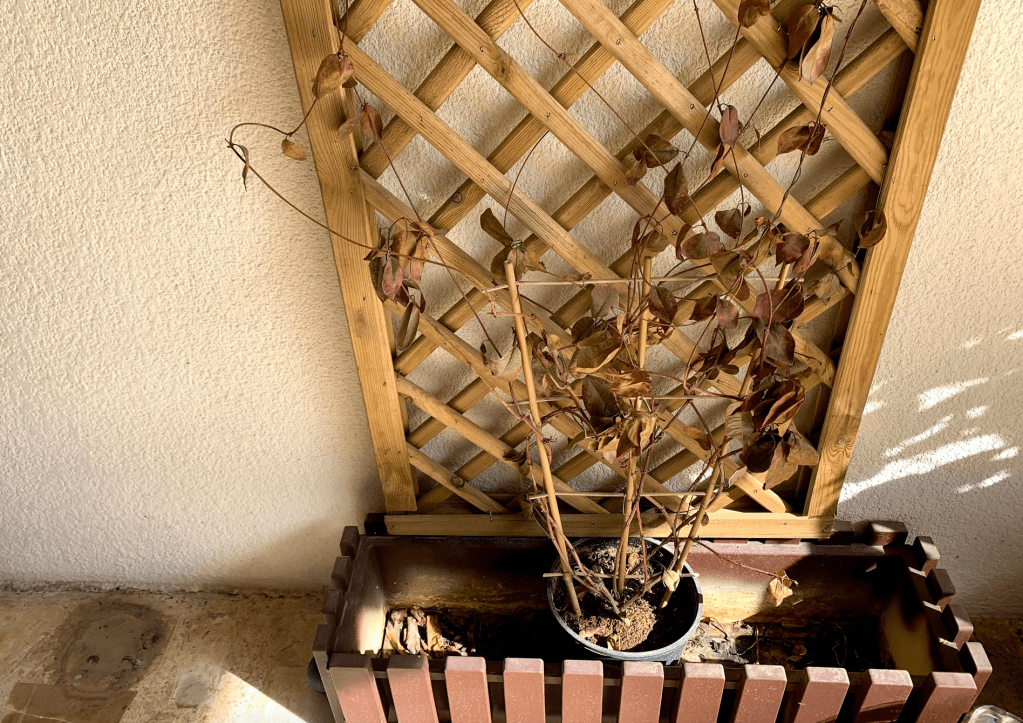
The remains of our Brazilian Jasmine vine. Formerly beautiful. Alas, ultimately doomed.

As we marveled at the survival of our tequila plant, we found it to be an unlikely source of encouragement. The attrition rate among our house plants had become a strange parallel to the deaths of local church plants. Our area and people group tend to present a vibrant and hopeful picture in the beginning of new groups forming. Then they all implode. Soon, those promising potential churches are gone without a trace. Where all the methodologies come to die. It’s a sadly realistic slogan for our part of the world. Got a methodology that’s being puffed as the current silver bullet for planting churches (or even movements?) among unreached people groups? Bring it here and watch it wither, just like my Brazilian Jasmine vine. Those flowers and shiny leaves were lovely until they met the wrath of the summer sun. Now they are no more.

And yet, we know that the promises of God for his bride will not fail. Sooner or later, we will have healthy reproducing churches take root among our people group. They will be able to survive the brutal seasons of persecution, fear, in-fighting, and false teaching. But they will have to be unusually hardy, scrappy churches. They will need to be able to come back from the brink of death, as it were. They will have to be like tequila plants. Their fiber will need to be made up of robust biblical conviction and gospel clarity. They will need to be fluent and practical in their putting on of the characteristics of a healthy church:

  1. Biblical Discipleship
  2. Biblical Worship
  3. Biblical Leadership
  4. Biblical Fellowship
  5. Biblical Membership
  6. Biblical Giving
  7. Biblical Evangelism
  8. Biblical Teaching and Preaching
  9. Biblical Accountability and Discipline
  10. Biblical Mission
  11. Biblical Ordinances
  12. Biblical Prayer

These churches will not only need conviction and clarity on the biblical principles for a healthy church, they will also need to find faithful expressions of those principles that fit both the scriptures and our local context. With the same spiritual DNA as a church in Melanesia or North America, these churches will need to find hardy expressions of that DNA for a context that kills off expressions developed in more temperate climates. I’m not at all talking about reinventing church. Whether something feels traditional or new and exciting has nothing to do with it. Rather, as church planters, our sense is actually that we will have to be both more doggedly biblical and more carefully contextual than we have been thus far. We need to be able to draw bright and clear lines from our method to the scriptures and then to the local context.

So locals say a plurality of pastors is utterly foreign to this culture? Well, let’s still do it, because it’s biblical. But lets go so deep into their culture and history such that we find echoes in their past (like tribal elders) that help contextually illustrate the biblical leadership principle. Let’s take off our Western preference for informal/funny leadership relations and put on a Central Asian appreciation for titles, ceremony, and gravitas. Let’s actually try to wrap our minds around the complex patron-client system that dominates this worldview so that we and local believers can address it biblically – redeeming, redirecting, and rejecting as necessary. After all, the New Testament church itself upended the patron-client system of the Roman empire. How did they do it? Let’s not plateau in our understanding of theology nor our understanding of our local culture. Instead, let’s go deeper in both.

If we can work like this, then we just may see local churches emerge that last. We just may see churches that are like tequila plants.

It Is The Glory of God to Conceal Things

Henry* was a local friend who had volunteered to help our relief and development office. He was extremely ambitious and his desire to leverage his connection with us for his future prospects was not exactly subtle. Even other locals were a bit taken aback by his drive and abnormal energy to get ahead. He represented a certain slice of the younger generation who were reacting against the fatalism of their culture and a bit too intoxicated with the Western ideals of self-determinism and the power to set one’s own destiny.

Yet alongside his drive, he had the normal Central Asian abundance of hospitality and relational energy. It was an interesting mix. One of my teammates befriended Henry and began taking trips with him to visit Henry’s father’s village and flocks and go on mountain picnics with him. During these outings, they began to study the Bible together. I was really encouraged to hear that this was happening as much of my time in that season was taken up by my focus on Hama and his network. Occasionally I would have the opportunity to speak briefly into these conversations, but mostly my teammate took point and I prayed and supported as I could.

This state of things continued for a couple of months or so, with Henry seeming close to understanding the gospel and then pulling back in defensiveness. Still, it seemed to be an upward spiral. One summer afternoon I was present in our office as the debate reached a tipping point.

“I need you guys to find me a priest,” Henry said.

“Why do you need a priest?” asked my teammate.

“I need someone who can explain the Bible to me better than you guys can. I just can’t understand it, no matter how hard I try. I need a religious professional.”

“Henry,” my teammate protested, “we are telling you plainly what the Bible says, you don’t need a priest or a pastor.”

“No! I need a priest. I need a professional religious teacher. Then this book will make sense to me.”

The back and forth continued like this for a bit longer. I eventually chimed in as well.

“Henry, you don’t need another human teacher. We’ve been telling you clearly what this book means, but you can’t understand it because you need God’s help. You need the Holy Spirit of God to be your teacher. Only he can open up your eyes now to understand this book. You need the Holy Spirit, not a priest.”

Henry ended up leaving, frustrated. Perhaps we could somehow connect him with a like-minded pastor. Maybe that would make the difference?

The next day Henry came back to our office, pale as a sheet.

“Henry, what is it? Come in!”

“I need to sit down,” Henry said. “I need to tell you something that happened.”

Henry’s entire demeanor was changed. No longer was he projecting his confidant, ambitious, driven persona. For the first time, I saw in his eyes what could have been humility. And fear, there was definitely fear.

Henry insisted we go into an inner room of the house and lock the door behind us.

“I have to tell you what happened last night. You need to help me know what to do,” Henry said. “Last night I was reading in the Bible you gave me. I was reading the book of Proverbs for the first time. I got to chapter three or four I think. I remember thinking about the part where it says ‘Trust in the Lord with all your heart; and do not lean on your own understanding.’ Then I fell asleep, with the Bible on my chest.”

Henry paused as he collected his thoughts in the dim light of the inner room. There was no electricity so we were sitting in a quiet but somewhat dark space. The taste of a room that needed to be dusted was in the air. Henry was on the couch, we were on two chairs, pulled up close and facing him.

“I had a dream. In my dream, I saw a man in shining white robes that came to me. I do not remember everything that he said, but he said to me, in my own language, ‘My son!’ – In my own language!”

“Do you know who that was, Henry?” we asked.

“I know it was Jesus. I don’t know how I know, but I know it was him,” he said. “He had an open book in his hand. He told me that I needed to read it. Behind him were several people, also wearing white robes, also with books in their hands. It was you guys. I saw you in my dream standing behind Jesus. I asked Jesus who you were and he said to me, ‘These are my people. You need to listen to them!”

At this point, my teammate and I turned to one another, wide-eyed with chills going through our bodies. I think we may have laughed in amazement and high-fived.

“Did he really say that, Henry? Did he really say that we were his people and that you should listen to us?! Ha! That’s wonderful, that’s amazing! Wow!”

“Yes,” Henry said, “He said that, and you were there. It was your faces and you were holding books like you were eager to give them to me.” My teammate and I shot each other knowing glances. We had been vindicated.

“What else did he say?” we asked.

“I can’t remember everything. The only other thing that is clear is that he said, ‘It is the glory of God to conceal things…’ Strange sentence. Does that mean anything to you?”

It had a familiar ring to it, but neither of us could remember off the top of our heads where it was from. So we pulled out our Bibles and laptops and began searching. It didn’t take very long for us to point out to Henry that it was from Proverbs 25:2 – It is the glory of God to conceal things, but the glory of kings is to search them out. We showed this passage to Henry.

Henry backed away from us, looking frightened.

“I… I didn’t read that part of Proverbs yet. I fell asleep in chapter four. I didn’t read that! But that’s what Jesus said, and there it is, in the Bible, right there! How did he do that?”

My teammate and I couldn’t stop grinning from ear to ear and shaking our heads. For a couple of college guys who had volunteered to spend a year in the Middle East, we never expected anything like this. It was enough to get to share the gospel with our friends and study the Bible with them. But it seemed that the Holy Spirit was out to rescue some of our friends, like Henry. And he was displaying his sovereign power in doing so.

“Guys,” Henry said, his face now in his hands. “It all makes sense to me now. Everything you’ve been trying to tell me. Everything that the Bible says. It’s so clear now when yesterday I just couldn’t grasp it. Something has changed.”

“Henry,” we said, “It seems that you found your teacher… or that he found you. The Holy Spirit has given you the light you need to understand God’s word.”

“So what do I do now?” Henry asked.

“Well, now you follow Jesus.”

“But how do I do that?”

We proceeded to walk Henry through the gospel one more time – God as holy creator, man as a fallen sinner, Christ as our savior and sacrifice, and the need to repent and believe. Henry affirmed that he believed all those things. We weren’t exactly sure what to do at that point, having ourselves been chewing on the issues related to the traditional sinner’s prayer as we had inherited it. So we opted to instead lay hands on Henry and to pray that God would confirm his gospel confession as true and if so, establish him in his new faith.

After we prayed Henry looked up, no longer afraid, but now full of joy. He was now a brother. He has quietly continued in his faith to the present day.

But what was going on with the quotation of Proverbs 25:2 in his dream? I am no dream interpreter, but my best guess is that this verse was quoted in Henry’s dream to emphasize that the truth had indeed been sovereignly concealed from him as he wrestled to understand it in his own wisdom. No matter how strong his drive was, Henry just couldn’t make sense of this book. Biblically, there is a particular glory of God that manifests itself in the concealing of mysteries. After all, he is a God with secrets and with thick darkness all around him (Deut 29:29, Ps 97:2). He wanted Henry to know that only the Holy Spirit could remove the veil from his eyes so that he could see the truth and beauty of Jesus Christ. Why? So that it would be all of grace, clearly all of grace with no room for boasting (Eph 2:8-9).

All of grace. Henry didn’t deserve to be given spiritual sight. Neither did I. It is the glory of God to conceal things. Yet praise God, it is also the glory of God to reveal them.

*names changed for security

Photo by Drew Hays on Unsplash

International Travel During Pandemic October

Around 3 a.m. last night we arrived in our Central Asian city after five months in the US. The return journey was unexceptional in many ways, though trips like this with multiple small children always come with their fair share of challenge and misadventure – He’s eating pretzels off the floor again. Gross. I should stop him, but is it worth it at this point? And yet travel in 2020 is unique enough that I thought a few observations on our trip would be of some interest.

On an encouraging note, we enjoyed seeing airports such as Dallas-Forth Worth and Doha, Qatar humming again with activity, even if it’s less than half of what it was last year. Five months ago when we took the repatriation flight the airports were deserted shells of themselves, dark, empty, and sad. This time travelers and airport staff seemed genuinely happy to just be out and involved in travel again. “Don’t apologize, we’re just glad to be doing some work for a change!” said an elderly counter agent while dealing with our complicated tickets and destination requirements. Alas, all of the Starbucks were still closed. We were hoping for one more American-style cold brew. We did manage to get in one last classic burger.

The planes were all very full, which was a bit surprising for us. Yet all the passengers seemed to don their required face masks and face shields without protest. We didn’t encounter any of the conflict over these requirements we’ve read about in the news. Most seemed happy to comply, glumly resigned, or already adapted to a new normal. Even on 14-hour flights, humanity is remarkably flexible. I mused to my wife about how our youngest might remember these flights. In a few years when we all travel once again with unveiled face, he’ll think back and recall all the space-age face equipment worn, perhaps wondering if that actually happened or if his memory is playing tricks on him. For some kids, returning to “normal” might actually feel like a bit of a loss. No more cool face shields and ninja masks. Bummer.

American Airlines for its part has not adapted to the extent that Qatar Airways has. Qatar brought with it both higher Covid-19 precautions (staff in full PPE, mandatory passenger face shields plus masks) and an almost complete return to pre-pandemic in-flight service. Qatar has never stopped flying during the pandemic, strategizing that it’s better business to make a name for itself as one of the only carriers still going strong. Their flights to and from our region have been a lifeline for us and our organization. I hope it will work out well for them when the industry gets back to normal.

Even with all the restrictions, Qatar Airways also managed to be remarkably child-friendly, ushering our family to the front of lines and showing special attention to the kids during the flights. As usual, this contrasted sharply with the way Western staff tend to treat families with small children. It’s sad to be reminded every time we travel between hemispheres how the East values children while the West views them mainly as an obstruction. “We have a connection to make!” one flight attendant huffed while we fumbled to get off the plane with our kids and our extra bags full of childhood diabetes equipment.

However, this kind of comment was the exception as most travelers and staff, Eastern and Western, seemed more appreciative of simple human interaction than they might have been before. The world has been starving for social contact. There was joy to be found for many just in the simple act of being in a small traveling crowd again. The language barriers, the seat negotiations, and the screaming/laughing kids seemed to be met with a measure of greater patience. Common grace is a wonderful thing. There was potential for a refreshing solidarity, room for conversation where each party gets to share how they’ve been affected by this global crisis. I imagine we’ll be swapping stories about 2020 for decades to come – not a bad thing at all for Christians eager for common ground that leads to conversation about deeper things.

Another trip halfway around the world. But likely one of our more unique journeys – the first one to require face shields and airport nose-swabs at least. Today we are jet-lagging something bad, but our hearts are overflowing with gratitude. Our three kids did great on a difficult journey. We were able to juggle our daughter’s new diabetes and a squirmy almost-two-year-old without any major mishaps. Our oldest son is at the age where he can now help push luggage carts and pull small suitcases! (Game changer). That airline food and coffee was pretty awful, but how wonderful that the long flights served coffee and meals at all. After a canceled flight we even got some rest at an airport hotel (last room available), just enough to keep us sane for our 3 a.m. arrival. God is so good.

So here we are, back in our adopted city, unpacking our bags, coming up on two years of almost-constant transition. Our hope now is for a season of stable presence and ministry. Like so many, we find ourselves largely in the dark as far as the details of God’s purposes for seasons of transition like this. Yet we do not trust in stability or in our ability to piece it all together (much as I might try). Our God is the God of sojourners and pilgrims, the God of wanderers like Abraham. He just saw us through another two day journey around the world… during a pandemic. He’ll see us through whatever longer journey we might yet face. In the end it will all weave together for glory.

Photo by Bao Menglong on Unsplash