In Missions, These Things Combined Mean Someone is Getting Played

Yesterday, I saw a claim made by an American pastor-missionary-trainer that he was heading to a nearby country to do some training with leaders from our region. Among other things, he said that one of the ‘streams’ this network of leaders represents has 100 churches in one of our sister unreached people groups. This is a group that shares the same ethnic name as our focus people group, but speaks a different related language. 

100 churches! Amazing, right? The Spirit must really be on the move in this part of the world!

Here’s the problem. The long-term workers on the ground who have actually learned the language to an advanced level only know of one church among that language group, and that a very unhealthy one. Some of our dear friends have labored for years in this unreached language and are finally on the cusp of planting a church – the first healthy church in that language group. And it’s not like some political border means we can’t easily go and verify either. The entirety of this language group’s homeland is right here in the country where we and these other missionaries live, only a short drive from where we live in Caravan City.

So, who’s right? The international trainer with the exciting claims or the missionaries on the ground who can speak the locals’ mother tongue and are neck-deep in direct discipleship relationships?

Sadly, this is not an uncommon occurrence in global missions. While it usually takes place in other regions of the world, with South Asia in particular being notorious for its wild claims of movements to Christ, every once in a while, I’ll hear of some organization making similar claims for our people group or those related to it. I cannot say much about South Asia or the fantastical claims made about what is happening there. But when it comes to our corner of Central Asia, I can testify that these claims are almost always smoke and mirrors.

“I’m immediately skeptical of whoever this is.”

This was my response when I heard this week about this leader and his trainings and his claims of 100 churches among our sister people group. This is because the different factors in this sort of claim combine to make a particular sort of smell, the smell of someone taking advantage of the people of God. The odor of someone doing the kind of work that soon disappears into the wind like so much chaff, while they then move on to some other work with an even better ROI.

Here’s a formula of sorts that tends to hold up pretty well here in Central Asia, and likely across the broader missions world:

A foreigner, more often than not non-residential, who doesn’t learn the language

+ short-term translated “trainings,” often in third countries or online

+ reports of amazing numbers of disciples and churches planted

+ ministry done solely and indirectly through paid local partners

+ claims that simple New Testament methods are being rediscovered and used

+ assurances that “God is moving in an unprecedented way among ______ !”

+ lots of appeals for money

_______________________

= someone is getting played

There are variations of the above formula, of course, but the fact that someone is getting played tends to stay constant across the board when you have a combination of the above ingredients. And by someone, I primarily mean generous believers back in the West who give to the trainer’s organization because they genuinely care about the advance of the gospel. These believers back in the homeland are deceived both into giving and into thinking that God is working in ways he is not actually working. Both are terrible ways to deceive people. But I would argue the second is probably more evil than the first. Tricking people out of their money is bad, of course, but relatively mainstream as far as sin goes. But Jesus said some terrifying things about those who attribute the work of the Holy Spirit to Beelzebul (Matthew 12:31-32). What might that mean about those who deceive others into thinking something is a work of the Spirit when it’s actually a work of Mammon? 

Not only that, but the effect on believers on either side of the world when they find they’ve been duped is awful. I have seen this effect firsthand among locals. For those who were unfortunate enough to first be exposed to Christianity in one of these evangelical missions money hustles, if they’re not successfully seduced into the hustle, there is a terrible moment when they realize that the leaders in this Jesus thing are just like those in Islam – hypocrites out for selfish gain. The light seems to fade from their face, and their whole demeanor sinks back into a guarded skepticism. After this, they are often unwilling to gather with believers again for years to come, if ever. Again, Jesus says terrifying things about those who cause little ones, such as new believers, to stumble (Luke 17:2). Some who are lauded as inspirational missionaries in this world will be wearing millstones in the next. 

If you look again at the above formula, you’ll notice that each of the parts on its own, except for the end result, is not necessarily bad. In fact, each part can be done faithfully. For example, there are some countries where missionaries can’t get visas. It’s not always necessary or possible for someone to learn the local language in order to do solid training. Genuine movements of God have happened in church history, such as the first Great Awakening or the Korean Pentecost. Sometimes ministry needs to be done primarily through local partners, and sometimes those local partners should be paid. There are times to return to simpler NT methods when good extra-biblical traditions have become too cumbersome. And appeals for money are good when made by faithful workers, as even Paul himself modeled. Yet there’s something about combining all of these ingredients together in our current era of evangelical missions that tends to be evidence that something poisonous is taking place. Bleach is a good household tool. So is vinegar. Put them together, and you get a deadly chlorine gas. 

There are three ways I’ve observed in which the foreign-trainer figure is complicit or not in the overall deception. First, there are situations where the foreign leader is himself fully deceived by the local partners, though the foreigner is a faithful Christian trying to do good work. I once knew of a solid Reformed pastor who would visit our region every year in order to partner with a local leader up in the mountains. Sadly, I would later learn this local brother he was partnering with was a textbook wolf. Like all wolves in sheep’s clothing, he was very good at deception, so he managed to secure lots of funding and visits from this faithful pastor through things like strategic photos, compelling stories, and crowded house church services full of mobilized ‘believers’ that would suddenly appear whenever this pastor happened to be in town. But this local man was the same one who was making sure that all of the residential missionaries got reported to the secret police and run out of town. This faithful pastor unfortunately died before we had the chance to expose how he was being deceived. 

For non-residential leaders who want to avoid this first kind of situation, the best thing to do is to befriend trustworthy long-term missionaries or local pastors on the ground who can help you vet potential partners. These need to be missionaries or pastors who know the language and who can verify, in-person whenever possible, that your local partners are really who they say they are. For those living on the field, the best course of action to avoid this is to go ahead and learn the language and culture yourself, or to make sure that some on your team do. It’s shocking how much can be missed when partnership is happening through translation. 

The second category is when the foreigner-trainer is aware that the reality of things is not exactly the same as what is being presented when they send out their newsletters. But because they feel that so much good is being done through this ministry or movement, or because they just don’t want conflict, they choose to turn a blind eye to the billows of black smoke filling the sky that seem to suggest that there is a fire somewhere around here. Those who choose this path are guilty of deceiving themselves, of people-pleasing, of foolishness, and maybe even of cowardice. Rather than continuing to listen to the voice of naivete or fear, leaders or trainers in this category need to get clarity on what is really happening in the ministry they are partnering with. Again, those in this category have no better allies than those long-termers on the ground. Then, they need to take courage, repent of their part, confront those doing the deception, and make a clean break. Yes, even if that means they are the Western guy telling the indigenous pastors that they are in sin. 

The third category belongs to the actual hustlers. These are the missionary-trainer types who are fully complicit in the deception. They have learned how to tell stories, share stats, and manipulate well-meaning believers so that the money flows for the projects themselves, for their local partners, for their own dopamine hits, and for their own pockets. I hate that this is actually happening on the mission field, but it is. It’s happening even in our own corner of Central Asia. These hustler types tend to be great communicators, amazing fundraisers, skillful project managers – and wickedly good at all kinds of gaslighting and deception. Their amazing level of travel, projects, and output shields them from criticism. As does the radical-seeming nature of their work, usually being connected to some country or region that is known as militantly anti-Christian. Who wants to question the work of someone who claims to be facilitating church-planting movements in regions that have been devastated by ISIS, for example? 

Those in this category are playing a very dangerous game. At best, if they are believers, then they risk making it into the kingdom by the skin of their teeth, while all their work is exposed as chaff and burned up (1 Cor 3:13-15). At worst, they are false believers whose entire lives and ministries are built around using the Great Commission for the sake of personal gain. Based on God’s wrath against those like Simon the sorcerer, Ananias and Sapphira, and Judas, I’m confident there is a special part of hell for people like this. 

No particular kind of methodology is fully immune to these sorts of predatory missionaries. But some methodologies are, by their very philosophy and structure, much more compatible with deception. I’ve not often come out in my writing directly against DMM (disciple making movements) and movement methodology practitioners. I know that there are some out there who are careful believers who are trying to use these methodologies in ways that are faithful to scripture. I respect these workers’ motives, even as I disagree with them about their work. But after a couple of decades now, the evidence is mounting that the results of these methodologies are often highly questionable and concerning. At the very least, a DMM-type approach provides the perfect cover for someone who wants deceive God’s people for the sake of financial gain, whether that be a local who is deceiving his foreign partner, or locals and foreigners who are in on it together. 

Every part of the above formula for someone getting played is compatible with the way DMM is often carried out on the field. Missionary ‘facilitators’ or ‘trainers’ are encouraged to be non-residential, or to not invest costly years in direct language and culture learning, but instead to increase their ROI by leaning fully on locals, who are, as is often pointed out, much cheaper to fund. Instead of long decades of direct evangelism, discipleship, and modeling by example, DMM tends to advocate short trainings where the trainees are then responsible to go out and implement what they’ve learned without any direct involvement of the missionary. DMM practitioners make all kinds of claims about astounding numbers of disciples made and churches planted, often in the parts of the world that are most resistant to the gospel. And these claims go hand in hand with claims of recovering New Testament methodology where ‘everyone is a disciple maker’ and where there are ‘no experts,’ emphases that tend to gut any real spiritual authority for the good guys, while creating all kinds of space for little tyrants to take over. 

And then there’s money. Perhaps DMM practitioners in other parts of the world don’t do it this way. But here in our corner of Central Asia, DMM and lots of money changing hands absolutely go together. Of course they do. Amazing reports of gospel breakthrough in hard places inspire God’s people to give generously. And money, at least temporarily, is a wonderful lubricant to make sure a large network of locals falls in line with your particular silver-bullet methods. 

Tangentially, many DMM emphases, such as its ‘no experts’ approach and dislike of formal organization and preaching, are terrible contextualization for our Central Asian culture. This means that locals will, temporarily, do what they need to in order to secure their monthly funding – or at least take enough pictures and videos to make it appear so. But once the money dries up, the locals don’t continue with their ‘disciple making.’ After all, these methods have been cooked up among Western missiologists who are stuck in their own post-institutional, egalitarian, results-driven cultural moment. Even if we don’t talk about their biblical merits or lack thereof, these approaches don’t make any sense to our Central Asian neighbors. Once the money is gone, one of my favorite old adages comes out again, 

“Welcome to Central Asia, where all the methodologies come to die.” 

Friends, watch out for the above formula. It is often the case that these ingredients together are a recipe for deception in missions, or at least for poor work that won’t stand the test of time. The advocates of this sort of work often sound so good. But just like grandma said, if it sounds too good to be true, it usually is. And as is the case when I heard about these 100 churches in our area (that don’t exist), when these ingredients are combined, someone is getting played. 

Note: I followed up and did some research on the leader making these claims. Sadly, all indications are that he’s a category 3 hustler type. “Borderline criminal” is how one faithful long-time worker among that people group put it. Lord, have mercy. May God grow his church here and protect the local believers as well as those back in the West from those who would use them for selfish gain.


If you have been helped or encouraged by the content on this blog, would you consider supporting this writing and our family while we serve in Central Asia? You can give here through the blog or contact me to find out how to give through our organization. 

One of the international churches in our region is looking for an associate pastor and our kids’ TCK school is also in need of teachers for the 2026-2027 schoolyear. If you have a good lead, shoot me a note here.

Blogs are not set up well for finding older posts, so I’ve added an alphabetized index of all the story and essay posts I’ve written so far. You can peruse that here

For my list of recommended books and travel gear, click here.

Photo from Unsplash

Winning the Argument, Losing the Relationship

Back in 2008, my fellow single teammates and I were invited to help with some English clubs that Ron*, an older missionary veteran, had set up at various universities. One of these clubs was the setting for that one time when a few of us donned overalls and fake hillbilly beards and tried to lead an auditorium of very perplexed Central Asian students in a rousing rendition of Soggy Bottom Boys’ Man of Constant Sorrow.

I also started traveling with Ron once a month to a university in a city three hours south of us. This city was down in the desert flatlands, and much hotter than Poet City, the kind of place where after a five-minute walk in the bazaar your shirt is already soaked through with sweat. 

I remember making this drive one time with Ron when he pointed out the old ruins of Zoroastrian fire towers up on a nearby peak.

“A.W.,” he said in his Texan accent, “Next time we do this drive, we should stop and climb up to those towers, lay hands on them, and pray down Chemosh! Pretty sure he’s the territorial spirit still in charge of this land.” 

I turned to see if Ron was joking. Nope. He was dead serious. I did my best to answer diplomatically. Ron was, after all, an older veteran missionary who had served in multiple countries. He regularly published articles in well-known missions periodicals and had been in leadership positions probably longer than I had been alive. But I was pretty sure then, and still am now, that Ron and I laying hands on Zoroastrian ruins and attempting to rebuke an ancient Babylonian god would have little effect on the power that Islam currently exerted over our local friends. Not that the same cadre of demons can’t be behind these three very different evil religious systems. And not that prayer is ineffective. But more because the Bible seems to have us taking on demonic rulers, powers, and principalities asymmetrically, primarily as we engage other humans with gospel proclamation, pray for them, and plant healthy churches. As well as, of course, the occasional exorcism

Even then, as a newly continuationist twenty-year-old, something felt very off about the way that certain missions circles turn casting down territorial spirits and doing spiritual mapping into their own kinds of pseudo-science, theories that they discuss and act on so confidently with so little actual biblical grounding. 

But I digress. This is not a post about territorial spirits and spiritual mapping. This is a post about evangelism gone wrong. 

Ron was leaving the country. Like other missionaries at the time, he looked at the young network of indigenous house churches that had been planted across our region and assumed that it was high time for the Westerners to “trust the Spirit” and “get out of the way.” This kind of assumption would, of course, lead to the tragic implosion of most of these house churches just a couple of years later. Their leaders weren’t even close to being ready for their mentors to leave them on their own. And most of the young local believers, like my friend Adam*, would be scattered to the wind. 

But in the summer of 2008, things were looking so promising that our people group was being held up by some organizations as a good example of how missionaries among Muslim people groups could get it right. And pioneering types like Ron were itching to move on and to hand off the projects they had started. That was the intention for this trip. Ron was going to say his goodbyes in this desert city and try to set things up so that my team (which was three college dudes at that point) could take over the English club. 

After the meetings were finished, a group of us went out to dinner together to celebrate over some good local food. Ron, his wife, and a single gal who was on their team were all flying out that week. So, this was their final meal with Muhammad*, a young local man who had been working as their project facilitator/translator for some time. 

These young local fixer-types are absolutely crucial for so many of the NGOs operating in our corner of Central Asia. They help us expats navigate government processes, serve as our culture advisors, interpret for us when needed, and do all sorts of practical intern work, whether it’s vehicles or offices or even just knowing where to find things in the endless alleys of the bazaar. If they are working for a Christian NGO, then they usually end up hearing the gospel a lot. Some of them come to faith. Others of them stay stuck in a weird long-term posture of being pro-Western, Christianity-friendly, and very much still committed to Islam. 

Apparently, the latter was Muhammad’s posture. But seeing that this was his last chance, Ron was determined to press him hard on the gospel. So, at some point toward the end of the meal, Ron suddenly called Muhammad out, asking him if he was ready to leave Islam and believe in Jesus. The abruptness of this pivot in the middle of the meal we’d been having caught us all a bit off-guard, Muhammad included. But Muhammad was a respectful and tactful guy from a culture not as uncomfortable as ours is with direct questions about religion. So, he recovered quickly, finding an honorable way to tell his boss, a much older man, that no, he was not going to do what he was suggesting. 

Ron, however, didn’t take the way out of the conversation that Muhammad had just extended to him. Instead, he pressed harder. Muhammad, sensing that he now needed to defend his beliefs which were being publicly challenged, starting pushing back more himself, bringing up many of the typical objections Muslims have against Christianity: Jesus isn’t the Son of God, Jesus didn’t die on the cross, the Bible’s been changed, the Trinity is illogical, and of course man can get to paradise by doing enough good deeds. 

This is where I came in. For some months, I had been engaged in almost daily evangelistic and apologetic conversations with my Central Asian friends. And I had been loving it. I had developed a strong arsenal of biblical, logical, and cultural responses to all of the typical Islamic objections to the gospel. One by one, I began to dismantle everything Muhammad was saying. 

This went on for some time. Ron would press. Muhammad would defend. I would dismantle. I was downright energized at how quickly my mind was working and how effectively the arguments seemed to be rolling off my tongue. I knew the case I was building was a powerful one. I didn’t know Muhammad super well, but surely, he would sense the truth in what we were saying and come around. I could clearly see that Muhammad’s claims were being destroyed, one by one, and I was encouraged by this. That is, until I looked up and noticed Rachel*, the single gal on Ron’s team, sitting off to the side of the table and looking at Muhammad with a look of pain on her face. 

What does that mean? I wondered to myself. 

I followed her gaze to Muhammad’s face, and that’s when I also noticed. Muhammad’s expression had become defensive, his eyes dark and hurt. It was the face of someone who had been trapped by those he thought were his friends, someone whose trust had been betrayed in the middle of a meal meant to honor his departing coworkers. It was the demeanor of someone who had been shamed by those he had been loyal to, not the look of someone being won by the beauty of the gospel at all. No, I suddenly realized, it was the look of someone who had been driven further away from Jesus by evangelism – evangelism done in truth, but not in love. 

Muhammad left that night very upset, not even wanting to say goodbye to Ron. Rachel left grieved. I left confused. But Ron left with a confident smile on his face, seemingly feeling like he had done his duty. Later on, he complimented me on how well I had done in the conversation. 

“You were on fire tonight, A.W.”

But I didn’t feel very happy about how things had gone. Yes, my arguments had been great. But something had gone very wrong in the whole relational dynamic of the evening. I had participated in some sort of evangelism that was so right it was wrong. We had won the argument, but lost the relationship. We had pinned Muhammad to the wall. In doing so, we had inadvertently communicated to him that he was only valuable to us if he believed in Jesus in the end. 

I don’t know what ever became of Muhammad. I’ve never run into him in the years that have passed since that summer evening back in ’08. But I’ve thought of him many times over the years, regretting how things went down. It’s easy for evangelistic conversations to get emotional and even heated. To some extent, this is only natural when humans are debating things that are so personal and weighty. However, I’ve become convinced that faithful evangelism is just as much about the how as it is about the what

Sure, some people will get offended and upset even if the evangelist’s demeanor remains loving and relational. But it is the duty of the evangelist, as much as it depends on them, to communicate grace and gentleness right alongside the bright and sharp truths of their words. The wise evangelist keeps a constant eye on the body language of the hearer, watching out for evidence that the tenor of the conversation is pushing them too far. And if it comes down to winning the argument or losing the relationship, the wise evangelist puts the argument aside for now and protects the relationship. 

Again, this is not always possible. Some people will blow up at you or cut you off, even if your demeanor clearly communicates that you value them regardless of whether they accept your message or not. But far too often, Christians are only focused on winning the argument in the short-term. And they forget that a long-term friendship that revisits the gospel again and again is far more powerful than a one-time gospel smackdown that makes that unbeliever never want to see you again. 

Is what I’m saying biblical? Consider Paul’s advice on evangelism in Colossians 4:5-6, “Walk in wisdom toward outsiders, making the best use of the time. Let your speech always be gracious, seasoned with salt, so that you may know how you ought to answer each person.”

Or, his advice to Timothy about how to navigate arguments, “And the Lord’s servant must not be quarrelsome but kind to everyone, able to teach, patiently enduring evil, correcting his opponents with gentleness. God may perhaps grant them repentance leading to a knowledge of the truth, and they may come to their senses and escape from the snare of the devil, after being captured by him to do his will” (2 Timothy 2:24-26).

The Bible has a category for prioritizing the relationship over the argument. That doesn’t mean we don’t speak the truth. But it does mean we need to pay careful attention to how we speak the truth. It’s possible to say the most offensive things with a demeanor that communicates care. That needs to be our goal. We want our unbelieving friends to be shocked by the hard truths we believe about them, and at the same time, shocked by how much we clearly love and care for them. This bizarre contrast should, in some ways, disturb them. 

“How can they believe I deserve an eternal hell when they are the same ones who show me more genuine love than anyone else does?” 

When our unbelieving friends are wrestling with these kinds of questions, we know we’ve gotten the posture right. 

These days, most of my evangelism is taking place in my living room. Every week, we partner with some local believing friends by opening up our home for a long evening of chai, snacks, and spiritual conversation. About half of the fifteen or so men who come are believers, and about half are not. Many of these young unbelievers are post-Islamic angsty philosopher types, but a few mainstream Muslim guys come too. The conversations range all over the place, but every week a good number of us believers get to go deep into gospel truths. 

As I’ve reflected on what exactly God is doing in these largely unstructured gatherings that leave our living room trashed every week and my wife and me with a ministry hangover the next morning, I think much of it might have to do with modeling relational evangelism for the local believers. Some of them, like a certain twenty-year-old I remember well, tend to get caught up in the emotion and the intensity of the discussions. One young believer, a passionate cage-stage Calvinist who is reading the Institutes via Google Translate, will often physically shake and have to excuse himself early because he’s gotten so worked up in an argument with an unbeliever about the gospel (or with a believer about TULIP). 

However, the hope is that week in and week out, these brothers will continue to share the gospel even as they also show hospitality and steady friendship to the many unbelieving guys who are also coming. Yes, I delight to see these believers’ answers and arguments becoming more sound, biblical, and compelling. But just as much, I delight to see them light up with genuine joy when Mahmoud*, the stubborn taxi driver philosopher, arrives at the door after not coming around for a few weeks. 

As with so many aspects of evangelism, it’s resting in the Spirit’s sovereignty that means that bold evangelism and genuine relational love need not be at odds with one another. Faithful evangelists can put the argument aside in order to care for the heart of the one they’ve been arguing with. How? Because they know that it’s not ultimately up to them to win. If Ron and I had leaned better on this truth all those years ago, we may still have shared the gospel with Muhammad that night. But once we sensed that he wasn’t yet open to Jesus, we could have put the conversation on pause, trusting that the Spirit would later open the door. It wasn’t necessary for us to force it. It wasn’t necessary for us to pin him against the wall and to publicly defeat him as we did. 

Looking back, I’m sorry for the way things went down that night, even though I trust that God can sovereignly use even that aggressive conversation to draw Muhammad to himself. Who knows? He may already be a believer, wherever he is out there. 

But I am also determined that, as much as it depends on me, I want to faithfully share the gospel, being willing to sometimes lose the argument. Why? To win the relationship. And that, perhaps forever.


If you have been helped or encouraged by the content on this blog, would you consider supporting this writing and our family while we serve in Central Asia? You can give here through the blog or contact me to find out how to give through our organization. 

One of the international churches in our region is looking for an associate pastor and our kids’ TCK school is also in need of teachers for the 2026-2027 schoolyear. If you have a good lead, shoot me a note here.

Blogs are not set up well for finding older posts, so I’ve added an alphabetized index of all the story and essay posts I’ve written so far. You can peruse that here

*Names changed for security

For my list of recommended books and travel gear, click here.

Photo from Unsplash


A Proverb on Donkeys and Dumpster Fires

Come and get this donkey out of the mud!

Yes, it seems there is no end to the proverbs featuring donkeys in our Central Asian language. Here’s yet another one. The meaning of this proverb is similar to the Google/Oxford definition of that smelly and colorful American idiom, dumpster fire, “a chaotic or disastrously mishandled situation.”

Let’s say that someone has mismanaged things so badly that it seems there’s no solution to be found. That’s when you pull this proverb out. 

There are daily household applications for this kind of a proverb, such as when questioning one child tattling about getting slapped in the face by a dirty sock leads back to the fact that they had just hit their sister, which then leads back to yet another sibling’s sin, which then leads to collective sin and foolishness against what all the offspring had been asked to do by their parents in the first place. Where does the discerning parent start when it’s general donkey dumpster fire behavior all around? 

Then there are times in ministry when you are faced with situations so convoluted by sin and foolishness that it boggles the mind how one person could ever create such a tangled, knotted mess. Here I recall a season early on in marriage when we were invited to move into the upstairs of a family from our church for the sake of life-on-life community. Shortly after moving in and starting a new community group with this family, one that was full of messy new believers with their own needs of intensive care, it emerged that the father of the household where we were newly living had been regularly committing adultery with another Christian woman from the same neighborhood – a woman whose husband was known for his love of guns. The fallout and damage control required for this situation was its own kind of baptism by fire for me as a 24-year-old brand-new community group leader. It might someday merit a post of its own, if I can ever figure out how to tell the story. At least it can serve here as a fitting illustration for what it looks like to try to get the proverbial donkey out of the neck-deep mud at a local church level. 

On the macro level, the political and ethnic situation of our entire region at large can often feel like this. Basically, every group has committed genocide against everyone else at some point, stolen each other’s land, oppressed one another, and then themselves gone on to suffer the same things. What does justice look like when everyone and their ancestors have everyone else’s and everyone else’s ancestors’ blood on their hands?

As we heard preached in the local language this past week, God’s word acknowledges the universality of these kinds of dumpster fires and braying donkeys stuck fast in the mud. The preacher of Ecclesiastes 7 concludes that section with this sober dose of realism, “This only have I found: God made mankind upright, but they have gone in search of many schemes” (Ecc 7:29). Alas, we fallen humans have a remarkable capacity to take God’s good gifts and to twist them into the most unbelievable messes.

As believers, we know that no mess is so intractable that God’s perfect grace and justice can’t eventually untangle and remake it, both now and in the coming resurrection. There is a real, if heavy, hope in that. This means we can confidently get down in the mud and begin digging. But we are right to lament the mess at the same time. 

Thankfully, as is so often the case in Central Asia, there’s a proverb for that. 


If you have been helped or encouraged by the content on this blog, would you consider supporting this writing and our family while we serve in Central Asia? You can give here through the blog or contact me to find out how to give through our organization. 

One of the international churches in our region is looking for an associate pastor and our kids’ TCK school is also in need of teachers for the 2026-2027 schoolyear. If you have a good lead, shoot me a note here.

Blogs are not set up well for finding older posts, so I’ve added an alphabetized index of all the story and essay posts I’ve written so far. You can peruse that here

For my list of recommended books and travel gear, click here.

Photo from Wilkimedia Commons.

Take a Sip of the Water, Ma’am

Airport rules can often feel arbitrary and absurd. They vary greatly from one airport to another and even from one trip to another through the same airport. Travelers come emotionally prepared to endure certain dehumanizing procedures only to be caught off-guard by airport staff who have unexpectedly changed things – and are now annoyed that you don’t already know what you’re supposed to do. 

Shoes on or shoes off when you go through the scanner? Passport only or boarding pass only, or both? To awkwardly look and attempt a smile at that little camera at the passport control booth or not? Bottles of water from the airport or the plane allowed into other parts of the airport or onto the plane? We try our best to keep our family hydrated in the parched land of 36,000 feet, but this last one and its ever-shifting yes, no, yes, yes, no!!! nature seems to always leave us scratching our heads. 

This past year, it even led to quite the standoff between my wife and one member of airport staff, a battle of wills that has now made it into our family travel lore. Here’s how it went down. 

We were getting off a flight from our Central Asian country and transiting through the Doha airport. This airport, like many in the Gulf region, is largely staffed not by Qataris but by workers from other countries. These professional SE Asians, S Asians, Africans, and others keep the airport masses efficiently humming along, often doing so with much more politeness than you’ll find at most American airports. Here, I recall a kind African lady who tried to convince us she could help us get out of the airport and to a city hotel during an unexpected 17-hour layover, even though this would have been illegal during those days of lingering pandemic restrictions. In the end, we opted not to take her up on her offer, a decision which had unexpected consequences of its own, involving matching luxury tracksuits of all things. 

Toward the end of the hot and dry flight, the flight attendants had passed out bottles of water to all of the passengers. Naturally, we assumed that bottles of water handed out on the plane, a plane of the flagship carrier of the airport we were headed to, would be fine to bring into the airport. After all, the whole no liquids thing is to prevent terrorists from bringing exploding liquids onto the plane. So, this time we didn’t tell our kids to chug their water lest there be none to be found for the next several hours. Instead, since we were about to disembark, we all just put our unopened or slightly-sipped water bottles into our carry-on bags. 

After a short trek from the plane to the transit area, we were met by an unexpected security scanner area. No big deal, we thought, as we put our carry-on bags onto the X-ray belt. But the respectful African man who was in charge of our line suddenly called my wife out in his thick Sub-Saharan English accent. 

“Do you have wata in yo bags, ma’am?” 

“Yes, they just gave us water on the plane.” 

“Take it out, please.” 

My wife proceeded to take out all of our bottles of water, which the man then lined up on the metal table after the X-ray machine. He then crossed his arms, staring at the water bottles suspiciously, then squinting his eyes at us. 

“They just now gave us water on the plane,” my wife explained, “And these ones are for our kids because there wasn’t much to drink during the flight. Do we need to throw them out? They’re from the plane.” 

“Take a sip of da wata, ma’am.” 

“Excuse me?” 

“Take a sip of da wata,” he said again, pointing with his chin. 

It took both of us a moment to process the request. It seemed this airport security officer wanted my wife to take a sip of her water bottle to demonstrate that it wasn’t… poison?

Somewhat annoyed, my wife took a sip of her water bottle. Thankfully, she did not drop dead.

“Take anada sip of da wata, ma’am,” the man said next, nodding at the other water bottles. 

“Why?” my wife countered. 

“Take a sip of da wata, ma’am. Is fo yo children.” 

“Yes, these other bottles of water are for my children.” 

“Then take a sip of da wata, ma’am.” 

“Of each of them?” 

The man continued to stand there, insistently, waiting for my wife to prove like some kind of cup-bearer that our kids’ bottles of water from the plane were neither poisonous nor explosive. 

Again, we were struggling to understand the thought process behind all this. Was this normal procedure? I’ve been traveling through airports my entire life and had never before witnessed this type of ritual. But also, our kids are, in some ways, germophobes. Despite my earnest appeals to reason, they will not drink after someone else, even if it’s their mom taking a small sip from their water bottle. 

My wife, knowing this, and not a fan of unexpected pressurized situations like this one, was looking for a way out. 

“I’ll just throw them all away.” 

“No. Is fo yo children. Take anada sip of da wata.” 

“No. I’ll just throw them away.” 

“Take a sip of da wata, ma’am.” 

“No. I’ll throw them away.” 

“Is fo yo children.

“…” 

I’m not exactly sure how long this exchange went on, with my wife and this airport security man staring each other down like some kind of battle of immovable ancient titans. 

Eventually, without breaking eye contact, my wife took a sip from each water bottle. I shushed our kids as they let out their germophobic protestations. Once again, my wife did not die, nor explode. And we finally moved past the security agent. 

At which point my wife defiantly threw the water bottles in the trash can. 

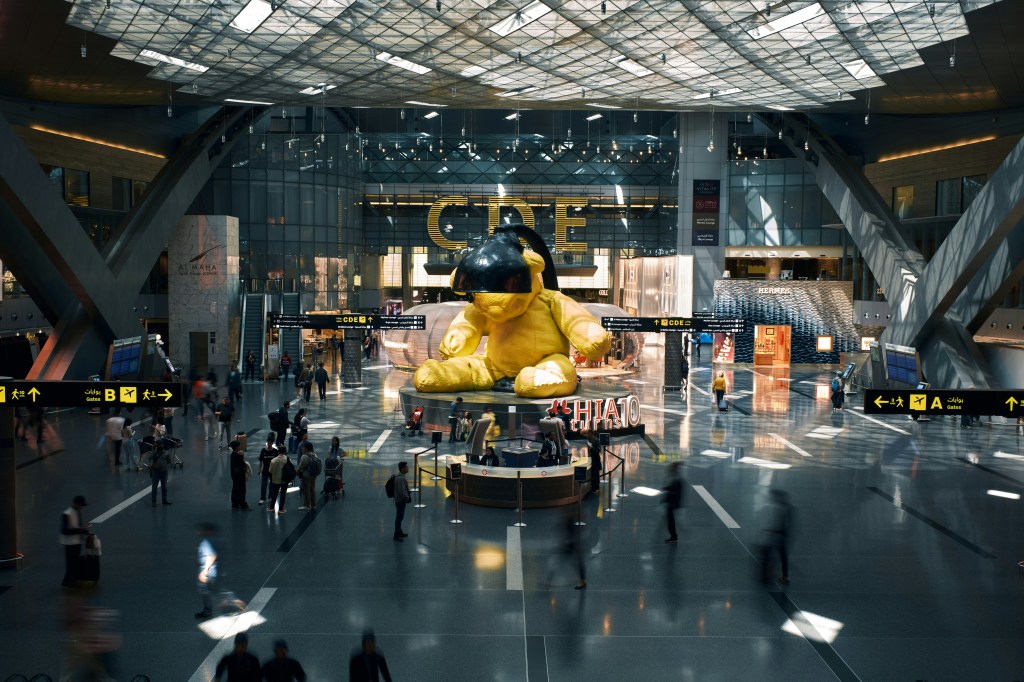
As we walked away and neared the Doha transit area with the creepy giant yellow teddy bear with a lamp coming out of its head, we tried to figure out what we had just witnessed. 

But the absurdity of it all was overtaking me. I leaned over to my wife, smiling. 

“Take a sip of da wata, ma’am. Is fo yo children,” I said, able to nail the accent because I’d heard the man say that phrase so many times.

She glared at me. I burst out laughing, as did the kids. Eventually, my wife cracked a smile as well. 

Were you to hang out with our family, you might hear this particular quote thrown out now and then. It’s been added to the extensive lineup of inside quotes always on hand, added to other classics like, “Goodbye boys, have fun stormin’ the cyastle!” (Princess Bride), “What abou’ them? They’re freeesh.” (The Two Towers), and “It’s a donkey bazaar” (Central Asian proverb). 

In light of the ever-shifting and often-dehumanizing procedures of air travel, it’s important to learn how to laugh at stuff like this. Why did that airport security man try to turn my wife into the sacrificial cupbearer of my family’s water bottles? I don’t think we’ll ever fully understand. But neither will he ever understand the legendary status he has now achieved in our family banter. 

“Take a sip of da wata ma’am. Is fo yo children.” 

Yes, African Doha airport water man. Your words will endure far beyond what you could have ever imagined. 


Happy New Year, friends! May your 2026 be a year full of the Lord’s kindness to you.

If you have been helped or encouraged by the content on this blog, would you consider supporting this writing and our family while we serve in Central Asia? You can give here through the blog or contact me to find out how to give through our organization. 

One of the international churches in our region is looking for an associate pastor and our kids’ TCK school is also in need of teachers for the 2026-2027 schoolyear. If you have a good lead, shoot me a note here.

Blogs are not set up well for finding older posts, so I’ve added an alphabetized index of all the story and essay posts I’ve written so far. You can peruse that here

For my list of recommended books and travel gear, click here.

Photo from Unsplash

When to Put Salt in the Guest’s Shoes

“Guests are like fish. After three days, they begin to stink.” 

I’m not sure when I first heard this saying, but it sheds light on an experience that seems to take place in every society. Sometimes guests come to stay. And then end up overstaying. Every culture has these sorts of guests who stay, and stay, and stay. And every culture, at some point, develops strategies to try and get rid of them. I’ve heard that some villages in our corner of Central Asia would secretly put a little bit of salt in the shoes of overstaying guests. Allegedly, the salt would somehow trigger a desire in the visitors to depart back to where they had come from. I didn’t know about this practice back when we had a local friend unexpectedly move in with us for nine days. But had I known of it, I just may have tried it. 

Jonathan* was a quirky believer who lived several hours to the south of Poet City*. He had come to faith while a university student in Poet City, and I had gotten to know him during my gap year on the field back when I was a single 20-year-old. To his great credit, Jonathan persevered in his faith when he moved back to his conservative desert city, even though there wasn’t even so much as a secret house gathering there for believers. To this day, there still isn’t. Instead, for his encouragement, Jonathan would travel up to Poet City every few months to worship with believers, to hang out with friends from his college days, and to ask around about jobs that might allow him to move. Understandably, Jonathan hoped to one day live in the more progressive Poet City and to escape the stifling heat and even more stifling Islamic culture of his hometown. 

So, during our first year on the field, when Jonathan contacted me, told me he was coming to town, and asked if he could spend the night at our house, I quickly agreed. Locals in our area are traditionally expected to extend honorable hospitality at the drop of a hat. We weren’t set up super well for hosting overnight guests in our open-concept two-bedroom flat, but we could figure something out for a night or two. After all, we thought, this would be a good cultural experience for us as a new family on the field. 

What I didn’t think to ask myself was why Jonathan was asking for help from us, of all people, brand new foreigners, when he had a decent network of college friends and believers that he already knew in the city. Was there some reason others were not willing to host this seemingly kind and respectable man? No, we didn’t think to ask these questions that more experienced missionaries might bring up. My wife and I simply wanted to try to do what we thought was the honorable contextual thing and host a friend who asked to stay with us. 

On the first evening, I picked Jonathan up from where he was hanging out at a popular row of teahouses and brought him back to our place for supper. Our meal together went well. Jonathan was peculiar in personality, oddly swinging between being very polite and being somewhat blunt. Yet overall, he was a kind and enjoyable dinner guest. 

After supper, Jonathan asked me if I could take him out to buy some peanut butter. At the time, this Western grocery item was only present in the bigger cities, and not where Jonathan lived. But apparently, Jonathan really loved him some peanut butter. So, we went peanut butter hunting and then went out to drink some tea with some of his college friends. 

Jonathan had come to town during the peak of the summer heat. We only had one air conditioner that could work at night on our 10 amps of neighborhood generator electricity. This was the unit in our master bedroom. Because of this, we made the summer nights more manageable for our little family by setting up a fan to blow the cooler air from our room into the kids’ room that was directly next to ours, the air-conditioned air being pushed from room to room through the open doors that met at a corner. 

That first night, we set Jonathan up in our living room as best we could, apologizing that all we could offer him for the night heat in that more private part of the house was a fan. However, since Jonathan was from a city far to the south of us that is much hotter than Poet City, we thought he should pass the night comfortably. We said goodnight and all turned in for the night. So far, so good. We went to bed feeling like decent hosts.

However, it wasn’t long before we heard some loud noises that sounded like porcelain being knocked around. My wife and I sat up in bed and looked questioningly at one another. What was that sound? I crept out of our room to find Jonathan, one leg stretched high, pant legs rolled up, washing his socks and a foot in the porcelain sink outside our little toilet and shower rooms – the same sink where we washed our hands and brushed our teeth. He was doing this so aggressively that the little sink was rocking back and forth on its porcelain stand. This, of course, was what was causing all the midnight racket. 

I thought this was odd. My wife thought it was downright gross.

“Tell him he can wash his feet in the shower room!” She whispered to me urgently when I told her what was happening.  

“Tomorrow. I’ll tell him tomorrow,” I assured her, still trying to make sense of the odd midnight scene I had just witnessed.

We settled back in to try to get to sleep when we were again woken up by the loud clanging of our roof door opening. It appeared that Jonathan had gone up to the flat roof to smoke a late-night cigarette. Smoking is still very common in this part of the world, even among believers, so we didn’t think too much of it. But as the hours passed, we noticed that he seemed to go up to the roof many times for many more late-night cigarettes. He also made what seemed like dozens of trips to the bathroom, which was right next to our bedroom. Eventually, sometime in the early hours of the morning, he at last settled down.  

The next the morning, we asked Jonathan how he had slept. 

“I slept very poorly, due to the heat.” 

Huh, I thought to myself, that’s a little more blunt than I was expecting. And strange that it affected him so much, given how locals are more comfortable in the heat than we are.

“Sorry about that, brother. We heard you up in the night a lot and wondered if it might be because of the heat.” 

“I was also feeling some indigestion, however, from the dinner you served me last night.” 

Wow, I thought to myself again, blunt again. Even in the non-hospitality-oriented West, most guests would at least state this indirectly and let the hosts put the pieces together. 

“Sorry again, our food is maybe a little different from what your stomach is used to.”

I shot a glance at my wife, who was doing her best to wrangle our toddlers and their breakfast demands while also laying out a generous spread of breakfast foods for our guest. Jonathan didn’t seem upset necessarily, just direct and a little condescending. Not unlike a teacher who felt it his duty to correct his students when they gave an incorrect answer. He was a teacher, in fact, newly hired at a private language institute in his hometown.

“Jonathan, would you like yogurt, or eggs, maybe an omelet?” My wife graciously offered. 

“No thanks, just peanut butter, thank you.” 

I saw my wife’s shoulders droop just a little as she realized her generous breakfast spread was all for naught.

After his quick breakfast of peanut butter and a little bit of local bread, Jonathan went outside for another smoke. 

“Well… that was a little rougher than I was expecting,” I said to my wife. 

“It’s okay,” my wife said. “Glad we could host him. Do you know what time he’s heading back to his city today?” 

“No idea, but I’ll try to find out indirectly when I drop him off in the bazaar.” 

To ask Jonathan directly, of course, would imply that we were not happy to host him as long as necessary, and would be very shameful. 

So, when Jonathan and I were close to the market, I tried to get the relevant info out of him. 

“So, what are your plans for today?” 

“Well, I have some shopping to do in the bazaar, then I’ll be meeting up with some friends. Could you pick me up for dinner tonight? 

“Um, yes… yes I can. So, will you be staying longer in Poet City?”

“Oh yes, yes, of course, I don’t want to go back home yet. I am looking for a job. Is it alright if I stay with you again tonight?” 

“Of course it is!” I answered, trying my best to play the honorable and generous host. But something in my stomach told me that we might have gotten a bit more than we’d bargained for in agreeing to host Jonathan in the first place. 

We went out to eat that night and paid for Jonathan’s meal. Strangely, he didn’t argue with me to pay for the bill, as would be customary when friends go out to eat together. I took note, but mostly wrote this off as some dynamic of hosting that we hadn’t learned about yet. 

When we got back to our place, we offered to set Jonathan up in our kids’ room so that he could have the cold air from the one AC unit blown in via our fan setup. Our two-year-old and four-year-old would sleep on floor mattresses in our room. This would mean closer quarters all around, but our family and Jonathan would still have at least a little bit of privacy since we were in different rooms. I was also sure to point out the shower room foot washing options for Jonathan.

However, just after we had gone to bed, Jonathan soon began his same sink foot washing, rooftop smoking, and bathroom routine. After what seemed like hours of this, we finally drifted off, praying for God’s help to be gracious hosts. 

At some point in the middle of the night, my wife shook me awake and pointed. There, on the floor and poking into our bedroom door, was Jonathan’s head, fast asleep and snoring. It took me a minute to realize what I was looking at. Even though the kids’ room was almost as cool as ours, Jonathan must have decided that he needed to be as close as possible to the coolest air, so he moved his sleeping pallet so that he was sleeping with the bottom half of his body in the kids’ room, his upper half just outside the doorframes, and his head stuck just inside our room. He was definitely asleep, but it was a bit unnerving nonetheless to have his head, well, just there, poking into our bedroom. 

The next morning, however, Jonathan seemed downright chipper. We, on the other hand, were starting to feel the toll of hosting. Still, we managed to have a pleasant (simple this time) breakfast together and to get some helpful advice from Jonathan about the local language. 

Second day, same routine. My wife asked me to find out Jonathan’s plans. I tried to do so indirectly. Jonathan ended up asking to stay with us another night. He continued his peculiar nighttime habits, including sleeping with his head just inside our door. My wife and I slept fitfully and woke feeling worse than the day before. 

This went on for nine nights.

Nine. Long. Nights. 

My wife and I soldiered on, but soon began to feel not unlike like Gandalf after his deadly battle with the Balrog.

Darkness took me, and I strayed out of thought and time…”

Eventually, even Jonathan began to pick up on the fact that we were struggling to remain energetic and joyful hosts. 

On day eight, at breakfast, he went into teacher mode again.

“You know, in my culture, it’s very important that you reassure a guest over and over that they are not causing any trouble to you. Otherwise, they may begin to feel insecure about the warmth of their welcome.” 

My wife, fearing her emotions might be displayed a little too obviously on her face, made a quick about-turn for the kitchen.

I took a deep breath and tried to answer in some way that was still kind, but which perhaps hinted at the fact that Jonathan’s welcome was indeed no longer as warm as it once was. 

“Yes… um… thank you for the advice. That’s good to know… Will you be needing a ride to the bazaar today?”  

By this point, we were getting desperate. We needed to find an honorable way out of this situation – and fast. Our little family was at the end of our rope. Our kids were exhausted from sleeping on the floor of our room. My wife and I were exhausted from having them in our room every night – not to mention the nightly presence of Jonathan’s head. We were burning through our meager finances with all of the extra food costs we were incurring. And Jonathan continued to not offer to help with any of these costs, despite regularly asking to eat out together. 

Our guest also showed no indication that he was planning on going back home anytime soon. He kept saying that he was hoping to find a job, but he was not doing any actual job searching. It slowly became clear that he was, in fact, waiting for me to find him a job and a place to rent. Until that happened, it seemed his plan was to just extend his stay with us. 

Clearly, whatever Jonathan’s assumptions were about this whole arrangement, they were wildly different from ours. We just thought we were hosting a believer for a couple of nights. But somehow, we had unwittingly become some kind of patrons now responsible for finding work and housing for our peculiar house guest. We were all for helping a brother out in reasonable ways, but we were in no position to find him long-term work and housing.

Jonathan didn’t seem to be picking up on the many ways we were trying to indirectly and honorably communicate that even though we were hypothetically ready to host him as long as needed, we were not actually able to host him any longer. Even when our indirect communication started becoming more and more direct, he still wasn’t getting it. No, we realized, we’d need to find some way to kick our guest out and still save some face for all parties involved. 

The answer came through a teammate. They were shocked to learn that a local had actually stayed with us for over a week. This was not normal, even for locals hosting other locals. Something was off. This teammate suggested that our family take a trip out of town, and thereby force our guest to figure out different lodging. Thankfully, we did have a trip we had been needing to take to a different city for some government business. By bumping it up a little, we had found a way out. In our local culture, having guests is the kind of thing you can use to get out of almost anything. But if you need to get out of having guests, apparently, having a trip is the magic escape key.

Jonathan did not take the news of our departure very well, seeming at last to understand that we really weren’t holding out on him and we really couldn’t help him in the way he had hoped. He told me that he didn’t have enough money to afford more than a couple of nights at a cheap bazaar hotel and that none of his friends were willing to host him. So, we helped him pay for a night or two at a little hole-in-the-wall hotel. 

As I dropped him off late at night, I felt bad for Jonathan. He seemed pretty down. Things were still respectful between us overall, which I was thankful for. Jonathan still vacillated in his speech between a strange bluntness and an odd propriety. But he did, in the end, say the things he was supposed to say as a guest. We also did our best to tell him how honored we were to host him – even if we were by that point on the verge of tears of utter exhaustion. 

That night, in the absence of feet in the sink, 3 am smoke breaks, and snoring heads poking in the door, my family slept like the dead. 

Looking back, I’m still not exactly sure what to make of Jonathan’s stay with us that summer. Perhaps he was simply wired to miss the normal social cues governing most local hospitality? Perhaps we were sending the wrong signals? It was hard to say, but the fact that he couldn’t find any local friends to host him was an indicator that it wasn’t just us. It seems that Jonathan had overstayed his welcome with others before as well. That meant that he was either of the type who had learned to abuse the local culture of hospitality, or that perhaps something else was going on that meant that, even though he was a local, he didn’t really know (or sense) the rules.

Believe it or not, we did have Jonathan stay with us a couple more times after all of this. But I had learned my lesson and was clear to tell him a certain number of nights we could host, one or two, and to set expectations accordingly. This sort of approach seemed to go much better.

And I think we would still host him if he ever came to Caravan City, albeit with some fear and trepidation. And boundaries. Very clear boundaries.

In all this, we learned that in a culture that extends lavish offers of (often unsustainable) hospitality, there will always be people who, wittingly or unwittingly, take advantage of this. Finding kind and honorable ways out of this is therefore a top priority for all who attempt to extend these offers that most take hypothetically. Because some will take you literally.

When that happens, you just might have to put some salt in their shoes. Or, in case that doesn’t work (and it probably won’t), you can always do as we did – and make an honorable run for it.


*Names changed for security

If you have been helped or encouraged by the content on this blog, would you consider supporting this writing and our family while we serve in Central Asia? You can give here through the blog or contact me to find out how to give through our organization. 

Two international churches in our region are in need of pastors, one needs a lead pastor and one an associate pastor. Our kids’ TCK school is also in need of a math and a science teacher for middle school and high school. If you have a good lead, shoot me a note here.

Blogs are not set up well for finding older posts, so I’ve added an alphabetized index of all the story and essay posts I’ve written so far. You can peruse that here.

For my list of recommended books and travel gear, click here.

Photo from Unsplash.com

All My Plans up in Smoke

Early on in my 11th-grade year, an older TCK in his twenties, an alumnus of our school, came back to visit. In the years since he had graduated and left Melanesia, he had joined the US military and become a member of Marine Recon. These are specialized Marines who carry out reconnaissance and combat missions similar to those of the US special forces.

During his visit to our missionary base, he met with me and several others who were getting close to graduating, telling us stories from his different missions and sharing how growing up as a missionary kid had been such an advantage for him in his overseas deployments. He told us how he had specifically thrived in the missions where they had been tasked to work alongside militia units from other countries like Yemen and Afghanistan, as well as how hungry many of his fellow soldiers were for spiritual truth. Because of this, he advised us to seriously consider whether or not God might want us to try to join elite units such as the Army Rangers, where we could maximize our cross-cultural skills, serve our country, and, after proving ourselves good soldiers, powerfully share the gospel with our brothers in arms.

One of the high school seniors and I, in particular, were seriously drawn to this idea. After this older TCK left, we continued to discuss it and to pray about it for several months. While the enthusiasm of this other student eventually cooled, I began to feel a deep conviction that this was exactly what the Lord wanted me to do. I had a natural love for adventure and a desire to overcome difficult challenges. I thrived in cross-cultural settings. I wanted to be in some kind of setting where I could be an evangelist. And my dad had been a Marine. In fact, this is where he had come to faith. The discipline, camaraderie, and mission focus he had learned in the military had deeply shaped his Christian faith and ministry. Looking back, I’m sure a large part of my motivation was also that I simply wanted to be like my dad, who had passed away when I was still very young.

But there was one problem. I had, and still have, exercise-induced asthma. The older TCK veteran had told me that this can sometimes be a disqualifying problem, but that he also knew soldiers who carried inhalers with them. So that I could be sure of the official line, I reached out to a recruiter via email. To my relief, the recruiter reassured me that my asthma would not be an issue at all.

This, I would later find out, was a lie. I didn’t yet know that US military recruiters have a reputation for saying all kinds of things in order to meet their quotas of new recruits, even things that are completely untrue (a friend who later joined the Navy also found out after he was in that a bunch of the promises he had been made were completely bogus). Not knowing this, however, I settled in my conviction that this was the path I was supposed to pursue, instead of going to university or Bible college like almost all of my classmates would. One practical upside of this, I claimed, was that I’d be able to use the GI Bill to pay for my college degree afterward.

The next year was spent going on long runs through the surrounding banana and coffee gardens, doing pyramid-style workouts, reading up on CS Lewis’ support for Christians joining the military, and arguing with many of my classmates, and even some of the adult missionaries, who disagreed with this vision for my future.

“My last job before I left the army was driving around the countryside in a jeep picking up kids like you who broke their legs after jumping out of planes in Airborne training,” one missionary uncle said, pointedly.

Even some of my closest TCK friends were deeply opposed to me pursuing this path. As was my older brother, who was a college student back in the US. He had serious questions about the morality of the US conflicts at the time that I would be called to participate in. But I was unshaken. God, whom I believed was leading me, was sovereign. And CS Lewis, after all, was on my side (although Jim Eliot was not), as were my Melanesian friends. I also had a sense that this path powerfully combined many aspects of my story and how God had wired me.

This being the case, I pursued this plan single-mindedly until it was the final semester of my senior year, and all the deadlines for college scholarships had passed. It was at this point that, for some reason, I emailed a different recruiter. This man was the one who told me the truth. Asthma was absolutely a deal breaker. No one who openly admitted to having asthma, even mild asthma, would be accepted into the US military. I had two options, he said. I could lie about it on my application. Or, I recall him writing, “If you still really want to serve your country, you can always join the State Department.”

The State Department? I had no interest whatsoever in joining that boring-sounding entity, whatever it was. And I definitely wasn’t going to lie. How could I claim to be going into the military to be a faithful Christian witness, yet willingly sin to get into the military in the first place? No, I had been utterly misled, and the path I had been wholeheartedly pursuing for over a year had suddenly come to a dead end. Perhaps I had been naive and full of youthful idealism. Perhaps I should have figured out the lie sooner. Whatever the case, I felt a growing numbness in my head and a sinking in my stomach as all my plans suddenly went up in a plume of smoke and darkness. I had been so sure. And now? I had absolutely no idea what I was supposed to do.

For the next several days, I walked around in a fog of disappointment and disorientation. My friends and teachers were kind about it, but many also, understandably, seemed relieved. One of the hardest parts of it all was wrestling with what had seemed so clearly to be God’s leading. If it had been God, why had the door he seemingly pointed to been abruptly slammed in my face? Had I completely misread what I’d thought had been God’s will? What if it had been simply my desires masquerading as God’s leading the whole time? Had God tricked me?

One afternoon, I sat at our dining room table, sifting through a pile of the promotional college material I had received. It was all too expensive, and all too late. I threw one glossy brochure after another into a pile, when I suddenly came across a simple paper flyer I had completely forgotten about. It described a new freshman year program being started at Bethlehem Baptist, John Piper’s church. It was called INSIGHT, which stood for “Intensive Study of Integrated Global History and Theology.” Basically, it was a Christian worldview program that would emphasize history, theology, and missions.

As I sat there looking at this piece of paper, I recalled when my Government class teacher had passed out these flyers. I had turned to my close friend, Calvin, with whom I would exchange CDs of Piper sermons, and said, “If I weren’t going into the military, this is exactly the kind of thing I might like to join.”

That moment and that conversation had been filed away in my brain for eventual deletion. But it came back to me as I wondered if Bethlehem might still be receiving applications. We inquired, and sure enough, they were still taking students for their inaugural year. It was remarkably affordable, always a plus for a missionary family like ours. It was connected to a ministry I was beginning to be deeply shaped by. And while Minneapolis might not be quite as exciting as jumping out of airplanes, I did find a year of intensive reading and discussion about history, theology, and missions to be an exciting prospect of another sort.

It wasn’t long before I was Minneapolis-bound, still reeling a bit from all my plans having gone up in smoke, but genuinely excited about what my freshman year would have in store. Little did I know that year in Minneapolis would be one of the most formative of my life. There, my long combat with the doctrines of grace would finally be settled. It was there that I would make my first Muslim friends and receive a calling to work among unreached Muslims. And it was in Minneapolis where I first heard about a particular corner of Central Asia, and how they needed young people to go spend six months to a year there, doing development work, making friends, and telling people about Jesus.

Truth be told, I still wondered sometimes about that military road not taken, and what would have happened had I been able to join the Army Rangers after all.

One day, early on in Poet City, I had the chance to talk to some members of the US military who were deployed in the region. Somehow, we found out that a couple of them were believers, and they found out that we were not just relief workers, but missionaries. I’ll never forget when one of them told me how badly he wished he could be in my place – free to mingle, to make friends, and to share the gospel. It struck me because there was still a large part of my heart that wished I could be in his place.

The Lord knew exactly the roles that soldier and I needed to be in. And my role, apparently, was not to share the gospel while jumping out of airplanes. Rather, it was to live in one of those very same regions where I might have served as a soldier, but sharing the gospel with a chai cup, rather than a rifle, in my hand, jumping in and out of cigarette smoke-filled taxis rather than C-130s.

As the proverb says, “The heart of man plans his way, but the Lord establishes his steps.” To this day, I still maintain that my initial plans had been good. But clearly, God’s plans had been better.

Friends, if all your good plans have similarly gone up in smoke, take heart. It really is a blow when this happens. But in it, God is painfully revealing to you his better plans. One day, you will wake up to suddenly find your steps mysteriously and wonderfully established – and then you’ll marvel at the goodness of God in blowing it all up.


If you have been helped or encouraged by the content on this blog, would you consider supporting this writing and our family while we serve in Central Asia? You can give here through the blog or contact me to find out how to give through our organization. 

Two international churches in our region are in need of pastors, one needs a lead pastor and one an associate pastor. Our kids’ TCK school is also in need of a math and a science teacher for middle school and high school. If you have a good lead, shoot me a note here.

Blogs are not set up well for finding older posts, so I’ve added an alphabetized index of all the story and essay posts I’ve written so far. You can peruse that here.

For my list of recommended books and travel gear, click here.

Photo from Unsplash.com

Why the Villagers Demanded Bible Teaching… and Ate Our Dog

When I was a two-year-old, my family lived in a highland village of Melanesia. We were only there for one year, living in another mission agency’s house while they awaited the arrival of a new family from Australia, and while we waited for an additional missionary house to be built in a small government station town about twenty minutes up the road.

My first memories are from this village missionary house. It perched on a gentle slope overlooking a broad valley of coffee gardens, banana trees, and endless wrinkles of little grassy or wooded ridges interwoven with rivers and streams as far as the eye could see. The sunsets were incredible.

From that house, I remember one of my older brothers showing me how to climb up onto the kitchen counter so we could get a sneak peek at my birthday cake, hidden up high in a cabinet. I remember Christmas morning, and trying to ride my new bike (with training wheels) down the wooden hallway. I remember swaying in the hammock outside, side by side with the kind local man who worked for the mission, maintaining the property. And I remember one day when that hammock broke on us and we suddenly plummeted to the ground.

Like most who served in that country, the missionaries who previously lived there had a dog on the property for security. This dog was a large rottweiler named Yankee. He is the first dog that I remember, and to me, he always seemed like a gentle, if smelly, giant. To this day, the pungent smell on my hand after petting a large dog long very much in need of a bath takes me back to those early years, and to memories of hanging around property with the local workman and Yankee the rottweiler.

While there, we also got a blue heeler puppy that we named Toro, who ended up not nearly as kid-friendly or mentally stable as Yankee was. Perhaps this was because the older and bigger Yankee would steal food from the puppy Toro’s bowl when we weren’t looking. Both of these dogs would eventually come to sad ends. Toro ended up dying later because he was a real punk of a dog who liked to hang by his teeth from the trunks of palm trees and didn’t know when to not pick a fight with stronger dogs. Yankee ended up dying, well, as a sort of sacrifice, which perhaps makes up for his crimes of stealing food from a puppy.

After the new missionary family arrived from Australia and we moved out, our families became fast friends. We lived pretty close to one another, and their kids were around the same ages as my brothers and I were, so we attended one another’s birthday parties and played Legos, pirates, and Star Wars together. These Aussie missionaries tried earnestly but in vain to teach us the proper way to pronounce ‘water.’ “It’s not waaderr, it’s woltuh.” At least we weren’t pronouncing it in the Philly way, like our dad’s side did, which was wooder. At that point, I couldn’t pronounce any of my R’s anyway, so no matter what accent I chose, it tended to just come out as waddle.

In those years, the dad of this family miraculously survived two events. First, he survived being struck by lightning. One day, he was hammering tent pegs out in the yard as rain clouds rolled in, when a lightning bolt struck the corrugated metal roof of the house, shot through the hammer in his raised hand, and plunged into the dirt of the yard. Uncle Phil, as we and the other MKs called him, survived this, shaken but okay. But Poor Yankee was left blind because of his proximity to the strike.

According to the beliefs of the local villagers, anyone whose house was struck by lightning was doomed, cursed by the spirits to die. So, they waited with certainty for Uncle Phil’s death. In their experience, no one was powerful enough to escape this doom once the lightning had struck. They must have seen this happen enough times because by that point, they believed, with deep tribal conviction, that this was simply the way the world worked.

Not long after this, the omen seemed to come true. Uncle Phil, his pickup, and the trailer he was towing for another missionary family slipped off the slick clay road and went rolling down the side of a mountain to certain doom. The road he went over the side of had a steep drop-off on one side, similar to the ones that I used to peer over in fear when my family would drive through the mountains (I still occasionally have dreams about these kinds of highland drop-offs and the car I’m in careening over them).

Anyone who looked down that long, steep slope and saw the pickup smashed at the bottom would have thought that he was a dead man. But amazingly, Uncle Phil crawled out of the crumpled vehicle still alive. He hadn’t had his seatbelt on, so when the truck went over the edge, he had been jostled in between the two front seats, where he had been protected from the metal and glass that had been smashed inward by the car’s long roll down the mountainside. He was quickly medevaced to Australia, and word of the accident was sent back to the village.

The villagers, of course, were certain that he would die and they would never see him again. But Uncle Phil did not die in Australia. He came back, alive and well. They had never seen anything like this. No one, in their long experience and oral memory, no one had survived the death sentence that came about after having their house struck by lightning. There must be something very different about this happy Australian Christian man. His Jesus must be more powerful than even the most powerful laws dispensed by the local spirits of the trees, rivers, and mountains.

This is how a church was born in that village. My parents had led one man to faith in the village during our year there. He, in turn, had led two more to faith. But when Uncle Phil got back, the village demanded multiple Bible classes every week. Even though Phil and his wife hadn’t yet mastered the tribal language, the requests were so strong that they went ahead with the teaching both in the trade language and, with the help of the first believer from the village, the tribal language as well.

As is so often the case in fear-power contexts like Melanesia, a demonstration of Jesus’ superior power is what the Spirit used to shock the locals awake so they would take the gospel message seriously. It’s not so very different from what often happens in Central Asia when Muslims have dreams. It’s not the only way the Spirit vindicates the gospel in these sorts of contexts, but it does seem to be one of his favorite approaches.

Sadly, this story is also how the very good boy, Yankee the rottweiler, met his end. After the lightning strike, blind Yankee was no longer a very useful guard dog, or really able to do very much at all. So, in a village area where locals struggle to get enough protein, and where their kids have large distended bellies from poor nutrition, Yankee was put down and given to the village for sustenance. It must have been a hard call for Uncle Phil and his family, and one I’m not sure I could have made. But I’m sure their hope was to be as good a steward as they could be of everything God had given them to reach the villagers, even their now-blind dog.

And thus a lightning strike led to the birth of a new church and the tragic end of old Yankee at the same time.

There are probably not many dogs in history who played a part in missionary breakthrough. John Paton’s little terrier, Clutha, comes to mind. But perhaps there is some kind of hall of honor in the New Jerusalem for good doggos that played faithful roles in the spread of the gospel. If so, I hope Yankee gets a mention there.


If you have been helped or encouraged by the content on this blog, would you consider supporting this writing and our family while we serve in Central Asia? You can give here through the blog or contact me to find out how to give through our organization. 

Two international churches in our region are in need of pastors, one needs a lead pastor and one an associate pastor. Our kids’ TCK school is also in need of a math and a science teacher for middle school and high school. If you have a good lead, shoot me a note here.

Blogs are not set up well for finding older posts, so I’ve added an alphabetized index of all the story and essay posts I’ve written so far. You can peruse that here.

For my list of recommended books and travel gear, click here.

Photo from Unsplash.com

How I Became A Yogurt Water Drinker

It was a hot and dusty August seventeen years ago when I became a yogurt water drinker. For my first nine months in Central Asia, I had steered clear of the stuff. Like most Westerners, I couldn’t quite figure out what to do with the concept of drinking yogurt, complete with ice chunks, dill, and a pungent, smoky-sour-salty flavor.

But we do not live in a world where our tastes or dislikes are forever fixed and unchangeable. No, all it takes is the right mysterious combination of factors and, suddenly, we love something we used to hate. I never cared for eggplant, for example. But a Lebanese restaurant I once ate at grilled it so perfectly crisp, so expertly salted and spiced, placed on top of a salad itself bursting with flavor, that I found myself really enjoying that bite of eggplant. After that experience of tasting the delights of what English speakers in other lands call aubergine, I was a changed man. Now, I even enjoy the mushy stuff. The same thing happened to me with mushrooms the first time I had them on top of pizza.

It seems there’s something about experiencing a thing in just the right context that can pull a 180 for the mind, affections, and taste buds, and unlock previously unknown delights.

The context that made me a yogurt water drinker was a miserable one. It was mid-August, well above 100 degrees Fahrenheit (38 °C), and I was taking an intercity bus trip. I was on my way from Poet City to a tiny village with a name that translates as ‘Matches’ (the kind that come in a box) to visit a strange mullah friend I had there. This man was strange because he was the only devout Muslim I had ever met who subscribed to a minority view that the Qur’an teaches that Jesus actually did die on the cross. He was also strange because of his over-the-top poetic proclamations he would make in place of normal conversation or even the normal Central Asian honorable verbosity.

“You are my brother and your mother is my aunt and I will plant a garden for you in my heart and place a chair in the garden where you will sit and little butterflies will fly around youuuu, ahaha!”

Like I said, this friend was strange. But after I gave him a Bible in his language on his previous visit and we pulled an all-nighter discussing its contents, he requested I bring him one in Arabic and English also. I was willing to endure the cringy proclamations of his affection for me if it meant getting to talk more with this mullah about Jesus.

In order to get to Matches village, I first needed to go to the bus terminal, where drivers would holler out the name of their destination city repeatedly in a sort of chant. “Philly-Philly-Philly-Philly-Philly-Phillyyy!” for example. I boarded the bus for the city closest to my destination, paid $5 or so, and went to sit while the driver waited for the bus to fill up with other passengers.

It only took a half hour or so for the bus to fill up enough to justify the trip, but by that time the backs of all of our shirts were drenched with sweat. The bus rumbled and groaned onto the simmering intercity roads, and we were off. There was no AC in this bus, so most of us kept our windows cracked open. Even the hot blaze of the summer afternoon wind was better than no air at all. It was not long before all of us in that bus became, as I once told the story to my kids and their classmates, the human equivalents of soggy dumplings.

The drive was about two hours long. On the way, we passed melon and sunflower fields, little rivers, parched brown mountainsides, and the muted greens of their squat scrub oaks. I spotted numerous storks as well, the leggy pilgrims, as the locals call them, and the massive nests they build this time of year on top of the electricity towers. Even in the fever heat of summer, this high desert land was not without its beauty.

About halfway through the drive, we pulled over at a little dusty rest stop in an area where dry reeds lined the sides of the road.

Some things feel the same no matter what culture you’re in. Whether getting off a midnight Greyhound in Milwaukee or an old Toyota Coaster bus in Central Asia, the body language of passengers thankful for a break is the same. Slowly but surely, all of us soggy human dumplings ambled off the bus, off to the squatty potties, and into the plastic chairs set up on a cement patio nearby. This porch area was shaded by a roof made of woven reeds, a criss-cross pattern that I noticed looked just like those used for the village house walls in the Melanesia of my childhood. There were also a few ceiling fans, nobly doing their duty to shove the hot air around a little bit, in spite of the tremendous odds stacked against them,

I glanced around at the other passengers, mustachioed men in collared shirts and parachute pants and women in their head coverings and long, modest attire. We were cooked, no way around it. And there seemed to be nothing we could do about it.

Then, and without being asked, small plastic buckets were set on the little chai tables in front of each of us. The buckets were pink or blue, and each had its own little ladle. Inside the buckets was ice-cold yogurt water, sloshing around a big frozen chunk in the middle. As I’ve already said, I was at this point not a fan of yogurt water. But it was at least cold, perhaps the only cold thing for hundreds of miles…

So, I dipped the ladle in the creamy substance and put it to my lips.

Bliss.

Sweet, icy, creamy, sour bliss!

I drained my little bucket quickly, as did all the other happily slurping passengers. Every sip of that ice-cold yogurt water was like a little sip of heaven.

You know that Bible story from 1st Samuel where Jonathan eats wild honey during a battle and his eyes brighten? That’s a very good description of what that yogurt water did to me in my soggy dumpling state. My eyes (and my mood) certainly brightened. Even more, my taste buds were converted. What before had not been appetizing was now, because of a surprising yet effective context, suddenly and ever afterward delicious. I got back on that bus a changed man.

And that’s how I became a yogurt water drinker.

I often think back to that little roadside patio when I take a sip of yogurt water and still find myself enjoying it. How interesting that our natural tastes can be so thoroughly transformed and reversed. It gives me hope that someday I may be able to enjoy those good foods in God’s creation that I can’t yet endure. I’d love to be able to really enjoy super spicy foods, for example, though so far this hope has been in vain. Yes, I am one of those guys who needs to ask for the lowest level of spiciness when eating Indian or Thai food. I’m doing my best, but alas, I can’t seem to will my taste buds to do anything other than burn and protest.

However, it’s not just our natural senses that harbor this potential. We live in a world where our spiritual tastes can also be reversed. What to the natural man is bitter, the man with a new heart finds deliciously refreshing. If the power of a sweltering desert road trip can change me so that I enjoy something I had previously hated, how much more can the power of the Holy Spirit take sinners who deeply hate the aroma of the truth and make them into those who “taste and see that the Lord is good?”

I don’t lose hope for all my Western friends who still can’t stand the taste of yogurt water. Nor do I lose hope for my unbelieving friends who can’t stand the taste of God’s justice and grace. Turns out the taste buds of our tongues can be radically changed. So can the taste buds of our souls.


We are now fully funded for this next year on the field! We’re so thankful for so many who have given and prayed and sent us encouraging notes in this season of support raising. Of course, if you’d still like to contribute to our work, that is still helpful and you can do so here through the blog or contact me to find out how to give through our organization. Would you join us in thanking God for his generous provision?

Two international churches in our region are in need of pastors, one needs a lead pastor and one an associate pastor. Our kids’ TCK school is also in need of a math and a science teacher for middle school and high school. If you have a good lead, shoot me a note here.

For my list of recommended books and travel gear, click here.

Mics in The Water And Other Baptism Blunders

This may sound odd, but if you ever plan on baptizing someone – meaning you yourself are the one to put them under the water – then you would be wise to get some practice beforehand.

All kinds of things can go wrong when immersing someone in the name of the Father, Son, and Holy Spirit. Just to mention a few of the mishaps that have occurred when I’ve baptized others, there was that one time when we baptized someone in moving water but didn’t think about how she was facing upstream. This meant that the river water not only went up right up her nose but, she claimed, all the way up into her brain.

Then there was the time we planned a baptism service in January with the assurance that the host would heat the water in the kiddie pool outside. After we arrived, he informed us there had been no electricity all morning. That meant the new believers coming up so symbolically out of the icy water also came up shrieking like Nazgul.

Another time, we failed to get a local believer’s kneecaps under the water when we dunked him. Hopefully, that doesn’t mean he’ll be raised without these crucial joints in the new heavens and new earth.

Neither am I alone in committing these kinds of baptism blunders. It’s not uncommon for the baptizer to botch the trinitarian formula in the excitement of the moment and suddenly find himself sounding like a modalist. Nor is it uncommon for the baptizee to forget to plug their nose and bend their knees, the latter of which means their legs fly up as their torso goes down, while the baptizer scrambles to not themself get pulled under. Even worse, baptizees who wear white garments experience a real-life version of that terrible dream where, for some reason, you’re in front of the church wearing only your skivvies.

All of this is exactly why my pastoral ministry professor in college took our class out to a local church so we could practice ‘baptizing’ each other. He warned us of many of the common blunders, taught us a tried-and-true technique for the actual physical dunking itself, then had us practice on one another. This was solid training, if somewhat unorthodox, the kind of hands-on activity that ends up serving you very well in ministry when you have to baptize someone for real.

No, we didn’t actually say the trinitarian formula when practicing, so we were careful in that way to not be disrespectful toward this weighty and beautiful ceremony. But yes, it was also a lot of fun. I think I got ‘baptized’ by my classmates five times that day. I am a Baptist after all, so I know that there’s only one dunking that actually counts. All the others before (or after) the one-and-done sign of the new birth are merely the equivalent of a rather short bath.

But you know one thing that training didn’t talk about? What to do with the microphone.

Turns out, my very first baptism blunder was dropping the microphone in the baptismal water. Thanks be to God (and to whatever deacon or sound guy set it up); it was a cordless mic. Here’s how it happened.

Reza*, my refugee friend, had at long last agreed to be baptized. As with his journey to faith, this involved lots of intense discussions. In the end, we got an exception from the elders so that a pastor could do a membership meal with him instead of an official interview. And Reza would also be free to swear by the church covenant and statement of faith orally, rather than signing them. Both of these decisions were, I felt, wise and kind concessions given the fact that ‘interviews’ and signing ‘confessions’ were so closely related to secret police interrogations in my friend’s culture and family background.

The Sunday night of the baptism finally came, and Reza and I found ourselves alone in the old stone church basement. Reza was wearing a poofy white baptism robe with dark clothing underneath. I was also wearing a similar robe, but underneath I had on a borrowed set of one of the elders’ big rubber waders.

I was excited. Reza had come such a long way. His sustained resistance to church membership had been much more of a struggle than I had expected. But he was clearly born again. So, he needed to follow Jesus in step one of discipleship: go under the waters of baptism.

Since he was the first person I’d ever baptized, I was mentally running through the steps I’d learned from my class. Reza, for his part, was freaking out.

He knew that once news of this step reached his dad, there would be blowback. Even though his dad was an agnostic leftist refugee on another continent, it would still bring shame on the family for Reza to do something so drastic as leave his sophisticated cultural identity to become a Christian – and a Baptist at that. Sure enough, soon after the baptism, his dad did cut off all his financial support for Reza.

I did my best to reassure Reza that he was doing the right thing, that any time we follow Jesus in risky obedience, joy and freedom follow. It didn’t seem like he fully believed me.

However, before we knew it, time was up. We were being summoned up the little winding stairs into the old baptismal. Reza’s resolve seemed to strengthen as he walked up the stairs, nervous but seemingly determined to go through with it.

The little tank we waded into was from the early 1900s. It was a hexagonal shape, with the front half of the hexagon facing the congregation. It had a foot or so of a glass railing at waist height, and two white wooden pillars at the front hexagon corners that held up the roof. The back wall of the hexagon was an old painting that attempted to portray a Jordan River scene of reeds and flowing water in faded blues, greens, and browns.

Reza was handed the cordless mic first. He took the manuscript of his testimony in his hand, gripped the mic in the other, and looked up at the crowd. Then he started reading.

Steadily, and with growing conviction and volume, Reza read of how he had been raised by his political and irreligious family, how he had gone deep into fundamentalist Islam as a teenager, how he had experimented with Hinduism and Buddhism in college, and how he had at last fallen into a hedonistic lifestyle after arriving in the US. Systematically, he laid out how all of these other paths had led to utter emptiness. Then he shared how he had learned about Jesus, how he had come to realize that the gospel was not only completely different from all other religious or philosophical systems, but true, and powerfully so.

When Reza ended his testimony, the room erupted in loud applause. A huge grin broke out on his face. Any sense of double-mindedness was now gone. He was ready.

I took the microphone, looking at my friend with deep affection and respect, and said,

“Reza, because of your profession of faith, I now baptize you in the name of the Father, the Son, and the Holy Spirit.”

Then I turned, set the mic on the small ledge at the back of the baptismal, and turned to position myself correctly for the dunking.

Noises and shouts of alarm from the audience suddenly interrupted me. Before I could figure out what people were yelling about, I heard a loud PLOP.

I shot a glance down toward our feet and there was the mic, bubbling and slowly rotating on the bottom of the tank.

Oh no! I realized, I’ve dropped the mic!

Turns out that the little ledge behind me that I had set the mic on was not flat after all, but slightly sloped so that any water could find its way down and off of it and back into the tank. As with water, so with microphones, apparently. The mic had rolled in a quick semicircle and right into the drink.

Reza shrugged toward the crowd and shouted, “Eh, it happens!”

The crowd laughed, and I found myself both thankful for Reza’s charisma and struggling to bend over in my stiff rubber waders to get the mic. Snatching it, I quickly placed it somewhere more secure.

I was somewhat embarrassed but also laughing. It was simply too much of a joyous event to let a little mishap like that get in the way. So, I called out again, this time without the mic,

“Reza, because of your profession of faith, I now baptize you in the name of the Father, the Son, and the Holy Spirit!”

Reza put his left hand on his nose and gripped that arm’s wrist with his right hand so that I’d have a good handhold, just as we’d practiced. I put my other hand behind his back and set my stance so as not to drop him. He bent his knees and went under, white robes splaying and flowing out in the water. After what seemed to me a long moment, I pulled him back out.

Once more, there was thunderous applause. As well as more laughter. Then the congregation started singing a rousing a cappella Doxology.

Reza and I hugged and went, dripping, down to the basement, where we hugged again. He was beaming.

“Brother,” he said, “I have never been this happy in all my life. I am so happy right now, I am so alive. Obeying really does lead to joy! I’m so glad I did this. I love Jesus so much!”

It was one of those moments I will always remember. Every time I give the same kind of counsel to some other Central Asian believer who is afraid that obeying Jesus won’t be worth it, I’m transported back to that old stone church basement and to that scene of soggy Reza beaming in his big goofy baptismal robe. Yes, following Jesus in risky obedience will always lead to greater joy and greater freedom. Always.

The microphone, alas, did not make it. One of our pastoral assistants later informed me that this rather expensive mic could not be salvaged. Although they apparently held onto it for a while in hopes of framing it for me.

And, of course, it was a good many years before I could be involved in baptism conversations at that church without somebody getting in a joke about how I dropped the microphone into the baptismal water. As a young leader, it was good for my humility.

Should you, dear reader, ever find yourself needing to baptize someone, and suddenly feeling quite unprepared, here are a few very important and practical questions to keep in mind.

First, are they a true believer who can proclaim the gospel through their testimony?

Second, under the leadership of their pastor or missionary, are they being joined by baptism to a church or are they themselves the start of a new one?

Third, do they know how to plug the nose and bend the knees, and to not wear white clothes?

Fourth, are they facing downstream and in water that is somewhat warmer than a Siberian lake and deep enough to get all of them under?

Fifth, have you practiced the trinitarian formula enough so that you don’t end up baptizing like a heretic?

And finally, if mics are involved, do you have a plan for keeping them fully out of the water?

There are, of course, other important considerations for baptisms in general as well as on a case-by-case basis. But hopefully this list can get you started as well as highlight a few common and not-so-common blunders.

Go then, and baptize those new disciples. And don’t worry if you end up making some baptism blunders of your own. One way or another, get them under the water and pull them out again, and they’ll come up beaming, ready to risk for Jesus.


We only need to raise 3k ($250 per month) to be fully funded for our second year back on the field. If you have been helped or encouraged by the content on this blog, would you consider supporting this writing and our family while we serve in Central Asia? You can do so here through the blog or contact me to find out how to give through our organization. 

Two international churches in our region are in need of pastors, one needs a lead pastor and one an associate pastor. Our kids’ TCK school is also in need of a math and a science teacher for middle school and high school. If you have a good lead, shoot me a note here.

For my list of recommended books and travel gear, click here.

*Names changed for security

Photo by Nate Neelson on Unsplash

Two Paralytics Have Their Sins Forgiven

Sometime around when our Iranian Bible study ran afoul of Mohler’s security and fell apart due to claims of espionage, Reza* had a dream in his small Louisville apartment. In his dream, a man was nailed to a sort of tree. The bleeding man spoke to him with kindness and told him he loved him. Reza didn’t know who he was, though he couldn’t help but feel like he knew his voice from somewhere in his past.

Upon waking, he asked his secular Turkish roommate who he thought the man in the dream might be.

“Really, bro? That’s Jesus, of course. Everyone knows that.”

It wasn’t long after that dream that Reza reached out to see if I wanted to hang out again. Walking up and down Frankfurt Avenue, Reza didn’t tell me about his dream. Instead, he and I discussed his diplomatic questions about what Christians believe about various topics. It seemed like he might just be making polite conversation, since he knew I was studying theology. But at some point, I asked him if he’d like to study the Bible one-on-one with me. To my delight, he agreed.

We started in the book of Romans but quickly shifted to Matthew. Romans was pretty tough to understand since Reza knew so little about Jesus, coming as he did from a more secular, leftist Iranian family. And I was hopeful that Matthew’s very Middle Eastern way of building the case for Jesus as Messiah might prove just as helpful for my new Iranian friend as it had for Hama* back when I was doing my gap year in the Middle East.

Reza, as I would quickly learn, was very sharp, very stubborn, and from a family of proud dissidents to boot. Once, when the Iranian president had visited Reza’s prestigious high school and held a time of Q&A, Reza had seized his opportunity to publicly ask the turbaned politician some very awkward questions. The president, of course, was not used to being called out like this, and by a kid no less, so Reza was blacklisted. That’s how things go in Iran, and an accumulation of similar developments like this is why Reza and his family eventually fled the country.

This defiant spirit was the same posture that Reza brought to our study of the Bible. So, as we sat in the sparse living room of our first apartment and my pregnant wife poured us chai after chai, Reza and I fought over every single millimeter of the claims of the gospel. Gone were the diplomatic questions, and out came all the guns and missiles of Reza’s intellectual and worldview bunker. There were times when the discussion got so heated and Reza seemed so offended that I was sure that he wouldn’t come back. But he did, week after week, for months on end. And every night as we fell asleep, my wife and I would pray that somehow God would break through Reza’s defenses.

As her first pregnancy wore on, my wife started falling asleep earlier and earlier in the evening. Often, after a valiant effort to stay awake and present for the discussion, Reza and I would look over to see her passed out in an armchair. It was on one of these nights, after we had sent my wife back to bed, that the breakthrough came.

Reza and I had made it, a millimeter at a time, up to Matthew 9, the story of Jesus forgiving the sins of the paralytic – and proving he had the authority to do so by healing the man’s legs as well.

There was something about this story that hit home for Reza. He wanted to know if Jesus really had the authority to forgive sins. I didn’t know it at the time, but Reza’s embrace of the worldly college lifestyle was weighing heavily on his conscience. Since he was more of a materialist than a Muslim at heart, I found it curious that, in this miracle story, he didn’t question Jesus’ ability to heal a paralytic. No, it seemed that Reza’s thinking was, in fact, largely in line with Jesus’ logic in the passage. Healing paralysis is small potatoes compared to forgiving someone’s sins. After all, a good prophet can do the former. But only God himself can do the latter.

I assured Reza that, yes, Jesus indeed had all authority to forgive sins, even his sins, even that very night. This story proved it. The whole Bible proved it. We sat in silence for a few minutes as the effect of this truth washed over Reza. Gone were the intellectual objections and the cultural offenses. Now it was simply Reza and his sins facing the stunning claims and power of Jesus Christ.

The realm of the spirit is, for now, invisible. But I could have sworn I saw a change that night. There was something about Reza’s response to our study in Matthew 9 that felt qualitatively different. Although it was raining heavily outside, Reza insisted on walking the short distance alone back to his place. He spent that walk thinking, praying, and feeling the rain wash over his body, just as it seemed the grace of God and the beauty of the gospel were washing over his soul.

As soon as he left, I texted a group of close friends to pray for Reza, telling them that it seemed like he had come closer than ever to really grasping the claims of the gospel.

“He seems so close! Or is maybe already a believer! Pray!”

Then I went back to tell my wife the good news.

“Hey, love. Wake up! I think Reza may have become a Christian tonight!”

With some difficulty, she rolled over and propped herself up on one arm.

“Wait, what? Reza got saved? Oh no, I missed it!”

And then we prayed together for him one more time.

As far as I can tell, Reza did indeed come to faith that night. But there was another part of his story that I didn’t learn for years to come.

Often, believers look back on their story and, over time, see more and more of the ways that God was drawing them to himself, preparing them years before they ever heard the gospel. These parts of their story aren’t in their testimony early on, but they tend to get added in over time, as God reveals more and more to them just how active and present he had been in their lives all along.

This was very much the case with Reza.

As a boy in the mountains of southwestern Iran, Reza had become unexpectedly paralyzed. After about a week in this condition, he had a dream in which a man appeared and told him that he was going to heal him. In the dream, the man touched Reza’s back and told him that he was going to roll him over. When Reza woke up, he was not only able to get up and walk, but also to go out later that day and play soccer with his friends. His grandparents, who took care of him, were stunned, unable to explain this miraculous recovery.

Years later, and some time after coming to faith, Reza realized why the voice in his dream about the man nailed to a tree had seemed so familiar. It was the same voice as the man who had appeared in his childhood dream and healed his paralysis so many years earlier. The man who had told him that he would heal him was the same man on the tree who told him he loved him.

No wonder the story of the paralytic man from Matthew 9 had such an effect on Reza. Some part of him already knew that Jesus had the authority to heal the lame. What he didn’t know was that this also meant he had the authority to forgive his sins.

But just like the man in Matthew 9, Reza reached out in faith that somehow, hope beyond hope, this could be true, that Jesus could work this deepest of all healings, the forgiveness of sin.

And just like that first paralytic so long ago, Reza walked home, a new man.


We only need to raise 9k ($750 per month) to be fully funded for our second year back on the field. If you have been helped or encouraged by the content on this blog, would you consider supporting this writing and our family while we serve in Central Asia? You can do so here through the blog or contact me to find out how to give through our organization. 

Three English-language international churches in our region are in need of faithful pastors. Our kids’ TCK school is also in need of a math and a science teacher for middle school and high school. If you have a good lead, shoot me a note here.

*names changed for security

For my list of recommended books and travel gear, click here.

Photo from Wikimedia Commons