Bedbugs in The Bowels of The City

The plan was simple. And at no point was it supposed to involve bedbugs or mafia-style van transfers.

I was carrying luggage needed for two single gals from our church who were headed to Western China for six months. They were flying out from a different part of the US, so we would meet up in the Beijing airport, then take the final flight together to the city where our missionary friends were living. On the way, my route had me spending the night in Guangzhou. Since the airport hotel had looked like it might break the trip budget, and I was at the time a youthful 26-year-old missions pastor, I just planned on sleeping in the airport.

Shortly before midnight, I had just got the bags from baggage claim and was scanning the airport for good spots to camp out, when the light started turning off. Airport staff then started shooing people out of the buliding. It didn’t seem like I would be able to sleep in the airport after all.

The airport emptied remarkably quickly, and I found myself following the signs for the airport hotel. What else was to be done? Close to the external doors, I was approached by a kind-looking middle-aged Chinese woman holding a laminated paper that said ‘Airport Hotel.’ She didn’t speak English, and I didn’t know any Chinese, but we nodded enthusiastically at one another to indicate that I was looking for the thing her sign advertised. She then motioned for me to follow.

True, the picture on her sign didn’t have any branding on it or necessarily look like the airport hotel I had seen online, but perhaps it was another one nearby. After all, major airports tend to have multiple airport hotels. If it were a different hotel, chances were good it would be more affordable.

We walked out to the curb and got into a small white van, where the big bags were lugged into the back. I settled in for what I assumed would be a short transfer. Sure enough, after only a few turns, we pulled into the parking lot of a big, shiny hotel.

This was where things started to get weird. Rather than dropping me off at the door, they pulled up next to an identical small white van in the parking lot. Then, they transferred the bags from one van to the other, indicating that they wanted me to also get into the back of the second van.

I didn’t know any Chinese, and they didn’t know any English, so I motioned questioningly toward the airport hotel fifty or so yards away. The two men driving the second van shook their heads and pointed at the back of the van. At this point, the first van with the woman drove off. I tried to ask if they were taking me to another airport hotel, and it seemed like maybe-possibly-hopefully that’s what they were trying to tell me in Chinese.

So, in what was not my soundest of travel decisions, I got in the back of the second van, hoping for the best. As soon as we started driving away from the hotel, I realized I may have made a serious mistake. I had no international data on my cell phone. I had no way of contacting anyone as I, and the bags I was supposed to be safeguarding, were driven away from the airport and into a strange and foreign city.

As the next half hour passed, I became increasingly concerned. We had left the major roads and had entered what I can only describe as the bowels of the city. We drove through tight alleyways full of wires, puddles, and humming neon signs advertising local establishments that had clearly seen better days. I am typically quite good at problem-solving in a pinch, but as we drove deeper and deeper into the dark maze of alleyways, I was utterly at a loss for what I should do next. I decided I might as well sit tight until we reached our destination, and simply try to make the best of things once we arrived – even if that meant I was soon to find myself robbed, stranded, or hostage to the Chinese mafia.

As I chewed on how my poor wife and toddlers might never know what became of me, I made a promise to myself, one I have largely kept to this day, to never travel again without some kind of way to contact others, some kind of working mobile data. And to keep an eye out for kind-looking middle-aged foreign women holding signs who turn out to have nefarious intentions. I chewed on this last one, especially. If it had been a young, attractive woman, I would have been more on guard. But her appearance, like that of a friendly 3rd grade teacher who just wants to tell you about the book fair, had been remarkably disarming.

At last, the van came to a stop. I leaned over and glanced up out the window. To my surprise and relief, I saw a faded hanging sign, one with the unmistakable shape of a plane on it. The building we stopped in front of was the sketchiest, smallest, and dirtiest airport hotel I had ever seen. But it was, in fact, some kind of lodging establishment. It was only fifteen feet wide or so, and three or four stories up, sandwiched in a row of other similar establishments that dripped and smoked and bulged and sprouted blackened wires and old AC compressors.

My erstwhile captors groaned and complained as they heaved the girls’ very heavy and very bulky suitcases up to the half room that functioned as the lobby and front desk. Then, they simply drove off into the darkness, leaving me with an older, jaded-looking man who seemed the proprietor. He was very unhappy that all I had on me was a credit card and gave me some kind of a talking-to, which, of course, I understood none of. When he was done, I simply smiled and shrugged and motioned that I had no cash on me whatsoever.

Resigned, the man muttered and walked me back out into the alley, where he pointed up the street toward a dilapidated ATM. To my great surprise, one of my cards worked. The clerk took something like $15 from me in Chinese yuan and then took me up to my room.

By this point, I was exhausted and more than ready to pass out on the little bed. But even though disarming middle-aged Chinese school teachers had not been on my threat radar, bedbugs definitely were. My wife and I had already faced them a couple of times, an unfortunate but common outcome of living in refugee communities in Louisville’s South End. I had learned the hard way the vital importance of always checking the sheets and seams of the mattress near the head of the bed for the tell-tale black spotting and little shiny bumps that indicate an infestation.

As soon as I knelt down and pulled back the sheet, I knew it was bad. There was not only widespread black spotting, but lots of the little reddish-brown bumps as well, evidence that baby bedbugs were growing. That meant the grown-up ones were also nearby, ready to munch on my Yankee blood as soon as I fell asleep.

By the grace of God, my main concern in that moment was not how to avoid being a midnight snack for bedbugs, but how to avoid accidentally infesting the home of the missionaries we were on our way to stay with. They’d had such a rough go of it already and were currently alone, the only missionaries in their city of several million. The last thing they needed was their missions pastor to bless them with a stubborn infestation of Guangzhou bloodsuckers.

So, I hatched a plan. I remembered that bedbugs don’t travel on bodies. They travel on clothes and luggage. So, I piled the bags up high on a table in the far corner. Then, I made the decision that the most loving thing to do was to sleep naked with my clothes for morning safely hung up in the shower. The bugs may get a free meal, but they would not get a free ride to Western China.

I fell asleep remembering a Korean friend from Bible college who was petrified of spiders and had to sleep on an old mattress on the dorm floor one night. Terrified, she poured out her heart to God in prayer, asking for angelic protection from the bugs – and awoke in the morning to see a dozen nighttime arachnids and insects seemingly struck dead by the angel of the Lord, legs up in the air, forming a little ring around the mattress where she had slept. Perhaps the deliverer of Hezekiah and my Korean friend would guard me as well from my own little army of six-legged foes.

I slept remarkably well considering these bleak surroundings, and woke up downright refreshed. I didn’t notice any dead bugs in a ring around me, but neither did I notice any bites or blood streaks on the sheets. I scanned my body for bugs, hopped in the shower, dressed, and went downstairs to greet the same grumpy man who had welcomed me the night before. He offered me some pork bawza dumplings. Anytime you get to have some form of pork for breakfast, things are on the upswing.

From there, things were remarkably smooth. Back to the airport. On to Beijing, where I met up with the two gals from my church. Then, on to our destination in Western China. The girls got their stuff there safely, I got to visit a family on the field who had not had anyone come to visit them yet, and – God be praised – I did not infest their apartment with bedbugs.

On a later trip, we visited some Chinese friends in Guangzhou and had a wonderful time, seeing a very different side of the city and the culture than I had on that fateful night when I was traveling solo. But my wife and I still laugh (and shudder) as we think about that night when I rode that sketchy second van down into the bowels of the city, thinking I was getting kidnapped by some kind of East Asian mafia.

Thankfully, it was not a kidnapping, only a relatively modest con job, one where the disarming lunch lady and her associates duped unwitting passengers into staying somewhere they’d never have chosen to stay willingly. It had that slimy deceptive feel to it, you know the one, like when that free breakfast suddenly turns into a wild eyed attempt to sell you a timeshare. Except that even timeshare presentations don’t mean you have to sleep as naked sacrificial tribute to the bugs.

And yet, considering the various pieces that could have gone very wrong, overall I felt I had escaped relatively unscathed. I determined that next time I’m stuck in an airport quickly shutting down, I’ll just pay the outrageous rate to stay in the legit airport hotel. That day would, in fact, come, many years later, far away in frozen Munich, dragging my exhausted kids in tow. But that is a tale for another post and another day.

For now, good night, sleep tight, and well, you know the rest…


If you have been helped or encouraged by the content on this blog, would you consider supporting this writing and our family while we serve in Central Asia? We need to raise 23k to be fully funded for our second year back on the field. You can help us with this here through the blog or contact me to find out how to give through our organization. 

Two international churches in our region are in need of pastors, one needs a lead pastor and one an associate pastor. Our kids’ TCK school is also in need of a math and a science teacher for middle school and high school. If you have a good lead, shoot me a note here.

For my list of recommended books and travel gear, click here.

*Names changed for security

Photo from Unsplash.com

First Flight Into Central Asia

Long ago, in late 2007, I took my first flight into Central Asia. I expected it to be significant. All first flights into a new place bring their own excitement and anticipation. But I did not expect it would turn out to be quite as colorful as it turned out to be.

Our motley crew of a team had been sitting on the floor of the old Dubai regional airport, which was not at all like the shiny new international airport we had just flown into. Most of us were signed up for six months of serving in Central Asia. Another couple of single guys and I were considering staying a full year. Our mission was to do relief and development work, along with evangelism and discipleship, hopefully laying the groundwork for a long-term church planting team. However, our coworkers on the ground had recently been chased out of the city we were supposed to serve in, escaping only by hiding underneath a car in a gun battle between terrorist assassins and local security forces. So, we were to land in another city, Poet City* in fact, and to be an ‘office in exile’ as it were. The idea seemed to be to figure it out as we went, and to do our best not to cause problems for the long-term personnel who were already living there.

The year that followed was to be a wild one. I would almost get blown up by tutoring next to a car bomb. Another teammate would almost get blown up by peeing next to a landmine. My friend Hama* would come to faith in part because of bad beer and a Jesus action figure that he got from a Samaritan’s Purse shoebox. It was one of the best years of my life.

However, at this point, we were still sitting on a dirty airport floor, camped out near what was (hopefully this time) our actual gate. Near us was a crowd of men from Bangladesh, also sitting and lying on the tile floor. They looked like they had been there for a while. It also looked like we were going to be on the same flight. In fact, these twenty or thirty men had been stuck in the airport for several days, caught in a deceptive migrant labor scheme. We later learned that they had been told they would be traveling to Mediterranean Greece to work in restaurants. Instead, they were being flown to the deserts of Central Asia to be street sweepers, and their passports by this point had already been confiscated, trapping them into doing a job they had never signed up for. In God’s strange sovereignty, some of these men would later come to faith through the faithful work of another missionary.

After what seemed like a very long time and not a little confusion, our plane was finally ready to be boarded.  

Walking out onto the blazing tarmac, I caught the faded name on the side of the aircraft – the national carrier of a faraway former Soviet Republic. Must be a rental. The inside of the plane did little to reassure me. The plane itself was an older craft. The cream walls were stained brown, and the flimsy legs of the seats seemed like they might snap off if you leaned too strongly to one side. Even the paint on the lit no-smoking signs was cracking, creating an interesting glowing web design that sprawled outward.  

This seemed to be only the second time for many of the Bangladeshi men to be on a plane.  And they were still quite giddy at this new experience – the lights, the seats, and the free snacks.  They kept pushing all the buttons, apparently just to see what they did. The Russian stewardesses, for their part, mostly ignored them. Some of the men, like the guy next to me from Dhaka, were obviously nervous. He didn’t know how to fasten his seat belt, so I leaned over and helped him, asking him questions about his homeland to try and put him at ease.

Soon, the intercom crackled, and the captain came on. But instead of the usual message of welcome and flight information, he informed us that there was something wrong with the plane’s landing gear. For our safety, we would need to disembark and get on another plane. 

Everyone groaned. Our flight was already hours late. 

Ten minutes later, we were still sitting on the plane when our captain came on the intercom again, announcing to everyone that he had, in fact, been mistaken.  

“Ladies and gentlemen, we will be taking off shortly. There is nothing wrong with the plane’s landing gear. Really. There is nothing wrong with the aircraft. Let me just say one more time that everything is perfectly OK. There are no problems with our aircraft… so… don’t be worried… again, our landing gear is… fine. [crackle, crackle, silence].”  

After this very reassuring speech, we all joined the man from Dhaka in being more worried than ever. One Central Asian businessman in the front stood up and demanded to be let off the plane, but it was too late. We had already started taxiing to the runway, and the flight attendants forced him to sit back down. 

The engines roared, and soon we were airborne. We were all in this together now, Americans, Central Asians, Bangladeshis, and even our stern Slavic flight attendants. Scenes flashed in my mind of what it might mean to land on a Central Asian mountain runway with our “perfectly OK” landing gear. But being somewhat accustomed to flying in sketchy aircraft overseas, these thoughts soon faded from my mind.  

Before long, the air in the plane took on a distinct odor, just as the regional flights in Melanesia would, the inevitable result of air travelers whose culture pays no mind to deodorant, and who have been stuck in an airport for several days. This pungent yet natural smell was especially pronounced in the area where I was sitting. At some point mid-flight, our stewardess had had enough.  Stopping in our area, she started shouting in a Russian accent, to no one in particular, that the shoes should be put back on.  

“Poott shooz ohnn! Poott sshhoozz ohnn!”

I stared at my feet. I stared at my neighbors’.  Everyone’s shoes were on… so we all just stared back at the stewardess.  Met with these dozens of blank stares, she let out a frustrated huff, gave up on her remonstrating, and got back to serving drinks. The man from Dhaka and I had some tea. Unlike airplane coffee, surprisingly horrid stuff, I have always found tea at 36,000 feet truly delightful.

Eventually, we began seeing lights dotting the blackness below.  We began our descent, neared the runway, prayed for our landing gear, and then breathed a sigh of relief as the landing gear did indeed perform “perfectly OK.” Praise the Lord. 

To top it all off, upon landing, all of our Bangladeshi friends broke out in rapturous applause. Even the grumpy stewardesses couldn’t help but crack a smile.

Soon, we were off the plane into the chilly air of a Central Asian November night. We got through customs surprisingly quickly, grabbed our bags, and most of the team hopped in a car. This left me and the two other college-age guys standing on a curb, alone, in the dark.  Over to one side, we noticed a man chilling with an AK-47 and a cup of chai.  

Welcome to Central Asia. What had we gotten ourselves into?


If you have been helped or encouraged by the content on this blog, would you consider supporting this writing and our family while we serve in Central Asia? We need to raise 26k to be fully funded for our second year back on the field. You can help us with this here through the blog or contact me to find out how to give through our organization. 

Two international churches in our region are in need of pastors, one needs a lead pastor and one an associate pastor. Our kids’ TCK school is also in need of a math and a science teacher for middle school and high school. If you have a good lead, shoot me a note here.

For my list of recommended books and travel gear, click here.

*Names changed for security

Photo from Unsplash.com

We’re Off Again! Plus Some Thoughts on Taxis

Tomorrow evening we’ll board the first flight of our return trip to Central Asia. Yes, tomorrow! A lot has taken place in the last few weeks and the fast-paced developments have shifted us into quick-move-the-household mode and prevented me from writing as much as I would prefer.

In short, all of the sudden we are nearly fully funded. Many generous friends have come together to provide enough support for us to get the green light to buy tickets so that we’re on the ground a full two days before our kids’ school starts. The very last piece that we are working to raise is 14k for our vehicle (If you can help with this one-time need, let us know!).

In the meantime, we’ll be making use of our city’s over-abundance of taxis – and hopefully getting into some good conversations with them. You never know what kind of conversation you might fall into with a Central Asian taxi driver. Sometimes they may teach you some classic Central Asian poetry lamenting the pharisaical tendencies of Islam:

A wish for the days of homemade naan
In a thousand homes, a pilgrim only one
Now for all, “Pilgrimmy pilgrim” is claimed
But pilgrims they’re not, nor their bread e’en homemade

Or, they may take things in a more political direction, complaining about the corruption in their government or telling me who they would vote for if they were an American citizen (Our taxi drivers strongly favor Republicans). Many will also ask if we know how they can get a visa to the West or even secure an American wife. That will be a negative on both fronts, my dear driver.

Somewhere in there, they’ll often ask us if we are Muslims. This of course is a wonderful opening into sharing what we believe. “You know, there’s a lot of external similarity between Christianity and Islam, but at the core, their messages about how a person is saved are completely contradictory…”

I hear we may even be getting fare meters on our taxis soon, which will be a nice change from the haggling typically required before you get in one (which I am particularly bad at). Now, if we could only help them to stop driving like they’re auditioning for a Central Asian version of The Fast and the Furious.

During an especially harrowing taxi ride through the mountains some years ago, I leaned over to a wide-eyed friend visiting from our sending church and hollered, “Times like this make you glad to be a Calvinist, eh?” Needless to say, the best of all possible worlds meant that we did indeed survive that ride, in spite of several close calls with oncoming semis. That same friend is now supporting us as we go back. I have a suspicion the taxis have something to do with this.

How did a post that started as an announcement of our return to Central Asia turn into an exploration of local taxis? I am not completely sure, yet here we are.

Tomorrow we get on a plane and so conclude twenty two months of transition. We came back from the field in late 2022, pretty certain we wouldn’t be able to return. Now, because of God’s kindness to us and the faithful friendships of so many brothers and sisters, we are not only going back, but are excited to do so. We covet your prayers.

As for the writing, I am excited to continue. Moving from one world to another is always a special time of being able to temporarily see things that will soon be overlooked as normal. I’ll be keeping my eyes open for these little glimpses of the absurd and the delightful.

And, more likely than not, a post or two will come from a particularly interesting conversation with a taxi driver.

If you would like to help us afford a solid set of wheels for driving around our corner of Central Asia (14k needed), you can reach out here.

For my list of recommended books and travel gear, click here.

Photos are from Unsplash.com

Lessons of Street Cats and Lentil Soup

For about a year when we lived in our old stone house next to the bazaar, we also owned a black German shepherd mix named Stella. Stella was an energetic and excitable young dog, but overall pretty good about not barking unnecessarily. In a culture that has only recently warmed to the idea of dogs as pets, this was something that we (and our neighbors) were grateful for, especially since one family up the street kept a couple of small dogs on their roof that yapped at night for hours on end.

But there was one thing that would make Stella go positively berserk with barking – when a street cat would perch up on our high courtyard wall, smugly taunting her. The worst part about this was that these evil felines liked to do this at 5 am. My wife and I were up enough in the night as it was with diabetic lows and electricity outages. We did not need to be woken up by Stella as well because some cat thought it was amusing to watch her bark and run in circles.

After several early mornings of running out into our courtyard yelling and throwing bathroom shoes at the offending kitty (and hoping the neighbors didn’t see), I decided that there must be some more efficient way to train these cats out of this sinister behavior. So, I decided to get an Airsoft gun. In this way, I would be able to easily give these cats a small sting they would remember, yet without causing any real injury to them. Plus, I could do this from the comfort of my bedroom window, which looked out onto the front courtyard wall which the cats so enjoyed perching on. For those not familiar with Airsoft guns, they are toy guns that shoot small plastic BBs – fast enough to be accurate and to sting, but slow enough to not break the skin.

We were soon to be in the US for some training, so I hatched my plan to deal with the neighborhood cats. I went on Amazon and found an Airsoft pistol, bought it, and shipped it to our US mailing address. I saw that it was advertised as having the same appearance and weight as a real Glock handgun, except for a bright orange cylinder protruding from its chamber, but I didn’t really care so much about the appearance as much as if it would be accurate and powerful enough to do defend both Stella’s sanity and our early morning slumber. Once I purchased the thing, I didn’t think anything more of it.

Several weeks later, we were en route back to our Central Asian country when I was stopped by the security personnel as our bags were scanned at the Istanbul airport. One officer came over to me, holding up the toy pistol, still encased in its new packaging.

“Do you have letter for this gun?” He asked me in thickly accented English. “You need letter to bring gun in baggage through Turkey.”

“No, sir,” I replied, “I don’t have a letter because it’s not a real gun. It’s a toy, see?” And I proceeded to point out the bright orange front.

“Yes,” he replied. “I know it’s toy. But why do you not have letter?”

“Because it’s a toy, not a real gun.”

The officer looked at me, looked at the Airsoft gun, looked back at me.

“But it looks like real gun.”

“Yes, but it’s not. It’s a toy. I understand I need a letter for a real gun. But this is not a real gun. It’s a toy.”

“Yes, I know it’s toy. But you need letter for gun.”

“For a toy?”

“No, not for toy, but for gun.”

By now another couple of security personnel had come over and begun breaking the gun out of its very stubborn plastic casing. I turned to my wife to tell her that this might take a little while.

My wife, for her part, was looking straight-up yellow.

“Are you okay?” I asked.

“Um… no… I’m super nauseous. I think I need to find a trashcan fast.”

“Oh no. I don’t see any trashcans anywhere, or bathrooms. And I think I might be stuck with these guys for a bit here.”

Our taxi ride to the airport had been relatively short, only twenty minutes or so. But because of this, the driver seemed a little upset at getting a lower fare than usual for an airport run and had driven the windy roads from the Black Sea coast to the airport like a man with a death wish.

“Sir, you need letter for this gun!” the officer continued. I turned away from my wife for a second to carry on my bizarre conversation with the security man.

“I don’t understand, this is a toy. I need a special letter for a toy gun? I just got this to keep the cats away, that’s all, it’s not a real gun…”

“Watch the kids, I’ll be behind that plant!” my wife blurted out as she jogged, roll of trash bags in hand, over to a large potted plant next to a departures screen nearby.

For the next several minutes, I tried to keep debating with the security officers while keeping one eye on my prone-to-wander offspring, and one eye on the figure leaning over, face in trash bag, behind the tall plant.

The officers had by now taken the toy gun apart and were suspiciously inspecting every aspect of it. For my part, I was ready to give up the gun as a lost cause, yet another casualty of the whims or confusions of airport security like so many other harmless items over the years. I could figure out another solution for the 5 am felines. Maybe I could get a powerful water gun? Or a laser pointer? Regardless, I realized that the family was falling apart fast, so, priorities.

“Sir, it’s okay, I don’t need the gun. I have to go help my wife behind that plant over there.”

“No, you can take gun, toy gun, now,” the officer said suddenly, handing me the Airsoft Glock. “But next time you need letter!”

I thanked the officer profusely, shoved the gun into my bag, and corralled the kids and the rolling suitcases that had begun drifting away on some invisible tide. We made our way over to my wife. She was still quite pale, staring off into the distance while holding a tied-up black trash bag in her hand.

“Lentil soup,” she said. “I never want to have Turkish lentil soup again.”

Bright yellow, salty lentil soup is a staple dish in Turkish cuisine. Up until that point, our family had always quite liked it. So, I hoped my wife’s very understandable resolution at that moment would ultimately prove to be a temporary thing. But I decided to keep these thoughts to myself.

“Well, praise God for that plant I guess. And especially for that roll of trash bags.”

Indeed, after enough instances of scrambling to help motion-sick kiddos who were suddenly regurgitating their last batch of plane food, we had eventually learned that mom should keep a small roll of trash bags in her carry-on at all times.

“Mmhm. Now, help me find a trash can.”

We wandered down the cavernous check-in area looking for somewhere we could discreetly deposit the remains of my wife’s lunch.

“They let me keep the Airsoft gun!” I told her. “But it was close. I shouldn’t have risked it, this thing looks and feels too much like a real gun. Hopefully, it ends up actually working.”

Eventually, we found a trash can, regrouped, and then went to stand in several more long lines before getting on our final flight home.

Later that week, back in our old stone house, I was woken up early in the predawn glow by Stella, once again losing her mind and barking loud enough to call down every neighbor’s angry cry of “Mud of the earth upon my head!”

I grabbed the Airsoft gun, cocked it, and gently opened up our window.

Sure enough, there on the wall was one of the street cats, staring blankly down at poor Stella, casually flicking her tail in an obvious act of cool condescension.

Not today, cruel kitty. I aimed the toy gun and pulled the trigger. A blast of air sent the small yellow BB barreling toward the cat, ricocheting off the wall right next to her tail. I heard a satisfyingly panicked yowl. And in an instant, the cat was gone, off to spread the word that there was a new sheriff in town, one with a strange new weapon so dangerous it had barely made it through airport security.

Stella whined and sauntered off. I smiled, closed the window, and got back under the covers. Things would be different going forward. With the help of the Airsoft pistol, we were taking dominion over the street cats, or at least keeping them away so we could get a little bit more precious sleep. Now if we could only figure out what to do about the pack of street dogs that also liked to come by our gate early in the morning and get into shouting matches with Stella.

I lay in bed, chewing on the lessons that had been learned.

Lesson learned #1: Don’t try to bring toy guns through airport security that look and feel almost exactly like real guns.

Lesson learned #2: If you do get said toy gun through airport security, then all you have to do is scare the cats with near misses in order for it to be effective.

Lesson learned #3: Never forget that small roll of trash bags in your carry-on when traveling internationally. You never know when the plane food, Turkish taxi drivers, or lentil soup might strike.

Lesson learned #4: If all else fails, find yourself an airport plant.

And with that, I drifted off to sleep… until the pack of street dogs came by.

If only 21 more friends join us as monthly supporters, we should be 100% funded and able to return to the field. If you would like to join our support team, reach out here. Both monthly and one-time gifts are very helpful right now. Thanks for your considering helping us bring in our final chunk of needed support!

For my list of recommended books and travel gear, click here.

Photos are from Unsplash.com

How We Snuck

They would never see it coming. No class would sneak off for their senior trip during the festive and lucrative Independence Day celebration. Yet that was exactly our plan, at least the first part of it. There were layers to our sneakiness. We would indeed skip out on Independence Day, but then we’d also pass the whole thing off as what was known as a fake senior sneak. Once everyone was convinced it wasn’t the real thing and that we were just spending the night somewhere nearby, we’d get on a plane and be gone for real. It was, in the language of Dune, “a feint within a feint within a feint.”

At our missionary kid school in Melanesia, the senior sneak was a proud annual tradition. Eleventh graders would work hard all year long hosting skate nights, cafe and restaurant nights, selling frozen burger patties, and doing other fundraisers in order to afford one secret and epic senior trip. Since we were living in Melanesia, the options were either to leave our school in the highlands to fly to one of the tropical coastal cities or even to take a trip to Australia. My class opted to stay in-country and go to a beautiful area none of us had ever been to, one famous not only for its peaceful and beautiful beaches but also for a historic WWII naval battle that took place nearby.

We planned to sneak during our school’s Independence Day festival because that was the one day no one would ever suspect. During the festival, each class set up booths and games to raise money for their class projects – picture fundraising activities like grease poles, dunking booths, and fake wedding booths where you could pay to have two very embarrassed classmates “married.” I remember one year cracking up as two mortified students were ceremoniously dressed up in ridiculous costumes and my older brother (the “reverend” that year) pronounced them man and wife, followed by a mournful tune on his trombone.

Anyway, the assumption would be that we’d need to work on Independence Day in order to raise more funds for our class trip. But we must have done a good job in our junior year’s work because these funds weren’t necessary for us to pull off a combined fake sneak and real sneak in one.

Our parade float was the first thing that gave any clue of our intentions that morning. Our float vehicle was a pickup truck. But instead of members of our class riding it in float-themed costumes, the truck bed had a bunch of life-sized cardboard cutouts waving out at the crowd. Each cardboard stand-in was wearing one of our class shirts and had the face of someone from our class glued onto it, grinning mischievously. On the sides and the back of the truck were large signs that read simply, “We Snuck!”

Layer one. The crowd saw the float going around and chuckled. “Clever! But surely they wouldn’t sneak, today of all days.” Slowly, the crowd realized that there were no twelfth graders anywhere. “Did they actually sneak?” By that time we, along with our class advisors, had been smuggled out of the base in big vans, heads down and giggling, trying to make sure that no one who just happened to be on the wrong side of the base that morning would spot our getaway.

Layer two. Once we escaped unnoticed, our destination was the one nice hotel in the nearby provincial capital town, named after the national bird. We would spend the day at “The Bird,” swimming at the pool and enjoying burgers and milkshakes. Meanwhile, our co-conspirators back at the base would spread the word that the seniors had been spotted at the hotel, clearly enjoying an overnight fake sneak. Everyone would laugh and assume that we would be back on base the next morning. But we had packed our bags for an entire week.

Layer three. The next morning, rather than drive back to the base, we drove to the airport and boarded a small Dash 8 plane to make our way to the nation’s capital city. We’d spend a day and a night there. While there, we visited a gold refinery, toured the one TV station in the whole country, and had dinner at a posh seaside restaurant. I remember ordering a massive mud crab for dinner, just for kicks. Its bright red color matched my gaudy red button-up and red lens sunglasses. Alas, the things we do when we are seventeen.

Layer four. The next morning we boarded another small plane to travel to our final destination. I was class president and I was thoroughly pleased at how well we had tricked everyone. Surely, how we snuck would long be spoken of in our school lore. The plans had gone off without a hitch and I for one didn’t think that there were any surprises left.

We were all settled into our seats but the plane seemed to be waiting for one last passenger. Someone stepped onto the plane. It was another American high school kid. That’s strange, I thought to myself. He looked oddly familiar. Suddenly I jumped up, realizing who it was. He came down the aisle, beaming, and we gave one another a huge bear hug – and then we cried a little.

It was one of my best friends. His family had left unexpectedly during our junior year, his dad suddenly caught in ministry-ending scandal. When they had left we’d all wept together at the airport, not thinking we’d see each other for years to come. It was terrible. Another close friend was unexpectedly gone, our friendship cut off by some of the hardest of circumstances.

Somehow, our class advisors had managed to be even sneakier than we were. They had arranged for him to come all the way from the States to join us for our senior trip. Now he would get to be with us during the trip we’d worked so hard for together.

It was one of the best surprises of my life.

To support our family as we head back to the field, click here.

For my list of recommended books and travel gear, click here.

Photos are from Unsplash.com

Why My Family Traveled in Luxury Soccer Tracksuits

When travel goes wrong, you might find yourself in all kinds of unexpected situations. This was true even when I was a single. But when travel goes wrong and you’ve got small children in tow, this changes the calculus even more. When this happens, never underestimate the lengths parents will go to keep their children warm, fed, and rested enough to hold back the I-am-so-exhausted-I-will-make-the-universe-feel-my-pain meltdowns. As we regularly see in the news, even adults can reach their limits when it comes to the constrictions and indignities of modern air travel. So, I don’t blame the little ones for showing on the outside what most of us big people are feeling on the inside. But for everyone’s sake, we have found it best to keep our kids away from that point of no return whenever possible.

Speaking of indignities, most airlines don’t count our region of Central Asia important enough to warrant flights during waking hours. The vast majority of our flights come and go between 2 and 5 am. This is of course to line up with the morning flight schedules in the “important” airports of the region. And yes, it’s brutal for small children. Mind you, this is how almost every trip to or from our region either begins or ends, standing in airport lines with bleary-eyed offspring at an ungodly hour of the night.

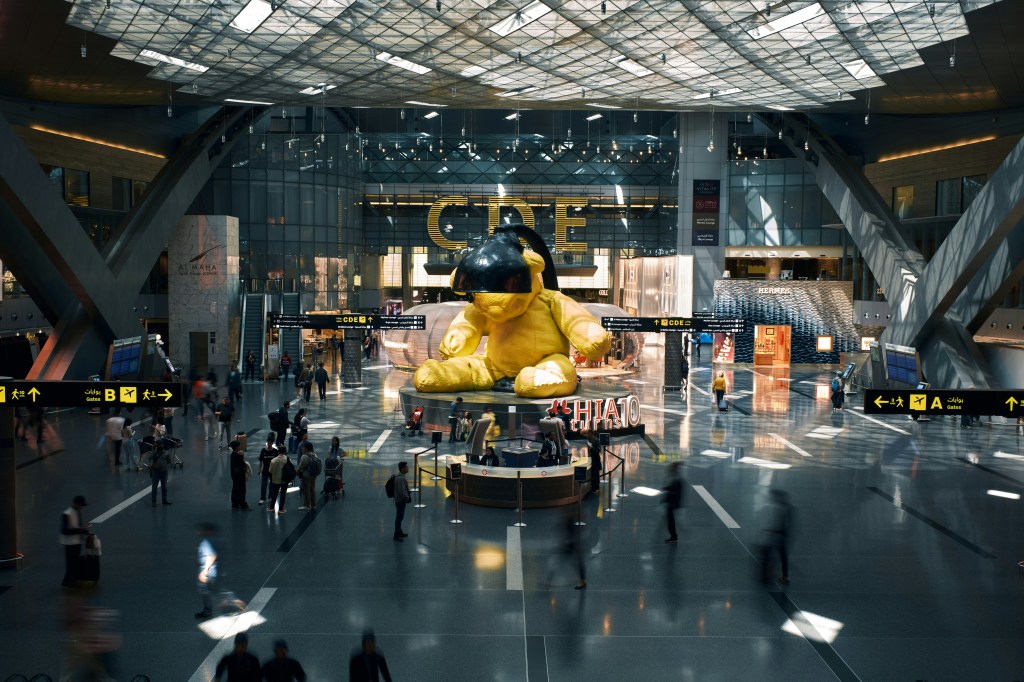
So, this was the typical beginning of a trip back to the US two summers ago. But something had delayed our first flight, which meant we sat an extra two hours in our departure airport, which meant we missed our connecting flight in Doha, Qatar. Having traveled through Doha before I was hopeful that they might simply put us on another flight, or in case of a lengthy delay, put us up in the hotel inside the airport.

Unfortunately, we landed and were informed that for the second of the three legs of our journey, they’d have to put us on a much longer flight (to Dallas, sixteen hours in the air), and that we’d have to wait inside the airport for another seventeen hours. And sorry, the airport hotel was full. And since we only had our vaccination cards, but not a valid PCR test, we were not allowed to enter the city to make our own accommodations. One very thoughtful member of airport staff tried to convince us that we had a decent chance of making it through immigration illegally, but we thanked her and decided that would probably make our situation go from bad to worse. Plus it was illegal. After all, the Doha airport is relatively new and clean. Surely we could figure something out.

We texted our teammates to let them know our situation and to call in some prayer support. One of them reminded me that we carried a travel credit card with trip delay coverage, up to $500 per person. I had not remembered this detail, so I thanked him profusely and tried to put a plan together as we sat on the floor and my kids played UNO. There was a quieter lounge with semi-private couch areas where we could get some sleep. We had been given access to it once before while traveling during the height of the Covid-19 travel shutdowns, when the massive Doha airport was eery and abandoned. Now that things were getting back to normal the lounge charged a lot for entry, but with all the hotel options closed off I thought we had a good chance of getting reimbursed for it through our card. If we got in for six hours’ access, that would mean fresh food and hopefully a few hours of sleep for the family before figuring out the next ten hours in the airport, and then the sixteen hour flight.

But there was one other problem. It was summer and so we hadn’t packed warm clothes in our carryons. And the airport was freezing. At the time, our kids were three, eight, and ten. They’ve always been on the smaller side and tend to get cold easily. This is especially true of our daughter who has type-1 diabetes. So, part two of my mission needed to be finding some kind of warm garments or blankets. This would make sleep more likely, and hopefully also keep them from getting sick.

Blessedly, the lounge we were hoping for wasn’t full and we managed to claim one of the semi-private couch areas. So far, so good. Thinking the more difficult part of the plan accomplished, I headed back out into the duty free area of the airport to find some warm sweatshirts or blankets. The airport had dozens of stores selling clothing, so I didn’t think it would take too long to find something reasonable.

I waved and smiled at the attendant in the first store I walked into and I went over to look at a rack of sweatshirts. My smile vanished as I looked at the tag – $450. Wide-eyed, I quickly exited that store and went into the one next to it. But the sweatshirts there were $300 apiece. In store after store I had the same experience. It seemed that luxury clothing was the only kind for sale in this airport. Where were the smart yet affordable Central Asian brands like LC Waikiki? There were no blankets or other warm things for sale anywhere. Just clothing roughly the price of a kidney.

The best option I could find were tracksuits/sweatsuits in the store of a football/soccer club, Paris Saint-Germain. These were warm, they had them in the various sizes we needed, and they ran just below $100 for the kids sizes and a little above $100 for the adults. After several rounds of the duty free area, I kept coming back to the PSG store as I slowly resigned myself to the truth that dropping over $500 on tracksuits was the cheapest option available to me. But would I be able to convince the credit card insurance to reimburse these? It was a gamble.

I thought of my kids shivering, curled up, and trying to sleep on airport couches. I thought of the dark patches beneath my wife’s eyes and the very long way we still had to go to even begin the second leg of our journey. I gritted my teeth, and bought the matching tracksuits.

I shook my head as I walked away and back toward the lounge, loaded with bags of PSG merchandise. My family didn’t even follow professional sports. Apart from a season in high school in Melanesia where I followed the Australian National Rugby League, I’ve never made the time nor had the desire to follow either American sports or those more popular globally, like football/soccer. In fact, one of the quickest ways to make my or my wife’s eyes glaze over is to turn a group conversation to professional sports.

But now, I told my wife as I returned to the lounge, now we would need to become soccer fans. Not because I had a sudden affinity for the team or for some guy named Messi who apparently played for them. No, simply because we were now financially invested in the Paris Saint-Germain Football Club. So invested, we would in fact travel the world as a family in matching luxury track suits. The kids, having been told that they were now officially fans of a French soccer team, put on the warm tracksuits, and promptly fell asleep. My wife liked hers also, though her eyes nearly popped out of her head when I whispered the price to her.

There have been times over the years when we’ve eaten at some very sketchy places, because that was what was required to keep the family going while on the road. Apparently, this was the other end of the spectrum. Sometimes you eat dodgy kebabs. Sometimes you don rich kid tracksuits.

During the rest of our time in Doha and even on the plane, fans of PSG said hi to us, gave us fist bumps, or otherwise complimented our sporty-seeming family and our matching outfits. We did our best to smile and play the part – and then shoot one another sideways glances. We were frauds, but at least we were warm frauds.

After what felt like days later, we finally made it to Dallas, where one last layover – at a hotel this time – would get us to our final flight the next day. At least being back in America meant people didn’t really know about professional soccer and would stop commenting on our wardrobe.

We walked into the lobby and were immediately greeted with a cheer by the man behind the counter.

“You fans of PSG?! That’s my team, bro!”

p.s. Thankfully, months later, the travel insurance did indeed reimburse the tracksuits.

To support our family as we head back to the field, click here.

For my list of recommended books and travel gear, click here.

Find at Home, Or Seek in Vain

To the Irish, the pope, the bishop of Rome who was successor to Saint Peter, was a kind of high king of the church, but like the high king a distant figure whose wishes were little known and less considered. Rome was surely the ultimate pilgrim’s destination – especially because there were so many books there that could be brought back and copied! But if your motive was holiness:

To go to Rome

Is little profit, endless pain;

The Master that you seek in Rome,

You find at home, or seek in vain.

Cahill, How the Irish Saved Civilization, p. 181

There’s some New Covenant common sense in this ancient Irish verse. Worshiping in spirit and in truth means there are no longer some mountains holier than others – nor cities. The presence of the Spirit in all of God’s people means physical pilgrimage is no longer necessary. The presence of God is just as near in Ireland as in Rome, in Melanasia as in Jerusalem.

On the other hand, having lived in frontier places without ready access to good Christian books, I fully understand a willingness to go to such tremendous lengths to acquire them.

Photo by Mathew Schwartz on Unsplash

Broken Bodies, Better Infrastructure

We just traveled back to the US for a medical leave. Once again, when crossing worlds from Central Asia to the States I was struck by a peculiar flipping of the condition of bodies and infrastructure. I wanted to write about it while the contrast is still fresh to my eyes, knowing that sometime in these first weeks I will lose that ability to notice the stark contrasts as my immediate surroundings register in my brain as the new normal.

For an interesting experiment, ask those who are newly visiting or moved to your area what jumps out at them, what their senses and mind can’t help noticing. It’s a reliable way to get fresh perspective on your immediate surroundings – surroundings your mind has already lost some ability to “see” as they have become the proverbial water the fish is surrounded by.

In short, when traveling from Central Asia to the West, the bodies get more broken, while the infrastructure gets less so.

The shift in infrastructure happens quickly. Most of the building supplies and goods available in our corner of Central Asia are a lower level of goods made in Asia for export to the developing world. You have goods made in China for the West. Then you have goods made in China for places like Central Asia. These are not the same. Disposable plates crumble into your kebab, headphones bought in the bazaar last a week and zap your ears with electric current, playground equipment cracks and warps. While Central Asian culture cares more for a certain sheen when it comes to its infrastructure – such as shiny door knobs and fancy ceiling panels – shortcuts in quality mean things fall apart remarkably quickly. One starts longing for solid everyday things – like toilet seats – that would actually last for decades. Yes, the quality of toilet seats does indeed have serious implications, and is one area where you very much want to get the Made-in-China-for-the-West variety.

Essentially, the infrastructure gets firmer as you transit through the Middle East to the West, getting broader, thicker, and simply less easily broken, culminating upon arrival in the US where even the luggage carts look like they have been working out, compared to their frail foreign cousins. You may catch yourself admiring a metal fence and wondering about the foresight of those willing to spend so much money on something so solid. Buy once, cry once, as a wise American deacon once said to me.

The human bodies seem to move in the opposite direction. In general, the population of Central Asia is on the younger side. The “baby boom” peak of our local area are those born in 1990. The diet is also significantly healthier. Fresh fruits and veggies are cheap and a central part of the local diet. As are fresh yogurt and pickled veggies, full of good probiotics. This seems to balance out all the bread, oily rice, and sugary chai locals consume on a daily basis. While some of the younger generation is being raised on fast food and beginning to develop obesity, most of the population would be in healthier weight ranges. Fathers and Grandpas typically have a bit of a stomach, good for resting their chai saucer on. Mothers and grandmas end up naturally a little heavier as they age, bearing children and caring tirelessly for the household. In short, bodies develop and age in a way that has been typical for much of human history.

However, moving Westward means moving into a world where the bodies are significantly more broken. Weight and diet are a big part of this (why are fresh veggies so crazy expensive in Western societies?), but are not the only one. It seems like a strange disrespect for the body accompanies the West’s public infatuation with model-standard physicality. When you’ve lived outside North America and reenter, it’s not unusual to be hit with a sense that something is deeply wrong with our body culture when getting on that first plane with other Americans, or when being hollered at by that first wave of TSA agents. It’s as if in the West we either worship our bodies and fight to preserve their youth for as long as we can, or we come to neglect and hate them. I myself have struggled with a spiritual form of this neglect, believing for many years that I could ignore the body if I was sacrificing it for ministry. My struggle is easier to hide than many of my fellow Westerners, since I atrophy when I neglect my health, rather than putting on weight. But we share in the same root malady. Something about the Western experience has caused us to believe we are no longer actually embodied.

Along with this, the West is also aging. The average traveler in American airports is at least middle-aged, if not older. There are very few children in Western airports. And those that you see are usually those of immigrant families from other parts of the globe. Even flight attendants and airport staff have a different posture toward children, with those of Central Asian or Middle Eastern culture being far more likely to happily accommodate the needs of those with little ones, whereas Western staff are not unlikely to find such families an inconvenience. It goes without saying that older bodies are more broken bodies, although this is a more natural brokenness, as opposed to that caused by the Western lifestyle.

The bodies get more broken, while the infrastructure gets less so. I notice these things not really knowing what they fully mean. But for a student of culture, the path toward understanding significance starts with observation, and then a long-term chewing on those observations until clarity suddenly drops. At the very least, noticing these weaknesses of culture keep us from an unhealthy pride in either one. Every watered valley has its jackal, as one of our local proverbs wisely says. Post-fall, our brokenness will manifest not only on the individual level, but also on a scale culture-wide. This should sober us and keep us from both culture despising and culture worship.

There may be cultures that have the moral capacity in this age to care for the physical body as well as well as the quality of the things we build around us to serve the body. Unfortunately, these things seem to currently be a trade-off of sorts. For now, it’s for the Church to seek to model this kind of stewardship, strangers and exiles though we are. For though the temporary physical things of this world will pass away, we are still to plant gardens in our Babylon. We do this freely, knowing that we have a city, and bodies, that are coming and that will last forever. Long after the finest body – or luggage cart – has turned to dust.

Photo by Grimur Grimsson on Unsplash

Another Take on a Character Proverb

Travel and business are a gold appraisal tool.

Local Oral Tradition

I’ve posted another version of this proverb in the past, but I believe that this version is the older one. In the local culture, they used to appraise gold by scratching it with a special device. The appraiser was able to tell the quality of the gold from the scratch made in its surface. In this proverb, the gold represents a person’s character. So in essence, travel and business, like a gold appraisal tool, reveal a person’s character.

As one who has traveled for my entire life, I testify that the travel part is certainly true. When a trip is long enough (and it doesn’t have to be that long), people are unable to keep up appearances. Sooner or later, they will get tired or stressed or sick or inconvenienced in some way. And at that point, character will spill out.

Every time we travel internationally, I am reminded of the difference the new birth makes in when it comes to simple kindness. In the dehumanizing environment of a crowded airplane, most want to protect at all costs the few rights and the small space they still have. Those who are kind to families with small children or to the sick or the elderly stand out. And often, turns out the kind and sacrificial ones are those who know Jesus.

In an age where we often lament the lack of difference between the Church and the world, I am happy to say that travel truly can reveal the reality of the new birth – and that it is a golden, wonderful thing.

Photo by Jingming Pan on Unsplash

The Border Bridge

“You have to leave tomorrow. There’s a chance the other faction of the government will take control of the border and your exit visa will no longer be valid.”

The land border was the only exit we had left. During a political crisis the airports had been shut down. Other borders were shut or went through territory too dangerous to traverse as Westerners. We had been stuck in-country for a while, hunkered down as we watched political powers slowly tighten the grip on the region we were living in.

One colleague wisely counseled us in that season, “There’s a unique stress to being stuck out of country, and there’s a unique stress to being stuck in. Which one can your family better handle right now?” It was time to risk the stress of being stuck out.

We handed off our responsibilities to local believers and partners and consulted maps together. The tense uncertainty of our ability to return meant it was a sweet goodbye with the little core of our local church plant. Early the next morning, we set off.

The journey to the one border crossing left meant a six hour drive through the mountains, then leaving our vehicle with some friends. From there we would take a taxi one hour to the border, go through the border processes, and then drive another two hours to an airport city in the least unstable country of our region. We looked forward to a two-night rest in a hotel once we got there. We would need it to be ready for the long flights back to the US with two small children.

The drive through the mountains went well. It was spring and the bright green carpet of grass was already creeping over the mountains. We drove by ancient cities and villages I still hope to visit someday. Everything was strangely quiet for the six hour drive. The vehicle drop-off went well. The designated taxi was waiting and we made the trip. So far so good. Now for the border – the most unpredictable part.

Had the other faction taken control and would they block our exit or fine us? Would the border even be open? Would there bathrooms – or chai?! I had crossed this land border once before, but that was ten years previous. We were at the mercy of our taxi driver, who thankfully was very adept at shuffling us and our documents from one window bureaucrat to another. He also had TV screens for the kids in the back seat, which played several Tom and Jerry episodes in a loop. This would prove to be remarkably helpful as we jumped back in the car and drove to join a massive line of vehicles. After managing to pull into line, we sat. And then proceeded to sit for seven hours.

It wasn’t that we were totally still. We probably moved about one centimeter per minute. In front of us was our country’s security checkpoint, then a bridge across a river – maybe 100 meters long – and the neighboring country’s security checkpoint on the other side. We thought we had gotten there with plenty of time, but before we knew it the afternoon was spent and the sun was setting. The only exit left was one massive bottleneck.

We sat and sat and inched forward and sat some more. We made it through our country’s security checkpoint without too much trouble. No sign anywhere of the rumored takeover. Sometime after sunset we made it onto the bridge itself. An encouraging development, to be sure – until our three year old daughter needed a bathroom. There was no way back. And we couldn’t access the bathroom on the other side of the next security checkpoint, down at the other end of the bridge. So we tried, in vain, to create a shield with the car door and to help her relieve herself there on the pavement of the bridge. What else was to be done? We had at least another two hours to go sitting on this bridge. However, the strangeness (security spotlights and all) was too much for her three year-old-system, and in spite of her full bladder, she simply couldn’t go anymore. My wife decided to see if we could get an exception for a cute kid desperately in need of a potty. She headed off toward the end of the bridge with our daughter in tow, and was able to make eye contact with a female border agent standing at a side door – who mercifully gave them illegal bathroom access. Technically that toilet existed on the territory of a country we had not yet been cleared to enter. But common grace still exists, and cute kids can secure all kinds of exceptions in Central Asia.

We had a lot of time that day to be still and notice our surroundings during the seven hours it took to cross that river. We started noticing something curious. Some people were milling around up and down the bridge by foot. As they would pass our vehicle and others, some would tap twice or three times on the metal siding of the car. It wasn’t aimless. It was some kind of pattern. We started noticing small packages being slyly passed up the line of vehicles and individuals ducking behind cars as the security spotlight hit, and running up behind the next car once it moved on. We were witnessing a robust yet seemingly common-place smuggling operation. All the taxi drivers – judging by the tapping system – seemed to be in on it. Including our own.

We had been clear with him that as Christians, we were not going to be able to take part in any cigarette smuggling that is typically expected of taxi border passengers. Taxi drivers will stuff passengers’ bags with bulk cartons of cigarettes and have the passengers claim them as their own. In this way the drivers and their associates are able to buy cigarettes cheaply on our side of the border, and sell them for a profit on the other. We simply would not participate in the part where we said they belonged to us, we had insisted with the driver. And he assured us that he was OK with this and wouldn’t try any funny business with the smokes.

Late at night we finally made it to the security checkpoint. I checked our bags as they were taken out of the trunk. No bulk cigarette packages. But I did notice some had appeared in the trunk. Fruit of the car-tappers, no doubt. We shuffled our bleary-eyed children away from their hours of Tom and Jerry on repeat and made our way to the X-ray machine. As soon as we put our bags on the belt, a young man ran up out of nowhere and placed the cartons of cigarettes alongside our bags.

“What are these?” the security agent asked us.

“These belong to them!” said the young man.

“No they don’t,” I said in the sister dialect of the local language.

“These foreigners don’t understand our language,” he said, “I assure you these belong to them.” And he smiled at me with a please play along now kind of look.

“No,” I said, “these are not ours!” I was grateful that these sentences were more or less intelligible across the dialects. A look of worry flashed on the man’s face as a couple of burly security men came and hauled him off. The security officer attending us just shrugged. I shot a look back at our driver who was scratching his head some distance from us, trying not to look disappointed that his sneaky plan had failed.

Around one in the morning we finally made it to the hotel where we were staying, after leaving our house around 5 a.m. the previous day. We slept hard.

Upon waking and heading down to the breakfast buffet, we immediately felt the stress lifting now that we were no longer in a country under political siege. I sipped my Americano and enjoyed the bright light coming into the hotel dining room. After the long season of security crises and our crazy border crossing day, we could now breathe easy for a little bit. Then it was off to the US for our first trip back since moving overseas.

My wife was staring at me. She started mouthing some words. I am positively terrible at lip reading, so after I tried and failed to understand what she was saying, she gave up and just blurted it out.

“I’m pregnant.”

“You’re what?!”

I nearly dropped my coffee. And that’s how I learned about our third-born.

Photo by Max Titov on Unsplash