When Mom and Dad Quietly Cast Out a Demon

This is the story of the one and only exorcism that my parents performed while they were Baptist missionaries in Melanesia – at least the only one that they were aware of. We’ll have to wait til heaven to find out what other spirits may have been driven off unawares as my parents went about their normal missionary work of sharing the gospel and strengthening young churches in the Melanesian highlands. Given how dark and pervasive the worship of the spirits is in that part of the world, I for one would not be surprised to learn in eternity that much more of this kind of warfare was going on than was obvious and visible at the time. 

One of the areas my parents worked in was about a half hour’s muddy drive up a mountain from where we lived – when the road was open and clear, that is. At one point, tribal fighting had broken out. In a bid to keep the police from burning down the warring parties’ grass homes, the locals had burned enough of the planks in the one bridge that crossed the river into their area to make it virtually impassable.  

For a while, my dad went into the area on his own, to avoid putting our family at risk. He’d ford the river on his motorbike in order to still be able to preach Sunday mornings in the church plant. The river was just shallow enough to do this, although it was full of large river boulders – just as the road itself was shot through with large boulders, rocks, and ruts. 

After the fighting settled down, I clearly remember us fording the river as a family in our 1980s Hilux truck and often getting stuck in the orange clay-mud on the far bank. We were regularly dug out by crews of kind villagers who placed large stones and grass clods under our spinning tires and pushed, laughing and knee-deep in mud, until our truck sprang free. This kind of thing could turn a thirty-minute trip into one that took two hours. 

At times, my parents would bring their own wooden planks to lay across the bridge’s steel beams so that they could make two temporary tracks for our pickup to drive across. Eventually, the rainy season washed away all the soil on the bank attached to our end of the bridge, and we were back to fording the river.

This area of the highlands was deeply animistic. The people were still largely in bondage to the fear of the spirits of nature and of their deceased relatives, but a veneer of Christianity had been painted over all this by different groups. The Catholics and Seventh-day Adventists had claimed this particular area as their territory. At one point, an aggressive crowd of “Skin Christian” (so-called by the local believers because their Christianity was only skin-deep) Catholics and SDAs surrounded my dad, angry that the Baptists would dare to do ministry on their turf. 

One of the regular attendees at the church plant was herself from one of these Catholic families. She went by the Western name of Janet and she was so faithful in her participation that my parents thought she had likely come to faith under their teammates who had begun the church plant.

One day, my parents had stopped to pick up Janet on the way to the church when her family told them she was ill and not able to get out of bed. Janet’s family had requested my parents to come see her on our way back from church.  Unalarmed, they continued up the mountain to the church.  

Once there, Janet’s friends at church told my parents how scared they were for her. Janet wasn’t just ill. Evil spirits had taken away her ability to speak. For some reason, one evening she had gone down to what was believed to be a dangerously spirit-infested part of the river, at the forbidden time of dusk. This was the same time of day and part of the river where her grandmother had also been attacked by spirits, losing her ability to speak and also to eat. Janet’s grandmother had quickly died afterward. The terrified church folks believed that Janet would suffer the same fate. The Catholic prayers and exorcism with ‘holy water’ had accomplished nothing. The other traditional tribal remedies had also been for naught. Could my parents – the Baptists – do anything to save Janet’s life?

My parents hadn’t been in the country long and had never faced a situation like this.  They had thought Janet was a believer. How was this possible? Over the next several hours while the jungle cicadas screamed and my dad tried to preach over them, my mom prayed fervently. Afterward, we all drove part way down the mountain to the hut where Janet was living. My parents, not sure of what they would encounter inside, left us kids in the truck with some other local believers who were getting rides back to the area where we lived. 

Going inside, my mom and dad saw Janet and began to try to speak with her. Janet could understand them but confirmed through nods and signs that she was completely unable to speak.

So, my dad got out his Bible. Not completely sure of what was going on, but knowing that evil spirits have no power over those who believe the gospel, my dad turned to one passage after another that proclaimed the good news about Jesus and about those who believe in him. He finished with 1st John 4:4, “Little children, you are from God and have overcome them, for he who is in you is greater than he who is in the world.”

My dad asked Janet if she truly believed the gospel message that he had been reading to her from the Bible. She nodded yes. So, my dad told her that if that was the case, then according to 1st John 4, the Holy Spirit now in her was more powerful than any evil spirit that had caused her inability to speak. He told her that he was going to pray and that he wanted her to repeat after him. Janet nodded a willingness to try this. 

The small group together in the hut bowed in prayer. My dad prayed the first sentence and waited. 

Then, Janet repeated it after him. 

As my dad continued to pray, Janet was able to repeat every line of the prayer after him. The power that had stopped her from being able to speak was now broken. She belonged to Jesus, so the river spirits no longer had any claim on her. My parents, the Baptist missionaries, had seemingly just cast out a demon. 

Later, when Janet shared her testimony in front of the church, she shared that this was when she had truly repented and believed. Previously, she had not yet been a true Christian. If this was the case, then it makes sense that the spirits would have previously had the authority to cause her muteness – and that they would have lost that authority the moment she was indwelt by the Spirit of God.

I’ve always appreciated this story from my parents’ ministry because I believe it’s a good example of the simple power of the gospel over the demonic. My parents didn’t do anything flashy or fancy to try to release this woman from demonic oppression. They showed her Bible verses and prayed with her.

It reminds me of one time in college when I heard pastors John Piper and Tom Steller talking about one of the few times they’d been asked to intervene on behalf of someone who seemed to be demon-oppressed. As I recall, they said it involved a lot of praying, a lot of singing, and a lot of sitting together with her until she was released. These kind of activities seem so, well, normal. Yet in the spiritual realm, in the real world so often hidden from us, they must have remarkable power. 

I believe that a straightforward reading of Scripture and church history shows us particular seasons of concentrated miracles and visible battles with the demonic. Corresponding to this, we see other long seasons where these things are much ‘quieter,’ much more subtle, going on in the background as it were. 

Christians should trust the sovereignty of God regarding which kind of season and context they find themselves living in. You may find yourself in a setting where demonic oppression is much more prevalent than anything you ever saw back home. Or, it may be, like my parents, that you’re only ever asked once in your life to pray for someone who has been attacked by demons. God is in charge of the particular subtlety or in-your-face-ness of our spiritual battles. Our role is simply to trust his power and to fight faithfully where he has placed us. 

Will we be ready if we are faced with a situation like Janet’s? Will we throw up our hands because the spiritual need in front of us doesn’t fit with our experience or theological framework? Hopefully, we won’t fall into the trap of thinking that we need some kind of special methodology or training in order to help someone who is oppressed by demons. We have the Holy Spirit, the one who is greater than the spirit that is in the world. We have the powerful word of God. We have direct access to the throne room of heaven. When we sing, the demons shudder.

I’ve not yet been asked to pray for someone who’s been attacked by a demon. But if I am, I plan to do what my parents did – pray, open up my Bible, and simply do what Christians do.

If 26 more friends join us as monthly supporters, we should be 100% funded and able to return to the field! If you would like to join our support team, reach out here. Both monthly and one-time gifts are very helpful right now. Many thanks!

For my list of recommended books and travel gear, click here.

Photos are from Unsplash.com
The Queen of Snakes

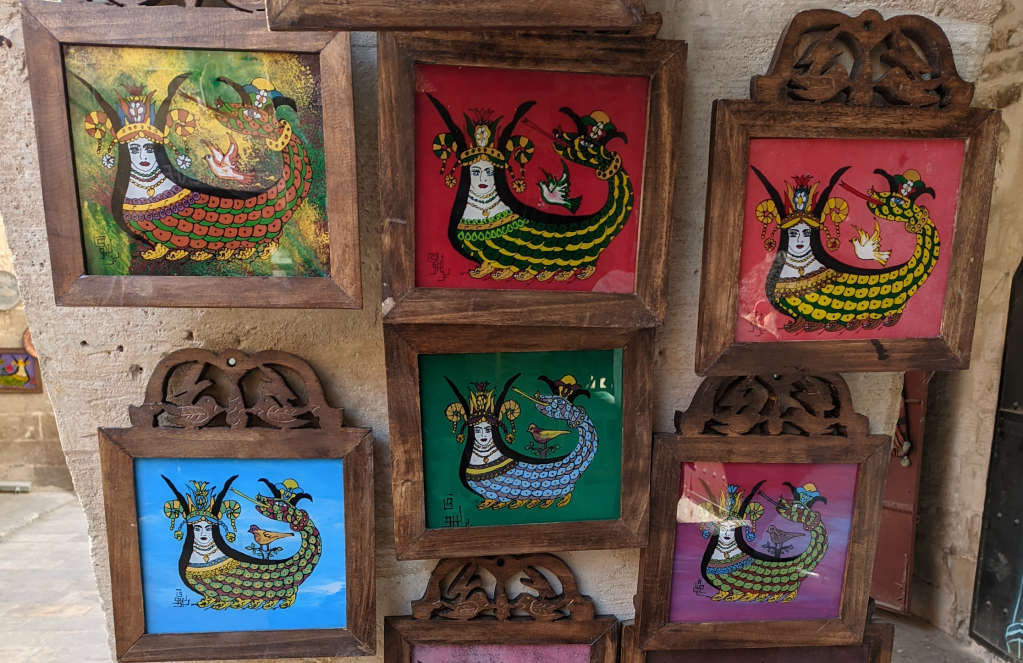
The first time I remember noticing her was when visiting local museums. The exhibits that showed what the inside of local houses used to look like regularly featured wooden chests. Inside these colorfully painted chests were usually blankets and cushions for guests. But on the outside of the chests were mirror fragments – and a painting of a strange woman-snake hybrid. I’ve also seen her hung up on walls as part of a tapestry or framed painting. In the local languages, she is called the Queen of Snakes. And I’m beginning to suspect that she has played a dark role in the historical beliefs of our people group.

The Queen of Snakes was never quite prominent enough for me to pay her much attention. Far more prominent were the evil eye pendants that seemed to show up everywhere. But listening to the Haunted Cosmos podcast got me thinking more deeply about the folk mythology of our people. Turns out there are some disturbing similarities between the Queen of Snakes and the strategies the enemy has used to deceive the nations from the very beginning. First, the story.

The tale of the Queen of Snakes often begins with a young man who is hunting for honey in caves. While exploring deep in a cave, he comes across a massive snake-like creature that has the body and head of a snake on one end and the torso and head of a woman on the other. He is terrified, but the creature tells him that she is not evil, but benevolent. She says that she is able to give him secret knowledge. The young man decides to stay with her and they eventually fall in love. After a long season of happiness, the young man must return to the city. But the Queen of Snakes warns him to tell no one about her, and that living with her has changed him. Now, if his skin gets wet, it will appear as the scaly skin of a snake.

After the young man returns to the city, the king becomes deathly ill. His viziers tell him that the only thing that can save him now is if he can eat the flesh of the mythical Queen of Snakes. No one, however, knows how to find her. But they do know that water can expose anyone who has been in her presence. So, the soldiers of the king go around pouring water on all the citizens of the city. Eventually, they find the young man when his skin betrays him. Under torture, he reveals the location of the Queen of Snakes.

The king’s men then bring the Queen of Snakes to the city. Right before they kill and cook her so that the king can eat her flesh and live, she gives a warning. She says that anyone who eats her head will be poisoned and will die. But if anyone eats her tail (presumably the snake head, but some allege it’s the other way around), they will live. The king, of course, orders that the Queen of Snakes be killed and cooked so that he can eat the tail. The young man, despairing in the death of his lover, eats flesh from the head. But it was a trick. In reality, the tail contained the poison while the head contained secret knowledge from time immemorial. The king dies, but the young man becomes the wisest man in the land and a great sheikh.

Okay, so this is a weird and creepy story. But is that all it is? How has the story of the Queen of Snakes affected the day-to-day spiritual practices of our people group? Well, more research here is needed. But this is what I’ve been able to figure out so far.

First, the image of the Queen of Snakes is believed to bring good luck and protection in general. This follows the theme from the story that she was a source of hidden wisdom. More specifically, the Snake Queen’s image has been used as a talisman to ward off sickness. This makes sense given the power of the Queen of Snakes in the story to provide healing. But the image of the Queen of Snakes has also been used to promote fertility. A picture of her is a very important part of a woman’s dowry – and that picture is then hung in the bridal chamber. In summary, the grandparents of my Central Asian friends believe that the talisman of this chimera provides protection, good fortune, wisdom, and fertility. And they want to make sure that this image is looking down on the marriage bed.

Yep, this sounds Satanic. First, there’s the twisting of the image of the serpent so that what is naturally repulsive and the enemy of the woman is instead believed to be a benevolent being. The most common position on the internet regarding the Snake Queen has her functioning as a symbol and even a patron saint of sorts for the women of our region. Second, there’s the whole theme of secret knowledge that this being promises. A friendly serpent being that offers hidden knowledge gives off some pretty serious Genesis 3 vibes.

But this is not the only way in which the lore around this creature is attempting to usurp power that belongs to God alone. The Queen of Snakes is also held up as giver and restorer of life. She gives fertility and she gives healing. And how does she do this? Well, in the story you have to eat her flesh. Some versions of the story even have successive serpentine offspring incarnating the Queen of Snakes after each of her deaths, meaning that she also possesses the key to new birth and immortality.

Now, in a disturbing – though honestly predictable – twist, the image of the Queen of Snakes has been adopted by LGBTQ activists in our region to promote their agenda.

Once we are back on the ground I need to do more research to see how this demonic element of folk religion is actually functioning among our people group. I need to ask my friends and their sisters, “What do you believe about the Queen of Snakes – and what did your grandma believe such that she put pictures of her up in even the most intimate parts of the home?” But even from the little bit that I know already, certain steps for local believers seem clear.

First, get rid of any Queen of Snakes images that you might have in your house. Sure, it might make your great aunt upset if you burn that talisman painting she gave you, but you really should chuck it – even if it’s only out of an abundance of caution. Yes, the presence of the Holy Spirit protects believers, but this shouldn’t make us cocky. In the mysteries of the spiritual realm, sometimes even objects can be used by the enemy to cause some serious trouble. You may be immune, but Christian history and common sense would indicate that you really don’t want something like that in your house while you’ve got kids who haven’t yet come to faith. Take dominion over your space, and just like Hama and Tara who took down their Islamic paraphernalia during the saga of plastic Jesus, get rid of the snake woman too.

Second, no longer believe and speak of the Queen of Snakes as some benevolent pro-woman character that’s a positive part of your heritage. All the evidence indicates that there’s at least some level of demonic deception involved in this creature. Christians will need a new posture toward this part of their traditional folk art.

Third, proclaim that the things the Queen of Snakes claims power to do are the territory of God alone. He alone is protector, healer, giver of children, and source of true wisdom. In all of these areas, the Queen of Snakes was a liar, a deceiver, and a usurper.

Finally, celebrate the victory that Christ has accomplished over not just Islam, but also over all the dark things of folk religion that clutter up the metaphorical basement of your worldview. Christ “disarmed the rulers and authorities and put them to open shame, by triumphing over them in him” (Col 2:15). When Jesus on the cross crushed the head of the serpent’s seed, he also crushed the power of the Queen of Snakes. Through the open proclamation of that good news in your language, she will no longer able to deceive you, your grandma, or your future bride. And that is very good news.

We will be fully funded and headed back to the field when 43 more friends become monthly or annual supporters. If you would like to join our support team, reach out here. Many thanks!

For my list of recommended books and travel gear, click here.

Photo by Wikimedia Commons

Trying to Find the Basement

“It’s like there’s a basement where there are some very dark things. We know it’s there, but we can’t find the door to it. If only we could get down there, then we could actually bring those things out into the light, and hopefully get to dealing with whatever it is.”

I remember sharing this sentiment with a veteran missionary and pastor in our region of Central Asia a couple years ago. We had been discussing the remarkable ineffectiveness of the missionary work among our people group over the last couple of decades.

Since the early nineties, a very significant number of gospel laborers and an astounding amount of funding has gone into planting churches among our people group. Most of it seems to have failed. Most of those who have professed faith are scattered or have fallen away from the faith. Most of the churches that have been started have imploded. Most of the workers have left.

Over the years, I have grown in conviction that at least two things are necessary to see this situation change. The first is the irreplaceable work of slow, steady, faithful ministry by example that is backed by prayer. Whatever else is needed, this is needed more. The locals must taste and see over the long term the beauty of a healthy local church and how faithful Christians live. Forget novel and exciting methods. As veteran missionaries once told us, “mostly they need people who can show them how to suffer well.”

Yet alongside of this, I share a conviction with some of the other veteran workers that there are some significant pieces of the culture that we are still somehow missing. It feels a little bit like what I’ve heard of black holes in space. You can’t see it, but you know something is there because of the destructive evidence being exerted on its environment.

A young local pastor told me that he believes the failure of the missionary work might be because his people are under a spiritual curse, some kind of hardening of heart because of all the times their ancestors committed genocide against the ethnic Christians of the region. I do not pretend to know very much about intergenerational spiritual realities, but perhaps this brother is right. Could there be some kind of spiritual bind that can only be broken by the Church’s Daniel-like repentance for the sins of the past?

Or is it that we foreigners simply need to press even deeper into understanding the hearts and minds and culture of those we are desperately trying to reach? On the one hand, the gospel’s effectiveness is not dependent on missionaries becoming expert anthropologists. On the other hand, stories like Peace Child and Bruchko are real, where gospel breakthrough happened when the missionary was able to wed the good news to some aspect of local culture or myth/memory that seemed to have been sovereignly planted there for that very reason. “In past generations he allowed all the nations to walk in their own ways. Yet he did not leave himself without witness” (Acts 14:17).

However, I hesitate because in the case of our people, it feels like we are not so much in need of finding something good that has remained as much as finding something dark and twisted that needs to be torn out – less redemptive analogy and more cultural exorcism, as it were.

At the very least, alongside prayer for spiritual breakthrough, a more systematic study of the culture will not hurt. Whereas missionaries to remote tribal peoples are trained to do this very kind of exhaustive cultural study, most of us in our region have taken more of a posture that assumes that if you systematically study the language, you’ll get the culture thrown in as well. But we have found this to result in some big holes. Some, merely odd. Some, very concerning.

I’ll never forget when a leader in training in our church plant told us very matter-of-factly that there’s a special spiritual word you can use to command the soil not to decompose a body until you can rebury it elsewhere, and it will obey you. He claimed to have seen this work on a body buried for over a month. And he seemed to have no idea that this folk religious/sorcery belief was incompatible with Christian belief and practice.

How many more beliefs are just like this, unseen beneath the surface, only emerging in times of crisis, in times that expose what someone really believes about the nature of life, death, and the spiritual realm? And are any of them regularly sabotaging church plants and relationships between local believers because they continue to go unknown and thereby unaddressed?

One of the reasons I’m excited about my new role when we head back to Central Asia is that it will require regular and deep study of the culture. The plan is for this study to then lead to biblical and contextual resources that address the things that emerge – including those things that emerge from “the basement.”

Some of it is not hidden at all, but well-known. As of yet there are no Christian resources in our language that take evil things like wife-beating, female circumcision, and honor killings head on. This must change.

God willing, it will. And sooner or later, God’s people will bring some light into that basement – and get to work banishing the darkness.

To support our family as we head back to the field, click here.

For my list of recommended books and travel gear, click here.

Photos are from Unsplash.com

Donkeys, Fireballs, and Other Near-Death Experiences

Balaam wasn’t saved by an angel. He was saved from an angel. This reversal of the expected formula is made even stranger in that his repeated deliverer is a donkey – one who can not only see the invisible angel, but who can also speak. And Balaam, at least for his first two near-death experiences, was utterly ignorant of the fact that he was being delivered from death by means of his remarkable long-eared servant (Numbers 22).

This is so often the way it goes. Death misses us by a hair and we are completely unaware of it, or at least unaware of what was going on behind the scenes once we do realize the great danger we just escaped. Just the other day we found a copperhead coiled up at the bottom of a rock we had been climbing and sitting on. I and several of my kids had apparently stepped around and right over him, busy admiring the view beyond of a Virginia river valley, taking pictures and peering over the cliff edge, completely unaware that the far greater danger was coiled up at our toes.

What had directed our feet so that they never stepped on the poisonous snake? What had directed the snake so that he stayed still, opting for freezing rather than fighting? Had it all been normal providence, aligning our days and choices just so in order to turn a potentially deadly encounter into a merely interesting one? Or was there direct involvement in that moment, a little nudge to the four-year-old’s foot by an invisible protector here, a word of warning inaudibly spoken to the snake there? Traditional Christian culture has angels invisibly intervening for us on the regular, saving us from calamity just in the nick of time, and often without us ever being aware.

If such guardians do function in this way, perhaps one activity in eternity will be watching one another’s Your Many Near-Deaths: Greatest Hits compilations. I can see it now, chilling with Darius* and Reza* in my room in the Father’s house as we watch one particular nail-biting act of deliverance. They rise to their feet, hand on their heads, yelling, “Bro!!! That was so close! How did you not die?! Look at you, just sitting there, sipping your chai like a complete donkey!”

Occasionally we do realize that something was definitely amiss in a given near-scrape. Something potentially deadly has happened, yet we were rescued, unharmed, in a way that doesn’t completely make sense. People don’t act they way they normally would. Train schedules are inexplicably off. For some reason we make a choice that we would not typically make. Natural elements behave abnormally. Fireballs burn an arc around us yet leave us completely alone.

One year ago I almost blew myself up in our kitchen. I did manage to blow up the kitchen, especially the stove. But I escaped unscathed, with the exception of some jumpiness every time I lit a gas burner for the next six months.

It all went back to to the difficulty of staying warm during the worst part of our Central Asian winters. The nights up in our mountain area often go below freezing, and the government makes its most severe cuts to the electricity during this season also. Two winters ago also proved to be one of the coldest snaps in decades. Add to the cold and the lack of electricity a natural gas shortage as well. All this meant not enough electricity to heat water for showers, dwindling supplies of LPG for cooking and portable heating, and one very cold family who couldn’t stop coughing. As a dad, I decided that it was time to pursue the nuclear option, something I had been chewing on for many a cold Central Asian winter.

With the help of a partner church, we purchased a 3,000 liter LPG tank for our roof and got a gas-powered water heater, a couple of LPG fireplace-type heaters, and all the necessary piping installed. This would mean that even if we had no electricity for days on end, we would have constant hot water, heating for at least two rooms during the day, and gas for cooking and hot drinks. The local workmen who installed all of this for us in the worst part of winter were great guys, and they even showed me what to do if the huge tank ever ran out. Conveniently, I could attach one of our smaller fifteen liter tanks to the gas lines and – voila – have gas in the lines until I could get the big one refilled. But, they stressed, it’s not good to let the tank completely empty. Refill it at twenty percent.

Well, Central Asia being what it is, the next few months were full of lots of ministry drama and various crises, and the big gas tank on our roof ran out without me noticing. It was late at night when this happened. My kids were already asleep and my wife was reading in our bedroom. I recalled what the workmen had told me several months before about how to temporarily refill the gas lines. So I went out back, attached a hose and nozzle to one of our small grill-style LPG tanks, and hooked it up to the house gas lines. But before I turned it on I made sure all the gas appliances were shut off. The gas nozzle I was using was one I was less familiar with, the kind that twisted open rather than a simple on/off lever. Figuring I needed to fill up many meters of lines for this to work, I turned the nozzle as far open as it could go, and heard a loud hiss as the gas rushed into the lines. So far, so good.

But as soon as I walked back inside I knew that something was not right. Another hissing sound was coming from the kitchen. I ran into the kitchen and could tell that gas was rushing out of the front right burner of the stove. I was confused. The burner was not on. But I figured that I’d better make sure. I made a panicky attempt to turn the burners off, forgetting that this stove had an electric lighter function. And in trying to make sure the burner was off, I accidentally triggered the lighter function. That’s when it happened.

A fireball filled the kitchen. Warm air wrapped around me, a shock wave hit my eardrums and rocked me backward, and the entire house shook. When this had passed I saw that the stove was on fire. What had been the front right burner area was now a geyser of flame, smoke, and melting plastic. Somehow I had the presence of mind to run outside and shut off the valve connecting the small LPG tank the the lines.

I ran back inside and was intercepted by my wife who has just run into the kitchen, wide-eyed. She thought our city was being bombed. I must have mumbled some kind of explanation to her that no, it was me. No enemies or terrorists bombing. I had managed to bomb the kitchen.

The next most important thing was to shut off the valve from the pipes to the stove and to grab the fire extinguisher. Both of these were back against the wall, right next to the side of the stove that was on fire. Not the best place for a fire extinguisher, I thought to myself as I strategized how to safely get past the flames. I managed to do it by draping a dish cloth over my head, ducking past the flaming corner, and shutting off the gas line. I also grabbed the fire extinguisher while I was down there and soon the stove and most of the kitchen was covered in a fine grey dust.

My wife went and grabbed the vacuum while I stood there, shocked and surveying the damage. What had gone wrong? Did I turn up the pressure too high on the unfamiliar nozzle? Did some kind of safety mechanism in the stove break, allowing gas to rush out when the burner wasn’t on? This was when I figured out that it was me who had lit the fireball by means of the lighter function in my haste to make sure the burners were actually off.

“Do I still have my eyebrows?” I asked my wife as she walked back in. I was very surprised when she answered in the affirmative. I had learned from friends in Melanesia that when facing down a fireball, the eyebrows usually don’t make it. I looked down for the first time at the hair on my arm and hands. Not singed at all. My clothes weren’t either. Wait, the tips of my thermal socks were crispy. And all around me, a semicircle was melted into the grey kitchen carpet. Other parts of the kitchen also evidenced contact with the explosion. Strangely, the exposed part of the trash bag had reversed itself, wrapping itself up tight around the lid of the bin when it had previously been wrapped over the sides.

We spent the next hour or so cleaning up all the extinguisher dust, and marveling that nothing worse had happened. What accounted for the fact that I was almost untouched by the giant fireball? Why had the carpet all around me melted while even my hair had gone unsinged? Was I protected by the normal flow of providence, or had there been some kind of abnormal intervention which stood between me and the flames? Is that even a valid distinction to make?

It’s unlikely I’ll ever know the answers to these questions in this life. “The secret things belong to the Lord,” as it says in Deuteronomy 29:29. And included in those secret things are many of the workings of providence in both our tragedies and our deliverances. No, unlike Balaam, ours is not usually to see behind the curtain when it comes to our close calls, but to learn from them and to be grateful for them. There’s wisdom there – like how not to nearly blow yourself up next time your LPG tank is empty. And gratitude – like prayers of thanks for the only real loss being a melted stove, and for the surprising bonus of not even one melted eyebrow.

Balaam was saved from an angel by a donkey. Could I have been saved by an angel from the consequences of being a donkey? Perhaps. A few more seconds of that gas rushing out and it could have been a much bigger bomb. But however it went down in the invisible realm, I am thankful for God’s kindness to me when I almost blew myself up a year ago. As I am thankful for his protection this week with the copperhead – and for all those other times that I don’t even know about, included on my tape of Your Many Near Deaths: Greatest Hits.

*Names changed for security

Photo via Wikimedia Commons

A Poem Laughing at Satan and Death Arguing

Ephrem the Syrian writes this poem as a fictional argument between Satan and Death, where each bicker about who is strongest. Ephrem, like many in church history, advocates laughing at our spiritual enemies as one important piece of spiritual warfare. Martin Luther agrees, “The best way to drive out the devil, if he will not yield to texts of Scripture, is to jeer and flout him, for he cannot bear scorn.” This poem is a call to confidently laugh today at evil, thereby echoing the victorious laughter of the coming resurrection.

Nisibene Hymns, no. 52

I heard Satan and death loudly disputing
which was the strongest of the two amongst men. 

Refrain: Praise to You, Son of the Shepherd of all, who has saved his flock
                from the hidden wolves, the Evil One and Death, who had swallowed it up. 

Death has shown his power in that he conquers all men,  
Satan has shown his guile in that he makes all men sin. 

Death: Only those who want to, O Evil One, listen to you,
             but to me they come, whether they will it or not. 

Satan: You just employ brute force, O Death,
            whereas I use traps and cunning snares. 

Death: Listen, Evil One, a cunning man can break your yoke,
             but there is none who can escape from mine.   

Satan: You, Death, exercise your strength on the sick,
            but I am the stronger with those who are well. 

Death: The Evil One has no control over the person who reviles him,
             but all who have cursed me, in the past or now, still come to me. 

Satan: You, Death, received your power from God,
            but when I make men sin I do it without any outside help. 

Death: You, Evil One, lay snares like a coward,
             but I use my power like a king. 

Satan: You are too stupid, Death, to recognize how great I am,
            seeing that I can capture free will.

Death: You, Evil One, go around like a hooligan,
             whereas I am like a lion, fearlessly crushing my prey. 

Satan: You have no one who serves or worships you, O Death, 
            but me, kings honor with sacrifices, like a god. 

Death: But many address Death as a benefactor, 
             whereas no one ever has or shall call on you as such, O Evil One. 

Satan: Do you not realize, Death, how many 
            call on me in one way or another, and offer me libations? 

Death: Your name is hated, Satan, you cannot remedy it;
             everyone curses your name. Hide your shame. 

Satan: Your ear is dull, Death, for you fail to hear
            how everyone howls out against you. Go, hide yourself. 

Death: I go open-faced among creation, and do not use deceit like you:
            you do not pass a single night without some kind of deceit. 

Satan: You have not found a better lot for all your truth:
            men hate you just as much as they do me. 

Death: Everyone fears me as a master, 
             but you they hate as the evil one. 

Satan: People hate your name and your deeds, O Death;
            my name may be hated, but my pleasures are loved. 

Death: Your sweet taste ends in setting the teeth on edge:
             remorse always accompanies those pleasures of yours. 

Satan: Sheol is hated for there is no chance of remorse there:
            it is a pit which swallows up and suppresses every impulse. 

Death: Sheol is a whirlpool, and everyone who falls in it is resurrected,
             but sin is hated because it cuts off a man's hope. 

Satan: Although it grieves me, I allow for repentance;
            You cut off a sinner's hopes if he dies in his sins. 

Death: With you his hope was cut off long ago; 
             if you had never made him sin, he would have made a good end. 

Chorus: Blessed is he who set the accursed slaves against each other
              so that we can laugh at them just as they laughed at us. 

Our laughing at them now, my brethren, is a pledge 
that we will again be able to laugh, at the resurrection. 

-Ephrem the Syrian, translated by Brock, The Harp of the Spirit: Poems of Saint Ephrem the Syrian, p. 104-107

Photo by Godfrey Nyangechi on Unsplash

A Fight Song on Killing Sin

“Demons” by Gable Price and Friends

We are in need of regular reminders to make war on our sin. My kids and I have been enjoying this particular song’s challenge to do just that, wrapped in its catchy Indie Rock style. A serious message and music that grabs you – one of my favorite combinations. “You can’t kill your demons if you make ’em your home.”

A Fight Song to Resist the Enemy

This is one of our new favorite songs as a family. Listen to that harmonica!

If you saw a lion trying to hurt someone you love
You’d find him with your hand or shoot him with a gun
If you saw a robber trying to break into your home
You’d hit him on the head with a hammer or a phone

We take care of our bodies
We take care of our things
But what about these hearts
That we’ve given to the king

Don’t let the enemy in

If you heard a fox telling you a lie
You would not believe him
cuz you’d know that he was sly
If you saw a serpent biting at your heals
You’d crush him with your foot
cuz he’s only come to steal

We take care of our bodies
We take care of our things
But what about these hearts
That we’ve given to the king

Don’t let the enemy in

If you met man who had a kingdom and a treasure
And he gave it all to you just for your good and for your pleasure
In it there was peace and joy and freedom from your strife
Wouldn’t you receive it and guard it with your life

You know this really happened
You’ve been given every blessing
Don’t believe the devil’s lies
No matter what he’s dressed in

Don’t let the enemy in

I won’t let the enemy in

“Don’t Let the Enemy In” by Land of Color

The Sheikh’s Spells

“You see those peacock doors?” my friend asked as we drove along a major road in our new neighborhood. “That’s where The Sheikh lives. He is super rich from all the people that come to him for – what do you call it in English? You know, when someone uses paper and verses from the Qur’an to curse someone’s enemies?”

“You mean spells?”

“Yes! Spells. He charges $35 for a basic spell – and dozens of people come to him every day. So many women come to curse families that they are fighting with. And he’s been doing it for decades.”

“Is that legal? Does the whole city know about him?” I asked.

“Ha! Yes, the government won’t stop it. And he’s super famous. Everyone knows what he does.”

“So do people come to him for blessing spells as well? Like if they want their child to recover from an illness?”

“Oh yes, that too. Spells for cursing and for blessing. And $35 is only for the most basic ones. He charges a lot more for the bigger jobs.”

“It’s just like Melanesia,” I said, shaking my head. “Every village had a man called a sangumaman, and he was basically the village witch doctor, cursing and blessing (for the right price), helping people try to manipulate the spirits.”

We drove along and passed a shiny new shopping mall, a place seemingly proclaiming the triumph of globalized commercialism over the superstitions of the past. It felt a world away from the strange peacock doors we had passed just a few minutes beforehand. I remembered again the subtle trap of believing that modernization in terms of businesses and other external infrastructure was actually changing the inner worldview of the culture. It isn’t – or at least it isn’t any time soon. What do they do when their child is deathly sick? That was always an important test in Melanesia for locals and professing believers. I didn’t expect it to have such a direct parallel here in Central Asia. Apparently folk Islam is still alive and well and running a profit right under our noses.

“You know,” I said to my friend, “someday one of us believers might need to challenge The Sheikh, and tell him that his most powerful spells can’t affect a faithful believer who’s got the Holy Spirit living inside of them. Now that would be an interesting contest. And when his curse failed, then I bet the whole city would know about it.”

“I’m down bro, when do we do it? He has destroyed so many families. Let’s take him down!”

I smiled at my friend’s enthusiasm. That day could very well come. But we certainly won’t go searching out that kind of confrontation. If the Lord clearly asked us to confront him, we would. I’ve read enough missionary biographies to know that the witch doctor has real power – but that he doesn’t stand a chance against the Holy Spirit. And though we are planning for a subtler route for gospel impact, sometimes that kind of direct confrontation is exactly what is needed for breakthrough.

I am reminded one of the main points of Sinclair Ferguson’s book, The Holy Spirit. That point is simply that over and over again when the Holy Spirit appears in the Old Testament, it it for this purpose: to go to war. Sooner or later, He will come for The Sheikh. And on that day all The Sheikh’s little spells will fail him.

Photo by CHUTTERSNAP on Unsplash

I Now Believe in Demons

One of my refugee friends had come to faith. In the rough and tumble season of his early years as a believer, he had a very hard time believing the Bible in some of its teachings about the spiritual realm. This friend had a mixed religious and philosophical background, with Central Asian communism being one of his main influences. Hence the skepticism about angels and demons. At one point of crisis, he lost his housing and moved in with another Central Asian refugee, S., an Iranian man who had claimed to be a Christian and who had been granted religious asylum in the US. My friend had only been there a few weeks when he called me up, sounding very disturbed.

“Brother, let’s go for a drive. I really have to talk to you about something,” he said.

“Sure thing, I’ll be there in a few minutes.”

At that point, we lived in an apartment complex full of Americans living in near poverty and refugees who had been resettled from several dozen nations. I drove over to the complex next door, where my friend lived. This one was mostly full of Nepalese refugees, but had a few Central Asian residents like S. My friend came out and hopped in the passenger seat of my little ’95 Honda Civic, which my Iraqi friends had dubbed “baby camel” because of its amazing gas mileage.

Not for the last time, my friend and I went on a meandering drive together, working our way around the roads of south Louisville while discussing something of deep spiritual import.

“Brother, I now believe in demons!” my friend started off.

“Really?” I said as I turned to glance at him. “Well… good. They’re biblical, you know. What happened?”

I remembered back to the numerous conversations we had had about the spiritual realm, where my friend had stubbornly refused to believe in demons as the Bible presented them. It was not that I was so very experienced in this area myself, but I had grown up on the mission field (in an animistic culture) and my parents had been involved in at least one direct encounter with the demonic. Then there are all the sober accounts from missionary biographies and church history, which present quite a strong case to even the most skeptical Christian. Beyond all these, there are the Scriptures themselves, which talk about the demonic as a quite literal fact of life in this fallen world and an enemy particularly exposed through the ministry of Jesus Christ. The Bible also presents demons as an enemy still occasionally dealt with by Christ’s followers at the beginning of the Church, without any indication that they would disappear entirely in this age.

“Brother,” my friend continued, “Since moving in with S., I’ve been sleeping on the couch. It’s only a one-bedroom apartment. Well, last night I fell asleep while reading my Bible. But I was woken up in the middle of the night by the television turning on and off by itself.”

As usually happens when friends describe things like this to me, the hair on the back of my neck stood up.

“It was flickering on and off all by itself, then other lights started flickering on and off by themselves also!”

“So what did you do?” I asked.

“Well, I was laying there under my blanket, afraid to move. Then I heard S. laughing and I saw a glimpse of him running up and down the hallway. When I got up to see what he was doing, I looked in his bedroom and saw that he was still in bed, fast asleep! But then at the same time, I whirled around, hearing him laughing hysterically and running around the kitchen! He was somehow, impossibly, in two places at once – fast asleep yet running around the apartment laughing. This was when I became truly terrified.”

We sat still at a traffic light, somewhere on Dixie Highway, my eyes open wide in astonishment. My formerly materialist friend had no motive to be making up this story about his new roommate who had just graciously given him a place to live. He continued.

“I went back to the living room, turned on all the lights, and started reading my Bible out loud. I didn’t dare stop for the rest of the night. Nothing else happened, but I was too afraid to go back to sleep. Then this morning at breakfast, I confronted S. about it.”

“Wow. What in the world did he say?”

“S. confessed to me that he’s always had this problem. He said, ‘They follow me wherever I go. So I move houses a lot. Whenever I move, it seems to get better for a while, but then they always come back. Whatever you do, don’t try to talk to them or stop them,’ he said. ‘One of my former roommates tried. They got angry with him and hit him in the head, and he lost his hearing.'”

My friend was clearly shaken up by this terrifying night. He continued, “I don’t know what to do. But I now know they are real, just like the Bible says. I was a fool to remain a materialist in this matter.”

“Well,” I responded, “I’m sorry this happened. But I’m glad you believe what the Bible says now about this. S. probably thinks they follow him, but the Bible seems to teach that they are somehow within him. Demons are almost always connected to people in the Scriptures. That’s probably why he can’t get rid of them when he moves houses. Let’s make a plan, you and me. The next time you see S., ask him if we can pray for him. Together with maybe a couple of other believing brothers, we’ll gather and lay hands on him and pray. I’ve never done this before, but I believe that we can help S. if we gather, pray over him, read scripture, and trust in the power of Jesus over whatever is going on with him spiritually. There’s some phony stuff that some churches get into, but Jesus’ followers have done this sort of thing quietly for 2,000 years.”

“I’ll ask him,” my friend agreed.

“Bro,” I said, unable to avoid feeling a little vindicated. “You should have believed the Bible! What a terrible way to find out the demonic is real!”

“I know!” my friend said, laughing and shaking his head, “I know. I have been thoroughly convinced.”

We both shivered, trying to shake off the creepiness of the whole affair.

Our plan set in place, I dropped my friend off and sent out a text for prayer. Strangely, right after this, S. disappeared, abandoning his apartment and never coming into contact with us again. I can only speculate as to why he ran off, but it probably had something to do with the fact that we were ready to pray for him. Perhaps the spirits tormenting him got wind of this plan and caused him to flee. Years later I heard from other refugees that they had seen him, that he no longer professed to be a Christian, and that he had gotten deeply involved in drugs. I pray that wherever he ends up, there will eventually be a community of believers who will be able to befriend him and pray over him, that he might experience the freedom from the demonic that Jesus gives.

As for my friend and me, it was a good but hard lesson in believing the Bible, even when it contradicts our experience. Whatever our “enlightened” cultures might claim, the demonic is real. We need not be fixated on it, but I pray that if we ever get another chance to directly pray for a demonized person, that we will be ready, and that we will see the delivering power of Jesus displayed in that unique and merciful way.

Photo by Matthew Ansley on Unsplash