A few years ago, my kids and I began a weekly daddy date rhythm. The idea is a simple one. Each Saturday, one of my kiddos gets to go out to lunch or dessert with dad, to a restaurant or cafe of their choosing (within reason, that is).
Somewhere in the past, I read a Christian blogger who recommended touching base on three F’s during this kind of outing: friends, fears, and faith. I’ve found this to be a helpful framework, and most weeks will try to ask questions in these categories, even if we don’t spend the bulk of our time discussing them. Some weeks, my kids don’t have much to say on any of these fronts. But other weeks, really fruitful conversations ensue, for example, about things they’re feeling anxious about.
I’ll also often ask my kids if there’s anything practical they need right now. With how fast kids grow and wear out or break their stuff, it seems there’s almost always some item of clothing, footwear, backpack, or glasses-related thing that it’s time to replace again, but which mom and dad didn’t yet have on their radar. Of course, this part of the conversation often turns to things a given kiddo wants rather than needs, which usually gets gently punted, but which also provides valuable data for future gift ideas or surprises.
I know that this kind of outing, once every three weeks or so, is not as important as the daily rhythms, such as meals together, spontaneous affirmation, consistent affection and training, and bedtime devotions. But I hope that over the years, these dates will contribute to our kids feeling seen, heard, delighted in, known, and loved well by their dad.
To be honest, it’s also good for my heart to make sure I have a structure like this built in, where I slow down and give individual attention to each of my kids. It’s far too easy for me to be merely present as a dad, but not really engaged.
An added bonus in all this is that we end up discovering places to eat that become family favorites. One such place is our local Keto restaurant. Yes, even here in our corner of Central Asia, Keto is a thing. For those who might not be familiar with this approach to food, a Keto meal is high in good fat and protein with low or no sugars or carbs. Many will adopt a Keto diet because when you eat like this consistently, it pushes the body to burn fat for its fuel instead of sugars, which, when done wisely, can lead to healthy weight loss.
But our family appreciates Keto food for a different reason. Our daughter has Type 1 diabetes. That means that every single meal or even snack involves calculating how many carbs she’ll eat and giving her just the right amount of insulin so that her blood sugar neither dangerously plummets nor heads off careening into the glucose stratosphere. Those familiar with diabetes know the low-grade toll that doing this every day, every single meal, can take, life-saving work though it is.
But there is one restaurant in Caravan City that I can take my daughter to, where she can rest from this otherwise mandatory work. Yes, all the meals and even the ice cream at our local Keto place are designed so that the carbs are so low as to be negligible. Add to this that the food is actually also extremely flavorful, and you can see why it’s one of her (and my) favorite places to go for a daddy lunch date.
This father’s heart delights to see his daughter simply free to order anything she wants from the menu, something that is almost never the case for her. Even with the correct amount of insulin, we’ve learned the hard way that certain kinds of carbs simply play havoc with her blood sugar, which means we end up carefully rationing (or saying no to) much of the food that kids her age are naturally drawn to. She bears with these limitations well most of the time. But the grief at not being able to eat like all her friends do does build up, and sometimes overflows. As it should.
Kids were not meant to have their pancreases killed by their own immune systems so that they could no longer make their own insulin. This is not the way it was supposed to be. Sometimes, on a particularly hard day, my daughter will cry out through her tears, “I hate diabetes!” So do we, love, so do we.
Because of this, it’s such a joy to see her free in this way, laughing and munching on a Keto burger or getting cheesecake-flavored ice cream all over her face. It’s a small preview of what one day we know will be true of her if she continues to wrestle with her faith and is truly born again, that she will be given a resurrected body, one that includes a brand new, eternally perfect pancreas. Yes, in the feasts of the New Jerusalem, there will be no toilsome carb counting and insulin calculating, knowing that even if we get it ‘right’, some curveball of hormones or device failure or who knows what could still lead to a high or a 2 am emergency low treatment. No, there will be none of this. Just freedom. Freedom and holy enjoyment of God’s good provision.
I know that the owner of this Keto restaurant did not open his restaurant just for us, just for my daughter. But it sure feels that way when we eat there. Who could have guessed that we would be so spoiled as to have this kind of place in Central Asia, and in the very neighborhood where we work and school and worship? No, the Islamic restaurant owner is probably just passionate about health and making a profit. May his business be blessed, and he someday come to know Jesus.
But I also know that the sovereignty of God is detailed enough, complex enough, that one of the many reasons he would ordain a Muslim man to open up a Keto restaurant in Caravan City is for my daughter’s and my encouragement. How very kind. How very much like a good and generous father.
The kind of father I long to be.
If you have been helped or encouraged by the content on this blog, would you consider supporting this writing and our family while we serve in Central Asia? You can give here through the blog or contact me to find out how to give through our organization.
Two international churches in our region are in need of pastors, one needs a lead pastor and one an associate pastor. Our kids’ TCK school is also in need of a math and a science teacher for middle school and high school. If you have a good lead, shoot me a note here.
For my list of recommended books and travel gear, click here.
A photo of Stalin and Nikolai Yezhov (right)The same photo, but with Nikolai Yezhov later edited out after a purge
The very human temptation after falling out with other Christians is to attempt to memory hole them. We try to speak and live as if they were not a significant part of our story. This is true even of church leaders and missionaries, who are, sadly, not at all immune to serious conflicts that lead to parting ways with formerly close friends and colleagues.
I have often heard Christian friends describe feeling completely cut off from dear friends after making a difficult and costly departure from their previous church or organization. “It feels as if we’re dead to them now.”
Even when Christians have a falling out with one another and serious conflict, why do we treat one another in this way? Why the attempt to sever the relationship, to memory hole or erase others from our past? Perhaps it’s a strategy of self-protection. It’s painful to open up that hurt part of ourselves again by bringing them up in conversation, or by giving them their proper place in the story of our church or missionary team. It may simply feel too complicated to know how to relate to them or to speak about them, given the fact that the story is no longer a simple, encouraging one with a happy ending. Even worse, perhaps it is the sin of bitterness and unforgiveness that causes us to treat one another this way.
This attempt to erase other Christians from our lives is not, however, what we see modeled by Paul. In the book of Acts, we see Paul and Barnabas have a very serious falling out over whether or not to partner with John Mark again after he had abandoned them on a previous missionary journey. We’re told by Luke, the author of Acts, that the disagreement became so sharp that Paul and Barnabas parted ways, with Paul and Silas heading one direction and Mark and Barnabas heading the other (Acts 15:36-41).
The book of Acts is honest, though careful, in its treatment of this conflict. Luke, the author, is writing this second volume with Paul as one of his primary sources. And there’s no evidence that, at the time of this writing, Paul had reconciled yet with John Mark, something we see hints of in later New Testament books (2 Tim 4:11). No, the book of Acts ends with Paul and his team seemingly still separated from Barnabas and his team. And yet, pay attention to how honorably the book of Acts speaks of Barnabas and his crucial role in the early church and in the early ministry of Paul himself.
Acts 11:24 says of Barnabas, “he was a good man, full of the Holy Spirit and of faith.” The awkward conflict between Barnabas and Paul doesn’t cause Paul and Luke in the writing of Acts to retcon Barnabas’ generosity (Acts 4), his key role in defending Paul in Jerusalm (Acts 9), his bringing Paul to Antioch (Acts 12), or how he accompanied Paul on the first missionary journey and stood with him at the Jerusalem Council (Acts 13-15). No, despite their eventual parting of ways, in the book of Acts, Barnabas is honored and given his proper place in the story.
Consider what this kind of truthful and generous telling of the story might have done in the heart of Barnabas were he ever able to read an early manuscript of Acts. How much healthier the cultures of our churches and organizations would be if we were to similarly honor those we’ve fallen out with. How much healthier our own hearts would be.
What do we lose if we speak honestly and respectfully of brothers and sisters who made significant investments in us, in our churches, and in our ministries, even if we must also honestly say that they later left because of conflict? What do we lose if we remember them, not just as individuals, but even corporately as churches or organizations? Doesn’t this better honor God’s mysterious sovereignty and how he writes our stories to include these glorious and messy relationships? Doesn’t this better point forward to the coming resurrection, when each of us will delight in one another once again and every relationship will be reconciled?
Yes, there are a minority of conflicts in which it is right and proper to cut someone off and to avoid speaking of them. This would be for divisive Titus 3 wolf-type figures, those who have proven to be exceptionally dangerous or false brothers. But the vast majority of Christian conflicts are not with these sorts of threats to the church. No, they are with other saints, sinners saved by grace, just like us.
The coming resurrection means that all Christian relationships will, in fact, outlive our local churches and our ministry organizations. Thus, seeking to maintain Christian friendships even with those who have left our particular temporary community is an appropriate pointer to this coming future reality.
The resurrection, the new heavens and new earth, means that every relationship story between genuine believers will have a happy ending. Paul and Barnabas may or may not have reconciled in this life. But I can guarantee that they are reconciled now, in the presence of Christ. And that reconciliation will only grow stronger and more beautiful for all eternity.
This is also true of us, brothers and sisters. So, let us honor one another, even those we’ve fallen out with.
If you have been helped or encouraged by the content on this blog, would you consider supporting this writing and our family while we serve in Central Asia? We need to raise 28k to be fully funded for our second year back on the field. You can help us with this here through the blog or contact me to find out how to give through our organization.
Two international churches in our region are in need of pastors, one needs a lead pastor and one an associate pastor. Our kids’ TCK school is also in need of a math and a science teacher for middle school and high school. If you have a good lead, shoot me a note here.
For my list of recommended books and travel gear, click here.
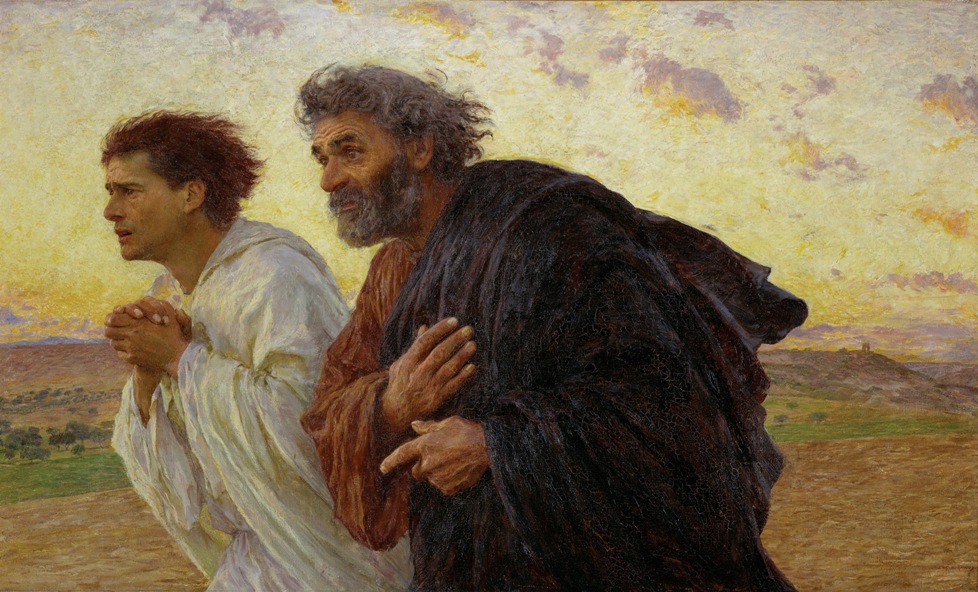
In recent years, I’ve heard increasing references to the apostle John’s comments that he outran Peter as they ran to see what had happened at Jesus’ tomb (John 20:3-6). Often, these comments are focusing on the potential humor in that John, now writing as an old man, still seems to point out that he really was faster than Peter – even when Peter had a head start. If true, there is a relatable humanity in this that is, in fact, funny. It seems to remind us that John was a dude just like the rest of us who enjoyed some good competition. But one preacher I heard a few years ago went as far as to say that John was actually sinning here in pridefully inserting these lines into his account. I was taken aback by this suggestion made from the stage to a megachurch of several thousand. Did this preacher really believe that inspired scripture contains a narrator making comments of sinful and petty one-upmanship?
As I’ve chewed on these brief details included in John’s Gospel, I think we have an explanation that makes a lot more sense than either of the above. See, the gospel of John was written much later than the other three gospels, even decades later. Because of this timing, it is apparent that some of what John is doing in his different accounts is clearing up misunderstandings that had taken root in the early church in the decades following Jesus’ ascension.
Consider John 21:20-23:
Peter turned and saw the disciple whom Jesus loved following them, the one who also had leaned back against him during the supper and had said, “Lord, who is it that is going to betray you?” When Peter saw him, he said to Jesus, “Lord, what about this man?” Jesus said to him, “If it is my will that he remain until I come, what is that to you? You follow me!” So the saying spread abroad among the brothers that this disciple was not to die; yet Jesus did not say to him that he was not to die, but, “If it is my will that he remain until I come, what is that to you?”
In this account of Jesus’ post-fish-breakfast conversation with Peter, John gives us details that are not included in any of the other gospels. Why? Well, his overall purpose of the book is evangelism and assurance. He wants his unbelieving readers to know that Jesus is the Messiah, the Son of God, so that they will have faith in his name (John 20:30). Likewise, he wants his believing readers to be strengthened in their confidence in this gospel. But in this passage from John 21, we also see one of John’s other purposes in writing. People in the early church were saying stuff that wasn’t accurate. So, John was out to clear things up. The Christians of John’s day commonly believed that Jesus had said John wouldn’t die. John wants us to know that this is not an accurate understanding of what Jesus actually said.
This brings us back to the curious details that John includes regarding his footrace with Peter to the empty tomb. Given that the resurrection of Jesus is the absolute center of the faith, a core component of the gospel itself, without which everything falls apart, it makes sense that the early believers would want to know with confidence the play-by-play details of its earliest witnesses. Now, it’s clear that some of the believing women, like Mary Magdalene, were the first witnesses. But which apostle, which of the twelve, was the first one to witness the empty tomb?
What if a disagreement existed in the early church based on different oral traditions, with some insisting that it was John and others insisting that it was Peter who first saw that the body of Jesus was missing? In this case, this is where John helpfully steps in and provides the needed clarification. Was John first, or was Peter first? Yes.
John outran Peter. So, he technically made it to the tomb first. However, for whatever reason, he did not go inside. Instead, Peter, true to form, charged right in. So John was first to the tomb. But Peter was first inside the tomb. Both oral traditions would have been true when understood correctly.
If there were indeed dueling ancient accounts about which apostle was the first witness to the empty tomb, this account would have cleared all that up. And this motive for including these details, to me, seems to fit much better with the rest of the book of John, where John seems extra careful to not draw attention to himself. For example, John refers to himself in the third person as “the disciple whom Jesus loved” rather than simply using “I” or even his own name.
Why does this matter? Well, even though it may cause us to chuckle to imagine John getting in one last dig at Peter, that kind of view doesn’t fit very well with a high view of scripture. If John did this, it would not be him writing honestly and repentantly about things he had done wrong in the past, like Peter writing through Mark about his denial of Jesus. Rather, it would be him somehow gloating while writing inspired scripture. As if while being carried along by the Holy Spirit, he would have been able to write, “Ahem,I just want you to know that I was really the faster man.”
No, in my opinion, this kind of interpretation of these details says far more about our own age and how we read ourselves into the text than it tells us about John’s actual purpose and context. Instead of this, I suggest that we consider this passage to be one of several where John intentionally includes details that helpfully clear up things that in his day were becoming muddled among the believing community.
Thankfully, whatever John’s original intention in including these details, the overall point of the passage couldn’t be more clear. The tomb was empty. Jesus had risen. Nothing would ever be the same.
Today, we celebrated that truth at a mountainside picnic service with dozens of Central Asian believers. They sang, preached, prayed, and danced, proclaiming that the resurrection has made them new – made them members of God’s forever household. Mary, John, and Peter’s surprising message is still spreading 2,000 years later, still transforming all who believe it. Even in the Islam-dominated mountains of Central Asia.
Happy Easter, dear friends. He is risen.
If you have been helped or encouraged by the content on this blog, would you consider supporting this writing and our family while we serve in Central Asia? You can do so here.
Two international churches in our region are in need of pastors, one needs a lead pastor and one an associate pastor. If you have a good lead, shoot me a note here.
For my list of recommended books and travel gear, click here.
Our age doesn’t naturally resonate with the justice of an eternal hell. Whether in the West or here in Central Asia, the spirit of the age means that the default for most is that hell feels unjust. This hasn’t always been the case. There are periods of history (e.g. the Middle Ages) as well as people groups throughout the history of the world for whom an eternal hell resonated and made all the sense in the world. But for most of us now, something has changed. This particular part of God’s reality has been so successfully suppressed in our cultures and consciences that even the most faithful believers struggle to feel that hell is just, even if they affirm that it is so in their minds and words.
This is certainly true of me. And it has been true for countless Central Asian friends of mine over the years. In this, pressing into the details and nuances of what has been revealed about hell has been helpful. In particular, this effort has helped me to both believe and feel more deeply that the justice of hell is a fitting, careful justice. I, like many, am tempted to feel that an eternal hell is a careless kind of ‘justice,’ a broad-brushed thing involving so much eternal collateral damage. This couldn’t be further from the truth.
Deuteronomy 29:29 says that, “The secret things belong to the Lord our God, but the things that are revealed belong to us and to our children forever.” There is much about hell that has not been revealed. We trust in the just and loving character of God for those (for now) unanswerable questions. But when it comes to what has been revealed, here we should lean in and pay attention to what the scriptures are saying or hinting at regarding the reality of hell. Here are seven of these points that I find myself often coming back to in conversations about eternal judgment.
First, God’s punishment for sin has been the same from the beginning and will be the same until the end of history. The law laid down in Eden still holds true. Sin deserves death, both physical death and eternal death in hell (Gen 2:17, Rom 6:23). God will justly uphold this law for every human being ever created. Their sin will be justly paid for with death. This will be either their own deaths or, for believers, the death of the only acceptable substitute – Jesus Christ, the lamb of God. God justly applies this law to every single person, with no exceptions. He is perfectly consistent in this.
Second, every human being is heading to hell because they have personally suppressed the light they were given. Romans 1-3 is clear. The entire human race has suppressed the light of God they have – whether this was the revealed, written word of God or merely the truths written on their conscience and visible in nature – that there is a God who is deserving of true worship. We have all suppressed this light and in its place turned to idolatry. This is universal.
Some shepherd boys recently asked me if I was a Muslim or a kafir, an infidel. I was a little taken aback by the sharpness of their question and simply told them I was a Christian, but later I thought more about how I should have answered. Because we have all equally suppressed whatever light of God we were given and in this willingly become his enemies, we are all, in fact, kafirs – every single one of us. This is square one, a good starting point for understanding how isolated or even seemingly good people could still deserve to go to hell.
Third, hell will justly reflect the degree of light which we have rejected. Even though everyone who does not believe will end up in hell, hell will not be the same for everyone. While what has been revealed tells us it will be terrible for all, it also tells us that hell will be worse for some than others. Jesus reveals this when he speaks of the Galilean towns that did not repent when they had the opportunity to see the ministry of the Son of God face to face (Matt 11:20-24). They had access to a stunning degree of God’s light, yet they rejected it. Because of this, their judgment will be worse than that of Sodom and Gomorrah, who only had access to a much smaller degree of God’s light. Dante is not completely off in suggesting that there are levels of hell. While we don’t know the details, Jesus tells us that God’s justice will carefully reflect the degree of access someone had to God’s light. More light rejected equals more judgment in eternity.
We instinctively feel that the man on the island is in a different situation than the one who grows up in a Christian family and rejects the gospel. Even though both are condemned for rejecting the light, God’s careful justice also acknowledges the differences that are in fact there.
Fourth, there is no repentance in hell. We tend to assume that once someone goes to hell, their eyes are opened and they genuinely plead with God for forgiveness while God callously ignores their change of heart. But what is the evidence for this in the Bible? On the contrary, the Bible seems to show us that hell will be full of worldly sorrow, not godly sorrow. In the parable of Lazarus and the rich man (Luke 16:19-31), there is no sense that the rich man has been truly humbled. Yes, he doesn’t like being in pain and he doesn’t want his brothers to experience the pain of hell. But that is the very definition of worldly sorrow – I’m upset about my sin because its consequences make me feel bad, yet the grief doesn’t lead me to repentance (2 Cor 7:9-12). The rich man still pridefully presumes to order Lazarus (and even Abraham!) around, showing he has not experienced the godly sorrow of true repentance. The New Testament’s language of weeping and gnashing of teeth are images of worldly sorrow and regret (Matt 13:42). They are not images of repentance. No, those in hell will never repent, but continue sinning forever, which means they are day by day adding to the justice of their sentence.
Fifth, the eternal nature of hell is just given that sin is committed against an infinite God. Many of us have heard the helpful illustration that argues for the fitness of an eternal hell due to the fact that sin is an assault against an eternal and infinite God. Hit my brother, so it goes, he might hit me back. Hit my neighbor, he takes me to court. Hit the president, I may be shot by his bodyguards, or at least locked up for a long time. The position of the one assaulted justly warrants different consequences for the same kind of sin. We know that this is true in this world. So, what if we assault the king and creator of the universe, the infinite one? Then we receive eternal consequences befitting of that crime. This is another point that, together with the lack of repentance in hell, helps us begin to feel how the eternality of hell could be just.
Sixth, those in hell will not appear the same as they did here on earth, but will be radically changed into a form that reveals their true nature and fits their eternal environment. We struggle when we picture an unbelieving family member or friend in hell, and rightly so. This current age is a mixed one, when sin and a fallen nature mingle with the remnants of the image of God in every human being (Gen 9:6). Because of this broken yet still present image of God in every human, every person still alive is rightly deserving of dignity and compassion, even though a fallen sinner. But this mixed existence where sin and dignity intermingle is a temporary one. The time is coming when every one of us will be changed (1 Cor 15:52). This change will display our true natures, whose sons we really are – children of God or children of the devil. It seems as if this change happens fundamentally yet partially after death, and then fully in the future resurrection when both believers and unbelievers are raised with new bodies (Dan 12:2, Acts 2:15, Rev 20:5).
Have you ever thought about what kind of resurrected body God will be giving those who are raised into eternal condemnation? For resurrection always implies embodiment in the original languages of the Scriptures. It seems that, like he always does, God will be giving the inhabitants of hell bodies that are appropriate for their environment. Cherubim and seraphim are made for heaven’s throne room, so their bodies reflect this, covered in wings and eyes and fire appropriate for God’s presence. Fish with their scales and gills are made for the sea and birds with their wings for the air. Humans are made to be gardener-worshipper-kings, with fingers and faces that reflect this. This principle applied to hell means that whatever the resurrected bodies of those in hell look like, were we to see them we would affirm just how fit they are for their dwelling place. Our problem is that we project the bodies appropriate for this sphere onto another one, hell (and heaven for that matter), and this leaves us feeling that things aren’t quite right with this picture. Indeed, they aren’t right, for we are projecting bodies into environments they are not appropriate for, like stumbling upon a panda bear in the Sahara desert – it does not belong there.
C.S. Lewis in his sermon, The Weight of Glory, explores this future transformation that will see believers and nonbelievers become what they truly are:
It is a serious thing to live in a society of possible gods and goddesses, to remember that the dullest and most uninteresting person you talk to may one day be a creature which, if you saw it now, you would be strongly tempted to worship, or else a horror and a corruption such as you now meet, if at all, only in a nightmare. All day long we are, in some degree, helping each other to one or other of these destinations… it is immortals whom we joke with, work with, marry, snub, and exploit—immortal horrors or everlasting splendours.
The scholar Anthony Hoekema also explores what happens with the image of God in believers in his book, Created in God’s Image. Hoekema shows from scripture how one day the image of God in believers will be not only be restored, but perfected in a way that outshines even what Adam had. Non posse pecare as Augustine put it, no longer able to sin. Glorified humanity will enter fully into “the freedom of the glory of the children of God” (Rom 8:21).
We should remember, however, that believers and unbelievers are on inverse tracks all throughout the scriptures. What takes place among the redeemed in redemptive history is always reflected in the negative among the lost. This means that there is something that will happen to the lost that is the opposite of glorification – a terrifying thought. Likely, the broken image of God among the lost will on that day be completely lost, fully replaced by the image of Satan – and their spirits and bodies will show this, just as ours with their glorified image of God will shine like stars forever and ever. “For to the one who has, more will be given, and he will have an abundance, but from the one who has not, even what he has will be taken away” (Matt 13:12).
If we were to able see unbelievers who are now in hell, or see them as they will be in whatever form future hell takes in the new heavens and new earth, then we would feel that they are exactly where they should be. Everything about them would reflect this, just as angels so clearly belong in heaven, just as everything about glorified believers will fit so perfectly with a new earth.
Seventh, our failure to feel the justice of hell reflects how little we understand the sinfulness of sin. Hell does not feel just to us because we are a people blind to how evil sin actually is. Or, in the case of believers, we are a people recovering from that blindness. Were God to truly open our eyes to see the darkness of the sin in our nature and in our actions, we would not struggle in the same way with the justice of hell. In fact, we’d probably struggle more with the scandalous nature of God’s forgiveness. It’s curious to me that former ages so much more exposed to suffering and oppression than we are struggled less with the concept of an eternal hell. It’s as if they had opportunity to see more clearly firsthand just how sinful sin actually is. And so their feelings about justice and hell were better aligned to what is revealed in God’s word.
Sin is so evil it doesn’t just make us unworthy to be in God’s presence. It makes us downright incompatible. Our very substance as sinful beings cannot draw near to the substance of God’s being without being exposed to eternal death. He is a holy, consuming fire, after all (Is 33:14, Heb 12:29). This is his nature. And his justice by its very nature will burn and afflict sin eternally. That is, unless we are changed to somehow be compatible with that fire.
This is no less than what is promised in the gospel, not only forgiveness but also transformation. We will be changed so that the holy fire of God’s nature will not afflict and torment us eternally, but will instead delight and empower us in its beauty (Is 33:15-17, 1 John 3:2). We will praise him forever because at last we will see hell clearly for the fitting and careful justice that it truly is.
Yes, one day we will also say about hell, “Hallelujah! The smoke from her goes up forever and ever!” (Rev 19:3). When this occurs it will be because our eyes are finally fully open. We will see the careful and fitting justice of God. And we will know and feel that it is good.
If you have been helped or encouraged by the content on this blog, would you consider supporting this writing and our family while we serve in Central Asia? You can do so here.
Two international churches in our region are in need of pastors, one needs a lead pastor and one an associate pastor. If you have a good lead, shoot me a note here.
For my list of recommended books and travel gear, click here.
Today we were voted back in as members of the international church here in Caravan City. What a joy it was to be officially joined again to this body of believers after almost four years away.
Like many international churches, our new/old church family is quite diverse. We have over twenty nationalities represented in the membership, coming from a very broad range of socioeconomic situations. Among the most impoverished of our members would be the migrant workers who come from Southeast Asia, South Asia, and Africa. Many work grueling hours for low pay, enduring slave-like treatment from local employers, paying higher visa fees and navigating more government red tape and corruption than we do, all while living a continent away from their spouses and children whom they work so hard to support.
I have often been thankful for the chance to be in covenant with these brothers and sisters. Their situation is so different from that of us Western missionaries. It’s also quite different from that of the local believers. When I hear of their faithfulness I am often taken aback – and reminded of things that I might otherwise miss were I only in fellowship with Western missionaries and Central Asians. Some missionaries here might feel that church relationships with migrant workers are a distraction from the work they have been sent to do. But I have often found it instead to be an unexpected source of encouragement and perspective.
This week, I was in conversation with another missionary here about patronage expectations from local believers. He asked my thoughts about the many local believers who say they don’t attend church because they can’t afford the taxi fare, instead hinting that the church leaders should cover the transportation costs for them.
I told him that we’ve often heard the same thing, but that locals will indeed pay taxi fare without grumbling for the weekly gatherings they prioritize. This was something we observed early on as we experimented with weekly English groups. At the time, our believing local friends would sacrifice to attend these groups in order to improve their English. But they wouldn’t show up for a house church meeting. At the end of the day, paying the taxi fare to come to church wasn’t an issue of means, but an issue of priorities and discipleship.
“But maybe the church could offer some kind of partial help,” I offered, “where if they pay the fare to the church meeting, then the church can help with the taxi fare back to their homes afterward. That way locals would still have some skin in the game.”
“That might work,” said my friend, “But then you have the example of the Pakistani brothers.”
“Why? What do they do?”
“They pool their money to afford a group taxi ride to church every week. But they don’t have enough to afford a ride back. They just come to the service in faith that God will provide them with rides afterward. To my knowledge, he always has.”
“No kidding!” I responded, “Well, in that case, I change my mind. We should not do the half-and-half thing, unless we do it for everyone. Instead, the local believers need to hear how these Pakistani brothers are prioritizing the weekly gathering like this. What an example.”
I was convicted and encouraged to hear of the faith of these migrant brothers. Even more so because this was the same week where our own vehicle purchase was being finalized. To tell the truth, neither myself as a Western believer nor my believing Central Asian friends would have considered this kind of transportation plan actually feasible or wise. But now we were confronted with some faithful South Asian brothers who have been doing it week in and week out for years.
It seems that sometimes the faithful poor are quietly the richest in faith among us. Blessed are you who are poor, for yours is the kingdom of God (Luke 6:20).
Now, I don’t believe that the rest of us should suddenly sell our vehicles, cut our incomes, and do as the Pakistanis do. Rather, scripture would call us to watch out for pride, to not put our trust in our transportation riches, and to instead trust God and be generous, ready to share our vehicles and taxi money to bless the body (1 Tim 6:17-19).
But I think the example of these brothers does mean that we should be convicted about how far we are willing to go to honor the bride of Christ. After all, if we are supposed to be willing to obey to the point of shedding blood, then that surely means we should be relatively radical in what we’re willing to do to obediently gather with God’s people (Heb 2:4, 10:25).
Yes, even if that might mean a very long and dusty walk home afterward. How interesting though that it has not yet meant this for our Pakistani brothers, even though they risk it week in, week out. For now, God seems to enjoy rewarding them with rides back home after church. And what a sweet weekly reminder of God’s provision this must be for these resource-strapped men.
But eternity is coming, and along with it all of God’s perfectly poetic rewards. And I, for one, will not be surprised if these migrant brothers end up with some of the nicest ‘rides’ in all of New Jerusalem.
If you have been helped or encouraged by the content on this blog, would you consider supporting this writing and our family while we serve in Central Asia? You can do so here.
God provided the needed teacher for our kids’ school. Praise Him!
For my list of recommended books and travel gear, click here.
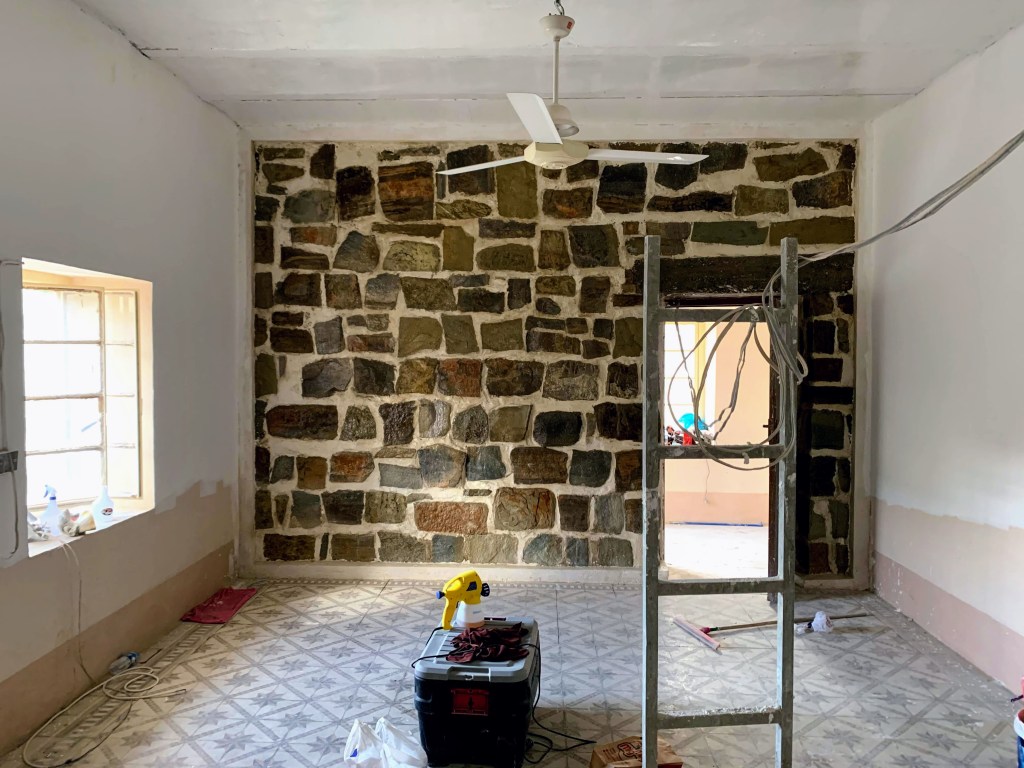
The wall of what would become the homeschool room, nearing completion
Our previous home in Central Asia was an old stone house right on the edge of the bazaar. It was very beat up when we agreed to rent it. Much of the wiring and light fixtures were still from the 1950s. The garden courtyard was an overrun mess of brambles and dust. All the water tanks were rusted out and useless. And two internal walls showed extensive water damage.
At the time, there were only two of us who really believed in the potential of this run-down, dusty old house. Me – and Adam*, my good friend who suffered from paranoid schizophrenia. Most of my local friends and colleagues understandably said I was crazy for taking on a project like this. But Adam, my one believing friend who technically was crazy, was adamant that we had to get this place. That in itself probably confirmed that the others were right. Nevertheless, I sided with my schizophrenic friend and went for it. My wife (who was nervous about the whole thing, yet bravely willing to follow her husband) and I had always wanted to live within walking distance of the bazaar and here was our chance. Surely, bringing a house back from the dead couldn’t be that hard.
In particular, Adam was captivated by the potential of the thick stone walls of this house, and especially the two internal water-damaged walls. Because of what to me looked like leprous wall spots of Levitical proportions, we would definitely have to replace the plaster, as well as patch the roof cracks. But, instead of then simply replastering the walls, Adam wanted me to let him get rid of all the plaster, polish and varnish the stones, and then put fresh white plaster in the seams of the rocks. The finishing touch would be framing the whole wall with a sharp plaster border. This labor would draw out the natural colors of the large stones, contrasting richly against the white of the plaster.
In this season, Adam wasn’t doing so well and wasn’t yet willing to gather with other believers again. He also needed work. And work, creative work, in particular, seemed to ground his mind and make him less prone to believe that the spy agencies of various Western nations were after him and trying to turn me against him. I thought a big project like this might be a chance for us to spend some time together as friends – and also get him around other local believers like Frank*, who was responsible for the painting and replacing the old wiring.
Some of these hopes turned out better than others. Adam’s enthusiastic work stripping the plaster off the walls filled the entire house with clouds of plaster dust for weeks on end. This meant that Frank was often kept from doing his electrical and painting work because of the conditions inside the house. I would be working on some ministry email or something, barricaded in one of the only rooms safe from the dust when Frank would walk in, fresh from an encounter with Adam.
“How you doing, Frank?” I would ask.
“Great!” he would say with an exaggerated smile, right before silently giving me an “I’m losing my mind and can’t possibly go on like this” face.
So much for the work building camaraderie. Even worse, the dust was covering the floors so thick that to get it out we had to bust holes in some of the walls so that we could use a hose to flush it all out. We’re supposed to be fixing this place up, I thought to myself as we drilled a fist-sized hole at the base of the homeschool room wall, not punching more holes in it. Maybe my bleeding-heart, idealistic, risk-prone tendencies had gotten the better of me in agreeing to let Adam do it in the first place. In the end, the work took three times longer than we thought it would.
But the walls. The stones. They came to life.
The two ugly bubbling and disintegrating plaster walls had been transformed into the most beautiful parts of the entire house. They were now two accent walls consisting of stones that shone in grays, rusty reds, pale oranges, and slate blues. The larger of them graced one side of our homeschool room, a perfect addition to a space that was soon to be overflowing with kids, books, Legos, and artwork. Adam and I loved that my kids would get to learn math and reading and Bible around that big, solid, colorful, stone wall.
When it was finished, everyone loved the end result. Even those who thought the whole project was crazy, even those who couldn’t bear to work with Adam and made fun of him because of his quirks and crazy ideas. You couldn’t deny it. The walls were stunning. Each of us had to admit that the one with the mind that wasn’t completely working correctly had been the only one able to look at something so ugly and see its true potential. And not only see its potential, but also realize its potential with long, sweaty, dusty hours chipping, grinding, and polishing.
I enjoy reflecting on what Adam did with those walls. Even when his mind was in a dark and confused place, the possibility of bringing beauty out of brokenness brought him to life and gave him purpose and focus. It brought him back to his friends for a short time. It even got him some money so he could do the honorable Central Asian adult son thing and help his parents (whom he lives with) pay some bills. In that dusty project, the image of God in a very broken believer shone briefly but powerfully, like a shaft of light unexpectedly breaking through a towering Kentucky storm front.
And it’s no overstatement to say that Adam’s work on the walls reflected the image of God. God is, after all, in the process of resurrecting – not broken down and decrepit walls and houses, but a whole world in this condition. His mind sees what the rest of us so often fail to see, how sinners can be transformed into saints through the mess of sanctification, how the beauty of the coming resurrection will make all of the suffering and sweat required to get there worth it. In our lives, he’s chipping off the old, leprous plaster, restoring a beauty in us that we lost long ago – and making it even more stunning than it was in the beginning.
I’m so glad I took the risk and let my friend tear up those walls. He claimed he could see something in them, what they could become. He was right. I’m so glad that God sees something in us, in me, what we can become. And that he relentlessly keeps up his transforming work.
p.s. Adam is doing great these days. After the initial breakthrough a couple years ago, God mercifully continues to give him a measure of healing from his paranoid schizophrenia. Adam has recently led a doctor friend of his to the Lord and has been bringing him to church with him regularly. Keep praying for him.
We will be fully funded and headed back to the field when 40 more friends become monthly or annual supporters. If you would like to join our support team, reach out here. Many thanks!
For my list of recommended books and travel gear, click here.
At first glance, the argument of Hebrews 11:16 might cause some to scratch their heads.
“But as it is, they desire a better country, that is, a heavenly one. Therefore God is not ashamed to be called their God, for he has prepared for them a city.”
This passage seems to say that the people of faith mentioned in Hebrews chapter eleven long for a superior eternal home. Because of this, God is not embarrassed to be associated with them. Why? Because he has indeed prepared that kind of city for them, that kind of homeland.
It’s not so much that the logical connections are hard to see in this verse, but that the assumptions behind the argument seem strange. Why does this passage imply that God might be ashamed of those who desire a better and heavenly country? What is so embarrassing or shameful about that?
Is it that these people of faith are messy sinners saved by grace? That their sin is the reason some might feel that God is ashamed to be associated with them? That conclusion, that God is indeed not embarrassed to be identified with sinners, is correct in a biblical-theological sense (Mark 2:16). But it does not actually fit with the context of this passage.
No, here it’s not their sin that leads to the sense that God might be ashamed of them. It is the seemingly-foolish lifestyle choices they are making, based on seemingly-foolish promises.
Noah invests in building an ark because he believes God’s word about a coming flood (Heb 11:7). Abraham leaves his influential city and lives in tents because he believes he is to inherit the land of Canaan (11:8-9). Barren Sarah believes she can give birth as a ninety-year-old woman because the angel of the LORD tells her so (11:11). Childless and elderly Abraham believes his descendants will be like the stars of the sky, like the sands of the seashore (11:12).
Contemporaries would say these people are not living in the real world. Global floods of extinction don’t happen. A family of tent-dwelling nomads doesn’t dispossess nations living in fortified cities. Old and barren men and women don’t produce offspring. They absolutely do not produce millions of them.
In the eyes of their contemporaries, these people are living foolish, even irresponsible, lifestyles. And why? Because of their faith in foolish-seeming promises. “You are living like that because God told you what now? What a waste! What a joke. What a shame.” This is how the wisdom of the world views the costly lifestyles of God’s people of faith.
But not so with God. This text says that God is not ashamed to be called their God. To be not ashamed means that he is honored to be known as their God, he is proud to be associated with them. What a humbling – and frankly shocking – idea. But this is God’s posture because the foolish-seeming faith and lifestyles of these men and women align so well with his character, his eternal plan, and even his past actions. As it turns out, God has already prepared a place for them, an eternal home – though this homeland is invisible now, the kind of place you can only hear about and cannot yet see.
When these foolish-seeming people live not for this temporary world, but for the one that’s coming, God delights in them, even as the world scoffs. God delights because they trust his promises. They trust his character. They risk based on the fact that he is a rewarder. And the heart of God rejoices when his people believe and live in keeping with these realities (11:6).
This truth matters to all believers, since all of us are sojourners and strangers in this age, awaiting our final inheritance (1 Pet 2:11, Rom 8:23). But it especially hits home for those engaged in gospel ministry. Those who decide to pastor, to church plant, to be foreign missionaries, these all embrace seemingly-extra-foolish lifestyles in the eyes of the world – and even in the eyes of many Christians.
For starters, the economic choices of a ministry lifestyle can seem downright disastrous. Pastors might live in a parsonage that doesn’t belong to them, labor in bivocational roles, or struggle with lower-than-average salaries. Church planters take huge risks to see a church birthed that may or may not survive, much less be able to support their family’s needs. Missionaries liquidate their households over and over again during their many transitions, each time incurring significant loss. Over time, these cumulative costs don’t compare very well to peers who have been busy investing in marketplace careers and appreciating assets.
The chances of seeing success and gaining influence also seem disastrous. These ministry Christians tend to choose difficult places to work – thorny church revitalizations, unchurched urban areas, remote agricultural communities, unreached people groups. It’s like they want to fail. As with the figures in Hebrews 11, this quixotic work is all driven by faith in foolish-seeming promises. You cannot truly live unless you first die (John 12:25). The meek will inherit the earth (Matt 5:5). The church will storm the gates of hell (Matt 16:18). Every nation and tongue will one day contain believers (Rev 7:9). Weakness is actually strength (2 Cor 12:9). Suffering is actually meant for good (Rom 8:28).
Yet as year by year the costs mount for minds, bodies, and bank accounts, it’s not only the world or worldly Christians who might say of these kinds of lives “What a waste, what a joke, what a shame.” Even gospel laborers themselves can sometimes look at the material fruit of their lives and feel the same way. “After all the costs, what do I have to show for it? The world is ashamed of my life. I feel ashamed of my life. Perhaps even God is ashamed of my life.”
These gospel laborers – and all Christians – need to remember the truth of Hebrews 11:16. God is not ashamed to be called their God. He has already built the city, the eternal inheritance, that awaits his foolish-seeming tent-dwellers. The world cannot see it, but a new heavens and new earth are coming, more certain than the sunrise. And when it is revealed, when the foundations are exposed by the final storm, the seemingly foolish will suddenly be seen as the truly wise, and the worldly-wise and wealthy will mourn at all that they have wasted. These latter await the terrible prospect of the God of the universe seeing the fruit of their lives and turning away from them, ashamed of them.
A great reversal is coming. The nomads will inherit the earth. And like the saints of Hebrews 11, happy is the Christian whose costly investments reflect the reality of that day. And happy is the God whose name they are given.
We will be fully funded and headed back to the field when 42 more friends become monthly or annual supporters. If you would like to join our support team, reach out here. Many thanks!
For my list of recommended books and travel gear, click here.
“it is difficult to define hiraeth, but to me it means the consciousness of man being out of his home area and that which is dear to him. That is why it can be felt even among a host of peoples amidst nature’s beauty; like a Christian yearning for heaven.”
–D. Martyn Lloyd Jones
There is no other band that I know of that captures the Christian’s sense of spiritual homesickness so well as The Gray Havens. In this song they express how even from childhood we can experience these mysterious pangs of longing. For many of us, this leads to a lifelong desire to stay wide awake so that we just might one day find the source of that joyous ache.
Do you know that sense that both Eden lost and the coming resurrection are even now bleeding through into this age? Have you ever caught a glimpse of them on a summer’s evening or an afternoon stroll through the bazaar? For me, these experiences are one means of grace that keep me a Christian, that guard my faith. I have tasted and seen something that is stunning and eternal. And when I have, I have been more alive than I could ever be with any pleasure this world offers.
“You have put more joy in my heart than they have when their grain and wine abound” (Psalm 4:7).
We will be fully funded and headed back to the field when 42 more friends become monthly or annual supporters. If you would like to join our support team, reach out here. Many thanks!
For my list of recommended books and travel gear, click here.
Fundraising. Support raising. Partnership development. Whatever you call it, it’s hard work. To raise all of your own support requires countless hours given to conversations, texts, calls, emails, posts, meetings, and presentations, stretched out over months. It involves weeks where you scratch your head because nothing seems to be working and other weeks where supporters seem to materialize ex nihilo. It can all feel like one big mysterious emotional roller coaster. So, it makes sense why so many Christians immediately rule out an exciting role as soon as they hear that it requires support raising.
But there are also upsides to Christian fundraising that are not often spoken of. And since my family is currently in the thick of it, we have front-row seats to these upsides. Namely, support raising leads to new and renewed Christian friendships – and through this to joy, lots of it.
Something remarkable happens when Christians give their money joyfully and without compulsion to free up another Christian for ministry. Through this simple transaction, both people end up closer to one another. This is easy to understand when it comes to the one being supported. Unless the supported worker has fallen into entitlement, the natural response of the new heart is amazement, gratitude, and joy that other believers would not only give to their local churches, but on top of that also give to their ministry. For any of us who know what it is to labor for a daily wage in this world of thorns, we naturally hold those in our hearts who include us in their sacrificial giving. You could even make the case that the entire book of Philippians is simply the overflow of Paul’s heart for his loyal, happy, broke Macedonian supporters.
But how does supporting someone else lead to increased joy and affection in the heart of the giver? Well, like Jesus says, “Where your treasure is, there will your heart be also” (Matt 6:21). Our hearts follow our money. So, when believers invest their money in the labor of Christian workers, they are also investing with them a part of their hearts. Authors like Randy Alcorn have often said that if one wants to grow their affections for missions, for protecting the unborn, for combating human trafficking, then one of the most practical things they can do is give their money to believers and organizations that work in these areas. Of course, for this to work, this giving should be something that we see and feel, something that doesn’t always happen in this age of automatic payments and disposable income.
In this multiplication of joy, in this movement of the supporter and the supported toward one another, we see one aspect of the created goodness of money. Yes, the love of money is a root of all kinds of evil (1 Tim 6:10), but money itself is not bad, nor even neutral. Money is part of God’s good created order. And one piece of evidence for that is that it strengthens the love, friendship, and joy between believers when one of them supports the other.
What a joy it has been to revive old friendships through our own process of fundraising as we seek to return to the field. What a joy it’s been to get to know other believers really for the first time, or to meet with acquaintances about support and to leave that meeting knowing that we have now become friends. I have had so much fun visiting churches and small groups – because of our support needs – and while there soaking in the evidence of God’s grace so apparent in these communities that I don’t get to be a regular member of. Yes, I’m here to share about our ministry and partnership needs. But I’m really here because of joy – joy that comes through new and renewed friendships, and which I also receive when you help me afford my family’s groceries and international health insurance.
That being said, Jesus says those who support us are actually getting the better deal, “It’s more blessed to give than to receive” (Acts 20:35). Our supporters are going to come out of this with even more joy than we are.
But perhaps one of the most remarkable things about Christian fundraising is that it is not only, nor even primarily, about our joy now. It’s about our joy in eternity. It’s about resurrection. That’s really the main point of Jesus’ teachings about money (Matt 6:20). By giving sacrificially, and by calling others to give, we are investing in one another’s rewards in heaven. When we exchange our temporary treasure for the sake of kingdom advance, we are somehow increasing one another’s joy, glory, and authority in the world to come. What an opportunity. Rich friendships and joy now – and rewards eternal.
One of the most tragic things about the church in Central Asia is that it does not yet know of these joys. At least in our area, local believers have largely not grown into regular, sacrificial giving. Most believe that as members of a church, they are clients, not patrons, and therefore they should be receiving financial support from the church, not the other way around. Because of this, they are massively missing out. Long-term, we want our work to move the needle in this area so that Central Asians might also know the joys of the early Macedonian believers, who gave even out of their poverty. Their joy and friendships now could be so much richer, along with their lives in the coming resurrection. There are some pretty big worldview issues to overcome here, but our sense is that once they get a taste of this joy, there will be no going back.
Fundraising gets a bad rap. Yes, it’s hard, even tedious work. But it is really an opportunity for deep Christian friendship and joy. It is an opportunity to increase one another’s eternal joy. If any Christian workers out there are struggling in your fundraising, or if you are dreading stepping into a role that requires support raising, take heart. There are some serious upsides – upsides that make all the hard work worth it.
And if any believers out there are lacking in friendships or struggling with discouragement, then look to how you’re using your treasure. It may be the secret to joy, and lots of it.
We will be fully funded and headed back to the field when 44 more friends become monthly or annual supporters. If you would like to join our support team, reach out here. Many thanks!
For my list of recommended books and travel gear, click here.
In recent months we have been witnesses to a quiet miracle. One of the deacons of our home church almost died when a car hit him while he was riding his bike to work. But God has not only brought him back from the brink of death but also stunned the doctors with the speed of his recovery.
Initially, things didn’t look good. Bryan* suffered dozens of fractures, brain swelling, and lots of internal bleeding. For several weeks it wasn’t clear if he was going to pull through. Bryan was one of the co-leaders of the home group we’ve been a part of during this season, so we had a close-up perspective of how everything was developing.
First, I must say that it is times like this when you truly witness the power of the local church. Our church immediately rallied to provide meals, childcare, and other help for Bryan’s family. The meal schedule was completely filled up for weeks on end within just a couple of hours of it being sent out. And brothers and sisters from the church regularly came by to visit and encourage Bryan and his wife, who was spending most days by her husband’s side in the ICU. Those who doubt the love and power of a local church need to see it in action when there’s some kind of emergency like this.
I was able to visit the ICU several days after the accident. Bryan was mostly under sedation, had a trach in his throat, and was covered in bandages, bruises, dried blood, and splints. At that point he was showing some response to male voices, so his wife encouraged those of us visiting to talk with him and to sing a hymn. I didn’t notice any response during that first visit, but we prayed hard that he would soon be able to breathe on his own as well as fight off the pneumonia that was getting worse. His wife, for her part, was remarkably steady and joyful, clearly being sustained by the prayers of God’s people.
The next time I visited was about a week and a half later. He still had the trach in his throat and looked largely in the same condition, but he was a little more alert. He was off and on able to make eye contact, squeeze hands, and give a thumbs-up. It was heartening to have even this level of basic communication with him again. Amazingly, it seemed like he had pulled through and was going to make it. But he would need many weeks, if not months, of slow recovery.
I came back to see Bryan again one week later. I was stunned. It was his first day sitting up in a recliner chair next to his bed. And he was fully and remarkably conversant, even though it was clear that his injuries were affecting his memory somewhat. Sometimes he would ask the same question he had asked earlier, or get confused about certain details. But the two of us spoke in depth for about an hour and a half. Most of the time was Bryan telling me how encouraged he was by God’s goodness toward him and his family.
Bryan is a chef by profession and in previous seasons we had spoken of this passion of his, how he felt like God had given him a particular delight in making amazing food and serving others in this way. We had even spoken before of how these things might be reflected in the New Heavens and New Earth. How might a chef occupy himself in the new creation? I decided to turn the conversation back toward this topic and to ask Bryan about the first thing he would do in the New Jerusalem after spending time with Jesus face to face. I couldn’t help but laugh at his answer.
“Fresh octopus! I’m going to cook the freshest and most amazing octopus.” Bryan’s blue eyes gleamed and his head shook as he said it. “There’s nothing like it.”
Why not? Who’s to say the New Heavens and New Earth won’t have fresh octopus for those the king has called to be the chefs of his kingdom? And if it can be stunningly delicious in this age, then just imagine the festival of flavors to come with it in the next. I told Bryan that I would gladly take a break from perusing the New Jerusalem library’s history section to join him for this particular seafood of the resurrection.
Just a couple weeks later Bryan was out of the hospital and back home. This past month he’s been able to attend our home group again and we’ve been able to talk about what he remembers about his time in the hospital. He can’t recall most of it, including our conversation about fresh octopus in the resurrection. But he did have a good laugh when I told him about what his answer had been to my question.
The doctors are stunned. Bryan’s body naturally should not have healed in the time that it did. It seems that God responded to the countless prayers being made on his behalf by allowing his healing to take place at 1.5 or 2x speed.
We who are Christians should be overjoyed by this, but we should not be surprised by it. As Lewis points out in his book, Miracles, the creator has certain rights over his creation which means he is free to alter the speed, scale, or direction of the processes he has created whenever he wants to. So water becomes wine instantly, rather than this needing the many months normally required. Storms are calmed at a word, rather than slowly dissipating as the weather system moves on. And the broken bodies of bike-riding deacons heal themselves at rates that confound modern medicine.
One day death itself will move in reverse direction and dry bones will put on flesh and come alive. On that day, it is said that there will be a feast. As for me and Bryan, we’ll be keeping an eye out for a particular dish – freshly prepared octopus.
To support our family as we head back to the field, click here.
For my list of recommended books and travel gear, click here.







 Entrusted to the Dirt
