When Mom and Dad Quietly Cast Out a Demon

This is the story of the one and only exorcism that my parents performed while they were Baptist missionaries in Melanesia – at least the only one that they were aware of. We’ll have to wait til heaven to find out what other spirits may have been driven off unawares as my parents went about their normal missionary work of sharing the gospel and strengthening young churches in the Melanesian highlands. Given how dark and pervasive the worship of the spirits is in that part of the world, I for one would not be surprised to learn in eternity that much more of this kind of warfare was going on than was obvious and visible at the time. 

One of the areas my parents worked in was about a half hour’s muddy drive up a mountain from where we lived – when the road was open and clear, that is. At one point, tribal fighting had broken out. In a bid to keep the police from burning down the warring parties’ grass homes, the locals had burned enough of the planks in the one bridge that crossed the river into their area to make it virtually impassable.  

For a while, my dad went into the area on his own, to avoid putting our family at risk. He’d ford the river on his motorbike in order to still be able to preach Sunday mornings in the church plant. The river was just shallow enough to do this, although it was full of large river boulders – just as the road itself was shot through with large boulders, rocks, and ruts. 

After the fighting settled down, I clearly remember us fording the river as a family in our 1980s Hilux truck and often getting stuck in the orange clay-mud on the far bank. We were regularly dug out by crews of kind villagers who placed large stones and grass clods under our spinning tires and pushed, laughing and knee-deep in mud, until our truck sprang free. This kind of thing could turn a thirty-minute trip into one that took two hours. 

At times, my parents would bring their own wooden planks to lay across the bridge’s steel beams so that they could make two temporary tracks for our pickup to drive across. Eventually, the rainy season washed away all the soil on the bank attached to our end of the bridge, and we were back to fording the river.

This area of the highlands was deeply animistic. The people were still largely in bondage to the fear of the spirits of nature and of their deceased relatives, but a veneer of Christianity had been painted over all this by different groups. The Catholics and Seventh-day Adventists had claimed this particular area as their territory. At one point, an aggressive crowd of “Skin Christian” (so-called by the local believers because their Christianity was only skin-deep) Catholics and SDAs surrounded my dad, angry that the Baptists would dare to do ministry on their turf. 

One of the regular attendees at the church plant was herself from one of these Catholic families. She went by the Western name of Janet and she was so faithful in her participation that my parents thought she had likely come to faith under their teammates who had begun the church plant.

One day, my parents had stopped to pick up Janet on the way to the church when her family told them she was ill and not able to get out of bed. Janet’s family had requested my parents to come see her on our way back from church.  Unalarmed, they continued up the mountain to the church.  

Once there, Janet’s friends at church told my parents how scared they were for her. Janet wasn’t just ill. Evil spirits had taken away her ability to speak. For some reason, one evening she had gone down to what was believed to be a dangerously spirit-infested part of the river, at the forbidden time of dusk. This was the same time of day and part of the river where her grandmother had also been attacked by spirits, losing her ability to speak and also to eat. Janet’s grandmother had quickly died afterward. The terrified church folks believed that Janet would suffer the same fate. The Catholic prayers and exorcism with ‘holy water’ had accomplished nothing. The other traditional tribal remedies had also been for naught. Could my parents – the Baptists – do anything to save Janet’s life?

My parents hadn’t been in the country long and had never faced a situation like this.  They had thought Janet was a believer. How was this possible? Over the next several hours while the jungle cicadas screamed and my dad tried to preach over them, my mom prayed fervently. Afterward, we all drove part way down the mountain to the hut where Janet was living. My parents, not sure of what they would encounter inside, left us kids in the truck with some other local believers who were getting rides back to the area where we lived. 

Going inside, my mom and dad saw Janet and began to try to speak with her. Janet could understand them but confirmed through nods and signs that she was completely unable to speak.

So, my dad got out his Bible. Not completely sure of what was going on, but knowing that evil spirits have no power over those who believe the gospel, my dad turned to one passage after another that proclaimed the good news about Jesus and about those who believe in him. He finished with 1st John 4:4, “Little children, you are from God and have overcome them, for he who is in you is greater than he who is in the world.”

My dad asked Janet if she truly believed the gospel message that he had been reading to her from the Bible. She nodded yes. So, my dad told her that if that was the case, then according to 1st John 4, the Holy Spirit now in her was more powerful than any evil spirit that had caused her inability to speak. He told her that he was going to pray and that he wanted her to repeat after him. Janet nodded a willingness to try this. 

The small group together in the hut bowed in prayer. My dad prayed the first sentence and waited. 

Then, Janet repeated it after him. 

As my dad continued to pray, Janet was able to repeat every line of the prayer after him. The power that had stopped her from being able to speak was now broken. She belonged to Jesus, so the river spirits no longer had any claim on her. My parents, the Baptist missionaries, had seemingly just cast out a demon. 

Later, when Janet shared her testimony in front of the church, she shared that this was when she had truly repented and believed. Previously, she had not yet been a true Christian. If this was the case, then it makes sense that the spirits would have previously had the authority to cause her muteness – and that they would have lost that authority the moment she was indwelt by the Spirit of God.

I’ve always appreciated this story from my parents’ ministry because I believe it’s a good example of the simple power of the gospel over the demonic. My parents didn’t do anything flashy or fancy to try to release this woman from demonic oppression. They showed her Bible verses and prayed with her.

It reminds me of one time in college when I heard pastors John Piper and Tom Steller talking about one of the few times they’d been asked to intervene on behalf of someone who seemed to be demon-oppressed. As I recall, they said it involved a lot of praying, a lot of singing, and a lot of sitting together with her until she was released. These kind of activities seem so, well, normal. Yet in the spiritual realm, in the real world so often hidden from us, they must have remarkable power. 

I believe that a straightforward reading of Scripture and church history shows us particular seasons of concentrated miracles and visible battles with the demonic. Corresponding to this, we see other long seasons where these things are much ‘quieter,’ much more subtle, going on in the background as it were. 

Christians should trust the sovereignty of God regarding which kind of season and context they find themselves living in. You may find yourself in a setting where demonic oppression is much more prevalent than anything you ever saw back home. Or, it may be, like my parents, that you’re only ever asked once in your life to pray for someone who has been attacked by demons. God is in charge of the particular subtlety or in-your-face-ness of our spiritual battles. Our role is simply to trust his power and to fight faithfully where he has placed us. 

Will we be ready if we are faced with a situation like Janet’s? Will we throw up our hands because the spiritual need in front of us doesn’t fit with our experience or theological framework? Hopefully, we won’t fall into the trap of thinking that we need some kind of special methodology or training in order to help someone who is oppressed by demons. We have the Holy Spirit, the one who is greater than the spirit that is in the world. We have the powerful word of God. We have direct access to the throne room of heaven. When we sing, the demons shudder.

I’ve not yet been asked to pray for someone who’s been attacked by a demon. But if I am, I plan to do what my parents did – pray, open up my Bible, and simply do what Christians do.

If 26 more friends join us as monthly supporters, we should be 100% funded and able to return to the field! If you would like to join our support team, reach out here. Both monthly and one-time gifts are very helpful right now. Many thanks!

For my list of recommended books and travel gear, click here.

Photos are from Unsplash.com

Pray for Missionaries to Enjoy The Culture

Try as I might, I simply cannot enjoy the taste of cooked peas. I like pea soup. I like snap peas. I like those dehydrated pea pods that are allegedly a healthier option than potato chips. But there’s just something about the taste of cooked green peas that makes my tastebuds twang and my body shudder.

This, in spite of the fact that I am, if anything, too convictional about the importance of being able to enjoy every good edible gift that God has given for our sustenance. When my kids call a certain food disgusting there is a part of my soul that registers that as a major problem and a worrying portent of a less joyful future for them. My wife, thankfully, is always on hand to remind me that disliking certain foods is quite normal and not something that always needs to be addressed as if it’s a great injustice against the Creator and against us, the vice-regent parentals he has appointed for these particular offspring.

Yes, the humble cooked pea reminds me that even when we have tried our best, the freedom to enjoy something is, at the end of the day, a gift from God. In this fallen world, we simply cannot always bring our bodies to enjoy everything that is, in fact, made for our enjoyment. There will always be some things that are fundamentally good that our bodies will register as bad, that we just won’t like. Sometimes we can change this. Often, we can’t.

When it comes to missionaries enjoying the local culture of their people group, these dynamics are also present. Missionaries are only partially responsible for their ability to enjoy the good parts of the local culture. But much of that ability is simply the mysterious gift of God.

It’s a grace and a help when a missionary is able to enjoy the good aspects of the local culture. Missionaries labor in what some studies have shown to be the most stress-inducing roles on the planet. Along with the normal troubles of life and ministry, they must also constantly reject and navigate the dark, twisted parts of a foreign culture – and there’s often much of this in a place that’s been cut off from God’s word and his people from time immemorial. These dark and distressing parts of culture are present in all kinds of unreached contexts and seem to be especially highlighted in isolated, tribal cultures.

Yet every culture retains aspects that still, somehow, beautifully reflect the image of God. These might be the outer layers of the culture, things like food and clothing and customs. They might be the inner layers, things like values and preferences and what is understood to be real. These are the aspects of the culture that point back to a good creation in the beginning and point forward to the strengths of the future Indigenous church. These parts of the culture are worthy of delight, even if they are significantly different from the good parts of the native culture of the missionary. When a missionary is able to delight in them, his life and work will be easier. When he’s not, it’s an extra burden that he must carry.

Now, I’m persuaded that missionaries should earnestly seek to appreciate and even enjoy the good in their focus culture. I believe that the effort to do this is the natural outworking of mature missionary love and humility. If a missionary does not even try to taste and see the goodness of a culture that is, for example, more people-oriented than time-oriented, then something is likely going wrong at the level of the heart.

But I also concede that this mature posture and effort of a given missionary may not produce the desired result. A missionary may try his hardest to enjoy the local music or local cuisine and, after years, still find himself barely able to keep it down. They may labor to know and understand the upsides of impromptu house visits, but still only feel them as incredibly stressful intrusions. When this happens, a missionary has come up against the wall of God’s mysterious sovereignty as it applies to our freedom or lack thereof to enjoy his good gifts.

This is why you need to pray for your missionaries to be able to enjoy the local culture. Because a significant part of their ability to do this is not in their hands at all, but in God’s. I have a good friend who served in a neighboring country in Central Asia. This friend, a godly brother, simply hated tea, yogurt, and olives – all major staples of his region’s diet. He tried his best, but nothing he did could change these preferences. On the other hand, I have known missionaries who were strangely drawn to the cultures of a different part of the world from the time they were children. What accounts for the difference? Certainly, nothing that they did. It was a gift given or not, plain and simple.

I genuinely enjoy many aspects of our Central Asian culture. Some of this is the result of intentional effort, tastes that have been acquired as it were. But some of it I can’t explain. Why should my heart come alive in the Central Asian bazaar when some of my expat friends hate the crowded, loud, and smelly nature of it? Why should I enjoy fizzy fermented yogurt water sprinkled with dill when it makes so many want to gag? I can’t explain these things other than they are gifts that I must learn to steward well. Perhaps someone has been praying for me.

Missionaries’ lives are full of so many things that are hard, that are draining. Small as it might seem, when they are able to find some measure of delight, joy, and even refreshment in aspects of the local culture, this makes a difference in their ability to remain on the field. When they don’t just know that something is technically good, but they are free to also feel its goodness, this is a real grace. And it’s encouraging to the locals as well.

So, pray for missionaries to be able to enjoy the local culture. Pray that they would be able to appreciate and delight in all of the good aspects, even if they’re wildly different from the good aspects of their own culture. Pray for me and my family in this area as we get ready to head back to the more culturally difficult of the two cities we’ve lived in in Central Asia.

And, while you’re at it, pray for me to be able to enjoy cooked peas. If God has created something good, then I want to be free to taste it as such.

If only 27 more friends join us as monthly supporters, we should be 100% funded! If you would like to join our support team, reach out here. Both monthly and one-time gifts are very helpful right now. Many thanks!

For my list of recommended books and travel gear, click here.

Photos are from Unsplash.com

Family Update, August 2024

Where does the beginning of August 2024 find our family? Well, geographically, we’re in middle Tennessee this week, spending some time away as a family in what we hope is our final month in the US. We arrived last night after a lovely summer drive through the Kentucky and Tennessee countryside. This morning, my kids got to swim in a lake, dig in its sandy beach, and scream when they saw a snake casually swimming through the water. My wife and I, for our part, are soaking up all the greenery we can before we head back to a land where the trees don’t grow quite so tall and quite so thick.

As far as timeline, the goal at this point is still to move back to Central Asia the first week of September. Our housing runs out at the end of this month and the kids’ new MK school starts the second week of Sept. So, between those deadlines and our eagerness to get back, we’re hoping to make it on a plane first thing next month.

Financially, can this happen? We’re not ruling it out yet. By God’s grace, 75% of our total needed funds (including both monthly and one-time setup costs) have been raised. This means only 25% is left, a lump sum that my fundraising spreadsheet today tells me is just over 34K. That’s certainly nothing to scoff at, but neither is it insurmountable. We have complete flexibility at this point to raise these funds through either one-time gifts or monthly giving, so it could be as simple as twenty more friends signing up for $100 a month plus five churches giving one-time gifts of 2K each.

It’s interesting to be this close but also to know that it’s going to take a significant push to get to the goal. It reminds me a little bit of when in high school we climbed the highest mountain in our Melanesian country, a peak just under 15,000 feet tall. We couldn’t see the summit for most of the hike. Then, at last, we rounded a spur of the mountain and could finally see the peak. We were encouraged because the destination was now within sight – but it was also clear that it was going to take another couple of hours of serious hiking to get up there.

We’d love your prayers for our fundraising efforts this next month. And if any of you faithful readers of this quirky missions blog (or your churches or businesses) want to help us meet this goal, we’d love to have your partnership. For those who have already started giving, we’re incredibly grateful.

How are our hearts right now? Feeling some of the uncertainty, but also resting in God’s good sovereignty. Of course, we very much hope to make it back to Central Asia in our preferred timeline. But the Lord knows if our current plans are sound or if what’s truly best is a little more delay and transition. We will seek to trust him no matter what.

I recently heard John Piper share about joy in suffering. He called when this happens for a Christian “an emotional miracle.” We definitely wouldn’t say we’re in a season of intense suffering right now. It’s more the normal everyday difficulties of missionaries in transition – the waiting, working, combating anxiety, planning, undoing your plans, trying not to get ahead of yourself, trying to discern God’s timing and our own responsibility to bring things about. But if asked if we could also use an emotional miracle of joy in the midst of this unique season, we would say yes.

Our kids could look back on this month of uncertainty and remember Mom and Dad as distant, stressed, and busy. Or, they could look back and remember August 2024 as one of the most content and joyful times of their parents’ lives. How wonderful that, in Jesus, it really could be the latter.

Not that I am speaking of being in need, for I have learned in whatever situation I am to be content. I know how to be brought low, and I know how to abound. In any and every circumstance, I have learned the secret of facing plenty and hunger, abundance and need. I can do all things through him who strengthens me. (Philippians 4:11-13)

If you would like to join our support team, reach out here. Both monthly and one-time gifts are very helpful right now. Many thanks!

For my list of recommended books and travel gear, click here.

Photos are from Unsplash.com

The Pregnant Street Dog Ate Your House

The Spring of 2018 was a wild time. Our region’s airports had been shut down by the surrounding powers. Militias funded by foreign regimes lurked at many of our borders, meaning Mercenary Dan would occasionally call me up trying to sell me armored convoys. There were rumors the only land border still open to us would soon be taken over by the hostile central government. And all the while I was trying to manage an earthquake relief project while also co-leading a young and messy church plant.

In the midst of all of this, we had a family wedding to attend in the US. We decided to go and take the risk of getting stuck out of the country, given the fact that we had been stuck in for so long. Adam*, who was recently back in his homeland after a decade in the UK, and struggling with some of the most intense reverse culture shock I’ve ever seen, had recently decided his calling was to start an NGO focused on caring for the street dogs of our city. Right as we were leaving, he texted me to ask if he could use our courtyard as temporary housing for a pregnant street dog he had found.

My answer was an unequivocal no. We were living that year in another missionary’s furnished home, which they in turn were renting from a fiery older feminist landlady. “I would go down and join the protests, but I’m too old now to run once the bullets start flying,” she had growled once while hosting us for tea. Needless to say, we wanted to stay in this woman’s good graces.

Now, our cities do have the scrawny little street dog types so common all over the world. But we also have street dogs that are the descendants of the enormous mastiffs that have been the working dogs of our Central Asian mountains from time immemorial. These yellowish-tan dogs can get massive, sometimes as big as donkeys, with huge, solid heads and jaws you’d never want to feel the force of. They were bred to guard sheep and fend off wolves, after all.

The pregnant mama dog that Adam had decided to rehabilitate was one of these mastiffs. But as I had clearly told him no, I left town and didn’t think anything more of it. Little did I know that while we were trying our best to cross a bottle-necked land border without being turned into cigarette smugglers, Adam had decided he would risk it anyway and lodge his pregnant canine project in our courtyard. After all, he thought, what could go wrong? It would only be for a few nights until a better situation could be found. The poor girl was pregnant and needed to be taken care of.

A couple of weeks later, we were wrapping up our short trip to the US and scheming for how to get back in-country when I got the message from Adam.

“Hey, bro! Glad you’re coming back soon. Hey… I have some bad news. The pregnant street dog ate your house… Sorry.”

I read the message and understood the individual words, but did not understand the actual meaning of the sentence. The pregnant street dog ate my house???

I got Adam on the phone as soon as I could. It was then that I learned that he had put the dog in our courtyard even though I had told him not to. That was bad enough. But apparently, the dog had been either really hungry or really frustrated at being cooped up because she had proceeded to scratch and gnaw two huge holes in the house’s front siding. The external walls of the house were made of cinder blocks covered in a thick layer of styrofoam, itself covered by a small layer of hard coating. This kind of siding was a newer attempt in our area to keep the cement blocks from absorbing so much of the summer heat and turning the house into one large oven for humans.

As Adam did his best to drum up sympathy for his trespassing and destructive guest, I remembered from a random childhood experience that styrofoam was technically edible. Perhaps the dog had gotten some pretty crazy pregnancy cravings, and, unable to satisfy these, had gone for the only somewhat-edible thing around. The size of the dog meant it had no problem breaking through the few millimeters of hard coating so that it could get at the styrofoam underneath. What its ravenous activity left in its wake were two large round areas of exposed cement – scarred with massive claw marks – framed by a bright white border of crumbling styrofoam. From the pictures Adam sent me, it was like someone had taken a shotgun to the front facade of our house and left two big holes the size of small doorways.

The landlady was going to kill me.

However, there was nothing to do other than begin the long trek home. After three flights, two overnight layovers, a four-hour bus ride across the border, and a seven-hour drive back to our city, we finally rolled up to our house. My wife and I surveyed the damage.

In the midst of what had been bright tan-colored siding, two roundish, dark grey cement scars glared out at us. As we stared, the wind blew, causing the courtyard to swirl with little styrofoam bead tornados. A plastic yard toy of the kids was over in one corner, mangled beyond all recognition. Dogzilla had indeed left her mark.

The following week was spent searching the bazaar trying to find the exact same kind of siding and color of paint so we could do a patch job. We never found an exact match (the sun fades paint and building products disappear from the market quickly) but we got pretty close. Our elderly landlady seemed disgruntled by it all, but since we paid for everything ourselves, she put up with it rather better than I expected. I did hear that after we moved out she may have been a little more open with others about her true feelings. Not at all that I blame her. A giant pregnant dog had taken large bites out of her property.

Adam, appearing very sorry for what he had done, promised to make it up for me by building us a doghouse for free some time. He kept his word when a few years later he built us a doghouse for our little black German shepherd puppy. However, Adam’s NGO for street dogs never exactly took off. Some ideas just aren’t meant to be.

As for the pregnant mama dog, Adam used wooden pallets to build her a dog house on an empty lot – which she then promptly abandoned. Alas, she was wild and free, a descendant of the great mountain dogs of old. Even though she was with child, she would not be constrained to human notions of domesticity. She would do what was necessary to maintain her freedom – even eating chunks out of the sides of houses.

There are many sentences I never expected to hear as a missionary. But among the most surprising has to be the one Adam sent me that Spring morning:

“The pregnant street dog ate your house.”

We will be fully funded and headed back to the field when 29 more friends become monthly or annual supporters. If you would like to join our support team, reach out here. Many thanks!

For my list of recommended books and travel gear, click here.

*Names changed for security

Photos are from Unsplash.com

Giving Culture Its Proper Weight

One of the interesting roles that God has given me is being the Reformed guy who tries to convince other Reformed guys that culture really does matter.

I cannot say how grateful I am for the Bible-loving, church-centered, missions-minded, theologically-robust Reformed circles that I have been a part of since college. The pushback that these circles have offered against the errors of popular missiology has been both courageous and necessary. That same pastoral and theological pushback has exposed my own missionary blindspots again and again, driving me back to the Word when I might have otherwise been swept along by the popular current.

When it comes to culture, for example, missionaries have all too often taken things too far. For example, they have taken something observably true like the homogenous unit principle – that the gospel naturally spreads along preexisting lines of culture and relationship – and made it into a prescriptive law: Serious missionaries should only share the gospel and plant churches in groups that share the same culture or are part of the same “household.” Or, popular missiology has elevated culture to such heights that it would rather missionaries disobey clear commands of scripture than risk “contaminating” the culture of the local believers with that of the missionary. In areas such as these, my Reformed, church-centered brethren have been absolutely right to sound the alarm. And I praise God that they were able to see these errors and speak up even if it meant upsetting the majority of their missionary friends.

However, the fact that culture’s role has been abused in missions often means that culture’s role now gets dismissed and discounted by those advocating for right and biblical priorities. It’s the classic pendulum swing, the baby getting tossed out with the bathwater. Or, as our Central Asian friends put it, the wet wood being burned with the dry.

Yet instead of being reactionary, we should seek to ask what kind of importance the Bible gives to culture – and to ourselves reflect that proper emphasis. If we study God’s book of creation, we will absolutely see that cultural differences exist and are very important. Indeed, entire disciplines (e.g. cultural anthropology) have arisen from studying this fact of creation. But what about God’s book of revelation?

One passage that helps us understand the weight the Bible gives to culture is 1st Corinthians 9:19-23, the classic passage on contextualization. Though even as I mention these verses I am aware that some may be tempted to tune out because this passage has been discussed in missions conversations ad nauseam. However, let me point out what a strange thing it is that we would effectively discount certain passages of the Bible because we’ve heard them referenced a lot. Regardless of whether passage feels novel or not, it’s the Word of God, and it still tells us about the nature of true reality. We must be on guard for the ways we are tempted to dismiss passages that have grown very familiar.

19] For though I am free from all, I have made myself a servant to all, that I might win more of them. [20] To the Jews I became as a Jew, in order to win Jews. To those under the law I became as one under the law (though not being myself under the law) that I might win those under the law. [21] To those outside the law I became as one outside the law (not being outside the law of God but under the law of Christ) that I might win those outside the law. [22] To the weak I became weak, that I might win the weak. I have become all things to all people, that by all means I might save some. [23] I do it all for the sake of the gospel, that I may share with them in its blessings. (ESV)

In this passage, Paul tells us of his posture when it comes to the differences between himself and those he is trying to reach. It is the posture of a servant (v. 19). The differences specifically referenced here include belief, ethnicity, and conscience (Jew, under/outside the law, weak, etc). All three of these areas overlap significantly with our modern category of culture – essentially, that individuals and groups of people are significantly different from one another because of their underlying beliefs and external practices. But Paul even goes beyond these three specifics and lays out his broader application of this principle with his language of “all things to all people.” This means that if there is a difference that is a potential barrier between Paul and his hearer, and Paul can do so while still following the law of Christ, then he is going to bend to the preference and practice of the other. In this way, he serves others by removing unnecessary barriers. And he thereby gains a better hearing for the gospel message.

From this passage, we learn that cross-cultural interactions are opportunities for service. Biblically, the one who bends to the preference and practice of the other – when permissible and for the sake of the gospel – is taking the role of a servant.

Cultures are different. They do not come together and cooperate seamlessly. There is a necessary series of adjustments that must and will take place when someone from one culture is interacting with someone from another culture. This is happening whether we acknowledge it or not.

Especially when it comes to mutually exclusive areas of culture, you must choose one or the other. We cannot run a meeting that is time-oriented and relationship-oriented at the same time. Either we begin the meeting when we said we would or we begin the meeting when everyone has arrived. We must choose. We cannot be night-oriented and morning-oriented at the same time. Bible studies that don’t kick off until 11 pm are not compatible with a church service that begins at 8 am. We must choose one or the other. If the Westerners serve the Central Asians, our church become more relationship and night-oriented. If the Central Asians serve the Westerners, our church becomes more time and morning-oriented. Both can be good options for serving one another, depending on the way in which they take place.

If we are to be like Paul, then this act of service should be chosen, intentional, and taken on by the stronger as a way to serve those who are weaker. Too often, this fact that one must serve the other in a cross-cultural interaction goes unrecognized. What results is one party becoming the servant of the other without having chosen this. It just kind of happens. And this often means the weaker are made to serve the preferences of the stronger, simply because this is how power dynamics work in the natural world. So often it’s not even intentional on the part of the majority or dominant culture.

But Paul has his eyes open for these differences, these barriers. He knows that they can make a difference in his ability to win and save others, in his chance of sharing in the gospel’s blessings with new brothers and sisters. So Paul, doing ministry in a multicultural world and planting multicultural churches, chooses the posture of a servant. Whenever possible, he will bend towards the culture of the other. While Paul will never compromise the Word of God and the scandalous gospel message, he can bend in this way because he recognizes that not every difference in belief, custom, and conscience is a gospel issue. Jews are different from Greeks. And they can be built up into one new man even while they preserve their distinctiveness.

My contention is that in this area, as in so many others, we should seek to be like Paul. We should also recognize the cultural differences among those we minister to. And recognizing these differences, we should give them their proper weight and choose the posture of a servant as often as we can. This is especially true for those who are leaders in the church.

Now for the denials. By calling for us to give proper weight to culture, here’s what I’m not saying:

  • I am not saying that this means that culture is more important than simple and clear gospel proclamation.
    • I am not saying that cultural differences alone are sufficient for planting separate churches (though language differences are).
    • I am not saying that we shouldn’t try in each and every local church to show that the gospel overcomes natural human divisions.
    • I am not saying that you must become an expert in each subculture of your very diverse congregation in order to truly serve them.
    • I am not saying that it’s wrong for you to live in, appreciate, and value your own culture.
    • I am not saying that you must always be the one to serve others in this area. It can go both ways.

    As in so many areas, to give culture its proper weight we must hold this principle in tension with other truths. I have often summarized this tension like this: The gospel serves every culture. And the gospel rules over and transcends all cultures. Both of these truths are wonderful and true and belong together. A Pauline worker is therefore one who seeks to serve others in their cultures while also planting and leading churches that create new hybrid gospel cultures.

    My Central Asian friends need to glory in the fact that Jesus has entered into their minority language and culture for the sake of redeeming a remnant from it for all eternity. And they need to glory in the fact that the gospel is not just for their people, but for all the peoples of the world, even their oppressors. As they grow in maturity, they too need to learn how to bend toward the preferences and customs of others that they are seeking to reach and serve.

    Now, some of us are called to study and put on another culture to a deeper extent than others. Cross-cultural church planters, I’m looking at you. But most are not called to this. Most Christians would simply be served to learn the biblical principle that they should strive to serve those who are different from them. And they can do this by learning about the cultural differences that exist and seeking to accommodate them as often as is loving. This is a very practical way to love others and small gestures in this direction often pay much bigger dividends than we’d ever expect.

    • “Is there anything about the way we do things around here that is difficult or strange for you?”
    • “How can we demonstrate respect and care for you according to the culture you grew up in?”
    • “What’s hard for you about being a minority in our church? What makes you feel like you don’t fit here?”

    Basic questions like these allow us to become the servants of others in the practical, day-to-day love that really counts. Rather than pretending that cultural differences don’t really matter because cultural differences have been abused, we should seek to be like Paul. We should seek to be a servant of others, “for the sake of the gospel.” Yes, it takes some work to do this. But there is great joy to be experienced if we will take this posture. Like Paul says, when others are saved we’ll get to share with them in the blessings of the gospel.

    So, Reformed friends, culture is not everything, but neither is it nothing. It really does matter. Let’s put it in its proper place and then take our proper place – the place of a servant.

    We will be fully funded and headed back to the field when 31 more friends become monthly or annual supporters. If you would like to join our support team, reach out here. Many thanks!

    For my list of recommended books and travel gear, click here.

    Photos are from Unsplash.com

    The First and Worst and Best Sermon I Ever Preached

    The first sermon I ever preached was to a bunch of Melanesian inmates serving time for murder.

    Uncle Mike, a missionary friend from a charismatic evangelical background, had a ministry at a nearby prison, the one the provincial government designated for hardened killers. Although, you’d never know this from visiting these prisoners and worshipping alongside them at the services that Uncle Mike conducted. On the contrary, in spite of their hardened muscles and cut jawlines, the inmates seemed kind and respectful and even humble. Yet each person there who wore the faded blue and red uniform had murdered other human beings – crimes that were most often carried out with machetes, homemade shotguns, or more powerful weapons smuggled in from neighboring countries.

    However, I learned from Uncle Mike that a small group of these prisoners had professed faith and a new church of sorts was forming within the prison. In addition, many others were also willing to gather for a service. This was prison in Melanesia, after all, so there wasn’t that much to do anyway.

    I visited this prison with Uncle Mike and his family several times during my senior year of high school. I was glad to tag along, to observe the ministry, and to try to get into gospel conversations with the inmates who were willing to talk. But I never expected to preach. So Uncle Mike’s request came as quite a surprise.

    “Hey, A.W.! Would you like to preach when we visit the prison on Easter Sunday?”

    “Um… preach?”

    “Yes! Preach. Preach a short sermon. I think you’d do great.”

    “Uh… okay. But I’ve never preached before.”

    “Don’t worry about it, it’s Easter! Just preach the gospel.”

    And just like that, I had accepted my very first preaching engagement. I decided on 1st Corinthians 15, verses 12-28 if I remember correctly. Uncle Mike had told me to preach the gospel, and it was Easter Sunday, so I thought a straightforward text on the reality and importance of Jesus’ resurrection would be a good way to go.

    I remember very little about the content of the sermon itself. I know that at that point I hadn’t received any training yet on how to study for, organize, and then actually preach a sermon. But I took to my task with all the gusto of a confident 18-year-old who has been filling his head with Passion sermons and missionary biographies.

    I do remember including a bizarre illustration that I had recently read in the local newspaper. Some farmer in our region had successfully performed mouth-to-mouth resuscitation on a chicken (so, technically mouth-to-beak?) and the chicken had – amazingly – come back to life. I included this illustration in an attempt to contrast near-death experiences and resuscitations with the resurrection of Jesus. “The resurrection of Jesus is categorically different from what happened to this chicken!”

    Needless to say, the lackluster response from my audience of convicts did leave me wondering if perhaps they didn’t find the story about the chicken CPR quite as funny as I did.

    As I wrapped up my sermon in the local trade language, I leaned on my Baptist upbringing to transition to an altar call of sorts.

    “With every head bowed and every eye closed, I want you to think about the good news you heard today about the death and resurrection of Jesus. And if anyone here wants to believe and be born again (literally “to turn your soul/stomach” in the local language), then just raise your hand. No one is watching you, every head bowed and every eye closed, just raise your hand.”

    At this point, Uncle Mike thought it best to intervene. With all the fire of a veteran charismatic preacher, he cued the worship leader to begin banging the guitar, strode up next to me, and proceeded to bellow to the crowd,

    “Jesus didn’t suffer and die in private! Jesus suffered and died in public! So, if you want to repent and follow Jesus, you need to do so publicly! Don’t be ashamed of Jesus! No! You stand up in front of everyone and give your life to Jesus! Open your eyes and come up here and follow Jesus!”

    As the believers began singing and Uncle Mike kept hollering, I just stood there, a bit taken aback, though not at all upset that Uncle Mike had deemed it best to take over the invitation part of the service. In fact, at that point a full dozen men suddenly stood up, came to the front, and were now being prayed for by Uncle Mike as he laid hands on their heads, shouting out his confident prayers. He motioned for me to do something similar with a couple of the other men who were now kneeling on the packed dirt floor in front of me. I wasn’t exactly sure what was going on, but if these men wanted to pray to follow Jesus, then I was all in to try and help them do so. I kneeled down next to them, walked them through a basic gospel outline, and prayed with them.

    Afterward, the inmate who was the leader of the prison believers came up and thanked me publicly for preaching.

    “And I think,” he continued, “this was maybe the first time Brother A.W. has ever preached.” He said this last part with a hint of a smile, just enough for me to pick up on the fact that it was probably a pretty rough sermon to listen to, all things considered.

    I left the prison that day very encouraged. Not necessarily that my sermon had been good or powerful, but that God had used it in spite of it all. How had it happened that after a haltering, first-time, chicken-CPR, second-language sermon from a scrawny white kid, twelve hardened murderers had wanted to give their lives to Jesus? The answer, I realized, must be in the gospel itself, in the power of the Word of God.

    After lunch at Uncle Mike’s that day, I picked up a missions magazine from his coffee table. There was an advertisement inside it for Christians to spend six months to a year in an Islamic Central Asian country, sharing the gospel.

    “Huh,” I thought to myself, “Now that sounds really radical. Maybe someday I could share the gospel somewhere like that. Although, Muslims kind of freak me out.”

    Little did I know that two years after that sermon, I would be in that very Central Asian country, taking part in the same program I saw advertised in the magazine that day. And just like in the prison, I would see God take some very imperfect evangelism and do something with it that was downright astonishing.

    I’m so thankful Uncle Mike gave me a chance to preach in the prison that Easter. That first sermon may have been the worst one I’ve ever preached. But it’s the only one where I’ve seen a dozen men stand up and want to give their lives to Jesus.

    We will be fully funded and headed back to the field when 31 more friends become monthly or annual supporters. If you would like to join our support team, reach out here. Many thanks!

    For my list of recommended books and travel gear, click here.

    Photos are from Unsplash.com

    Define: Hermeneutics

    This video from the Great Commission Council seeks to define hermeneutics, the study of how to rightly interpret the Bible. Proper hermeneutics is vital for faithful missions, not least because the way we use our Bibles is how the local believers will come to use their Bibles. However, many of the most popular missions methods out there model a sloppy use of the text, seeking to ground methods in the Bible in ways that just don’t fit with the genre or intent of the passage. Therefore, one of the most important things we can do to see sound missions methods on the field is to train missionaries in how they should and should not get their methods from the Bible – to train them in sound hermeneutics.

    We will be fully funded and headed back to the field when 33 more friends become monthly or annual supporters. If you would like to join our support team, reach out here. Many thanks!

    For my list of recommended books and travel gear, click here.

    Why Does Jesus Say No One Is Good but God Alone?

    “But Jesus himself says he is not God!” In Mark 10 and Luke 18, he says, ‘Why do you call me good? No one is good but God alone.'”

    This is one of the more common arguments from the Bible that Muslims will try to use to disprove the divinity of Jesus. Not too long ago, a Muslim commenter on this blog said this very thing. If you spend any time at all doing evangelism with Muslims you are bound to hear this claim. So, how should a Christian respond?

    I actually like it when my Muslim friends bring up this passage. This is because instead of Jesus denying his divinity here, I think there’s a case to be made that this passage is an example of the direct opposite – of Jesus in fact claiming to be God.

    First, the context. Jesus is here responding to the rich young ruler who asks him what he must do to inherit eternal life. But this young man has begun his question by addressing Jesus as, “Good Teacher.” So, Jesus’ response to him is in two parts. First, he calls into question the way in which he addressed him. Then, he goes on to answer what is required for this man to inherit eternal life. Those of us familiar with this passage know that the young man goes on to claim that he’s kept all of the commandments that Jesus draws out of him. But then, when Jesus tells him to sell everything that he has, to give the funds to the poor, and to follow him, the young man goes away sad because he cannot bring himself to part with his wealth. You can read the passage for yourself here and here.

    When I’m talking with my Central Asian friends about this, I will often respond first by saying. “Well, what’s going on here is that Jesus is a good teacher, and you of all people should know that the best teachers teach not only direct lessons, but also indirect lessons.”

    Usually, this response is met with some level of furrowed brows. So, I’ll go on to explain.

    “Here, in Central Asia, you use indirect communication all the time. In little things like saying yes to an offer of tea, you actually don’t say ‘Yes.’ Instead, you say, ‘No,’ then, ‘Don’t trouble yourself.’ Even more, you greatly value the ability of indirect communication to teach profound lessons. So, you should be able to appreciate when Jesus is using indirect communication to make a point – and not all of a sudden become like Westerners who insist something be communicated simply and directly in order to be understood.”

    Here, I might remind them of a folk story of their people where a father has seven sons who are always fighting. Fed up, one day he lines his sons up and hands six of them a single stick. Then, one by one, he commands them to break the stick. Each of the six sons breaks his stick easily. But on the seventh son, the father hands him the bundle of broken sticks and commands him to break them. The seventh son cannot break the sticks, even though he tries with all his might. “Do you understand?” The father asks. Eventually, one son speaks up. “Yes, father. When we are divided and fighting amongst ourselves we will always be weak, easily broken. But if we will only be united, together, then no one will ever be able to break us.”

    None of my Central Asian friends balk at this father’s indirect object lesson. Instead, if anything, they find the lesson to be even more profound given the subtlety and the indirect buildup. The point is to remind them that they have a category already for indirect teaching, they really respect it, and therefore it doesn’t follow that they should deny Jesus the right to teach in this way also.

    Indeed, when it comes to Jesus’ encounter with the rich young ruler, this is exactly the kind of teaching method Jesus is employing in both parts of his responses. He is being an excellent Middle Eastern teacher, leveraging the subtlety, the double meanings, and the buildup for the lesson to have its maximum payoff.

    First, he asks the young man why he calls him good, since “no one is good but God alone.” Notice here especially what Jesus does not say. Jesus does not say that he is not God. He simply asks the young man why he called him good. Then, he makes a theological statement. Only God is good. The direct, simplistic way to understand what Jesus is saying here would be that this young man made a mistake by calling him “Good Teacher.” But Jesus does not say that. He leaves it open – open to another possible meaning. That meaning is this – that Jesus in fact is good and, therefore, that he is God. The logic at play here goes like this: 1) Only God is good, 2) Jesus is clearly good, 3) Jesus is God.

    In this way, Jesus is here once again teaching wise as a serpent and innocent as a dove in the midst of wolves. For those who don’t have ears to hear, he is merely saying what every 1st-century Jewish person believed – that only God is good. For those with ears to hear, he is affirming that he is good and therefore he is God. And for those who would accuse him of blasphemy before his time has come, Jesus has subtly claimed divinity in a way that does not yet give them something solid to grab hold of.

    The rest of Jesus’ response to the rich young ruler continues to be a masterclass in indirect teaching. Even though Jesus knows that no one can be saved by keeping the commandments, Jesus tells the young man to list out the commandments and then tells him to keep them. When the young man affirms that he has indeed kept them all his life, then Jesus gives him a final command, one that exposes his idolatry. Tragically, money is his god, more important to him than YHWH and more important than following YHWH’s messiah. In this way, Jesus indirectly demonstrates that the young man had not in fact been keeping the commandments at all. He was an idolater. He was not good, because no one is good but God alone.

    The subtle and indirect nature of this second part of the response strengthens the case that the first part of the response – Jesus’ question – should be understood in the same way. When Jesus says, “Why do you call me good? No one is good but God alone,” he is really saying that he is indeed good, and therefore he is God. The rich young ruler, merely intending to be respectful, was speaking more truly than he knew. His standard of goodness was woefully insufficient, as proved by his assessment of his own life. But God allowed him to address Jesus in a way that was utterly and ironically spot on. Jesus is a good teacher; in fact, the only good teacher.

    Our Muslim friends need to understand that the case for Jesus’ divinity is built by dozens and dozens of indirect logic passages just like this one. No one forgives sin except God, Jesus forgives sin, Jesus is God. No one is good except God, Jesus is good, Jesus is God. The examples go on and on. We need to help our friends understand the type of logic and the type of lessons used by Jesus and his Apostles to establish Jesus’ divinity. And yes, they even have an advantage over us in understanding these lessons and logic, which are, after all, very Middle Eastern and Central Asian in their character.

    Jesus is an incredible teacher, the very best. And good teachers don’t just teach directly. They teach indirectly also. He who has ears to hear, let him hear.

    We will be fully funded and headed back to the field when 34 more friends become monthly or annual supporters. If you would like to join our support team, reach out here. Many thanks!

    For my list of recommended books and travel gear, click here.

    Photos are from Unsplash.com

    The Healed Will Heal Others Also

    “Workman!!!”

    I turned around, knowing exactly whose voice and contagious laugh that was.

    It was Adam*, my very first believing friend in Central Asia, plaster wall visionary, goofball, and dear brother embattled with mental illness. We gave one another a big laughing bear hug in the middle of all the other arriving campers.

    This past week I was on a short setup trip to Central Asia and towards the end of the trip I left my apartment-hunting to join a bunch of the local believers for one night in an ancient valley in between our two cities. This came about because my trip had just happened to coincide with the annual camping trip that one of my former teammates leads for a sports outreach he conducts. A good number of the local believers in our previous city, like Darius*, have also been regularly involved with this sports group from the beginning. It’s been a great opportunity for them to do relational evangelism with the unbelieving participants – as well as a chance to learn about mortifying anger when it gets stirred up by the fierce combat otherwise known as ultimate frisbee.

    “A.W., what should I do? The other player I’ve been struggling with said ‘Good job’ to me when I scored. Outwardly, I said, ‘Thanks,’ but in my heart, I said, ‘You father of a dog!’ …Do you think I need to repent?'”

    Out of the twenty or so men who ended up coming on this camping trip, I was glad to see it was about half believers and half not. In the midst of a trip focused on logistics, I was hopeful that this night would make for some encouraging conversations. I was not to be disappointed. Most of us were up past 3 am. And the conversations ranged all over the place – apologetics, philosophy, linguistics, as well as just catching up and cutting up. Needless to say, my rusty local language skills got put to work. At one point, I wondered what in the world my jet-lagged self was doing trying to discuss Hegelian philosophy in another language at 2 am with a new believer.

    Perhaps the most encouraging conversation of the night was with Adam and his friend, Dr. Troy*. I had heard recently that Adam, my dear friend who for the last couple of years has been on the mend from paranoid schizophrenia, had led one of his friends to faith. This friend was Dr. Troy. And this is how it happened.

    Dr. Troy had grown up in a family that taught him the way to get ahead was to appear outwardly unimpressive and foolish, but to secretly work harder than all your peers, resulting in the end in a great upset when you came out ahead of all of them. Needless to say, this approach to life did not win Dr. Troy many friends. He grew up isolated, angry, and hating most others around him.

    “I was like this all the time,” he said, pulling up a picture of a hissing cobra which was for some reason wearing a seat belt.

    But though he was isolated and angry, he succeeded in getting high marks in school, was accepted to medical college, and eventually became a new doctor. One day, a trip to the bathroom at the hospital where he was doing his residency meant that he missed the person who came by to mark down employee attendance. So, Dr. Troy went down to the first floor to find him. Notice here how eternity can sometimes hinge on such seemingly mundane events.

    While downstairs, Dr. Troy was approached by a bearded man in his late 30s who wore a mischievous grin and looked at him with bright eyes that carried a hint of either brilliance or insanity – or perhaps both. This was, of course, Adam. Dr. Troy was somewhat confused and offended that this obviously local man began the conversation in English, rather than in their native tongue. Nevertheless, he heard him out and answered his questions about a friend that he was there to see. When asked about his good English and strange insistence on using it, Adam replied by telling Dr. Troy that he was an English tutor and handing him his business card. If the good doctor was interested in IELTS tutoring, then Adam told him he could contact him.

    A little while later, Dr. Troy did just that. For quite some time, Dr. Troy had been struggling with major depression, anxiety, and hopelessness. All of his meds only seemed to be making things worse. He wanted to do something that might boost his self-esteem, and so he thought passing the IELTS English test might be just the thing. In the beginning, their relationship was purely focused on English. But one day something shifted. Dr. Troy broke down and told Adam about his deep despair. He told him that things had gotten so bad that he had even become suicidal.

    Adam proceeded to share his own story with Dr. Troy, how he had grown up in a deeply dysfunctional local family, how he had found Jesus as a young man, how he had then wandered from Jesus during his sojourn in Europe, falling into drugs and mental illness. He then described how his friends had helped him get back to Central Asia, how that had failed to bring any improvement, but how one day God had unexpectedly freed him from so much of his mental suffering. In the days since, Adam told him about his steady trajectory of healing that included regular church attendance, serving others, cutting way back on meds and stimulants, and seeking to deal honestly with the costs of his unhealthy upbringing.

    Dr. Troy was compelled by the testimony of his quirky English tutor and decided to see if a similar path might help him as well. He decided to trust Adam and follow his advice. And Adam provided Dr. Troy with that ingredient of healing so transformative for the human heart and mind – a loyal Christian friend who will simply stick with you, even in the blackest night.

    But I was curious as I listened to this tale. Was Dr. Troy really now a believer? It’s one thing to identify with a new group of friends because they’ve shown you kindness in your suffering. It’s another thing to believe in Jesus and apostatize from everything you were taught growing up in an Islamic society.

    “Jesus is all about love,” Dr. Troy said to me, “This was remarkable to me. He’s so different from Muhammad.”

    Okay, I thought to myself, getting a bit closer

    “The thing is,” Dr. Troy continued, “He’s the only one without our human failures. The only one. Everyone else is so broken, so messed up, does so many wrong things… like me. He’s the only one without… without…”

    “Without sin?”

    “Yes, that’s the word, without sin. The only one. That’s how it’s so clear that he must be the Son of God. Not like all the other prophets. All of them sin. But not Jesus.”

    Dr. Troy shook his head and stared at the tea kettle, now steaming on top of a bed of coals.

    “A.W.,” my former teammate said, joining the conversation, “Have you heard the good news? Dr. Troy is going to get dunked soon,” he said with a smile and a cautious look at the other campers milling around.

    “Wow, may you be holy!” I said to the good doctor, which is the local language equivalent of ‘congratulations.’ That phrase always feels extra appropriate for occasions such as this. I knew that if things had reached this point, then Dr. Troy must be showing strong signs of the new birth. My former teammates and the mature local brothers are trustworthy soul doctors.

    “I don’t know what I would have done had I not randomly met Adam that day,” Dr. Troy said, “I mean, yes, he’s a very strange man, you know how he does the — and the —-”

    Here, Dr. Troy, with a clear gift for imitation, made several of the bizarre expressions and body movements that Adam tends to make. This, of course, set Adam laughing like the good sport he is, so I felt free to chuckle as well. The impressions were spot on.

    “But my life has changed so much since I’ve been following his advice. I took him to visit my family and my parents and sisters thanked him over and over for all the ways they’ve seen my life change because of his influence.”

    Adam beamed awkwardly as Dr. Troy said this latter part. I looked at him and remembered what a hard road he’s had. Back in 2008, he was the most gifted evangelist I had ever seen. But then he had wandered for a very long time. In fact, Dr. Troy was the first person he had led to faith in fifteen years. It seemed that perhaps the gift he had been given as a new believer, the gift of evangelism, was at last being fanned into flame again. What an answer to prayer. I had so long hoped that Adam’s mind would turn away from fixation on the shadowy figures he thought were drugging and tracking him, and turn back to Jesus and to telling others about him. Now I was staring at evidence that it was actually happening.

    Later that night Adam and I had more heartfelt conversation together. I told him how proud I was of him, and how thankful I was to see him continuing to gather with believers and now even serving others as well. I reminded him that God has made us to heal in community, that God himself gives us a relationship of complete safety and acceptance through Christ, and thus we can invite others into the community of the church where they can find true healing now – and complete healing in the resurrection.

    “Adam, Jesus has granted you a measure of healing in this life. I’m so glad to see it. But don’t forget that this is just a taste. In the coming resurrection, you won’t just have a mind partially restored, but a mind and a whole body perfected and healed, forever.”

    “Thank goodness for that!” Adam said, laughing and running a hand over his tired face and through his rapidly graying hair.

    Adam went on to humbly ask forgiveness for all the trouble he had put my family through during his darker years. And to ask me to please buy some flowers for my wife on his behalf – since she was the only woman who still showed him kindness and hospitality during that time. He wanted to know what he could do for me, anything at all.

    “Adam, you know we will always be brothers and friends, no matter what. Just don’t forget that. But you also know we’ll need to live in another city when we come back in a couple months. So I would ask that you keep on serving this young church that we love so much – and keep on sharing the gospel with others, just like you did with Dr. Troy.”

    “You got it, bro,” Adam said, giving me a fist bump. And I knew he meant it.

    At that point, Darius snuck up behind me and gave me a big strangling bear hug. And from there, the night continued on with more rich conversations with believers, challenging questions from unbelievers, games, and ultimately a few hours of very uncomfortable sleep.

    I have so missed this kind of setting. This past year and a half in the States has been good in so many ways. God has provided rest, refreshment, healing, and help above and beyond what we could have asked for.

    But I have to be honest. I can’t wait to be living in Central Asia again. And I can’t believe we’ll actually get to do so.

    We will be fully funded and headed back to the field when 35 more friends become monthly or annual supporters. If you would like to join our support team, reach out here. Many thanks!

    For my list of recommended books and travel gear, click here.

    *Names changed for security

    Photos are from Unsplash.com

    From Leprous Plaster to Gleaming Stone

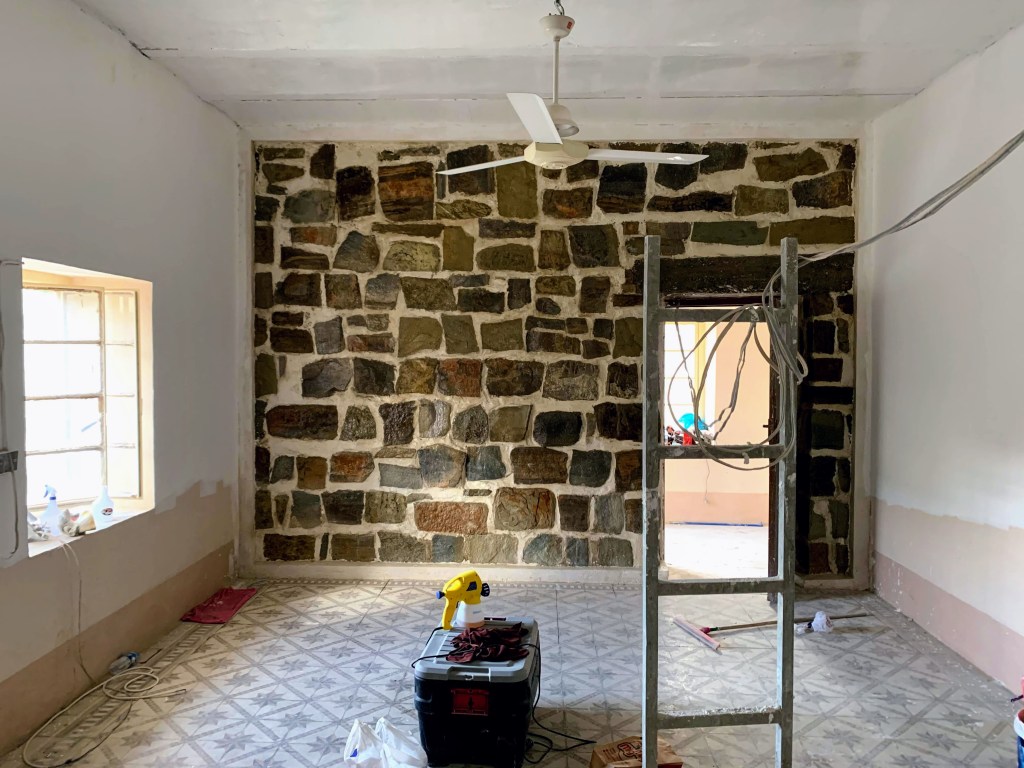
    The wall of what would become the homeschool room, nearing completion

    Our previous home in Central Asia was an old stone house right on the edge of the bazaar. It was very beat up when we agreed to rent it. Much of the wiring and light fixtures were still from the 1950s. The garden courtyard was an overrun mess of brambles and dust. All the water tanks were rusted out and useless. And two internal walls showed extensive water damage.

    At the time, there were only two of us who really believed in the potential of this run-down, dusty old house. Me – and Adam*, my good friend who suffered from paranoid schizophrenia. Most of my local friends and colleagues understandably said I was crazy for taking on a project like this. But Adam, my one believing friend who technically was crazy, was adamant that we had to get this place. That in itself probably confirmed that the others were right. Nevertheless, I sided with my schizophrenic friend and went for it. My wife (who was nervous about the whole thing, yet bravely willing to follow her husband) and I had always wanted to live within walking distance of the bazaar and here was our chance. Surely, bringing a house back from the dead couldn’t be that hard.

    In particular, Adam was captivated by the potential of the thick stone walls of this house, and especially the two internal water-damaged walls. Because of what to me looked like leprous wall spots of Levitical proportions, we would definitely have to replace the plaster, as well as patch the roof cracks. But, instead of then simply replastering the walls, Adam wanted me to let him get rid of all the plaster, polish and varnish the stones, and then put fresh white plaster in the seams of the rocks. The finishing touch would be framing the whole wall with a sharp plaster border. This labor would draw out the natural colors of the large stones, contrasting richly against the white of the plaster.

    In this season, Adam wasn’t doing so well and wasn’t yet willing to gather with other believers again. He also needed work. And work, creative work, in particular, seemed to ground his mind and make him less prone to believe that the spy agencies of various Western nations were after him and trying to turn me against him. I thought a big project like this might be a chance for us to spend some time together as friends – and also get him around other local believers like Frank*, who was responsible for the painting and replacing the old wiring.

    Some of these hopes turned out better than others. Adam’s enthusiastic work stripping the plaster off the walls filled the entire house with clouds of plaster dust for weeks on end. This meant that Frank was often kept from doing his electrical and painting work because of the conditions inside the house. I would be working on some ministry email or something, barricaded in one of the only rooms safe from the dust when Frank would walk in, fresh from an encounter with Adam.

    “How you doing, Frank?” I would ask.

    “Great!” he would say with an exaggerated smile, right before silently giving me an “I’m losing my mind and can’t possibly go on like this” face.

    So much for the work building camaraderie. Even worse, the dust was covering the floors so thick that to get it out we had to bust holes in some of the walls so that we could use a hose to flush it all out. We’re supposed to be fixing this place up, I thought to myself as we drilled a fist-sized hole at the base of the homeschool room wall, not punching more holes in it. Maybe my bleeding-heart, idealistic, risk-prone tendencies had gotten the better of me in agreeing to let Adam do it in the first place. In the end, the work took three times longer than we thought it would.

    But the walls. The stones. They came to life.

    The two ugly bubbling and disintegrating plaster walls had been transformed into the most beautiful parts of the entire house. They were now two accent walls consisting of stones that shone in grays, rusty reds, pale oranges, and slate blues. The larger of them graced one side of our homeschool room, a perfect addition to a space that was soon to be overflowing with kids, books, Legos, and artwork. Adam and I loved that my kids would get to learn math and reading and Bible around that big, solid, colorful, stone wall.

    When it was finished, everyone loved the end result. Even those who thought the whole project was crazy, even those who couldn’t bear to work with Adam and made fun of him because of his quirks and crazy ideas. You couldn’t deny it. The walls were stunning. Each of us had to admit that the one with the mind that wasn’t completely working correctly had been the only one able to look at something so ugly and see its true potential. And not only see its potential, but also realize its potential with long, sweaty, dusty hours chipping, grinding, and polishing.

    I enjoy reflecting on what Adam did with those walls. Even when his mind was in a dark and confused place, the possibility of bringing beauty out of brokenness brought him to life and gave him purpose and focus. It brought him back to his friends for a short time. It even got him some money so he could do the honorable Central Asian adult son thing and help his parents (whom he lives with) pay some bills. In that dusty project, the image of God in a very broken believer shone briefly but powerfully, like a shaft of light unexpectedly breaking through a towering Kentucky storm front.

    And it’s no overstatement to say that Adam’s work on the walls reflected the image of God. God is, after all, in the process of resurrecting – not broken down and decrepit walls and houses, but a whole world in this condition. His mind sees what the rest of us so often fail to see, how sinners can be transformed into saints through the mess of sanctification, how the beauty of the coming resurrection will make all of the suffering and sweat required to get there worth it. In our lives, he’s chipping off the old, leprous plaster, restoring a beauty in us that we lost long ago – and making it even more stunning than it was in the beginning.

    I’m so glad I took the risk and let my friend tear up those walls. He claimed he could see something in them, what they could become. He was right. I’m so glad that God sees something in us, in me, what we can become. And that he relentlessly keeps up his transforming work.

    p.s. Adam is doing great these days. After the initial breakthrough a couple years ago, God mercifully continues to give him a measure of healing from his paranoid schizophrenia. Adam has recently led a doctor friend of his to the Lord and has been bringing him to church with him regularly. Keep praying for him.

    We will be fully funded and headed back to the field when 40 more friends become monthly or annual supporters. If you would like to join our support team, reach out here. Many thanks!

    For my list of recommended books and travel gear, click here.

    *names changed for security