The beautiful thing about learning local proverbs is how they can succinctly provide a winsome response or even a rebuke in a touchy conversation. This is my go-to proverb when local friends say, “All the members of that people group are filthy/bad/fathers-of-dogs.” Amazingly, when I respond with this local proverb, I am usually met with chastened agreement.
1st Corinthians 11, with its discussion about head coverings, has been called one of the most confusing chapters in the Bible. Often the discussion about this chapter zeroes in on whether or not women are universally required to wear head coverings in the church, or whether this requirement was a local/historical application of a universal principle. I lean toward the latter, finding the case compelling which advocates that Corinthian female head coverings were a sign of modesty and faithfulness among the married women of the Greco-Roman world. So today, whatever forms communicate that principle of modesty and faithfulness in a contemporary culture would be a good way to apply 1st Corinthians 11 to the ladies of our churches.
But what about the men? Why would men in Corinth desire to cover their heads when praying or prophesying in the church? This is why I love learning about the New Testament background and culture. As L.P. Hartley said, the past is a foreign country; they do things differently there. Check out this revealing note from the ESV Archeology Study Bible:
Roman statuary depicts emperors and senior magistrates as partially covering their heads with fold of their togas when offering a public sacrifice (“praying”) or reading its entrails (“prophesying”). Paul instructs the Corinthian men not to dishonor Christ by praying to him in the same way that others addressed false gods such as Apollo. By praying with their heads uncovered, they show they are praying in a new way and worshiping a different deity than their pagan neighbors.
ESV Archeology Study Bible, p. 1710
That’s right. Roman emperors and other officials covered their heads to pray and prophesy. There’s even a statue from Corinth of Caesar Augustus doing this very thing (pictured above).
So how in the world do you apply this underlying principle of countercultural worship forms to the men of contemporary churches, whether in the west, the global south, or among the unreached people groups of the world? In some contexts it might be simpler than others. Where we serve in Central Asia, we should apply this by raising up men who preach and pray and even dress differently enough from the mullahs and imams of the mosque that it’s clear that they are worshipping different deities. The god of the Qur’an is not the same God of the Bible and the apostle Paul would have that distinction reflected in the public praying and prophesying of men in the church.
How would this be applied in the post-Christian West? I’m not quite sure, and I would welcome help in fleshing this out. Who would be the equivalent of the emperor and other Greco-Roman officials? Perhaps the political, business, and culture leaders. And the equivalent of making a civic religion sacrifice and reading its entrails? Perhaps any false-salvation narrative held up publicly by one of these leaders, whether that be a president promising the answer is revived nationalism, an opposition promising liberation from oppression by means of more government regulation, or a tech titan on stage promising life change through their latest generation technology. Men in the church, do you sound like them when you pray and speak in the gathered assembly of believers? Or is there enough different about your public presentation that it’s clear you serve a different God?
And in the realm of the painfully obvious, don’t wear a toga to church and during prayer drape it over your head. A form that risked gospel clarity in Corinth, for us, would at least risk appropriate gospel gravity.
To support our family as we head back to the field, click here.
For my list of recommended books and travel gear, click here.
This is a common question Christian men wrestle with when considering cross-cultural missions. It’s not a bad question. God has called us men to protect and provide for our families. Yet might provision and protection look differently for those upon whom the end of the ages has come?
[3] Greet Prisca and Aquila, my fellow workers in Christ Jesus, [4] who risked their necks for my life, to whom not only I give thanks but all the churches of the Gentiles give thanks as well. [5] Greet also the church in their house. -Romans 16:3-5 ESV
Come on, Aquila, you risked your own life and the life of your wife for the sake of Paul? What would have become of Prisca had you died, a widow from a persecuted minority in a pagan society? Is this not a failure of biblical manhood? What about your priorities as one called to be a husband?
Wait a second, Paul is commending these actions… and calling for the global church to give thanks for what Aquila and Prisca have done. Apparently, there is something deeper going on here that makes risking one’s life (and the life of one’s spouse) worth it, if done for the sake of the gospel.
This question hits close to home. My own father died on the mission field when I was a four-year-old, leaving my mom a widow and me and my siblings to be raised without a dad. Was this incredibly hard at times? Yes. A core part of grieving seems to come from the bereaved imagining life without their loved one. I was young enough that I was not able to do much of this at the time of my dad’s death. Instead, the grieving happened slowly over time, one quiet blow after another as the realization landed yet again: this is what it means to not have a dad.
But that was not the only realization that sunk deep into my soul. The other was this: this is how God keeps his promises and takes care of the fatherless. Over and over again I saw God’s faithfulness to take care of my family. It was unmistakeable. His hand to bless us through the suffering and to help us was apparent everywhere. Friends even came to faith because my dad died. Because of this, I was raised with the truth of God’s sovereignty in suffering deeply rooted in my experience and also staring up at me from the pages of Scripture. So when I first stumbled onto Piper sermons in high school, I leaned in. This man preached the God I knew. A God big enough to turn even death for good.
My wife and I now serve in a part of Central Asia that has some serious security concerns. We have three small children. The recurring conversations about whether or not to evacuate our area has led us to joke that our team’s theme song should be The Clash’s Should I Stay or Should I Go. For now, however, our local area continues to be a pocket of remarkable stability in a very volatile region. Still, there are rumors of terrorist sleeper cells around and I have the same health condition that took my dad’s life. What would happen to my family if I were to die? The very same thing that happened to my mom, my siblings, and myself – God would keep his promises and take care of them.
I’m not advocating any glib risk-taking here. I know all too well the painful cost. Any risk for the sake of the gospel needs to be exactly that – risk for the sake of the gospel. Total unity between spouses is also key in deciding what risks to take. Yet I am wanting to exhort my peers, dads of young families, who might struggle with fear as they wrestle with a call to the nations. Surprisingly, and by the grace of God, it is because my dad died that I was freed to take my family to risky places.
Perhaps your death, or merely your willingness to risk for the sake of Jesus, will be what frees your children to also serve Jesus in risky places.
[24] Truly, truly, I say to you, unless a grain of wheat falls into the earth and dies, it remains alone; but if it dies, it bears much fruit. [25] Whoever loves his life loses it, and whoever hates his life in this world will keep it for eternal life. -John 12:24-25 ESV
A hospital worker apologized to us today after asking us about how we ended up living in Central Asia. “I’m sorry, maybe you get tired of telling your story,” she said. We eagerly assured her that no, we are not tired at all of sharing how God led us to live in our unexpected corner of the world. The fact is that most missionaries are actually surprised by how few questions they get asked when they return to their home countries. Or, after years of living overseas, full of misadventures and crises, the only question that comes is, “So, how was your trip?”
“Um…it was… good?”
If you get the chance to spend time with missionaries who are back from the field, here is a list of questions most would be delighted to answer. Because so few ask questions like these, when someone does ask them it does our souls good, and we are encouraged as we speak of and remember God’s faithfulness.
What were some of the mighty things you saw God do in your time overseas?
What were some of the harder things that you faced?
How have your kids been doing growing up as third-culture kids?
How have you changed since you went overseas?
Tell me about the things you love about your focus people and culture.
How have you grown in your understanding of the gospel as you have served cross-culturally?
How did God call you to go overseas in the first place?
What are things you wish you could say to believers in your home country?
Do you have any funny stories that happened while on the mission field? Epic language mistakes?
What are the things your family most desperately needs prayer for?
Missionaries are storytellers at heart. But we’re often not sure if friends and family really want to hear our stories of breakthrough, tragedy, miracles, misadventures, and those times when we made complete fools out of ourselves. By asking these and similar questions, you let us know that you really do want to hear about our lives. And just as we are encouraged by sharing these things, we hope that our stories will also encourage you.
To support our family as we head back to the field, click here.
For my list of recommended books and travel gear, click here.
“Don’t go downtown tonight. Lots of protests planned.”
This is not an abnormal sentence for life in our corner of Central Asia. This time however, it was spoken about our home city in the US, where we are currently on medical leave. Like dozens of other cities, ours has been rocked by protests this week, sparked by the horrific killing of George Floyd in Minneapolis. Much ink has been spilled rightly lamenting the patterns of sinful injustice along with the sinful responses to these developments. Situations like this, with their impossible complexity, highlight the depths to which all sides are grievously affected by the curse. It all seems like a horrible Gordian knot. We desperately need the servant of the Lord from Isaiah 42 to untangle it, to bring justice in the gentle and supernatural way that only he can.
A bruised reed he will not break, and a faintly burning wick he will not quench; he will faithfully bring forth justice. He will not grow faint or be discouraged till he has established justice in the earth.
May he come quickly.
However, should he tarry, I want to advocate for the goodness of multiethnic churches as one key part of moving forward in race relations in the US, and even all over the world. Or did you think racism is a uniquely American problem? Sadly, it’s not. Racism is a global cancer; America is just comparatively public and loud about its racism issues (which is something to be commended). Many other nations, for face-saving reasons, do not air their dirty racism laundry, but oh, it is there, sometimes with twisted roots which are thousands of years old.
The problem with fallen humanity is that we self-sort by default. Despite our best intentions, most naturally ooze in the direction of those most similar to ourselves. This dynamic has been well-documented recently for political orientations, leading to our current situation of Democratic cities surrounded by Republican suburbs and countryside. But it also happens along ethnic and linguistic lines. In missions circles we call it the homogenous unit principle. The gospel flows most quickly along previously established blood and relational lines – the so-called “Bridges of God”. People tell their family and friends about Jesus and then ended up worshipping Jesus with mainly their family and friends. And in one sense this is only natural. It’s so natural that many question the need for multiethnic churches at all. After all, what’s the big deal with white folk wanting to worship in their culture and black folk wanting to worship in their culture? Don’t we believe in the goodness of a church for every people group in the world? Doesn’t God get glory from each unique cultural and linguistic expression of church? Doesn’t he preserve these differences such that they are still visible in eternity in prophetic passages like Revelation 7:9? Yes, there is a strong biblical case to be made that the gospel is for every language and for every culture. It uniquely redeems and honors each of them and should be uniquely expressed through each of them, like an opal displaying a thousand flaming colors within. God really does turn Babel on its head, turning the curse of many languages and peoples into a display of eternal glory. This is a truth worth dying for among the remote unengaged people groups of the world.
Yet alongside the gospel’s power to redeem every language and culture stands the biblical truth that the gospel is powerful to unite diverse cultures. To miss this is to miss one of the main themes of the New Testament, that the gospel is reconciling the previously irreconcilable – the Jew and the Gentile. Because the gospel was preached to both Jew and Gentile, many New Testament churches were multiethnic, a hodgepodge of Romans, Greeks, Palestinian Jews, and Hellenistic Jews. Hence the many issues that provoked passages like Romans 14. Paul labored until the end of his life to maintain the unity of these early multiethnic churches against the barrage of cultural and theological issues that threatened to divide them, issues such as food differences and the observance of sacred days. Though not mentioned explicitly, one can easily imagine the many history-related interpersonal issues that could arise between the Jewish believers, the oppressed, and their Greco-Roman brothers and sisters, the historical oppressors. After all, put in modern terms, the Greeks and the Romans were both repeatedly guilty of genocide against the Jews, alongside many other forms of oppression.
While monoethnic and monocultural churches proclaim that the gospel uniquely redeems a given ethnicity and culture, and such churches may at times be necessary or all that is possible, multiethnic churches return to the apostolic milieu, displaying the radical power of the gospel to reconcile those from different races and cultures even as it redeems each one individually. This display alone is worthy of the hard work it takes to establish and maintain these kinds of churches. And it is hard work, harder than ever in the age of Trump. However, along with this, multiethnic churches accomplish something very simple and practical. They supernaturally push back against human self-sorting and help diverse believers to actually know and hear one another.
Multiethnic churches provide a context where people from different races and cultures can deeply know one another, through the mutual bonds of covenant community. Communication differs tremendously from person to person, as every married person in the world will readily attest. How much more then does it differ from ethnicity to ethnicity and from culture to culture? If two people from the same culture are struggling to understand one another, the best thing they can do is to spend more time together and keep on communicating. Sooner or later they will learn how to get on the same frequency, they will come to understand what the other person actually means when they speak certain verbal constructions. The exhortation to “Pay attention to what he means, not what he says” is only possible after a certain degree of personal knowledge. But if believers self-sort, and don’t find themselves in contexts where they can know and be known by those different from them, then how will this communication threshold ever be reached? How will white and black believers ever be able to understand what the other actually means if they don’t spend abundant time together working for the kind of friendship where there is deep mutual understanding? Respectful distance will not be enough. Respectful distance will only lead to more misunderstanding and division. What is needed is a spiritual family, one committed to speak and listen to one another in biblical ways.
American Christianity remains remarkably segregated. There are reasons for this. On a practical level, it is very deflating to be repeatedly misunderstood, and those most likely to understand us are those most like us. So we drift toward worshipping with “our people” whether by default or by discouragement. Yes, we are all speaking English, but my contention is that white and black believers in this country aren’t really hearing and understanding one another. How can they when they remain so separate? Even if they worship together, most majority-culture believers are not awake to the real cultural and communication differences that underlie different American subcultures. But these differences are present and active nonetheless, a more present reality to those from minority cultures who must navigate between their culture and majority-white culture on a daily basis.
What do these points have to do with the protests spreading across America right now? In short, we cannot address the root issues of injustice in our society if we cannot truly understand one another. After all, a cultural and perhaps linguistic divide led to injustice even in the early church, which led to the establishment of the office of deacon (Acts 6). As one who lives in the daily challenges of cross-cultural (mis)communication, I believe that such failure of understanding and communication is a major element of racial issues in America, though because of the assumption of a common language it often escapes notice. As a Christian and member of a multiethnic church, I know that only in the church do we possess the spiritual resources necessary to truly unite those from different ethnicities and cultures. Yet American churches are highly segregated, because self-sorting is what naturally happens. It doesn’t have to be this way. In the midst of a divided nation, multiethnic churches can be seedbeds for inter-racial and cross-cultural understanding. And not just understanding, but even friendship and love. That’s why we need more multiethnic churches.
But according to his promise we are waiting for new heavens and a new earth in whichrighteousness dwells. 2 Peter 3:13 ESV
We are currently on a medical trip, back in the US for a few months. One big difference since we went overseas? Nearly all our peers have purchased houses. There was a time, about a decade ago, where I had no desire whatsoever to buy a house. In fact, if caught in an unguarded moment, I may have even said that those who purchased homes (especially in the suburbs) and settled down were in some way compromising, or least not living the kind of radical missional lifestyle that is really needed in this age. But things change after marriage and multiple children. Things change after a dozen more moves and a thousand more goodbyes. The valuing of thingsthat last grows stronger. Alongside of this also grows a deepened sense of true, biblical spirituality and the desperate need for not only those who will live like nomads for Jesus, but also those who will put down deep roots for Jesus. The sent ones simply can’t do what they do without being vastly outnumbered by the senders, those who have invested deeply enough in one place and one church so that they are able to send people like us to the nations. My family has been clearly called to go. Nevertheless, I feel a deep longing in this season of life to go and buy some farmland with a little patch of woods and to build a house there. Yet as far as I know, this desire is not compatible with our calling and dream to plant healthy churches among our Central Asian people group. So what is to be done?
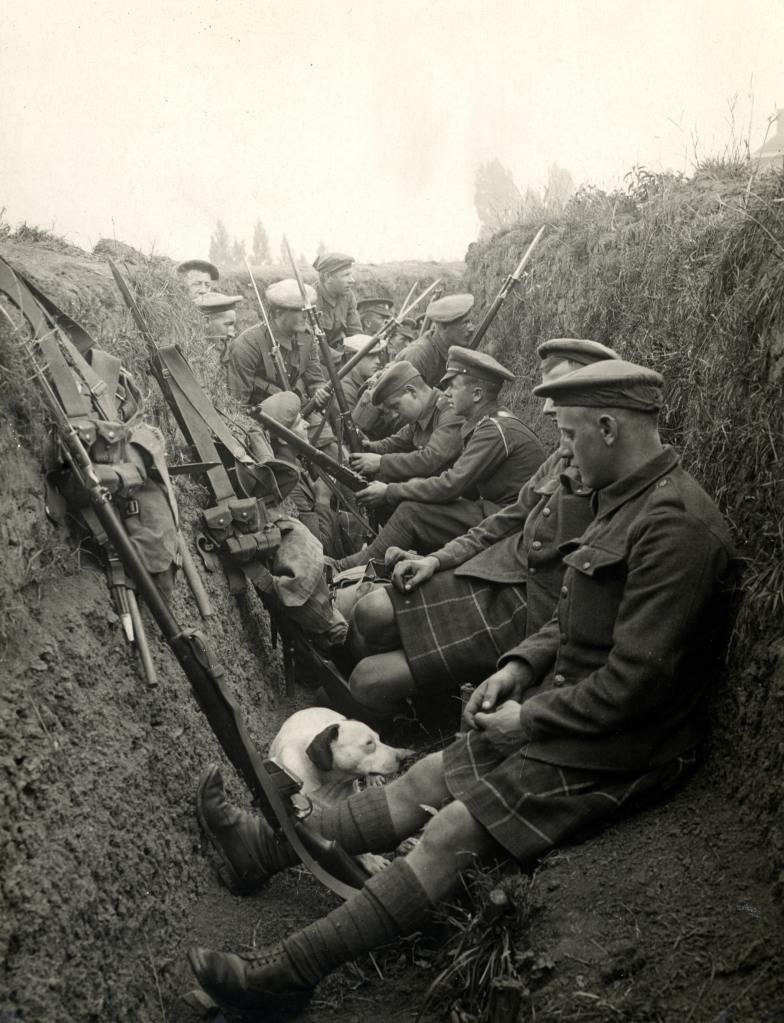
Picture a battalion of Allied soldiers in WWI. Before the war, one was preparing to be an artist, one an athlete, another a musician. Then the war started. Now they spend their days in muddy trenches, hunkering down under artillery barrages or making yet another brazen charge to try to claim a few more meters of muddy earth. They do not doubt their duty to their country and are proud to be fighting for the defense of their homeland. Yet the dreams and the desires – to paint, to play, to make music – are still there. They even get chances to dip their toes in these pursuits occasionally during lulls in the fighting, when fellow soldiers make tea in the trenches and there’s opportunity to pull out that precious sketchpad, the cricket bat, or the fiddle. These men are called to fight as long as duty and honor requires, so what becomes of their dreams? They are deferred to the glorious future – after the war is won.
I find this to be a helpful analogy not just for missionaries, but for all believers. Which of us can say that we do not have unrealized dreams and desires? Is there any believer in the whole world who feels that this life is long enough to fit in every single good longing of their heart? It is not long enough. The years of our life are seventy, or even by reason of strength eighty; yet there span is but toil and trouble; they are soon gone, and we fly away (Psalm 90:10). This is why we so desperately need eternity. God has filled our hearts and our imaginations with many more desires than can be fit into one lifetime. We must die to most of them. The secret of the believer is that we only die to them temporarily. The end of the war is coming, and we are on the winning side.
I have been accused of being a dreamer, so this truth may be unusually sweet mainly for those like me who live with a head full of tantalizing ideas (which we compulsively share with our long-suffering spouses). But I find the idea of deferring dreams to the New Heavens and the New Earth ever so practical as I seek to be faithful in the ministry calling that God has given me, faithful in the dream of seeing an unreached people group saturated with true worshippers. What am I to do with the desire to buy some farmland and build a house? What about all those amazing languages I will never get to learn and all those books I will never have time to read? Will I ever have time to master an instrument, or to plant orchards and eat their fruit, or to learn how to sail? Perhaps. Yet if any of these things are given in this life, I will count them as an unexpected bonus, a gracious preview of what is coming. Not unlike a fiddle playing in the trenches.
If we believe what the scriptures say about a New Heavens and a New Earth, then that future will be just as real to us as the inevitable end of any earthly war. It’s coming, sooner or later. And in that world there will be all the time we desire, and then some, with which to worship God through the enjoyment of his new creation and the fulfillment of all his given desires. Until then, my wife and I will continue to express our many dreams and then when necessary, say to one another, “Let’s punt it to the new heavens and the new earth.” See, this hope is not a pipe-dream for us, not merely a coping mechanism, but something real. Something which is actually approaching the biblical understanding of hope – that which you can’t yet see, and yet you hear the sound of its sure and steady approach.
It was 1:00 am in Richmond, VA, 2015. I was sitting next to a young Middle Eastern immigrant, reminiscing about what we missed about his native region. This young man was in an enviable situation, one which many are in fact dying to achieve as they freeze to death in refrigerated lorries or drown in the waters of the Aegean. My friend had legal residency in the USA, was going to a good university, and had a steady job at his uncle’s Mediterranean restaurant. As we talked and sipped black tea (loaded with egregious amounts of sugar), the topic of ISIS came up. At that point they still controlled an area of the Middle East comparable to the size of many countries. While we spoke, this young man confessed to me that he watched ISIS propaganda videos and followed some of their accounts. And, in spite of everything, his heart was stirred. He still insisted that their violence did not represent true Islam, but it was clear that there was a powerful resonance in their message, one which at the very least caused some measure of internal doubt and wavering for a young Muslim with a promising future in the West.
There’s a good reason young men (and women) from all over the world joined ISIS, and continue to join it and similar groups. It has nothing to do with them being uneducated or from impoverished backgrounds, as is sometimes reported in the media. In fact, most who volunteer for jihadist groups are actually well-educated and from middle class or upper class families. Instead, many join because of a powerful understanding of history that goes like this: creation, fall, redemption, restoration.
No, I’m not speaking of that redemptive history, which begins with God’s creation of a good world, which then falls into a curse through man’s sin, a world that is redeemed through the death and resurrection of Jesus Christ, who is now restoring all things, culminating in a new creation. That’s the original and true metanarrative, wonderfully fleshed out in the recent wave of biblical theology texts and children’s story book bibles. I am instead speaking of a diabolical hijacking of that story. It goes something like this. Creation: Long ago there was a united and just society, the Islamic Ummah. This society, established by God and led by the caliph, ruled a huge empire and ushered in an unprecedented age of justice and enlightenment. Fall: Sadly, this world was undermined by the scheming of pagan Western nations, who finally divided the Islamic Ummah and ended the caliphate at the close of WWI. The Muslims of the world have been under the curse of foreign domination and internal division ever since. They have strayed far from the teachings and lifestyle of Mohammad. Redemption: This tragic situation can be redeemed if faithful Muslims from all over the world are willing to sacrificially return to the true teachings and lifestyle of early Islam, spilling their blood in noble jihad to restore the caliphate once again. Restoration: The blood of the martyrs will lead to victory and a renewed caliphate, which will once again rule the world in righteousness and usher in the day of judgment and the resurrection of the dead. Cue the epic music and visuals and you have a very moving propaganda video, especially for those who have felt any sense of inferiority as Muslims.
What exactly does the secular West have to combat a powerful metanarrative like this? Be true to yourself? Follow your heart? YOLO? Human rights because… Nazis are bad? Story after story of Western converts to Islam contain the same line, “I found my partying and my secularism to be empty. In Islam I found meaning and purpose.” Many young Muslims, like people everywhere, want to be part of something greater than themselves. When an individualistic pursuit of pleasure or success comes up empty (and it always does), when a community experiences oppression (real or perceived), the metanarratives beckon, promising purpose, redemption, and eternal life. This is bad news for a Western world too jaded to believe in metanarratives anymore. The West pumps trillions of dollars into stopping Islamic extremism and yet only succeeds in tripling the global number of jihadist fighters. Sure, the West has better physical weaponry, but when it comes to ideology, they’ve brought their Beyonce CDs to a gun fight – at least when it comes to the radical minority that is awake to the desire for glory, honor, and immortality (Rom 2:7).
Once or twice I have tongue-in-cheek explained my job as taking potential ISIS recruits and turning them instead into Southern Baptists. No, this is not exactly what is going on, but there is a grain of truth to this playful distortion. The scriptures reveal to us the one true account of redemptive history, the authentic story of Creation, Fall, Redemption, and Restoration. We have access to the only metanarrative that can cut deeper to the heart of a young radicalized Muslim than the sermons of the late Al-Baghdadi. Sadly, as things currently stand many will never hear this true account, but only the hijacked version. As much as it is up to us, then, let us resolve that every potential jihadi recruit has the chance to hear the gospel in a language he can understand, and from the mouth of a believing friend.
“So, you go to seminary school. What’s that all about?”
There it was, the opening I had been seeking for months. Handed to me out of nowhere while I did the dishes at the restaurant sink. I blinked, then stammered, and went for it.
While in college, I had gotten a job as a delivery driver for a local branch of Jimmy Johns, the sandwich shop chain that prides itself on “freaky fast” delivery. I didn’t know how much of a cross-cultural experience I was in for. Because the area of our restaurant was full of hip bars and nightclubs, I worked mainly the nightshift, delivering sandwiches to famished partiers at the bar or those having just returned home, as long as they didn’t pass out before I made it to them. There were many quiet hospital staff deliveries as well, but also the runs where inebriated twenty-somethings requested that I toss the sandwich through their second story window and they throw the cash down. They were too drunk to make it down the stairs. My manager kept our shop temperature at near-freezing to deal with the recurring problem of the intoxicated coming in to buy a sandwich and falling asleep at one of our tables. The freezing temperature trick was actually quite effective. But I, as the only Christian working in that restaurant, did not feel very effective.
My American coworkers were all unchurched or post-Christian, most were drug users, some were alcoholics, others were LGBTQ or living with their partner. On more than one occasion, coworkers were arrested for drug possession. I, on the other hand, was a missionary kid who grew up in Melanesia, spent time in the Middle East, and was now going to the undergrad of a Southern Baptist seminary. I hung out with refugees and believers from many cultures, but I had the hardest time knowing how to connect with the younger, unchurched crowd from my “own” culture. There were many times I wished for my dad’s counsel, who had passed away many years before. He had grown up an unchurched American, was radically saved, yet never forgot how to connect with the partiers for the sake of the gospel. When I hung out with internationals, bridges to spiritual conversation seemed to overflow like the facial hair of an Assyrian monarch on an ancient stone relief. But when the topics of conversations were about parties, sleeping around, slasher movies, and hiphop artists I had never heard of, I just found myself at a loss.
Discouraged, I returned to the kinds of prayers I had lifed up many times in settings where I was insecure in my identity and didn’t know how to get to gospel conversation.
Lord, you know I want to share the gospel with my coworkers. But, I just don’t know how. I don’t know how to find a door in the conversation. But if you make one, I will step through it. I could force one, but somehow that doesn’t feel right. Would you turn the conversation? Would you help me?
I can’t remember how many times I prayed this prayer while I did the dishes, mopped the bathroom floor, or returned from another 3 a.m delivery in my beat up ’95 Honda Civic. How could I share the gospel with Middle Eastern Muslims and yet be so clueless when it came to people my own age in my own country? I kept on praying, tried to work hard, reported all my tips (much to the confusion of my supervisors), and tried to listen well. Sooner or later a door would open.
Then late one night, a slower shift than usual as I recall, a kind lesbian coworker asked me about seminary school. God had opened the door. I don’t remember much of the conversation that followed, but I know that I got a chance to speak of my faith in Jesus and my motivations for studying the Bible. My coworker must have spread the news of our strange conversation around, because it wasn’t long until some kind of switch flipped and all my coworkers started asking not only about seminary, but also about why I didn’t under-report my tips, and (scandalous!) why I was waiting until marriage to sleep with my fiancée. This final topic evoked quite a bit of interest, not unlike a team of anthropologists encountering a member of an unknown tribe for the very first time.
God had graciously opened the door, and then he kept on opening it. I got to share the gospel many times with my coworkers. They wanted to know what the Bible really said about being gay and about drugs and they even wanted to know about my experiences sharing the gospel in the Middle East. Coworkers started talking amongst themselves about their beliefs and their upbringings, even when I wasn’t involved in the conversation. They started joking that my presence alone caused everyone to start talking on cue about God and Jesus, “like some kind of #!@/ reverend of Jimmy Johns!” Through these conversations and friendships that developed we even got to set up a meeting between my pastors and a local chapter of the Gay-Straight Alliance where we were able to share extensive gospel truth.
Truth be told, I don’t know if any of my coworkers have come to faith from that strange season of sandwich delivery. My hope is that some of the seeds planted will one day sprout to life. I don’t even know that I learned much about how to connect well with my unchurched American peers. But I saw yet again how gracious God is to us when we approach him as needy evangelists, full of desire and yet just not sure how to share the gospel effectively. I still find myself often praying that prayer, most recently while meeting with a local teacher in the middle of the month of Ramadan, as we sat together in a shady green garden. He wanted to talk about politics and culture. Somehow the conversation spiraled in to rich gospel content. Just like Jimmy Johns, God had done it again.
Lord, if you will turn the conversation, if you will open the door, I will step through it...
p.s. If anyone living in areas with a strong bar scene wants to start up an evangelistic ministry, there is a great opportunity to be had once the bars close early in the morning. People are hungry, lonely, need caffeine, and want someone to talk to. I’ve heard of this kind of outreach happening in N. Ireland, where booths are set up to offer tea, coffee, food, and conversation, but not heard of anything like this yet in other countries. Once the ‘Rona dies down, could be a promising field for ministry. I’ve never felt so alone as a believer as I did in the middle of the night in the bar district. So many needy people, yet all the faithful were asleep.
This week I heard more fully about Hamid*, a friend from our former city whom I thought had fallen away from the faith. Three years ago he left our fledgling church plant, furious that we insisted on Jesus being the only way to God and that true believers must also hold to this truth. His mother was very sick at the time, which added personal fuel to the fire. Hamid’s departure, full of anger and insults and personal attacks, was so extreme that I thought he was gone for good. Or at least that he had demonstrated his faith to be a farce. But I kept praying for him over the last three years, helped by the example of George Mueller and his simple, persistent records of prayer requests and answers. Nevertheless, I was shocked and then excited this week to hear that Hamid had not only started coming back to the church again, but had actually repented to my teammate in tears for his conduct and words three years ago. He confessed that since then, God’s hand has been heavy on him. This is a stunning confession. In our context, it almost seems harder for a professing believer to repent of his sin and reconcile than it seems for someone to come to faith. Hamid’s remarkable about-face has encouraged me afresh to keep on praying for my friends who have fallen away or flamed out. As John Piper has said, we always resist the Holy Spirit, but the Holy Spirit is powerful to overcome that resistance anytime he pleases. May the Spirit continue to be pleased to overcome Hamid’s resistance – indeed, my own resistance – to his glorious work.
The part of Melanesia I grew up in could be quite dangerous. Similarly, the areas of American cities I have lived in are also considered not the best neighborhoods around. And the Central Asian region where we currently serve has its own unique dangers – I narrowly missed being blown up by a car bomb some years ago. While different groups have exposed us to some fantastic training and resources, the deepest practical security lessons I have learned came from my single mom.
After my dad passed away, we eventually returned to the mission field as a family of four: my single mom, my two older brothers, and myself. The Melanesian country we lived in was particularly dangerous for single women. Yet my mom moved around with incredible freedom and independence, with barely any security incidents for over seven years. My mom is very short and slender, so it wasn’t that she cut such an imposing figure that the bad guys stayed away. She didn’t carry a handgun on her either. Instead, she simply lived out some good missiological and neighborly principles. I have learned that these several things can mean the ability to live safely almost anywhere in the world.
First, my mom learned the local language well. All missionaries are supposed to do this, but sadly many can’t or won’t learn the language to the point where they would be considered advanced speakers (language learning is very difficult!). Yet the ability to understand what is being spoken around you and to speak yourself quickly and intelligibly is a massive part of situational awareness and staying safe. Learning the language(s) well and continuing to learn for the long-term should be a central part of wisdom for living safely in risky places. Just one well-dropped comment in the local language can alert everyone around that not only do you understand everything that is being said, but also that you are no mere tourist unable to respond and react in the powerful local vernacular.
Together with the language, my mom also learned the culture well. She learned not only what words meant but also what forms meant, things like body language and clothing and honorable conduct. Especially for foreign women, understanding how to dress modestly and interact respectably could mean the difference between a normal trip to the market and a terrifying encounter with a man with a machete. Learning the culture teaches you how to prevent dangerous situations from happening, how to defuse those that do become threatening, and also how to respond once an incident has occurred (Which in Melanesia even meant the possibility of summoning an enraged mob to your defense). Learning culture is harder than learning mere language because so much of it operates below the surface and must be intuited and pieced together. And yet the often invisible culture sets the rules that can mean life and death. In our our current Central Asian context, my wife has learned that respectful greetings to men, such as shop owners, can place her in the category of an honorable sister who should be protected, rather than the category of strange and probably-immoral foreigner, which means she is less likely to be objectified.
Finally, my mom did everything with local friends. Whether we were making a run to town for groceries or going on a village trip or going to church, we almost always had one local “brother” or “sister” or more with us. No matter how good you get at the language and the culture, you will never be able to interpret a situation as quickly and as intuitively as a local can. This extra set of eyes and ears provides a massive boost to freedom and security in a given context. Being accompanied by local friends also makes a powerful visual statement, especially in honor-shame or tribal contexts. It means you’ve got people who will vouch for you and who will defend you, people who are loyal to you. In these cultures this can mean not only that you’re less of an easy target, but also that you are the kind of person who does not deserve to be attacked or robbed. If you have visibly earned the respect of local friends, then other locals are more likely to extend respect you also – even those who might rob you.
My mom knew the language and the culture and she went everywhere with local friends. The honorable conduct of “Mama R” meant that she had freedom to move around safely that surpassed that of most of the other expat women in our context. We now serve in a very different part of the world, but I think of these things when we have the opportunity to visit parts of our region or city that might be more dangerous. These principles are valid anywhere, even in our home country. Sure, we might be fluent in American English, but could we grow in better understanding the various subcultures around us and in befriending those from those cultures? Absolutely. And that would mean greater safety and freedom with which to take the gospel into risky places.
Greater freedom and safety should, after all, be leveraged for greater gospel access. I learned that from my mom.





 Entrusted to the Dirt
