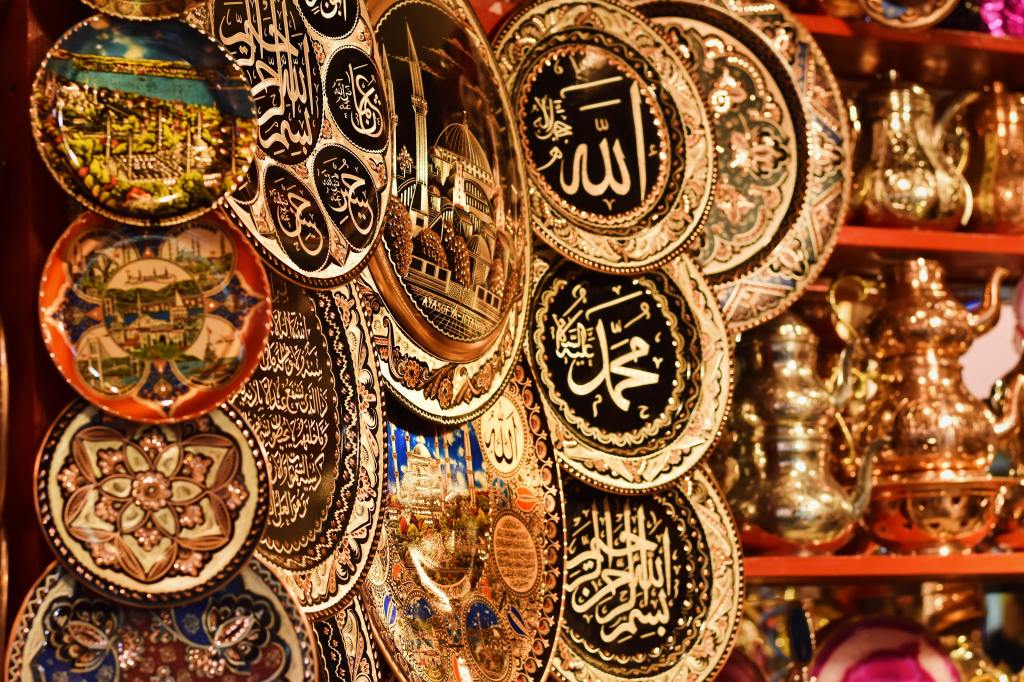
Short answer: It depends.
Long answer:
First, some historical background. There were Arab Christians before the emergence of Islam that used Allah to refer to the Christian God. These were Arab tribes such as the Lakhmids, the Banu Taghlib, and the Ghassanids who lived on the borders of the Byzantine and Sassanian empires. In fact, one of the oldest sources of written Arabic is a monastery inscription written by Hind, mother of the Lakhmid king, Amr, which reads “This church was built by Hind, mother of King Amr and servant of Christ… May the God for whom she built this church forgiver her sins and have mercy on her son.” Arabic Christians have continued throughout history to use the name Allah to refer to the God of the Bible to the present day. The name Allah is linguistically related to the Aramaic name for God, Alaha, and more importantly, to the Hebrew name, El. So in terms of history and etymology, Allah has a strong case. It has been conveying the meaning of the God of Bible’s identity for at least 1,500 years among Arabic-speaking Christians. Its sister languages have been similarly using its cognates for even longer than that.
But what about Islam? What happens when a rival religion emerges and hijacks the name for God the Christians have been using, filling it with unbiblical meaning? The god the Qur’an describes is vastly different from the God the Bible describes. The god of the Qur’an is a simple unity who is transcendent, but not imminent. The God of the Bible is a complex unity, a Trinity, who is both transcendent and imminent. The nature of the former means he cannot become a man to die a shameful death on a cross for the atonement of sins. The latter did, as the eternal Son took on flesh and became the man, Jesus Christ. Despite this and many other differences, Arab Christians throughout history, including our evangelical brothers and sisters, have held onto the name Allah for God. They are the linguistic insiders, the ones best qualified to know whether the biblical meaning of God can still be communicated by the form, Allah. English speakers should defer to native Arabic speakers, agreeing that within the Arabic language, Allah can be used to speak of the Christian God.
As English speakers, a little reflection on our own word, God, can be helpful here. In spite of its polytheistic Indo-European and Germanic baggage, the name God has been redeemed and filled for a millennium and a half with biblical meaning. Therefore, our own experience tells us that names of deities with pagan baggage can become faithful linguistic servants of the true revelation. Let’s say Mormonism, with its own unbiblical views of God, overtakes Christianity in the West and becomes the dominant religion. Would we abandon the name, God? Unlikely. We would probably labor for thousands of years to refill the form with its biblical meaning, not unlike what Arab Christians have done.
But…
The name Allah should not be used to refer to the God of the Bible outside of Arabic-speaking communities. There are at least three reasons for this.
The first is that Christian history and missions history have shown that whenever possible, Christians should seek to redeem the indigenous word for the all-powerful creator God that already exists in that language, if one exists. Again, we English speakers live this reality every day when we say God instead of YHWH or El. Why has redeeming the chief divinity’s name been so effective throughout history in hundreds of languages? My theory is that the name for the all-powerful creator god in a given language represents an ancient remnant of early monotheism, diluted sometime after Babel into polytheism, but still there, waiting like a time-bomb for a Christian missionary to come along and connect that name back to its source. He has not left them without a witness to himself (Acts 14:17).
The second reason for not using Allah in other linguistic contexts is that Allah primarily represents/means the god of Islam in those other languages, making it more harmful than not to communicating the biblical God. Languages other than Arabic don’t have the broader range of meanings of Allah that Arabic has, in which Allah continues to be used also as the God of Arabic Christians and Jews. These languages often have another name for the all-powerful creator god in addition to the more narrowly-understood Allah proclaimed among them by Islam. This is true of the Muslim Central Asian people group that we work among and many others. Our focus people group, interestingly enough, has a name for God that is a very distant cousin-cognate to our English term, God. When they use this indigenous name, it carries a broader sense than Allah does, thus giving us more room to build biblical categories. We sense this even in English. When someone speaks of Allah we understand that that person is speaking of the god of Islam in a narrower sense than we use the term God in English. Words really do carry around meaning-baggage with them, and we need to acknowledge it and carefully judge if a name is already so tied to unbiblical meaning as to be not worth the salvage effort. In other languages, Allah is not worth the effort it would take to redeem it, especially when God has preserved an indigenous name for the all-powerful creator god in that language.
That brings me to my third reason to not use Allah to refer to the biblical God in non-Arabic contexts. Islam teaches that in order to please God, you must pray, worship, and live like a 7th century Arab. It teaches that Arabic is the language of heaven and thus holier than all other languages. This means that all those other people groups who are Muslim have been raised to believe that their language is inferior for praying to Allah and that they will only get the spiritual merit they need to gain paradise if they pray in 7th century Arabic. In a real sense, they must become Arabs or they will go to hell. Why have the Persians, the Turks, the Kurds, the Berbers, the Dari, the Pashtun, the Baloch, the Somalis, and so many others blindly accepted this linguistic and cultural colonialism? It is tragic that no one has taught them that gentiles don’t need to become Jews in order to be saved, and therefore, they do not have to become Arabs. Missionaries run the risk of contributing to this Arab-supremacist heresy when we thoughtlessly or “creatively” use Allah among non-Arab people groups. Instead, we should be proclaiming that the true God knows their language and knows their people, that he loves them and desires for them to worship him in their own language as a unique manifestation of his glory – that he will even preserve worship in their language for all eternity (Rev 7:9). These truths are precious and powerful for oppressed people groups in a way that dominant people groups (like English and Arabic speakers) sometimes struggle to understand. Yes, the gospel will call them to transcend their ethno-linguistic identity as members of the race of Christ, but first it will honor their ethno-linguistic identity. In salvation, God will come to them and will speak to them in their mother tongue. So should we.
So, can Christians use the name of Allah to refer to the God of the Bible? It depends. If it’s in Arabic, absolutely. In other languages, let’s avoid it wherever possible.
Arab Christian History Source: Baumer, The Church of the East, p. 92
Photo by Rumman Amin on Unsplash



 Entrusted to the Dirt