…by century’s end Isidore was building a real library in Seville, which consisted of about fifteen presses (or book cabinets), containing perhaps some four hundred bound codices, an amazing number for the time. The only other continental library known to us in this period was in Calabria [S. Italy] and the fate of this library is lost in the blood and smoke of the sixth century. Gregory of Tours wrote this sad epitaph on sixth-century literacy: “In these times when the practice of letters declines, no, rather perishes in the cities of Gaul, there has been found no scholar trained in ordered composition to present in prose or verse a picture of the things which have befallen.”
Ireland, at peace and furiously copying, thus stood in the position of becoming Europe’s publisher. But the pagan Saxon settlements of southern England had cut Ireland off from easy commerce with the continent. While Rome and its ancient empire faded from memory and a new, illiterate Europe rose on its ruins, a vibrant, literary culture was blooming in secret along its Celtic fringe. It needed only one step more to close the circle, which would reconnect Europe to its own past by way of scribal Ireland.
Columcille provided that step. By stepping into the coracle that bore him beyond the horizon, he entered the Irish pantheon of heroes who had done immortal deeds against impossible odds. As he sailed off that morning, he was doing the hardest thing an Irishman could do, a much harder than than giving up his life: he was leaving Ireland. If the Green Martyrdom had failed, here was a martyrdom that was surely the equal of the Red; and henceforth, all who followed Columcille’s lead were called to the White Martyrdom, they who sailed into the white sky of morning, into the unknown, never to return.
In this way, the Irish monastic tradition began to spread beyond Ireland.
Cahill, How the Irish Saved Civilization, pp. 183-184
When the civilizations which Christians have made their homes begin to collapse, look to the fringes. God is often at work there, and just may use the most unexpected peoples and places to restore the light to lands once bright, now overrun by darkness.
Ephrem the Syrian writes this poem as a fictional argument between Satan and Death, where each bicker about who is strongest. Ephrem, like many in church history, advocates laughing at our spiritual enemies as one important piece of spiritual warfare. Martin Luther agrees, “The best way to drive out the devil, if he will not yield to texts of Scripture, is to jeer and flout him, for he cannot bear scorn.” This poem is a call to confidently laugh today at evil, thereby echoing the victorious laughter of the coming resurrection.
Nisibene Hymns, no. 52
I heard Satan and death loudly disputing
which was the strongest of the two amongst men.
Refrain: Praise to You, Son of the Shepherd of all, who has saved his flock
from the hidden wolves, the Evil One and Death, who had swallowed it up.
Death has shown his power in that he conquers all men,
Satan has shown his guile in that he makes all men sin.
Death: Only those who want to, O Evil One, listen to you,
but to me they come, whether they will it or not.
Satan: You just employ brute force, O Death,
whereas I use traps and cunning snares.
Death: Listen, Evil One, a cunning man can break your yoke,
but there is none who can escape from mine.
Satan: You, Death, exercise your strength on the sick,
but I am the stronger with those who are well.
Death: The Evil One has no control over the person who reviles him,
but all who have cursed me, in the past or now, still come to me.
Satan: You, Death, received your power from God,
but when I make men sin I do it without any outside help.
Death: You, Evil One, lay snares like a coward,
but I use my power like a king.
Satan: You are too stupid, Death, to recognize how great I am,
seeing that I can capture free will.
Death: You, Evil One, go around like a hooligan,
whereas I am like a lion, fearlessly crushing my prey.
Satan: You have no one who serves or worships you, O Death,
but me, kings honor with sacrifices, like a god.
Death: But many address Death as a benefactor,
whereas no one ever has or shall call on you as such, O Evil One.
Satan: Do you not realize, Death, how many
call on me in one way or another, and offer me libations?
Death: Your name is hated, Satan, you cannot remedy it;
everyone curses your name. Hide your shame.
Satan: Your ear is dull, Death, for you fail to hear
how everyone howls out against you. Go, hide yourself.
Death: I go open-faced among creation, and do not use deceit like you:
you do not pass a single night without some kind of deceit.
Satan: You have not found a better lot for all your truth:
men hate you just as much as they do me.
Death: Everyone fears me as a master,
but you they hate as the evil one.
Satan: People hate your name and your deeds, O Death;
my name may be hated, but my pleasures are loved.
Death: Your sweet taste ends in setting the teeth on edge:
remorse always accompanies those pleasures of yours.
Satan: Sheol is hated for there is no chance of remorse there:
it is a pit which swallows up and suppresses every impulse.
Death: Sheol is a whirlpool, and everyone who falls in it is resurrected,
but sin is hated because it cuts off a man's hope.
Satan: Although it grieves me, I allow for repentance;
You cut off a sinner's hopes if he dies in his sins.
Death: With you his hope was cut off long ago;
if you had never made him sin, he would have made a good end.
Chorus: Blessed is he who set the accursed slaves against each other
so that we can laugh at them just as they laughed at us.
Our laughing at them now, my brethren, is a pledge
that we will again be able to laugh, at the resurrection.
-Ephrem the Syrian, translated by Brock, The Harp of the Spirit: Poems of Saint Ephrem the Syrian, p. 104-107
The events which took place at Babel most definitely fall into the category of judgment. Genesis eleven describes how the early peoples of the earth all shared one language. And contrary to God’s desires, they did not spread out and fill the earth, but decided they would band together, build a city in the land of Shinar, and construct a tower to challenge the heavens. In this way, they would “make a name” for themselves. You don’t have to be from an honor-shame culture to understand that making a name for yourself essentially means working to build up your own honor and reputation. It was pride, pure human pride – and that accelerated because everyone knew the same words, the same language.
God, not in the least threatened by this little rebellion, comes down to see what the residents of this city of Babel are up to. There’s some rich irony in the text here – the tower builders are not nearly as high up as they think they are. After seeing how the linguistic unity is enabling their prideful building campaign, God decides to instantly scramble their languages by means of a miraculous act of judgment. Once this has been accomplished, everything falls apart. Faced with mass communication confusion, the building of the city stops and the peoples end up spreading out over the face of the earth after all. Their dispersion is largely involuntary, a forced obedience of sorts thrust upon them by their dysfunctional language situation. Babel was judgment. Judgment for human pride. Judgment for neglecting the creation mandate to go forth, multiply, and fill the earth.
Yet Babel was not only an act of judgment. It was also an act of creation. Creation through judgment. Apparently, when God acted, dozens of languages burst into existence instantly and then began to live and move and have stories and descendants of their own. These languages would be the first ancestors of the language families in our world today, with language families meaning simply groups of related languages. For example, English, Latin, Farsi, and Hindi all come from the Indo-European family of languages. While Arabic, Hebrew, and Aramaic come from a different family, the Semitic. However, while languages within a given family are clearly related to one another, separate language families don’t seem to share any common descent. Historical linguists can try to reconstruct ancient languages like Proto-Indo-European and Proto-Semitic, but they can’t seem to find any links suggesting these early languages emerged from a common ancestor. Similar to the problem facing speciation in Darwinian evolution, what seems to emerge from the data is not one connected tree from which all the descendants are traced back to a single ancestor, but rather a forest of trees that seem to have been there at the beginning. Like subspecies, languages branch back toward these early independent trunks, but not further, posing a great mystery for historical linguists. Christians of course have a good answer. We believe in a humanity created in the image of a speaking God, and in Babel, the source of this world’s incredible language diversity.
It’s curious to note that the result of this judgment – a world of linguistic diversity – is never promised to disappear. The restoration of all things does not seem to include a future where we are restored to being a monolingual species. Revelation 5:9 and 7:9 instead suggest that noticeable language differences are actually preserved in eternity. John can tell that the great multitude before the throne is made up of those from every tongue. “After this I looked, and behold, a great multitude that no one could number, from every nation, from all tribes and peoples and languages, standing before the throne and before the Lamb, clothed in white robes, with palm branches in their hands, and crying out with a loud voice, ‘Salvation belongs to our God who sits on the throne and to the Lamb!'” (Revelation 7:9, 10). Our unique languages don’t seem to melt away into some heavenly tongue, like cast off vestiges of a divided past. Rather, God’s plan from the beginning seems to be the redemption of humanity’s diverse languages, a restoration where they are finally free to perfectly glorify God in a great multilingual choir of the saints.
We see hints of this plan in God’s choice to reveal the Scriptures in multiple languages: Hebrew, Aramaic, and Greek. At various points in history, these multiple fallen languages are given the honor of being the vehicle by which God reveals his eternal word. Even Persian gets a bunch of loan words in the Bible. Then, when the Spirit comes at Pentecost, what does he choose to do? To empower the apostles to preach and worship in the foreign languages of pilgrims who had come to the feast from dozens of far-flung lands. Put together with the visions of Revelation, the picture we get is that both at the birth and at the final destination of the Church, the many languages of the world do not fade away to be replaced by some heavenly tongue, or some chosen earthly tongue like Hebrew. No, instead we see the languages of the nations transformed, employed in the praise of God.
It seems as if, as he so often does, God has chosen to bring beauty through judgment, a greater grace and glory than would have existed had the judgment never taken place. After all, this is the logic of the cross and salvation history. Yes, judgment falls. Yet amazingly God’s grace shines even brighter for it. Should we be surprised that God delights to also do this with the arc of language history? It reminds me of how God gave a king to Israel in 1st Samuel chapter eight. Being granted a monarch was a judgment, a consequence of Israel wanting to be like all the other nations, and their rejection of God as king. And yet we know that God’s plan was, through this rebellion, to raise up David – and eventually the eternal son of David. God’s forever king for his people was the plan from the beginning. And yet an initial hint of this mystery’s unveiling was a story of human failure, and divine judgment.
What might God be up to in his plan to redeem the languages of Babel and their many descendants? Here I’m helped to remember the limitations of a single language. Languages are good, wonderful even, but they are limited. Everyone who has learned another language has experienced the frustration of a perfectly descriptive term existing in one tongue, but not in another. In my home we have terms from Melanesia as well as from Central Asia that have made their way into our daily household English. This is because English lacks a word for those particular situations or feelings. If languages are thus limited to describe everyday realities, then how much more limited are they to describe eternal realities? To describe the Godhead?
In Greek, and my adopted Central Asian language, God can be called Lord Heart-Knower (Acts 1:24), and yet this title simply doesn’t work in my mother tongue, English. On the other hand, English has so many wonderfully-succinct terms for God’s attributes like omniscient and omnipresent and omnipotent that require multiple words – or even a whole sentence – to communicate in many other languages. Alas, as with the sons of Adam, so every language has also fallen short of the glory of God. No, when it comes to the task of glorifying the Trinity for all eternity, a single language was apparently not enough. Rather, God seems to have desired thousands of them, all working together to leverage their unique strengths and beauty for his eternal praise – and the enjoyment of his people.
For surely languages will also be redeemed and preserved for the sake of our enjoyment. While polyglots delight in the freedom that comes from being able to speak and think in a dozen different ways, even my four-year-old cracks up when a good pun is made (and scripture is full of witty puns and wordplay). Language was created for our enjoyment, and even in this broken age we get small tastes of the fun that is coming to us beyond the resurrection. Perhaps in eternity the Spirit will give us a supernatural ability to speak and understand all languages, in a sort of permanent Pentecost. Or, perhaps we will use the time provided by eternity (plus a resurrected mind) to learn all of the many tongues spoken by our brothers and sisters. We simply don’t know yet. I tend to hope we’ll get to learn them the old-fashioned way, maybe a little easier, but still getting to make funny mistakes.
What we do know is that God wanted a universe with thousands of unique languages. And so, even though Babel is a reminder of human pride and God’s just judgment, it is also the start of something which will ultimately become an amazing tapestry reflecting God’s glory. There are eternal upsides to the shattering of humanity’s united language. In Babel there is beauty, unexpected, but even more wonderful for it.
Since Christianity was, by 381/392 at the latest, the state religion of the Roman Empire, conciliar [council] decisions served as civil laws, as soon as the emperor ratified them. Local bishops were the first to perceive this, as they were obligated to uphold the opinions declared orthodox by the councils. Opposition to conciliar pronouncements led to civil sanctions; dissenting bishops were sent into exile and replaced with orthodox ones. However, since the bishops often had at their disposal a strong following, dismissal by force could not be carried out immediately, for the threat of revolt was too great. This was all the truer when, in the traditional hotbeds of unrest in the patriarchs of Alexandria and Antioch, anti-Byzantine nationalistic reflex arose. During the tumult of that time there were many casualties, and in the case of the Melkite patriarch of Alexandria, Proterios, even murder: an angry mob killed the unfortunate patriarch in 457 in the baptistery of his cathedral. Other prominent victims were Flavian, the deposed archbishop of Constantinople, who was so badly injured by monks and soldiers at the so-called ‘Robber Synod’ of 449 that he died of his wounds three days later; and Bishop Severian of Scythopolis, who was murdered in 451 on the return from Chalcedon. For these reasons, in the large cities communities often remained divided, each with their own clergy and their own churches. Although a canon law assigned only one bishop per city, for a time Antioch had four vying for power! It was in this patriarchate that the battles between Miaphysites, Dyophysites and Melkites loyal to the emperor raged most fiercely.
However, the intensity of these theological disputes – unimaginable to us in the twenty-first century – cannot be explained just on the basis of political circumstances. As W. Klein has aptly stated, at that time ‘dogma was not yet the specialized science of a few theologians, but rather the stuff of everyday conversation, and it resembled modern disputes over party politics.’
Baumer, The Church of the East, pp. 37-38
Notice the knock-on effects of an earlier period of Christian nationalism. Local bishops forced to uphold the official state doctrine, or risk civil sanction or exile. Backing for other rival doctrines fueled by anti-nationalist sentiments. The physical assault and murder of church leaders, whose pronouncements were now just as political as they were spiritual.
Those now calling for a return to Christian nationalism would do well to chew on the times in the past where it has indeed been tried, and so often led to the corruption of the church and the loss of its spiritual power. There is a better option, what Baptists have called the spirituality of the kingdom of God.
“Now that I have have this comprehensive power of attorney for you, I can legally get you a second wife – even without you knowing. Better watch out, when you come back from out of the country you may have a second wife, ha!”
Mr. Talent* conveniently dropped this news after several of us on the team had finished the POA process with him, meaning that he could now hold this over each of our heads. Thankfully, being a believer, Mr. Talent understands now that polygamy is a sin, despite his joking. Even before coming to faith, his first marriage had been difficult and had fallen apart, and he is also of the local demographic that would resonate with the ancestral proverb that “a man with two wives has a liver full of holes,” i.e. become a polygamist and embrace a life of pain.
And yet polygamy continues in our corner of Central Asia as a relatively normal thing among a sizeable minority of the population. Why does it still happen when polygamy is technically illegal in our area and when the culture itself has proverbs that speak to its danger? For something that is so foreign to us in the West (at least for now), it’s helpful to understand the justifications used by other societies for polygamy so that we can more skillfully oppose it with biblical truth.
The overwhelming majority of locals in our area are Muslims, and this means that a religious motivation is ready at hand for anyone who desires to marry an additional wife – even if this religious reason serves as a thin veneer for the true motivation. After all, the founding figure of Islam, Muhammad, had around twelve wives (there’s some disagreement about the actual number, and our local imams say thirteen). Being the supposed prophet and founder, Muhammad is held up as the ideal Muslim. So if a Muslim man wants to live like the prophet, and thereby be blessed, he will traditionally consider polygamy as a logical way to do this. However, only the prophet is allowed a dozen wives. Normal Muslims are limited to four.
Justifications in Islam for this polygamy in Muhammad’s life vary, but the most common one that I’ve heard is that it was an act of social justice, since so many wives had become widows in the holy wars that led to Islam’s founding. This doesn’t explain why Muhammad married seven-year-old Aisha, his favorite wife. Nor does it explain why he took his adopted son’s wife to be his own, conveniently receiving a divine revelation declaring adoption an un-Islamic concept in order to make it seem like he was not actually marrying his son’s wife (thereby making adoption among most Muslims a shameful thing to this day). But I digress, the logic for this first reason for polygamy among Muslims skirts these issues and simply maintains that Allah has blessed polygamy in the life of the prophet, and thereby in the life of faithful Muslims who commit to caring for each wife equally.
This Islamic sanctioning of polygamy means it often takes place in spite of the laws of the country where the couple resides – laws often viewed as Western and infidel-influenced. Polygamy is illegal only in the region of the country where we’ve been residing, but it is legal in other regions. So, local men who desire an additional wife will travel down south and work things out there, often with a wink from their local Islamic authorities, who are supposed to be abiding by the law and not encouraging polygamy at all. This dynamic is also present among some Islamic refugees in the West, where a man might fill out his paperwork as having one wife and one “sister” in order to bring both his wives with him to the West. He’ll set up two households in his new country, and live as a polygamist under the radar.
Another very common reason for polygamy among the Muslims in our area is infertility. Similar to stories of the Old Testament patriarchs, a man will often take a second wife if his first wife has proven unable to conceive after a given length of time. This is because children, and male heirs specifically, are so highly prized in the culture. We knew a village family in this situation, where a new wife had recently been acquired because the first wife seemed to be infertile. Again, similar to the stories of Rachel or Hannah, the public shame the first wife experiences in this kind of situation is almost unbearable. The presence of the second wife would serve as an excruciating daily reminder of her shame and and failure. If the medical issue resides with the man, he may keep taking on new wives, blaming each one in turn for what is actually his biological problem. Thankfully, modern medicine is making this kind of situation less common, as long as the man isn’t too proud to accept what the doctors are saying.
Surprisingly, it can sometimes be the first wife who pushes for the husband to take a second. This is because the first wife is often given a promotion of sorts when a second wife is taken on. The veteran wife will often get to hand off the more difficult housework and cooking to the second wife. Or the first and second wives give the hard labor to the third, etc. This could be viewed as compensation of sorts for the embarrassment of the husband taking on another wife, but can also be pursued in a sadly practical way for a marriage that’s unhealthy anyway. If the relationship is already cold and practical, why not get some help around the house? Similarly, one of my wife’s close friends desires her husband to take on a second wife primarily so that she can be free of his sexual demands. Having an additional wife might even provide some relational connection for a lonely wife who is disliked by her husband and his extended family. Just as the wives of a polygamist can often be bitter rivals, they can also become friends who support one another when both are stuck in the same situation, married to a bad man.
Polygamy can also be pursued by extended families in order to increase the standing of each. A poorer family might want one of their daughters to marry a wealthy or powerful patron. The patron’s standing as a holy, powerful, and apparently desirable man is thus increased, and the family of the girl gets a boost in honor and the brideprice money, which would be considerably more in this situation than if she were the sole wife of a man with less status. For example, one aged mullah in our country recently took on a third wife who is thirty-four years his junior. This kind of family status arrangement is likely what is going on here.
A final category of justification for polygamy is often simply the whims and desires of the man. If he is unhappy with how things are going sexually, or in terms of the cooking, or even if he just wants to flaunt his power as the domestic strongman, he might take on another wife. The first wife (or wives) cannot stop him from doing this, though in their own ways they can make him pay for it, hence the proverb about having a liver full of holes. Sadly, much polygamy takes place for no other reason than an already-married man takes a liking to another woman he has seen and decides that he simply must have her. I had to cut off contact with one village friend because he kept calling me, insisting that I translate for him as he flirted with a migrant worker, trying make her his second wife without the knowledge of the rest of his family.
The Bible is not silent on polygamy, though the case made against it is an indirect one. The first polygamist we see in Genesis is Lamech, a domineering and violent man. Then, in the stories of the patriarchs, both Abraham and Jacob become polygamists because of sin – Abraham’s doubting God’s promise and Laban’s deception of the inebriated Jacob. What ensues is a terrific mess, with rival wives, warring children, and men who must repeatedly eat the bitter fruit of their polygamous households. The kings of Israel are then expressly forbidden from taking on many wives in the style of the harems of the other nations, and we see the destruction of polygamy in both David’s and Solomon’s stories, even turning their hearts away from God. As the Old Testament period winds on, it becomes clear that God shows grace to polygamous households in spite of the institution, not because of it. The narratives of scripture are all consistent in their painting polygamy in a negative, worldly light.
At last, in the New Testament, Jesus calls the religious leaders back to God’s creation pattern for marriage – a man shall leave his father and mother and hold fast to his wife, and they shall become one flesh. Two become one, just like Adam and Eve in the beginning. In this passage as well as Paul’s insistence upon leaders being one-women men, monogamy is clearly assumed and polygamy thereby understood to be out of bounds. It may have been tolerated under the Old Covenant, but the New Covenant has come, where Christ has one holy bride, not multiple. And this relationship now serves as the pattern for all Christian marriages.
Whatever the justifications of polygamists, God’s word has come to silence them with its indirect yet forceful case. To have multiple wives is to lie about the nature of God’s covenant-keeping love, to lie about the nature of God himself. Believers in Christ are to live in such a way that their marriages are imperfect yet genuine metaphors of Christ and the Church – and as in the recent Western order, to influence society such that the injustice of polygamy is no longer tolerated.
For polygamy is unjust, both to the women whose dignity and agency are violated in polygamous marriage, as well as to poorer and younger and even average men, for whom marriage in a polygamous society becomes less and less attainable. A case could even be made that polygamous societies lead to greater violent conflict, as there is a clear connection in history between nations with a shortage of brides and nations that try to conquer their neighbors. And polygamous societies will always lead to many more available single men than available single women. How can it be otherwise when having multiple wives becomes a status symbol of the religious, the wealthy, and the powerful?
The justifications of polygamists are mixed. Some are good desires, such as the desire to have children, or to get some relief from the never-ending household labor. Christians can recognize the good in these desires and point toward better ways to pursue these goals and to respond when they are denied. Other, selfish, desires that lead to polygamy are to be rejected outright. Hence, knowing what the underlying motivation is for taking on another wife will be key to responding both biblically and skillfully. Why skillfully? Because in polygamous societies, you are the crazy one who thinks that monogamy is the only way to go. For them, polygamy is simply normal, perhaps even good, the way the world is. Helping locals to turn against their own polygamous heritage will be no easy task, but speaking to their underlying motivations will only help in this effort. I’ve laid out here the main motivations for polygamy in our context, but other polygamous contexts will bring with them their own unique justifications that will require understanding and appropriate response.
Polygamy has been around an awfully long time, and no doubt it will continue to pop up various human societies into the future. As it decreases in Central Asia, it may stage a comeback in the post-Christian West. The Church will need to confront it wherever it finds polygamy, lovingly but boldly calling men and women to a faithful monogamy that points back to Eden, and forward to the coming marriage supper of the Lamb.
To support our family as we head back to the field, click here.
For my list of recommended books and travel gear, click here.

To the Irish, the pope, the bishop of Rome who was successor to Saint Peter, was a kind of high king of the church, but like the high king a distant figure whose wishes were little known and less considered. Rome was surely the ultimate pilgrim’s destination – especially because there were so many books there that could be brought back and copied! But if your motive was holiness:
To go to Rome
Is little profit, endless pain;
The Master that you seek in Rome,
You find at home, or seek in vain.
Cahill, How the Irish Saved Civilization, p. 181
There’s some New Covenant common sense in this ancient Irish verse. Worshiping in spirit and in truth means there are no longer some mountains holier than others – nor cities. The presence of the Spirit in all of God’s people means physical pilgrimage is no longer necessary. The presence of God is just as near in Ireland as in Rome, in Melanasia as in Jerusalem.
On the other hand, having lived in frontier places without ready access to good Christian books, I fully understand a willingness to go to such tremendous lengths to acquire them.
This is one of my favorites pieces so far by Ephrem the Syrian, Christian poet from the 300s. Ephrem writes this hymn largely from the perspective of death, bracketed and interspersed with some narration. Death begins its discourse in verse two, beginning confidently, then shifting to a tone of alarm as Christ enters Sheol and robs it of a “tithe” of its captives, and ending ultimately in a posture of submission, promising to deliver up all its captives in the future resurrection. It is a long poem, but well worth the read for rich biblical allusion and parallelism that Ephrem uses – as well as the enjoyment to be had as Ephrem uses his sanctified imagination to portray death panicking as he realizes just who Jesus is and what he is doing to his domain.
If any singer-songwriters ever read this post, consider this a request for an adapted version of this song by Ephrem. Such a song could be very powerful for the contemporary Church, just as it would have been for the believers in frontier Nisibis 1,700 years ago.
Nisibene Hymns, no. 36
Our Lord subjected His might, and they seized him,
so that through His living death He might give life to Adam.
He gave His hands to be pierced by nails
to make up for the hand which plucked the fruit; He was struck on His cheek in the judgment room
to make up for the mouth that ate in Eden; and while Adam's foot was free
His feet were pierced; our Lord was stripped that we might be clothed;
with gall and vinegar He sweetened
the poison of the serpent which had bitten man.
Refrain: Blessed is He who has conquered me, and brought life to the dead, to His own glory!
Death: "If you are God, show your might,
and if you are man, make trial of our might!
Or if it is Adam you are wanting, be off:
he is imprisoned here because of his debts; neither cherubim nor seraphim are able
to secure his release: they have no mortal amongst themselves
to give himself up for him. Who can open the mouth of Sheol,
dive down and bring him up from thence,
seeing that Sheol has swallowed him up and holds him tight forever?
"It was I who conquered all the sages;
I have got them heaped up in the corners of Sheol.
Come and enter, son of Joseph, and look at the horrors:
the limbs of the giants, Samson's huge corpse,
the skeleton of the cruel Goliath; there is Og, the son of the giants, too,
who made a bed of iron, where he reclined:
I cast him off it and threw him down,
I levelled that cedar at Sheol's gate.
"I alone have conquered many,
and now the Only-Begotten seeks to conquer me!
I have led off prophets, priests and heroes,
I have conquered kings with their array, the giants with their hunts,
the just with their fine deeds - rivers full of corpses
I cast into Sheol, who remains thirsty forever however many I pour in!
Whether a man is near or afar off,
the final end brings him to Sheol's gate.
"I have spurned silver in the case of the rich
and their presents have failed to bribe me;
owners of slaves have never enticed me
to take a slave in place of his owner, or a poor man in place of a rich,
or an old in place of a child. Sages may be able to win over
wild animals, but their winning words do not enter my ears.
Everyone may call me 'hater of requests',
but I simply perform what I am bidden.
"Who is this? Whose son?
And of what family is this man who has conquered me?
The book with the genealogies is here with me -
I have begun and taken the trouble to read all the names from Adam onwards,
and none of the dead escape me; tribe by tribe they are all written down
on my limbs. It is for your sake, Jesus,
that I have undertaken this reckoning,
in order to show you that no one escapes my hands.
"There are two men - I must not deceive -
whose names are missing for me in Sheol:
Enoch and Elijah did not come to me;
I looked for them in the whole of creation, I even went down
to the place where Jonah went, and groped around, but they were not there; and when I thought
they might have entered Paradise and escaped, there was the fearful cherub guarding it.
Jacob saw a ladder:
perhaps it was by this that they got up to heaven.
"Who has measured out the sea-sand
and only missed two grains?
As for this harvest, with which illnesses like harvesters
are daily busied, I alone carry
the sheaves and bind them up. Sheaf-binders in their haste
leave sheaves, and grape-pickers forget whole clusters,
but only two small bunches have escaped me
in the great harvest that I have been gathering in by myself.
"It is I", says Death, "who have made
all kinds of catches on sea and land:
the eagles in the sky come to me,
so do the dragons of the deep, creeping things, birds and beasts,
old, young and babes; all these should persuade you,
Son of Mary, that my dominion reigns over all.
How can your cross conquer me,
seeing that it was through the wood that I was victorious and conquered at the beginning?
"I should like to say much more
- for I do not have any lack of words! -
but there is no need for words, for deeds
cry out close by; I do not, like you, promise
hidden things to the simple, saying that there will be a resurrection;
when, I ask, when? If you are so very strong,
then give a pledge on the spot
so that your distant promise may be believed."
Death finished his taunting speech
and our Lord's voice rang out thunderously in Sheol,
tearing open each grave one by one.
Terrible pangs seized hold of Death in Sheol; where light
had never been seen, rays shone out from the angels who had entered to bring out
the dead to meet the Dead One who has given life to all.
The dead went forth, and shame covered the living
who had hoped they had conquered Him who gives life to all.
"Would I were back in Moses' time",
says Death, "he made me a feast day:
for that lamb in Egypt gave me
the first-fruits from every house; heaps upon heaps of first-born
were piled up for me at Sheol's gate. But this festival Lamb
has plundered Sheol, taken his tithe of the dead and led them off from me.
That lamb filled the graves for me,
this one empties the graves that had been full.
"Jesus' death is a torment to me,
I wish I had chosen to let him live: it would have been better for me than his death.
Here is a dead man whose death I find hateful;
at everyone else's death I rejoice, but at his death I am anxious,
and I expect he will return to life: during his lifetime he revived and brought back to life
three dead people. Now through his death
the dead who have come to life again trample me at Sheol's gates
when I go to hold them in.
"I will run and close the gates of Sheol
before that Dead One whose death has plundered me.
He who hears of it will wonder at my humiliation,
because I have been defeated by a Dead man outside: all the dead want to go outside,
and he is pressing to enter. The medicine of life has entered Sheol
and brought its dead back to life. Who is it who has introduced for me and hidden
the living fire in which the cold and dark
wombs of Sheol melt?"
Death saw angels in Sheol,
immortal beings instead of mortal,
and he said: "Trouble has entered our abode.
On two accounts I am tormented: the dead have left Sheol,
and the angels, who do not die, have entered it - one has entered and sat at the head
of his grave, another, his companion, at his feet.
I will ask and request him
to take his hostage and go off to his kingdom.
"Do not reckon against me, good Jesus,
the words I have spoken, or my pride before you.
Who, on seeing your cross, could doubt
that you are truly man? Who, when he sees your power,
will fail to believe that you are also God? By these two indications
I have learnt to confess you both Man and God.
Since the dead cannot repent in Sheol,
rise up among the living, Lord, and proclaim repentance.
"Jesus king, receive my request,
and with my request, take your hostage,
carry off, as your great hostage, Adam
in whom all the dead are hidden -
just as, when I received him, in him all the living were concealed.
As first hostage I give you
Adam's body. Ascend now and reign over all,
and when I hear your trumpet call,
with my own hands will I bring forth the dead at your coming."
Our living King has arisen and is exalted,
like a victor, from Sheol.
Woe is doubled for the party of the left,
dismay for evil spirits and demons, suffering for Satan and Death,
lamentation for Sin and Sheol, but rejoicing for the party of the right
has come today! On this great day, then,
let us give great praise to Him
who died and came to life again, so that He might give life and resurrection to all!
-Ephrem the Syrian, translated by Brock, The Harp of the Spirit: Poems of Saint Ephrem the Syrian, pp. 58-65
Christian theologians such as Tertullian (c. 160-225), Irenaeus (c. 140-202) and Hippolytus (c. 170-236) argued against the Gnostics as follows. There is only one God, who created the world, which is inherently good, so the acceptance of a second, inferior, demiurge is absurd. Yet more absurd are the cosmological speculations of the Gnostics and their conviction that the path of salvation led not over the redeeming work of Christ carried out on the cross but rather over a secret knowledge accessible to only a small elite. The salvation of Christ is not restricted to an elite but, rather, is open to all people who believe in him and his message. It should also be noted that, although early Christianity overcame Gnosticism, it was nonetheless influenced by its disparagement of and contempt for the material and corporeal.
Not only are the Roman provinces gone, the whole subtle substructure of Roman political organization and Roman communication had vanished. In its place have grown the sturdy little principalities of the Middle Ages, Gothic illiterates ruling over Gothic illiterates, pagan or occasionally Arian – that is, following a debased, simpleminded form of Christianity in which Jesus was given a status similar to that of Mohammad in Islam.
The Irish did not especially mean to be deviant, but their world hardly abounded in models of Christian orthodoxy. After Patrick, they experienced an influx of anchorites and monks fleeing before the barbarian hordes, and these no doubt provided them with some finer points on eremitical and conventual life. “All the learned men on this side of the sea,” claims a note in a Leyden mansuscript of this time, “took flight for transmarine places like Ireland, bringing about a great increase of learning” – and, doubtlessly, a spectacular increase in the number of books – “to the inhabitants of those regions.” But not a few of these men were bone-thin ascetics from such Roman hinterlands as Armenia, Syria, and the Egyptian desert. The Ulster monastery of Bangor, for instance, claimed in its litany to be “ex Aegypto transducta” (“translated from Egypt”); and the convention of using red dots to adorn manuscript initials, a convention that soon became a mark of Irish manuscripts, had first been glimpsed by the Irish in books that the fleeing Copts brought with them.
Several years ago we found ourselves on vacation in Istanbul, Turkey. I have always loved Istanbul, the city that spans two continents and is overflowing with history, culture, kabab, and – crucially – very good coffee. Very few places in the world feel so Western and so Eastern at the same time, depending on which direction you are coming from.
For some reason I was on my own that sunny spring morning walking through the hip neighborhood of Kadiköy, a colorful part of Istanbul full of little cafes, restaurants, and shops. I was on the hunt for a coffee shop that had come highly recommended from a friend who knew way more about coffee than I did. I followed google maps to the small intersection where the coffee shop was supposed to be. The square was paved with grey flagstones, with a small metal statue of a crocodile in the center. Most of the traffic through it was shoppers on foot, with the occasional cart or miniature van.
I didn’t see the coffee shop, so I double-checked the map. I was in the right spot. Maybe it had closed? Eventually I glanced up and realized that the coffee shop was a second floor establishment, perched above a cell phone accessories store, with a balcony that looked down on the square. I ambled over to the cell phone store and found the narrow staircase tucked beside it that led up to the cafe.
Once there, I was convinced by the kind barista to try a Japanese cold brew. It was the first time I had ever had one of these beverages. During hot summer visits to Istanbul I had already come to appreciate Istanbul baristas and their cold brew skills. I was on vacation, after all. Why not try a Japanese cold brew while in Turkey, made with beans from Ethiopia? I knew that once we returned to our region of Central Asia, I’d be back to only being able to get coffee that sometimes tastes of moldy dirt and often hits the palate like a bitter slap to the face.
As it would take a few minutes to brew, the barista encouraged me to go and find a spot on the sunny balcony. I sat down at the counter seating right on the edge of the balcony, got out my Bible and journal, and observed the square down below. I noticed a strip of white-grey marble running down the center of the street and found myself reading a curious name carved into it, Khalkedon. The name seemed familiar to me, bearing a striking resemblance to what I knew as Chalcedon, the location of the great church council of 451, where the ancient church hammered out how to articulate the nature of Christ. Surely, this wasn’t where that took place, was it? My tourist mobile data was acting up, but once I got it working again I looked it up. Sure enough, Chalcedon used to be a village outside of Constantinople, now Istanbul, and was eventually absorbed by the city, now forming a part of the Kadiköy neighborhood. This was indeed the location of one of the most important councils in Christian history.
I scanned the square for any kind of historical marker or monument that might alert passersby to this hugely significant history. I didn’t see anything. The crocodile statue, while a decent piece of artwork, did not seem to have any connection to christology or creeds. The businesses around the square and the people shopping there didn’t seem to show any awareness of this history either. This made sense, since Istanbul is an overwhelmingly Islamic city now. But still, surely they must know something about it. I decided to put the barista to the test. After all, he did work in Chalcedon.
The square of Khalkedon, ancient Chalcedon
My cold brew was ready, so I went back inside the cafe to pick it up.
“Can I ask you a question?” I asked as I held the cold brew up to my nose, enjoying the sharp rich aroma as I swished it around.
“Sure,” he answered, smiling.
“How long have you worked here?”
“Several years.”
“Do you know about the history of this place, Khalkedon?”
“No, not really.”
“Well, right here, right in this neighborhood, one of the most important meetings in the history of Christianity took place, about 1,500 years ago.”
The barista gave me an inquisitive look.
“At that council they debated how Jesus could be both fully man and fully God!” I continued.
The barista continued to stare at me.
“Have you ever heard this before?” I asked. He shook his head.
“Well, when you get home, look up the council of Khalkedon, or Chalcedon. If you work here, you’ve gotta know the amazing history of this place. It’s really significant.”
“Thanks… I will,” he responded. Then, seeming a little perplexed, he turned to work on someone else’s drink.
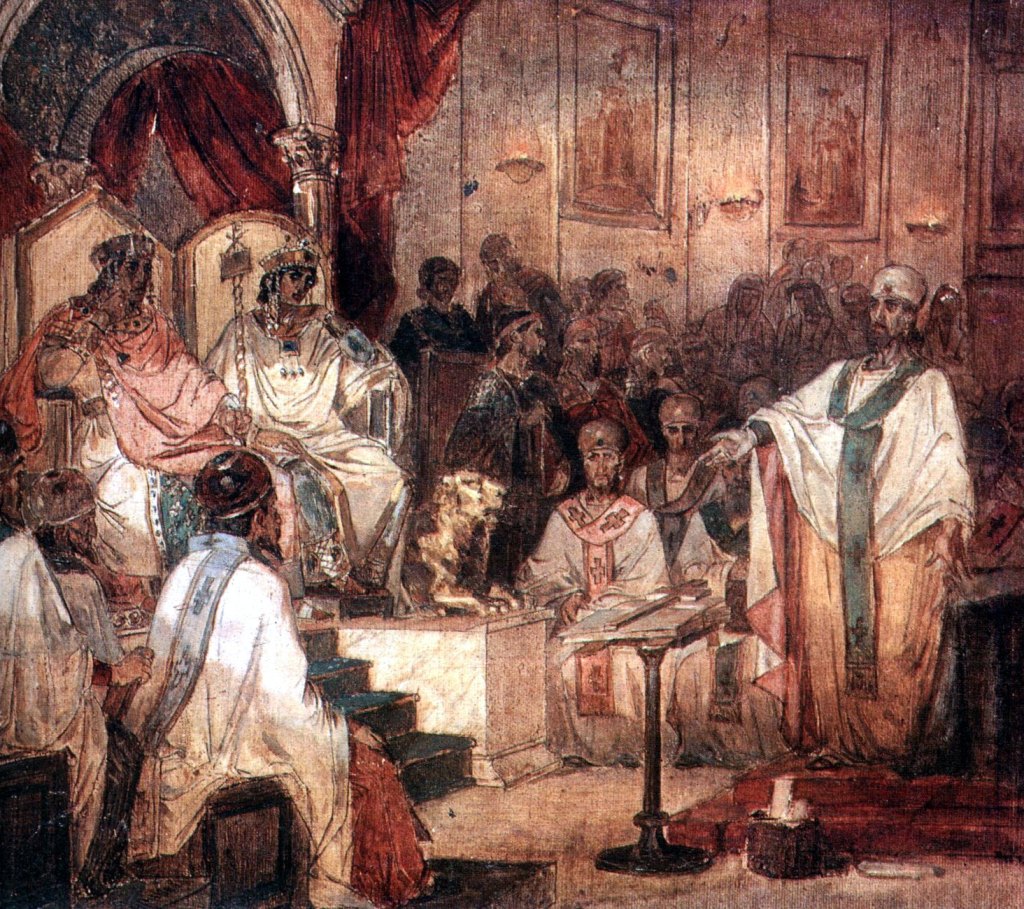
I went back out to the balcony and enjoyed the cold brew and some Bible reading, imagining what Khalkedon must have looked like back in the year 451, when the emperor Marcian and 520 leaders of the ancient church gathered to debate the oneness and the twoness of Christ, and how in human language we might best summarize what the Bible has revealed of this great mystery. It’s from this council’s creed that we have received the orthodox formulation of the nature of Christ as one person, two natures. This council rejected the teachings on the one hand that Christ had only one nature (Monophysitism), and on the other hand that he had two persons (Nestorianism). Christ was one united person in two natures, fully human, fully divine. Sadly, Chalcedon was the theological occasion for the eventual break between the churches of the East – those outside the Roman empire – and those in the West. These churches had already been significantly divided by language, political borders, and culture. But the controversy over Chalcedon made the split official, one that has lasted to this day.
Istanbul is not the only place to have a hidden historical witness to Christian faith. Many parts of the 10/40 window used to have a significant presence of Christians in antiquity or in the middle ages. Just forty five minutes outside of our Central Asian city is a ruined monastery-citadel complex from the 400 or 500s. Locals know nothing about it, and it took tracking down an archeologist in Texas to get confirmation that this is indeed an ancient Christian site. Since then we’ve been able to take groups of local believers out to the site so that they might marvel at the evidence that their own ancestors may have had access to the gospel 1,500 years ago. Of course, this is a tremendous encouragement to them.
All over what is now the Muslim world, there are mosques that have been built on the foundations of ancient churches, abandoned chapels and monastaries in remote areas, tombstones, and even carpet patterns that reflect this lost history. There is a sadness to these silent witnesses. Persecution has often meant that Christianity has been almost or entirely snuffed out in regions where it was once strong. And like the Chalcedonian barista, the locals have no idea of the significance of what they are walking past every day. How did this happen? How could God have allowed the Church to lose areas that used to be strong enough to be sending bases of ancient missionaries?
Yet there is also encouragement to be found in the presence of these ancient stones. They are silent witnesses – but only until a believer comes along who is able to interpret for them. When this happens they begin to cry out. God has been active in the history of this people and this place. Your ancestors have not been left without a witness. Christianity is no Western religion foreign to your soil – it was here long before Europe was Christianized. To follow Jesus is for some an opportunity to return to the faith of their fathers before they succumbed to the sword and choking caste system of Islam. Like the tide, the gospel may recede for a season, but it will be back – unstoppably so. As Zane Pratt famously said at the tomb of Tamerlane, the Mongol Muslim ruler most responsible for the extermination of Central Asian Christianity: “We’re back… and you’re dead.”
If the West becomes even more post-Christian, we will undoubtedly have more of these silent witnesses ourselves, flagstones, monuments, and ruins that speak of our decline. We must remember that they also point forward to our return. And that no matter how dark it gets, God will somehow preserve a witness. Someday, a Central Asian Christian may just find himself pointing a Western pagan barista to the Christian truth present in the very stones around him.
Therefore, following the holy fathers, we all with one accord teach men to acknowledge one and the same Son, our Lord Jesus Christ, at once complete in Godhead and complete in manhood, truly God and truly man, consisting also of a reasonable soul and body; of one substance with the Father as regards his Godhead, and at the same time of one substance with us as regards his manhood; like us in all respects, apart from sin; as regards his Godhead, begotten of the Father before the ages, but yet as regards his manhood begotten, for us men and for our salvation, of Mary the Virgin, the God-bearer; one and the same Christ, Son, Lord, Only-begotten, recognized in two natures, without confusion, without change, without division, without separation; the distinction of natures being in no way annulled by the union, but rather the characteristics of each nature being preserved and coming together to form one person and subsistence, not as parted or separated into two persons, but one and the same Son and Only-begotten God the Word, Lord Jesus Christ; even as the prophets from earliest times spoke of him, and our Lord Jesus Christ himself taught us, and the creed of the fathers has handed down to us.
The Chalcedonian Creed, Chalcedon, Asia Minor, AD 451
To support our family as we head back to the field, click here.
For my list of recommended books and travel gear, click here.