From the viewpoint of the empire the most troubling areas in Roman Asia were the two sore spots of Armenia and Judaea. Armenia was the focus of unending trouble with Persia. It had always been more oriental than Greek or Roman. Traditionally, despite its fierce pride in its own independence, it had come to be regarded as a fief of the Parthian emperor’s second son, and thus it was at first more a Persian than a Roman client-kingdom. Rome began to claim it as part of its own sphere of influence after a Roman victory in 69. B.C., in the days of the Republic, but only after three hundred years of tug-of-war between Rome and Persia did it finally turn Western, and then as much because of Western Christianity as of Roman power. Christian merchants are said to have been the first to introduce the new faith into the kingdom, but the “apostle to Armenia” was the great Gregory the Illuminator, who converted the Armenian king, Tiridates I (261-317) around the end of the third century. All Armenia, it is said, quickly became at least nominally Christian a decade or two before the conversion of Constantine. For this reason Armenia is often called the first Christian nation, though such a claim, as we shall see, must be qualified.
-Moffett, A History of Christianity in Asia, vol. I, pp. 8-9
Just tonight while having dinner with some Iranian believers I heard them use the term Gregorian Orthodox when referring to the ethnic Armenian Christians of their homeland. When they said this, I wondered which Gregory was being referred to. Well, it seems this would be him, Gregory the Illuminator, the one whose ministry led to the official Christianization of Armenia. However, let’s not forget the brave Christian merchants who were the true pioneers and ‘apostles’ of Christianity in that land who undoubtedly prepared the ground for Gregory’s later success.
The other ancient kingdom claiming the title of ‘first Christian nation’ would be Osrhoene, another small client state constantly fought over by Rome and Persia. Its capital was the city of Edessa, in modern-day şanliurfa, Turkey. It’s interesting to note that it was not Rome that first attempted the merger of Christianity and the state. Rather, it was these two minor border kingdoms, one of which most have never even heard of.
If you have been helped or encouraged by the content on this blog, would you consider supporting this writing and our family while we serve in Central Asia? You can do so here.
For my list of recommended books and travel gear, click here.
The rental car employee behind the desk looked strangely like a Central Asian Laurence Fishburne. And he spoke with a similar self-assurance. I half expected him to pull out some colored pills and start telling me about the nature of reality.
“But I need my passport to travel between cities,” I countered.
“Inshallah they will accept your residency card instead. But in order to rent a car, you must leave your passport with us here. Otherwise, the police will penalize us. You’ll get it back next week when you bring the car back.”
I shot a questioning look at my wife. She shrugged with resignation and sipped her chai, signaling that she’d be happy to let me make the call on this one.
Leaving your passport overnight with someone else is never a good idea in a region like ours. The normally stable security situation might suddenly spiral out of control, calling for a quick evacuation. In fact, even as we sat in the car rental office on that sunny afternoon, missiles had just the previous week cut through the sky directly above our city, en route from one country to another as they took turns hitting each other in another round of geopolitical saving face.
But all indications on the ground were that our security status quo would continue. And we needed to get our son to his first ever Discipleship Now gathering happening for expat teens several hours away in Poet City*. Worst case scenario, my family could fly out of the country without me while I tracked down rental car Morpheus to get my passport back as the country melted down.
In this whole exchange, I couldn’t help but be reminded of the time I’d been required to leave my passport overnight in order to check out a library book. Yes, a library book. If you’ve never thanked God for the common grace that causes people to return rental cars and library books, you probably should. Because when this common grace is absent from a society, they will go to extreme measures to guarantee you bring their stuff back.
Years ago, the government of our region conducted a rather controversial referendum when every other government told them not to. So, to punish them for going ahead with it, the rest of the other governments did their best to lock our region down. Airports were closed, borders sealed, and Shia militias massed nearby preparing for a potential invasion. One border crossing remained open, plus one air route through an unfriendly airport that included a substantial fine. So, we still technically had two ways out if needed (when it gets down to only one way out, that’s usually the trigger for an evac). Things went on like this for a good several months, and thankfully, never got any worse. The Shia militia, for example, never came to town, in spite of Mercenary Dan’s* dire predictions and attempts to sell me armed evacuation transport.
In the end, diplomacy seems to have worked out an uneasy resolution. Its effect was such that ever since that time our region has been weaker, less prosperous, and less functional, but still mostly free and peaceful. Compared to war or invasion, that’s not a bad outcome. However, during the crisis itself, things got pretty sketchy there for a while. It was not a time to go without your passport – especially not for a library book.
But here was my dilemma. I had to write a term paper for a class I was taking online called History and Religion of Islam. It was an excellent class, even though it had a very heavy workload. For example, we had to read Ibn Ishaq’s massive official biography of Muhammad in only one week. I would not recommend this. If you’re working with Muslims, this is an important book to be familiar with, but please, be kind to yourself and read it over the course of several weeks or months.
For my term paper, I had settled on the topic of the Islamic conquest of our people group. Search as I might, I could not find a single book or even article in English that addressed this historical event. Much of this has to do with the identity of our people group. Even though they were definitely around back then, and in great numbers, they were a seminomadic mountain people. Authors tend to write history about the civilized cities in the plains and the majority people groups, not the nomadic minorities. No, the sources were almost nonexistent, so to put together a narrative of the conquest I would need to find a sentence in a chapter here, a paragraph in a book there. To do this, I would need to make use of Poet City’s public library.
Poet City is known as a city of writers. And in fact, the culture of writing, selling, buying, and discussing books is strong. But this does not mean that it has a good library. Something has gone wrong in the culture such that the same locals who would never steal cash from the overflowing money changers’ tables in the bazaar would steal a book from the library. Perhaps it is because the library is viewed as an impersonal institution rather than an entity connected to one’s relational network (thus requiring more honorable conduct). Because of this, the library is a neglected, distrustful place.
However, I had heard that there was a small English section, one which might include books about our area’s history. Upon visiting one afternoon, I found it. It was dusty, tucked away in a side area that few seemed to visit. But I couldn’t have been more excited. There were several books written by local historians that had been translated into English. These were books you couldn’t find online. The only way to read them was the old-fashioned way, by getting ahold of a rare physical copy. I had found gold.
It was when I went to figure out the checkout process that I discovered they wanted to confiscate my passport.
“No one is allowed to check out a book unless they leave us their national ID card or passport.”
“Uh, really? Why is that?”
“So that the books don’t get stolen.”
“I’m not going to steal the books. Isn’t there anything else I can leave? My phone number, my address?”
“No, dear, we will only accept your passport.”
“But you know we are in a security crisis. We are foreigners. We might be told to leave the country at any moment. And for that, I’ll need my passport.”
The librarian stared at me, not impressed with my argument.
“OK,” I continued, “where is the passport kept?”
“Here, in the library.”
“What if we are told to leave at night after the library is closed? Could I come and get my passport?”
“No, you would have to wait until the next morning to get it back.”
“I’m so surprised by all of this. There must be another way.”
“You can talk to the library director,” the librarian said, “but he will not agree to let you take a book out unless you give us your passport as a pledge.”
In the end, the library director and I were able to work out a compromise. He would keep my passport in his personal briefcase and take it home with him at night. We would exchange phone numbers. In case of emergency, I could call him in the middle of the night to return the books to him and get my passport back. This arrangement might seem even more sketchy to a Westerner than leaving it in the library. But in Central Asian culture, I sensed that making this kind of personal arrangement with the director actually moved things into more reliable honor-shame obligation territory, and out of the territory of institution and policy where locals might excuse themselves from any responsibility if it happened to be inconvenient.
Still, it was far from ideal. And I was pretty sure that if my teammates were in the country, they would never go for it. But we were on our own for this stretch of the crisis, so we would need to muddle along through the different risks as best we could.
Now, it probably says something about how much of a history nerd I am that I would take this kind of risk. But I have to say, it was totally worth it. How so? Well, one of those books contained the only local account of the Islamic conquest ever discovered.
The Arabs devastated the valley*
Abducted girls and women
Massacred the heroes
Extinguished the fire altars
This stanza of a longer poem of lament was discovered about a hundred years ago on a pottery shard in a farmer’s field. Written in an older form of our people group’s language, and using an old Christian alphabet, it’s the only known source from our people group from the period when they were conquered by the Islamic invasions of the mid-600s. All the other sources are written by the victors in official Islamic histories of the conquest a couple hundred years later, such as the accounts of the famous Islamic historian Al-Tabari. But this source that I stumbled upon was not only local, written by the conquered, but it was probably written much closer to the events themselves as well.
In contrast to the common narrative among our people group that they converted to Islam peacefully, these lines of verse tell a different story. According to this source, the Islamic invasions resulted in the devastation of their home areas. Women and girls were carried off as sex slaves. Defending soldiers were slaughtered. And the local Zoroastrian fire temples were destroyed.
The existence of this kind of local witness is quite a remarkable thing. It confirms what the Islamic sources later say. The conquest wasn’t peaceful. It was jihad. It was a bloodbath. And there it was, hidden away in an obscure book in a neglected library.
I spent that evening at home skimming the books I had checked out and taking pictures of the pages that I needed for my paper. Then, first thing in the morning, I rushed back to the library to return the books and get my passport back. The library director seemed surprised that I was back for it so soon. But for my part, I was not wanting to extend our risky arrangement any more than was absolutely necessary. Having accomplished the goal of the risk, it was now time to return to safer ground.
It was not too long after this that we found ourselves suddenly crossing the last remaining land border and making good use of those passports. A family wedding provided a good reason to get out of the pressure cooker, even if only temporarily.
Among our other activities during our three weeks in the US, we quickly applied for second passports. The laws in our host country were shifting and it looked like we’d have to send off our passports for a month or two to get a new kind of residency visa. But having two passports for each member of our family would mean we could do this and still be able to travel at a moment’s notice if needed.
And, just in case, if we needed to safely check out a library book or rent a car? Well, then we could do that too.
If you have been helped or encouraged by the content on this blog, would you consider supporting this writing and our family while we serve in Central Asia? You can do so here.
For my list of recommended books and travel gear, click here.
*Names of places and individuals have been changed for security
In the 1800s, most missionaries who worked in the Muslim world worked among the ethnic Christians of the region. The theory was if these spiritually-dead ‘Christian’ communities were reawakened and genuinely came to faith in Jesus, then the gospel would flow from them and penetrate the majority Muslim community. Sadly, this compelling theory proved to be completely wrong. The historic animosity and barriers between the minority Christians and the majority Muslims instead prevented the gospel and church plants from flowing from one community into the other. This was true even though the minority community was fluent both in their native Christian languages (Armenian, Syriac, etc.) and in the language of the Muslim majority (Persian, Turkish, Arabic). There were encouraging exceptions now and then, but largely, the original theory was based on a wrong assumption, that missionary engagement with a minority language group would lead to the majority language group also being reached.
Today, a kind of reversal of this story is taking place. Many are assuming that our unengaged minority people groups can be reached by missionaries focusing on the majority language groups.
Specifically, the unengaged people groups of our region keep getting passed over by both large organizations who want to ‘maximize their impact’ as well as by the small number of specialized missionaries explicitly trained to learn two languages in order to church plant among such minority groups. On paper, it makes sense. Most, if not all, of the members of our area’s minority language groups can clearly understand the gospel in one of the more dominant regional languages. This is because they have grown up as minorities needing to be fluent in a national or regional language in order to go to school, do business, and navigate government processes. Were someone from these minority groups to come to faith, the thought is that they could then join a church that worships in one of the majority languages that they know.
With this kind of bilingualism or trilingualism being the long-term situation on the ground, our minority language groups get categorized as having access to the gospel – and therefore not as urgently in need of missionaries as those minority groups that cannot clearly understand the gospel in the languages of their neighbors. There is a clear logic to this ‘triage of lostness’ that I do not completely disagree with. Those who can understand the gospel in another language because they are bilingual or trilingual are not in the same situation as those who cannot currently hear the gospel in any language they can understand.
However, I believe there is a faulty assumption that comes along with this valid distinction. And that assumption is that because the minority group can speak the majority language(s), the gospel and even church plants will then actually flow from the majority group and into the minority communities. Essentially, the assumption is that fluency or near-fluency in a dominant language means the primary barrier to the gospel for these minority groups has been removed. So, if missionaries are present planting churches in the majority language, then the outworking of this assumption is that this is sufficient for passing over these minority language groups. They will be reached, eventually, through the dominant languages.
It’s a sound theory, but alas, it doesn’t hold up on the ground. At least not in our corner of Central Asia. I wish this weren’t the case. But we must work with the lost as they are, and not with the lost as we wish they would be, nor as we thought they would be back when we were in training.
Unfortunately, the witness of decades of gospel work here has shown that apparent access to the gospel through majority languages itself doesn’t remove the necessary barriers keeping churches from taking root among these minority groups. It removes one barrier, yes, but there are apparently other barriers in place that keep the gospel from penetrating these minority groups in a significant way. This means that the ability to clearly understand the gospel in a majority language should not be used as the only or primary filter for considering whether certain groups should receive missionaries who learn their language or not.
What will it take to reach these minority groups? The same thing it has taken to plant churches among our focus people group (itself a minority group in its country, but big enough to be a dominant language group compared to these smaller language communities I’m discussing). What is needed is a long-term commitment to engage a people group in the language that is closest to its identity. This helps answer the objection that some of these groups are functioning as if they have two heart languages. Sure, they may be fluent in two or three languages. But only one of them bears their name. And for most of these members of minority language groups, the language that bears their name is still the language they dream in, talk to their spouse in, curse in, and pray desperate prayers in.
The missionary who does the hard thing and learns that tongue (often in addition to learning one of the majority languages – probably 6-8 years of labor) will find himself doing ministry with greater power, skill, and trust than were he to simply do ministry in the majority language. Yes, to learn someone’s mother tongue when no one from the outside has ever learned it before gives you serious power in conversation, and I use that term intentionally. This is a natural power in communication that the Spirit can then also infuse with spiritual power when he sees fit. If you have ever learned even a phrase or two in a minority tongue then you know what I am talking about (or if you’ve ever been stuck in a foreign land and experienced the immense relief that comes over you when someone addresses you in good English). Along with power comes skill, the ability to speak clearly and compellingly in the intimate language a person uses with their parents, their lover, and their children. And with all of this comes trust. After all, by learning this tongue no one else will take the time to learn you have led with an incredible display of honor, respect, even love – and that for a language that is usually ignored, suppressed, or mocked. The locals will come to trust you and share their secrets with you in a different way than if your relationship was only in the majority language. You have learned their heart language, so they’re more likely to entrust their heart to you. This is simply the way humans work.
So, what are the barriers preventing the gospel from naturally flowing from our majority language groups to our minority language groups? Well, as we’ve established already, it’s not the lack of a shared language. The minority groups are fluent in the majority languages. Rather, there seems to be a complex web of factors that prevent our good theory from working in reality, that prevent the gospel and churches from taking root in these communities. These interlocking barriers would be things like majority-minority identity preservation, distrust and animosity between communities, and the fact that seeing a church in your neighbor’s language and culture might not actually convince you that this Jesus thing is actually an option for people like you.
If none of your ancestors have ever believed in Jesus, then this last barrier often requires a peculiar kind of demonstration. Often, it requires a Jesus follower from the outside entering into your language and culture and awkwardly attempting to model all this for you. “God knows your language and he knows and loves your people, my friend,” they will try to tell you in your mother tongue, while probably butchering the grammar of that sentence. This, believe it or not, can have a similar effect to having witnessed some kind of miracle.
We may feel like we can cross minority language groups off the list if they can hear the gospel in the majority languages of their country. But at least for our area of Central Asia, this would be a tragic mistake. These groups have been bilingual or trilingual for hundreds of years and not lost their distinct ethnic and linguistic (and sometimes religious) identities. They aren’t going away anytime soon. And they aren’t being reached ‘downstream’ from the work being done in the majority languages. No, it’s going to take something much more proactive, intentional, and downright stubborn for churches to be planted among these minority groups.
We need gospel laborers. We need trailblazers. Those who are willing to question missiological laws and ask the hard questions about why solid theories aren’t actually proving true on the ground. Eight years of your life to learn two languages is totally worth it if it means churches planted among a language group that has never before had gospel witness in its own culture and tongue.
Unreached language groups can be reached. But the best way to do this is by preaching the gospel to them in their own language, not in the language of their more powerful neighbors. This is true even if they are bilingual and even if they say you don’t have to. Learn that unknown tongue. See what the Lord does with that sacrificial labor. It will be so hard. And it will be so worth it.
If you have been helped or encouraged by the content on this blog, would you consider supporting this writing and our family while we serve in Central Asia? You can do so here.
For my list of recommended books and travel gear, click here.
…perhaps, indeed, we should be talking not of language prestige but language charisma. Sanskrit, besides being the sacred language of Hinduism, has owed much to disciples of the Buddha; and Hebrew would have been lost thousands of years ago with Judaism. Arabic is more ambiguous: in the long term, Islam has proved the fundamental motive for its spread, but it was Arab-led armies which actually took the language into western Asia and northern Africa, creating new states in which proselytising would follow. Arabs were also famous as traders round the Indian Ocean, but the acceptance of Islam in these areas has never given Arabic anything more than a role in liturgy. Curiously, the linguistic effects of spreading conversions turn out to be almost independent of the preachers’ own priorities. Christians have been fairly indifferent to the language in which their faith is expressed, and their classic text, The New Testament, records the sayings of Jesus in translation; and yet Christianity itself has played a crucial role in the preservation of, and indeed the prestige of, many languages, including Aramaic, Greek, Latin and Gothic.
– Ostler, Empires of the Word, pp. 21-22
Ostler makes some interesting observations here on the effect that religion has on languages. It’s a mixed picture. Clearly, religion can be one major factor in why languages spread and how they are preserved. But as he notes, the results can be very unpredictable. The acquisition or spread of a new faith along with a new language sometimes go together. But not always.
In terms of Christianity’s posture toward which language we use to make disciples, we often forget the fact that the sayings of Jesus in the New Testament are a Spirit-inspired translation of his actual words. This is good evidence that God is a pro-translation God, modeling for us that the most important truths in the universe can indeed make the jump from one tongue to another. This apparently holds true even though the range of meanings for an individual word in a given language is always slightly or even vastly different from that of its equivalent in another language – if an equivalent exists at all. Languages are never one-to-one equivalents, and yet God provided four infallible translation accounts of Jesus’ teachings. This provides much hope for those of us involved in translation work that is definitely fallible, but God willing, still good.
Christianity’s preservation of languages through Bible translation alone is something celebrated even by pagans. But languages redeemed to serve the Church can still go awry. Forgetting that not even the language of Jesus was preserved by the authors of the New Testament as the holy language of heaven and earth, believers in certain ages have tried to elevate their own languages instead, whether that be Latin, Greek, Coptic, Syriac, or KJV English. While the desire to preserve a tongue once used mightily by God is commendable, it becomes a bad thing when a rigid ongoing use of that tongue in liturgy or preaching increasingly denies God’s people the kind of hearing that can lead to faith.
Every Sunday for decades, the gospel was utterly unintelligible for one of my closest friends who grew up in an ethnic Christian community here in Central Asia. This was not only because he was not yet born again – but because God’s word had been fossilized in an ancient form of his language that was no longer intelligible to anyone but the priests. Turns out the miracle of the new birth can only take place when the gospel is communicated in a language we can understand.
The language is never the end in and of itself. It is the means by which we reach our goal of spiritual communication. Lose sight of this and we risk losing entire people groups that once were saturated with vibrant churches and true believers.
If you would like to help us purchase a vehicle for our family as we serve in Central Asia (only 3k currently needed), you can reach out here.
Our kids’ Christian school here in Central Asia has an immediate need for a teacher for the combined 2nd and 3rd grade class. An education degree and some experience is required, but the position is salaried, not requiring support raising. If interested, reach out here!
For my list of recommended books and travel gear, click here.
Even before he became emperor, Augustus, grandnephew and heir of Julius Caesar, had carved out the boundaries of Roman Asia. He avenged the defeat of the Romans at Carrhae and drove the Persians east into the Syrian desert. His people urged him to sweep on across Asia like a Roman Alexander. Wipe out Persia, they cried. Some would have had him push even farther, to India. But Augustus sensed, perhaps unconsciously, that Rome’s power base was the Mediterranean and he persistently refused to be drawn into endless land wars. Having conquered Armenia he paused and, instead of pressing on, chose rather to force a treaty of peace in 20 B.C. on the hapless Parthian emperor, Phraates IV. It was an important date in history. It marked the beginning of a new era, the pax Romana, a hundred years of almost uninterrupted peace that Christian writers ever since Origen have hailed as a praeparatio evangelium, one of the ways in which God prepared the world for the coming of Christ and the establishment of the church.
That same treaty changed the pattern of church history also by fixing the boundary between Rome and Persia roughly along the course of the Euphrates River. As a result, from the beginning of the recorded history of Christianity, if any line of division is to be drawn between Asian and Western church history it falls most appropriately not at the western edge of the Asian continent and not at the Mediterranean, but at the Euphrates. It was there that East met West. West and north of that line, Asia Minor, Roman Syria, Judaea, and Armenia were all drawn sooner or later out of Asia proper into the history of Western Christianity. This was a separation, political and cultural, that as it turned out was eventually to divide the church and grievously affect the progress of Christianity in both the East and the West.
–Moffett, A History of Christianity in Asia, vol. I, p.7
It’s interesting to note that the long Roman peace, and the ways in which it was a preparation of the world for the spread of the gospel, may be owed to this decision by Augustus to not press on to conquer more of a weakened Persia. What if he had pressed his advantage and tried instead to be that Roman Alexander others were calling for? How did he know that it would be a classic blunder if he got involved in a land war in Asia?*
By remaining content with the Euphrates boundary, Augustus effectively established a new status quo with his neighboring empire. And in this revamped east-west arrangement – which lasted largely until the coming of Islam – Christianity was not only able take root in an age of relative peace but eventually to thrive in both the Roman west and the Persian east. Though, as Moffett notes, the longterm affect of this line would also lead to deep regional divisions in the Church.
*only slightly better known than the fact that you should never go in against a Sicilian when death is on the line
If 23 more friends join us as monthly supporters, we should be 100% funded and able to return to the field! If you would like to join our support team, reach out here. Both monthly and one-time gifts are very helpful right now. Many thanks!
For my list of recommended books and travel gear, click here.
But we can expect the language history of the world to be revealing in another way. A language community is not just a group marked out by its use of a particular language: it is an evolving communion in its own right, whose particular view of the world is informed by a common language tradition. A language brings with it a mass of perceptions, clichés, judgements, and inspirations. In some sense, then, when one language replaces another, a people’s view of the world must also be changing.
– Ostler, Empires of the Word, p.13
The languages we speak greatly affect our worldviews. This is humbling because we often cannot even see the ways our languages have influenced the way we think until we learn another language, another ‘lens’ for interpreting life with its own unique take on things.
I never knew that English was limiting me to one word for ‘uncle’ until I learned our Central Asian language, which uses different terms for an uncle on the mother’s side vs. an uncle on the father’s side. This distinction led to my friend Adam* recently asking my kids, who call him Uncle Adam in English, whether he was an uncle on my side or on my wife’s side. The unanimous vote among the offspring was that he was an uncle on my wife’s side, which my kids probably chose for reasons of their own. However, if they were from our Central Asian people group, they would know that this means that Adam would be less important when it came to legal and identity matters, yet because of that viewed as the more affectionate, relational type of uncle. Dad’s side is for the official stuff. Mom’s side for the relational.
Here, the local language reinforces the local worldview that there are major distinctions to be made between the father’s side of the family vs. the mother’s side. Were our locals to get so good at English that they eventually stop using their own language, this distinction in the culture may also eventually fade away.
Ostler is right. You can never change languages without also experiencing worldview change. This interplay is something worth keeping an eye out for.
We will be fully funded and headed back to the field when 38 more friends become monthly or annual supporters. If you would like to join our support team, reach out here. Many thanks!
For my list of recommended books and travel gear, click here.
“But do we have any precedent in the Bible for incorporating diverse styles of worship?”
The question was an unexpected one. One reason plural leadership is so good is because invariably one elder will come up with a question no one else is thinking of. The rest of us were just assuming that it was right and good to expand our church’s styles of musical worship to better reflect our diverse congregation. It seemed to fit with the Revelation 7:9 vision and with the fact that the New Testament advocates generally for Psalms, hymns, and spiritual songs (Col 3:16), but otherwise seems to leave the details of musical worship up to the wisdom of the local churches – assemblies which were no longer just Jewish, but were fast becoming also Greek, Roman, Scythian, Persian, etc.
The question got me thinking. How much of a case is there in the Bible for the practice of incorporating diverse styles of music in the regular worship of our churches? After percolating on this for a number of years, I’ve become more and more convinced that a quiet but convincing biblical case can be built that God delights in receiving worship in the many musical styles of the world, just as he delights in receiving worship in the many languages and cultures of the world. And that this case can be built from the hymnal of Israel and the early church – the Psalms. This case is built on the history and context of the Psalms, as well as on the nature of music itself.
When it comes to its nature, music is much like language or culture; namely, like a cloud. Music does not sit still. It cannot. It’s always slowly changing and moving, shifting and developing in ways that clearly reflect where it’s been yet defy even the most skillful predictions of where it’s going next. With music, just add time and you will inevitably get substantive changes in method and style. Seeking to ‘freeze’ a musical tradition as that which truly represents a people is just as futile as trying to ‘freeze’ a language. You can protest all you like, but they will go on changing. They are clouds, after all, not mountains. Their nature is a moving one.
This is where the history and the context of the Psalms come in. We are told that Moses is the author of Psalm 90, which would make it the earliest psalm that we have. Moses was likely living and writing around 1400 BC. Of course, the most famous psalmist is King David, writing 400 years after Moses, around 1000 BC. Yet other psalms are attributed to Hezekiah (Ps 46-48), who was living around 700 BC, 300 years after David. The latest psalm seems to be Psalm 137, “By the rivers of Babylon,” which clearly speaks of the Judean exile to Babylon which took place in the 500s. That means there’s a span of roughly 900 years between the writing of the earliest and the latest Psalm.
That’s a lot of time for a given musical tradition to undergo all kinds of natural internal development. Were you to time travel, you’d likely recognize some elements of the music of the Judean exiles all the way back in the music of Moses. But Moses – were he to travel with you to Babylon – would probably be a little offended at what had become of his beloved Hebrew musical tradition. This is because the changes would have been considerable, perhaps as great as if he were encountering the music of a foreign nation.
Add to this the fact that musical style, again, like language and culture, does not exist in a vacuum. Musical styles borrow from one another, just as languages borrow vocab from their neighbors. Instruments and melodies get adopted from one culture to another at perhaps an even faster rate than words since music itself has a quality that seems able to transcend other natural differences. This is why it’s sometimes been labeled “the universal language.” This means that whatever musical traditions Abraham’s household brought with them from Ur probably picked up Canaanite/Hittite influences in the several generations that passed until Joseph’s time. After this, 400 years of Egyptian sojourn and slavery would have made its own significant imprint on the musical style of the Hebrews by the time Moses got to writing the first psalm. Once back in the promised land, another 400 years of musical mingling in Canaan brings us to the time of David. And the centuries of monarchy would have had their own cross-pollination. Finally, it’s not far-fetched to assume that Jewish music would have been influenced dramatically during the exile. Just remember what happened to the Hebrew language.
So, when the Psalter is finally finished in its current form, post-exile, the Psalms represent roughly 1,000 years of the natural diversity that emerges within one musical tradition – as well as the added diversity of external influence from at least Mesopotamian, Canaanite, and Egyptian musical styles. The finalized Psalter, before its melodies were lost, would not have been a ‘pure’ representation of the Jewish ethnic musical style. Instead, it would have been a collection of songs that represented a Jewish synthesis, one representing a long absorption of melodies and styles from many centuries, geographies, and cultures.
Perhaps a Jew in exile singing the Psalms of David would feel similar to how we feel when singing O Come O Come Emmanuel, one of the oldest melodies that we still sing in Evangelical churches. The song’s lyrics are in fact much older, but the earliest record of its current melody comes from France, about 600 years ago. Hum the melody of this song to yourself and notice how it seems to be from a different world. That’s because it is from a different world. It may be a familiar part of our Western European Christian tradition, but every time we sing it we are singing a song from a very different time and culture. For an even older tune, listen to a song from 1700 years ago, Phos Hilaron. Then compare these old melodies with the music of today. Even if you cut out the warp-speed mutations that happened to music in the 20th century, it’s stunning how diverse music can be in one religious tradition.
What’s my point? Essentially, the Psalms are evidence that the songbook of the people of God was one that originally contained a rich diversity of musical styles. We can know this because of the nature of music and because of the history and context of the Psalms themselves. Apparently, God ordained that his people, for centuries, sing diverse melodies, some of which would not have felt like the stirring tunes of their particular generation, but rather the music of other peoples and other centuries. In this, we have a quiet case for using diverse musical styles in our churches.
This really matters, though we don’t typically feel how much it matters until we are ourselves a minority worshipping in the melodies of other cultures and lands. One of our African American pastors recently stood up and shared, in tears, how much it ministered to his soul that our church choir had sung a song from the black gospel tradition when the Anglo-Irish melodies of our reformed circles are our more standard fare. Back in Central Asia, we once took the melody from one of the most requested local worship songs and wrote new English lyrics to it so that it could be sung in the international church where we were members. Since then it has become a favorite song of the church’s many members who are from a Muslim background. We should want to serve the diverse members of our churches with melodies that help the words reach their souls – and those are often melodies from the musical traditions that they grew up with.
This is why it can be so hard for the majority culture of a given church to incorporate diverse musical styles in its worship. Because the melodies the church typically sings are from their culture and tradition, the majority already feel the sweet union of the words and the melodies down in their bones. It can take a while for them to realize that for those from other musical traditions, that double encouragement is not necessarily taking place. But in the Psalms there seems to be precedent for both – singing the melodies that feel like the songs of your people and singing the melodies that feel like you are being transported to a foreign land.
Here it must be said that it is indeed possible to be edified by singing the songs of another people, another culture, another century. It takes time and growth, yes, but it can happen, and it is healthy to learn how to be fed with melodies from the distant past as well as with others that just don’t hit your heart in thatway (yet). Keep singing them and meditating on the truth they contain. You may be surprised at what happens to you as those foreign-seeming melodies slowly inch closer and closer to your heart. Just as a deep view of church history and a broad view of the global church serve to strengthen the believer’s head, so equivalent Christian music may serve to expand his heart.
Do we have any precedent in the Bible for incorporating diverse styles of worship in our services? I say yes, and not just in the New Testament. Even in the Old, we see that one style and culture of music is not sufficient for the worship and delight of God. Instead, he quietly included 1,000 years of musical diversity in his Psalter long before he sent the New Testament Church out to write and sing new hymns and spiritual songs to the ends of the earth. The New Testament posture toward musical worship that we’ll see in full bloom in heaven (and even now is flourishing) had its first budding in the Psalter. In it we can see the shoots of both freedom and tradition, service to others as well as room for our own souls to drink deep.
So then, sing to the lord a new song, sing to the Lord, all the earth (Ps 96)! Sing an old song too. And while you’re at it, for the sake of that refugee in your service, sing a foreign one as well.
We will be fully funded and headed back to the field when 34 more friends become monthly or annual supporters. If you would like to join our support team, reach out here. Many thanks!
For my list of recommended books and travel gear, click here.
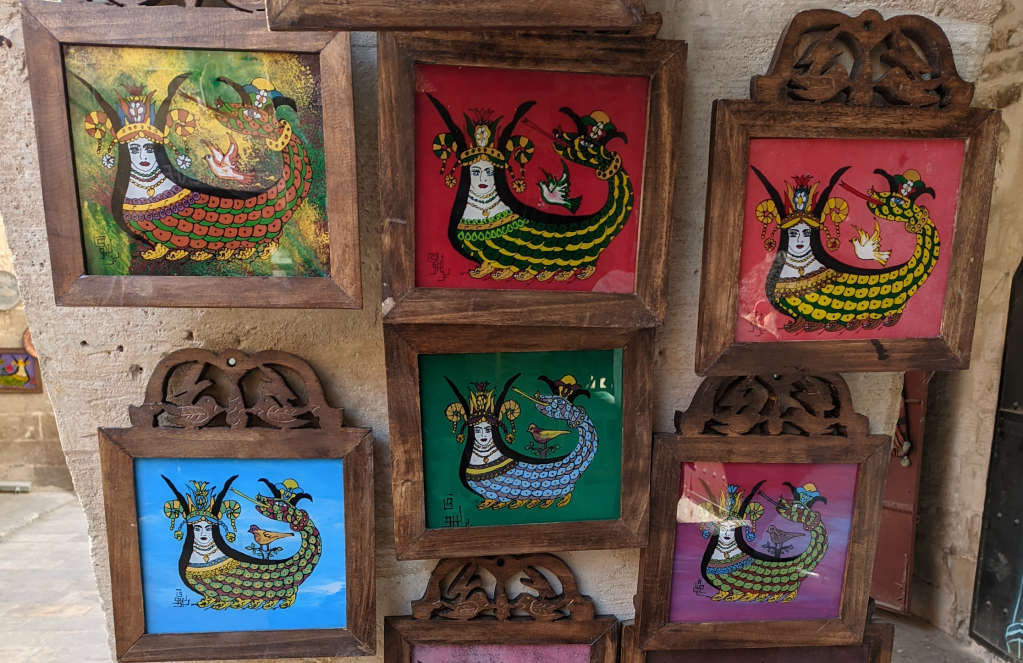
The first time I remember noticing her was when visiting local museums. The exhibits that showed what the inside of local houses used to look like regularly featured wooden chests. Inside these colorfully painted chests were usually blankets and cushions for guests. But on the outside of the chests were mirror fragments – and a painting of a strange woman-snake hybrid. I’ve also seen her hung up on walls as part of a tapestry or framed painting. In the local languages, she is called the Queen of Snakes. And I’m beginning to suspect that she has played a dark role in the historical beliefs of our people group.
The Queen of Snakes was never quite prominent enough for me to pay her much attention. Far more prominent were the evil eye pendants that seemed to show up everywhere. But listening to the Haunted Cosmos podcast got me thinking more deeply about the folk mythology of our people. Turns out there are some disturbing similarities between the Queen of Snakes and the strategies the enemy has used to deceive the nations from the very beginning. First, the story.
The tale of the Queen of Snakes often begins with a young man who is hunting for honey in caves. While exploring deep in a cave, he comes across a massive snake-like creature that has the body and head of a snake on one end and the torso and head of a woman on the other. He is terrified, but the creature tells him that she is not evil, but benevolent. She says that she is able to give him secret knowledge. The young man decides to stay with her and they eventually fall in love. After a long season of happiness, the young man must return to the city. But the Queen of Snakes warns him to tell no one about her, and that living with her has changed him. Now, if his skin gets wet, it will appear as the scaly skin of a snake.
After the young man returns to the city, the king becomes deathly ill. His viziers tell him that the only thing that can save him now is if he can eat the flesh of the mythical Queen of Snakes. No one, however, knows how to find her. But they do know that water can expose anyone who has been in her presence. So, the soldiers of the king go around pouring water on all the citizens of the city. Eventually, they find the young man when his skin betrays him. Under torture, he reveals the location of the Queen of Snakes.
The king’s men then bring the Queen of Snakes to the city. Right before they kill and cook her so that the king can eat her flesh and live, she gives a warning. She says that anyone who eats her head will be poisoned and will die. But if anyone eats her tail (presumably the snake head, but some allege it’s the other way around), they will live. The king, of course, orders that the Queen of Snakes be killed and cooked so that he can eat the tail. The young man, despairing in the death of his lover, eats flesh from the head. But it was a trick. In reality, the tail contained the poison while the head contained secret knowledge from time immemorial. The king dies, but the young man becomes the wisest man in the land and a great sheikh.
Okay, so this is a weird and creepy story. But is that all it is? How has the story of the Queen of Snakes affected the day-to-day spiritual practices of our people group? Well, more research here is needed. But this is what I’ve been able to figure out so far.
First, the image of the Queen of Snakes is believed to bring good luck and protection in general. This follows the theme from the story that she was a source of hidden wisdom. More specifically, the Snake Queen’s image has been used as a talisman to ward off sickness. This makes sense given the power of the Queen of Snakes in the story to provide healing. But the image of the Queen of Snakes has also been used to promote fertility. A picture of her is a very important part of a woman’s dowry – and that picture is then hung in the bridal chamber. In summary, the grandparents of my Central Asian friends believe that the talisman of this chimera provides protection, good fortune, wisdom, and fertility. And they want to make sure that this image is looking down on the marriage bed.
Yep, this sounds Satanic. First, there’s the twisting of the image of the serpent so that what is naturally repulsive and the enemy of the woman is instead believed to be a benevolent being. The most common position on the internet regarding the Snake Queen has her functioning as a symbol and even a patron saint of sorts for the women of our region. Second, there’s the whole theme of secret knowledge that this being promises. A friendly serpent being that offers hidden knowledge gives off some pretty serious Genesis 3 vibes.
But this is not the only way in which the lore around this creature is attempting to usurp power that belongs to God alone. The Queen of Snakes is also held up as giver and restorer of life. She gives fertility and she gives healing. And how does she do this? Well, in the story you have to eat her flesh. Some versions of the story even have successive serpentine offspring incarnating the Queen of Snakes after each of her deaths, meaning that she also possesses the key to new birth and immortality.
Now, in a disturbing – though honestly predictable – twist, the image of the Queen of Snakes has been adopted by LGBTQ activists in our region to promote their agenda.
Once we are back on the ground I need to do more research to see how this demonic element of folk religion is actually functioning among our people group. I need to ask my friends and their sisters, “What do you believe about the Queen of Snakes – and what did your grandma believe such that she put pictures of her up in even the most intimate parts of the home?” But even from the little bit that I know already, certain steps for local believers seem clear.
First, get rid of any Queen of Snakes images that you might have in your house. Sure, it might make your great aunt upset if you burn that talisman painting she gave you, but you really should chuck it – even if it’s only out of an abundance of caution. Yes, the presence of the Holy Spirit protects believers, but this shouldn’t make us cocky. In the mysteries of the spiritual realm, sometimes even objects can be used by the enemy to cause some serious trouble. You may be immune, but Christian history and common sense would indicate that you really don’t want something like that in your house while you’ve got kids who haven’t yet come to faith. Take dominion over your space, and just like Hama and Tara who took down their Islamic paraphernalia during the saga of plastic Jesus, get rid of the snake woman too.
Second, no longer believe and speak of the Queen of Snakes as some benevolent pro-woman character that’s a positive part of your heritage. All the evidence indicates that there’s at least some level of demonic deception involved in this creature. Christians will need a new posture toward this part of their traditional folk art.
Third, proclaim that the things the Queen of Snakes claims power to do are the territory of God alone. He alone is protector, healer, giver of children, and source of true wisdom. In all of these areas, the Queen of Snakes was a liar, a deceiver, and a usurper.
Finally, celebrate the victory that Christ has accomplished over not just Islam, but also over all the dark things of folk religion that clutter up the metaphorical basement of your worldview. Christ “disarmed the rulers and authorities and put them to open shame, by triumphing over them in him” (Col 2:15). When Jesus on the cross crushed the head of the serpent’s seed, he also crushed the power of the Queen of Snakes. Through the open proclamation of that good news in your language, she will no longer able to deceive you, your grandma, or your future bride. And that is very good news.
We will be fully funded and headed back to the field when 43 more friends become monthly or annual supporters. If you would like to join our support team, reach out here. Many thanks!
For my list of recommended books and travel gear, click here.
But Rome was an intruder in Asia, like Greece before it. The Romans were only accidentally, not intrinsically, Asian, despite the legends of their origin in Homeric Troy as recounted in Virgil’s Aeneid. In fact, the Roman policy toward its holdings in Asia was to break off western Asia from the land mass of the continent and absorb it into the sea-centered Western world of the Mediterranean. To Roman eyes, Asia Minor, Syria, and Palestine were the eastern shores of the Great Sea. To the Parthians, however, these same lands were the western edge of Asia and belonged to Persia. The first seven centuries of church history, therefore, unfolded within the wider context of an imperial conflict between Persia and Rome that set East against West in mortal battle for control of what is now misleadingly called the Middle East.
– Moffett, A History of Christianity in Asia, vol. 1, p. 6
When Westerners think of the world of the New Testament, they tend to think of Rome as the undisputed superpower of the world. A more accurate view would be to view Rome as the great Western power in constant rivalry with Persia, the great power to the East. Rome and Persia were regularly battling over the Middle East, and New Testament cities like Antioch often paid the price.
Because Christianity emerged in this context of overlap between East and West, it’s just as inaccurate to claim Christianity as an Eastern religion as it is to claim it is Western. It is both. It was birthed and thrived in the great tug of war between Rome and Persia. Cyrus and Caesar both played their role in preparing the world for the spread of the good news.
We will be fully funded and headed back to the field when 44 more friends become monthly or annual supporters. If you would like to join our support team, reach out here. Many thanks!
For my list of recommended books and travel gear, click here.
When you live in an area of high desert, wise cultivators of the land learn how to slow the water down. Our corner of Central Asia gets just as much rain as London, but it’s concentrated in two main periods of rainfall, our equivalent of the early rains and the late rains mentioned in the Old Testament. This means that most of the abundant rainwater is lost in runoff and not available during the long periods of dryness.
The more parched and eroded the land is – often due to poor management or abandonment – the worse it gets at retaining the water. But when humans (or beavers in other climes) simply slow the water down with things like small dams, a local ecosystem is transformed. More water remains in the ground, meaning plants stay green longer into the dry summer. Plants grow and develop deeper roots, and thus retain more of the nutrient-rich soil. This in turn leads to even more plant growth, which attracts animals. Quite literally, the desert blooms. If you go on YouTube and search for permaculture projects in Arizona, the Sahel, or the Middle East, you can see some amazing examples of this.
We saw our own example in the traditional courtyard of our previous house in Central Asia. We had a well on the property, so we were able to begin regular watering of the fruit trees and bushes that lined the courtyard walls. We slowly planted more and more herbs and small trees in this border area and eventually planted grass in the center yard areas as well. In spite of the intense heat, the plants flourished now that they had regular access to water and weeding. Olives, pomegranates, figs, loquats, grape vines, rosemary, lavender, roses, tequila plants, and lavender all grew happily. And the animal life followed. By the end, our courtyard was home to scurrying geckos, croaking toads, chirping crickets, scampering mice, and cooing pigeons. Our house was surrounded by cement city, but our courtyard was a little green oasis. In its old stone walls, it had dirt, water, and humans who sought to cultivate the land. So it came to life.
Those living in Central Asia and the Middle East have long known the importance of using water effectively. Persians built underground water tunnels to their cities and royal gardens, patches of cultivated green where our word for paradise finds its origins. Assyrian emperors like Sennacherib built aqueducts to bring the waters of the mountains to Nineveh to water his palace gardens (likely the true location of the famed hanging gardens of “Babylon”). For centuries, careful systems of irrigation kept the fertile crescent, well, fertile. When particularly brutal conquerors came through and slaughtered local populations, as the Mongols did, the land itself “died” a little more as these careful water management systems broke down. Modern wars, agriculture, and mismanagement have made these regions some of the most water-endangered places on the planet.
But the water is still there, in the rain and in the mountain streams. So, much of the land could be resurrected if the government and the locals simply prioritized wise ways to slow the water down. To this day, I don’t understand why the rainwater collection tanks which were standard for my childhood homes in Melanesia are not used in our part of Central Asia. Or, why policies like those of Bermuda roofs are not adopted to mandate roof construction so that more of the precious rain can be collected? Wells we have aplenty, but they are systematically exhausting the groundwater reservoirs. And we have some large dams, mainly for hydroelectricity, but very few of the smaller rock dams or other permaculture practices are used that can make one valley sustainably green, while the next valley over is parched and brown.
Among the countless good works that missionaries in our region could do to commend the gospel message, there is much room for Christians who know how to make the desert bloom. Our locals love their land and delight in their little patches of greenery in a way I’ve seldom seen in the West, so this could be the kind of platform work that locals highly value – and one that buys considerable space for controversial gospel work. Despite my description of our previous courtyard, I am not a natural green thumb or farmer. For me not to kill it, it needs to be simple and hardy. Hence the rosemary and tequila plants. But I know there are many skilled farmer-types out there, some who perhaps have never thought about how a love for the soil and a love for the nations can come together.
However, I recently learned that slowing the water down is not the wise thing to do in every context. In some regions, to care for the land you need to speed the water up. I learned this while visiting some friends who are church planters in Eastern Kentucky, where they have too much water. There, to have land that you can cultivate, you need to get yourself some very effective drainage. Otherwise, the ground is simply waterlogged clay. Rather than dams, they need ditches, and lots of them. In Eastern Kentucky, wisdom calls for speeding up the water.
In all of this, I am reminded of the different emphases of different seasons and places of ministry. I have written long and often about the need to slow down when it comes to missions and church planting in Central Asia. Spiritually speaking, it is a desert. To resurrect the church in these regions we need to take the time to learn the language and culture, to invest years on end in discipleship and character development in order to see qualified leaders raised up. In the harsh summer sun of Islam and persecution, rapid church planting and movement methodology have led to churches that quickly bloom and just as quickly wither like the grass on the traditional mud rooftops. Instead, we need churches that are like olive and oak trees. Yes, they are slow-growing. But they are hardy – and they can last and steadily multiply for a thousand years.
But this does not mean that there is never a time and a place for speed in missions and church planting. Any student of church history will know that there really are seasons of remarkable spiritual awakening. Even in my own parent’s story, I hear an echo of this. They were missionaries in Melanesia and were supposed to be church planters. But they never planted any churches because the churches were planting themselves. Instead, they invested in eight different churches over a short period, providing interim leadership until a local pastor could be found. Relatively speaking, they moved fast. They still sought to disciple believers faithfully, but the pace of ministry there was simply running at a faster rate than we have seen in Central Asia.
That being said, one key mistake of contemporary missions is the assumption that we can reverse engineer movements of the Spirit and replicate them anywhere on the mission field. It’s Finney all over again, “Revival is a work of man” and all that. But the other ditch is to live as if revival or awakening might never break out in our ministry context. The steady wisdom of most ministry contexts says to slow the water down. But wisdom also says that this might not always be the case. What if you find yourself in a metaphorical Eastern Kentucky?
Just because man-made revivalism is out there doesn’t mean that we should discount the possibility of genuine revival – or a genuine movement. When the Spirit is truly moving, when it’s a time of spiritual deluge, we should have a category for moving faster than we would otherwise be comfortable with. I imagine the disciples were a little uncomfortable with what they were required to do when they had 3,000 or 5,000 a day becoming believers during and just after Pentecost. “Jesus spent three and half slow years with us, are we really ready to vouch for this pilgrim from Cyrene who only just heard the good news of the kingdom for the first time this week?”
Yet another time to move fast is when it’s clear that a given person or church is already saturated with the truth. When this is the case, it’s no longer time to sit and soak. Instead, it’s time to get up and start pouring out. For some of our Western churches that are awash in rich resources and mature disciples, the need of the hour is to start asking questions like, “What would it take for us to send a church planter out every year?”
We need to rightly discern the context and the season of ministry in which we find ourselves. Much of the world is the spiritual equivalent of desert. We need to figure out how to slow the water down. But other places and seasons may call for an unusual burst of speed, for helping the water to move even more quickly. The key here is to not presume that we can somehow produce this latter season, yet always to keep faith alive that we could see a season or two like this if we continue in faithfulness.
As for me and the literal land, don’t be surprised if you find me someday building some small rock dams across the stream of a desert valley. Even for those of us who are not wired to be gardeners, there’s something ancient that lingers from that old great-grandpa Adam. Deep down in our bones, we are made to make the desert bloom.
To support our family as we head back to the field, click here.
For my list of recommended books and travel gear, click here.








 Entrusted to the Dirt

