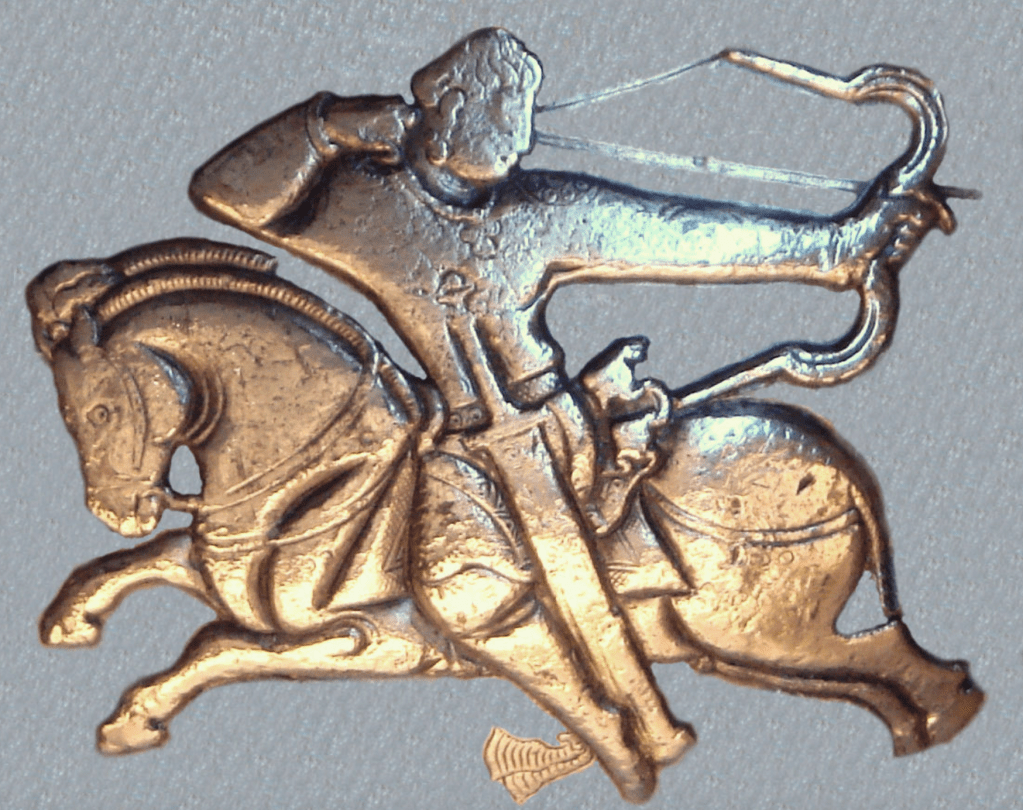
The shield protected the bearer from both hand-carried and missile weapons. In the Pauline analogy, the shield is used to “extinguish all the flaming darts of the evil one” (v. 16). Horse archers constituted the main combat units in the Parthian Empire – Rome’s primary eastern foe in this period. The Parthians’ fearsome reputation, having defeated the Roman legions in numerous battles, made Paul’s analogy of the flaming darts, or arrows, of Satan appropriate.
ESV Archeology Study Bible, p. 1756
Though Christians and Westerners are generally aware of the northern barbarian threat to the Roman Empire, most learn almost nothing about Rome’s bitter rival empire to the East, the Parthians. WordPress, the platform I’m using, provides me a useful illustration here as it doesn’t even have Parthian in its dictionary and keeps flagging it as a misspelling. It’s as if we are conscious of the peoples east of the Euphrates up until the book of Malachi. Then, all of the sudden, the light of historical consciousness turns off and the focus shifts to the West.
Yet here was an empire not only able to go toe-to-toe with Rome, but even able to defeat many Roman armies throughout the centuries. The Parthians had risen to power following the collapse of Alexander the Great’s empire. At first glance they seem to be an interesting blend of Greco-Persian cosmopolitanism and the horse culture of the great steppes. They were certainly much more tolerant of early Christianity than the Romans were – an important point not to be dismissed. The great persecutions of Christians under Zoroastrian rulers would not come about until the Parthian empire gave way to the Sassanians and Rome had been Christianized.
Though we may be ignorant of them, inhabitants of the Roman empire would have been very aware of this other superpower. I found it interesting that this street knowledge of the political enemy may provide background for the familiar Armor of God passage in Ephesians chapter 6, particularly the part about “flaming darts” (6:14). As the passage quoted above states, the Parthian horse archers were the main fighting force of the Parthians. Apparently they were so skilled that they were able to ride their horses without stirrups and fire their arrows accurately at the enemy legions – even turning their torsos to shoot backwards while their horses sped in the opposite direction. This particular tactic came to be known as the “Parthian Shot.” This may have come down into modern English as “parting shot” since authors like Arthur Conan Doyle used “Parthian Shot” in their writing to describe a last comment or jab given during an exit.
Returning to Paul and Ephesians 6, the image the original readers may have had in mind was that of a Roman soldier’s shield deflecting the flaming arrows of Parthian horse archers – archers who were shooting at them while simultaneously riding with terrifying skill. Sounds like quite the dangerous situation, especially for a foot soldier. As such it was an effective analogy, not just communicating the danger posed by Satan’s attacks, but also the tremendous power provided by this shield of faith.
Finally, [the Mongol ruler] Il-Khan Ghazan (ruled 1295-1304), who converted from Buddhism to Islam, offered the Western European rulers Pope Boniface VIII, King Edward I of England and James II of Aragon his conversion to Christianity in the case of a military alliance against the arch-enemy Egypt.
But the age of the Crusades had passed and Acre, the last Christian bastion of Palestine, had fallen in 1291. In 1287 the kings Philip the Fair of France and Edward I of England had given the cold shoulder to Rabban Bar Sauma, the Nestorian special envoy of Il-Khan Arghun. Even though the mission brought no results, it testifies to the international character of the Church of the East at that time that the Ongut Rabban Bar Sauma, who had lived in a monastic cell south of today’s Beijing, came to Baghdad and later traveled to Italy and France, becoming a kind of Asian Marco Polo in reverse.
In light of the lack of European interest in an anti-Islamic alliance, Ghazan remained a Muslim. Thus a window of opportunity for a possible re-Christianization of the region that is today Iran and Iraq closed forever.
Can Islam be true Islam without a Caliphate? That is the question that has been simmering within the Islamic mind for one hundred years. The final Ottoman caliph was deposed during secular reforms after World War I. Ever since then there has been no caliphate, Islam’s equivalent of theocratic empire.
For a parallel Christians might be more familiar with, consider the similar question that Judaism faced after the destruction of the first and second Jerusalem temples. How can the faith live on when so much of it assumed the existence of a particular structure? With that structure gone, can the faith reinvent itself and reinterpret commands that seem impossible without that sacred structure?
After the destruction of the first temple in 586 BC, Judaism was able to eventually return from exile and rebuild. Yet it changed nonetheless, developing the synagogue system and coming to a deeper understanding of the kingdom of God as a universal one. God’s throne is revealed in the exile prophets as being a wheeled chariot. It is not limited to one locale. These changes laid the groundwork for much of Jesus’ and the apostles teaching about the true nature of the kingdom of God in this age.
But the Jews were unable to rebuild the second temple after its destruction in AD 70. This destruction at the hands of the Romans forced massive changes in Judaism leading to the disappearance of the Sadducees and the survival of Judaism through the Pharisees at the Jamnia school. Blood sacrifices were reinterpreted so that good works were now counted as equivalent. Rabbinic Judaism developed in new directions. Judaism survived, but even to this day Jews and Christians who study the Torah can feel the tensions introduced by the fact that the temple system is no more.
For traditional Islam, the caliphate is a divinely-ordained structure, a cornerstone of the world as it should be. The Islamic community is supposed to be led by a political and spiritual leader like Muhammad, Abu Bakr, or Uthman. Even though the history of the caliphate is a very mixed bag, its abolition is viewed by some as one of the greatest tragedies to ever happen to the Islamic community, a fall/curse motif of sorts. While the vast majority of Muslims have embarked on a process of making Islam compatible with the modern world system – nation-states, dictatorships, democracy, human rights, etc. – a minority of Muslims seeks to reestablish the caliphate system. This minority interprets Islam’s primary sources such that spiritual Islam goes hand-in-hand with a political system. They believe you can’t have true Islam without a caliph and a caliphate. They point out, rightly, that this is assumed by the original sources. The Qur’an and Hadith do not advocate for a City of Man vs. City of God intertwined worldview, but rather for the here and now to become the City of God, by the sword if necessary. The borders are supposed to be physical and clear. There is the house and Islam where the caliph rules, then there is the house of war. That’s it.
This minority seeks to implement what ISIS called the “prophetic methodology.” This means moving away from the majority view that advocates for a personal faith in Islam, expressed in the community of the mosque and in nation-states which have blended Western law codes with Shari’a. The minority views this kind of blending as an adulteration of true Islam. How do groups like Al-Qaeda and ISIS get their philosophical attraction? They appeal to this tension within the Islamic mind. Can Islam be true Islam without a caliphate? Can jihad really be redefined to only mean spiritual war with oneself and good deeds toward others? Can Shari’a really be faithfully blended with law codes developed by those (like the English and the French) whose traditional religion ascribes partners to Allah?
You can see how the divisions come about. It’s as if a group of disgruntled Jamnia rabbinic students begin to meet secretly, disagreeing with their teachers’ positions that blood sacrifices can all of the sudden be reinterpreted as good works, now that the gentiles have destroyed the temple. That’s not what the text says! they might say, shaking their heads. From there it’s not very long until an armed group is formed and ready to attempt an attack against the Romans. They will spill their blood in hopes that the temple can be rebuilt. They believe faithfulness depends on it.
It’s important to note very clearly that the vast majority of Muslims are compatibilists, that is, they live and believe in the blending of Islam with the modern world. These Muslims are not working for a restoration of the caliphate. And yet we should not be surprised when secret or militant groups form around the ideology of restoring the caliphate. It is a tension not yet resolved within the mind of Islam, despite what a liberal mullah in a Western city might tell you. The tension is real and it’s presence makes sense given the sources and history.
Our contemporary age is witnessing this identity crisis within Islam play out, especially from the 1970’s to the present. Most of our Muslim friends will be far too practical to go down this road, but those ISIS propaganda videos still may strike a chord in their hearts. Practically, we need to support the moderates. A rigid return to the “prophetic ideology” is bad news for all, as the world saw in Al-Baghdadi’s caliphate. If Islamic interpretation can cement the compatabilist view as the dominant one, that is overall good for the world. Though I don’t myself know if its foundation is solid enough to be victorious. It’s main problem is a serious one – a straightforward reading of the primary sources.
But as Christians we should also learn to speak the gospel into this tension, calling our Muslim friends to a better kingdom, one which exists parallel to the kingdoms of this world and does not call for a theocratic empire run by a fallen mortal. Here instead is a spiritual kingdom that adopts its rebels, gives them new hearts and new names, and outlasts all of the temporary and flawed kingdoms of this world. All the while it seeds these transient systems with communities of eternal life and eternal truth – cities within cities as others have described it. Some Muslims longing for a caliphate will find themselves drawn by the Spirit to a surprising answer.
The Empire of God is coming in all its fullness, therefore, now is not the time for jihad. Now is the time for giving ourselves sacrificially to our enemies. It is the age of mercy and free pardon for all who will repent and align with the embassies of this coming kingdom. Our Muslim friends are right to long for a better ruler and they are right that Jesus is returning, yet they need to know that he is returning not as a mere prophet and warner, but as the true and divine king. The answer to the deep longings for a perfect leader ruling a perfect government will not be found in a new caliph. It can only be found in Jesus Christ.
To Roman citizens, the place to be was a Roman city or villa. The pagus, the uncultivated countryside, inevitably suggested discomfort and hardship. The inhabitants of the pagus – pagani, or pagans – were country bumpkins, rustic, unreliable, threatening. Roman Christians assumed this prejudice without examining it. Augustine, in his profundity, realized that the ahistorical Platonic ascent to Wisdom through knowledge and leisured contemplation was unaccomplishable and that it must be replaced by the biblical journey through time – through the life of each man and through the life of the race. Still, the words iter (journey) and peregrinatio (pilgrimage) made him shudder. As bishop of Hippo, he almost never visited the country districts over which he held nominal sway, and once when he did he was nearly ambushed by Circumcellions, radical Donatists who were a sort of Chrsitian combination of Act Up and the Party of God. His travels to Rome and Milan as a young man were never repeated, nor would he in a million years have thought of venturing beyond the Ecumene, outside the Imperium, lay chaos unimaginable: “Here do be monsters,” the medieval maps would say of unmapped territory.
Cahill, How the Irish Saved Civilization, pp. 107-108
And so there developed along the Euphrates a fourfold border: political, dogmatic, ecclesiastical and linguistic.
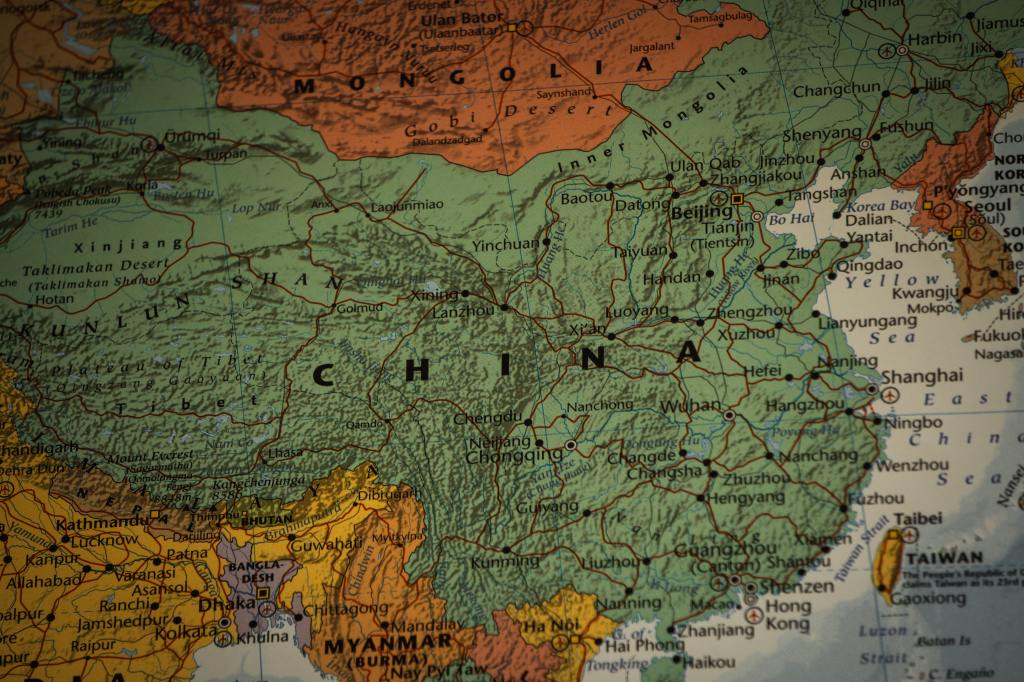
Since the Church of the East was denied access to the West, it consequently oriented itself towards the East. While Bishop David of Basra initiated contact with the Indian Thomas Christians of Kerala around 295/300, Nestorian monastic missionaries advanced into the Arabian Peninsula, as well as towards the peoples of the Central Asian steppes. After the loss of its Arab dioceses to Islam and a first setback in China, the Church made renewed efforts towards the east beginning in the eleventh century, and reached the Mongol peoples and the Middle Kingdom.
At that time, the authority of the patriarch of the Church of the East extended from the Euphrates to the Yellow Sea…
Hardened physically and psychologically by unsharable experiences, hopelessly behind his peers in education, he cannot settle down. One night in his parents’ house, a man he knew in Ireland visits him in vision: Victoricus, holding “countless letters,” one of which he hands to Patricius, who reads its heading – VOX HIBERIONACUM, The Voice of the Irish. At that moment, he hears the voice of a multitude (beside a forest that Patricius remembers as being “near the western sea”), crying: “We beg you to come and walk among us once more.” “Stabbed in the heart, ” he is unable to read further – and so he wakes up.
Try though he might, he cannot put the Irish out of his mind. The visions increase, and Christ begins to speak within him: “He who gave his life for you, he it is who speaks within you.” Patricius, the escaped slave, is about to be drafted once more – as Saint Patrick, apostle to the Irish nation.
Cahill, How the Irish Saved Civilization, pp. 105-106
Old Testament background continues to fascinate. I’ve recently come across two customs from the Babylonian and Assyrian Empires that once again prove that the past is truly a foreign land. This type of material is interesting because it adds more texture and color (here literally) to ancient history. It reminds us that these were real people, just like us, with their own complex traditions and cultures – that they were just as fully alive as we are. Not unlike the effect of seeing old black and white footage restored in color for the first time, these details help the stories, carvings, and statues feel more real. That in turn helps guard us from treating the Old Testament narratives as more like myth and less like actual history that we ourselves are connected to.
Micah 5:1,strike the judge of Israel on the cheek. This may allude to a ritual in the Mesopotamian Akitu festival known as the royal negative confession (with “judge” here referring to the Israelite king). A third-century-BC Seleucid source describes how, in this ritual, the high priest would stand before a statue of Marduk and recite the Enuma Elish (the Babylonian creation epic) in order to emphasize Marduk’s superiority over other gods as well as his creation of all things, including mankind. After the temple was cleansed, the priest would take the royal insignia from the king, slap his face, and force him to kneel before the statue of the god. The king was then to confirm that he had not misused the power given him by Marduk nor violated the welfare of Babylon or Marduk. The high priest would then slap the king again and force him to cry, possibly to demonstrate his contrition. After this, the king’s authority would be restored.
Nahum 2:3, shield is … red. The palace of Sennacherib in Nineveh depicts the typical Assyrian shields of his day, such as those used in his conquest of the Judahite city of Lachish in 701 BC. According to the early fourth-century-BC Greek historian Xenophon, armies of Assyria, Babylon, and Media typically dressed in blood-like scarlet in order to intimidate their enemies.
ESV Archaeology Study Bible, pp. 1289, 1296
So the next time you are reading an Old Testament account of Nebuchadnezzar, imagine him at the head of a column of soldiers who are dressed in blood-like scarlet – and he himself with blood-shot eyes because his high priest recently slapped him until he cried.
We probably have some updating of the Sunday school flannel boards to do.
Even the first Christian historian, Eusebius of Caesarea (265-339) in his ecclesiastical history, devoted scarcely a word to the Asian Christianity of Mesopotamia that had begun to develop rapidly in the second century. The reasons behind this the lack of attention to the Church of the East grew out of the geopolitical situation of the time. In those days the River Euphrates, with its source in the north-east of modern Turkey and its mouth at Basra on the Persian Gulf, separated the Roman Empire from the Iranian Empire. Aside from isolated Roman advances towards the east and Iranian advances towards the west, the Euphrates stood as a stable national boundary, whose political impermeability was breached only by merchant caravans.
Baumer, The Church of the East, pp. 1-2
It’s interesting what powerful effect the Euphrates river had on the development of the early church. As a major geographic barrier, it also functioned as political, linguistic, and cultural barrier, separating civilizations and leading to a western forgetfulness, to this day, of the millions of Christians that lived outside of the Roman Empire, in the lands to the East.
“How about it, Christian?” taunts the captain. “You say your god is great and all powerful, so why can’t you pray for us? We’re starving to death, and there’s little chance of our ever seeing a living soul!” It’s hard to know whether the captain would have spoken Irish or Latin to Patricius [Patrick]; but Patricius, though his Latin is abysmally awkward at times, has a good ear for dialogue. Here is the original, which gives us an excellent idea of how ordinary men used the tongue of Cicero: “Quid est, Christiane? Tu dicis deus tuus magnus et omnipotens est; quare ergo non potes pro nobis orare? Quia nos a fame periclitamur; difficile est enim ut aliquem hominem umquam videamus!”
“From the bottom of your heart, turn trustingly to the Lord my God,” the visionary instructs them, “for nothing is impossible to him. And today he will send you food for your journey until you are filled, for he has an abundance everywhere.” The young man’s sincerity affects the weakened sailors, who, bowing their heads, try a moment of faith. The sound of a stampede attracts their attention; and as they raise their eyes, a herd of pigs hoofs it down the road in their direction. Not just food, but the best food of all!”
Cahill, How the Irish Saved Civilization, pp. 104-105
This account comes from Timothy Tennent’s excellent course, Introduction to Islam, which is available for free on biblicaltraining.org. It’s been maybe ten years since I first heard this story, where Tennent recounts events from the ministry of Christy Wilson in Afghanistan. When I heard it, I was struck by the kindness and severity of God. Kindness in how the (modern) foundation of the Church in Afghanistan was built with a group of believers who were physically blind. How very much like our God to do this. Severity also, in how the government of Afghanistan was overthrown the day after they bulldozed the church building – and the country has been in turmoil ever since. What’s more, this overthrow was predicted by one of the local believers who warned the Crown Prince of the impending judgment if he proceeded, just like some kind of Old Testament prophet come to life. Also watch for the rich irony present connected to the term, underground church.
The following is a transcript of the end of the final lecture in the course:
“Christy Wilson, among many things, was really committed to working with Muslims. He was born in Iran and he grew up in Iran. As a young boy he heard about next-door Afghanistan. Of course, no missionaries are allowed in Afghanistan. When he was asked as a little boy what he wanted to do when he grew up, he said, “I want to be a missionary” just like his dad was. They said, “Where do you want to go?” He said, “Afghanistan.” They said, “You can’t go there, they don’t allow missionaries there.” He said, “That is why I want to go there.” Typical Christy Wilson reasoning. He did go there. He went there as a tentmaker and he has become of course and was, a great leader in the area of tent making and as an English teacher. He ended up teaching English to the Crown Prince of Afghanistan. He had a tremendous ministry there for over twenty years.
In May of 1970, which is now over 30 years ago, they officially opened up the first and only church in the whole country of Afghanistan. This was a huge accomplishment because it had never been done before and Christy Wilson by sheer persistence, which he had a lot of, and prayer – he was committed to prayer – he talked the government into allowing him to build a church for the international community there. They built an international church, in fact a couple. In fact, Dudley Woodberry who wrote this other book I mentioned, pastored that church whenever Christy was gone on sabbatical or whatever. But Christy Wilson was the main pastor of the church and they built this beautiful church. People from all over the world gave money for the building of this church, a beautiful structure. They had open Christian worship happening in Afghanistan. If you know the history of Afghanistan, this is unbelievable.
The reason it happened is because Dr. Wilson worked very, very hard to do things to show them that Christians would be good for the country. He and his wife Betty started the first blind work for the whole country. Betty Wilson learned Braille and when the Crown Prince saw this young boy come before the King and was given a copy of the Qur’an, interestingly, and he was called upon to read the Qur’an, a blind person reading the Qur’an in Braille. The man could not believe it. He kept trying to fool him by instructing him, “Read here, read there.” He thought the guy had memorized it. He would switch around, and he would read it. When he realized this was a blind person who could actually read, he made an announcement to the whole country, “If you are blind, go to Dr. Wilson, he will teach you how to read.” They had hundreds of these blind children show up at their doorstep. Betty Wilson, who of course was with us for our dedication of our Christy Wilson Center, took these blind children and she spent years teaching them how to read. To this day, the leaders of the church in Afghanistan are blind people from her work there. It is amazing. These were those children years ago.
In 1970, they opened this church because they had a relationship with the government. Because of pressures from the Muslim fundamentalists, etc., they finally were pressured to close this church down and destroy it. This was a real tragedy because this was a huge answer to prayer and they were very concerned about it. Christy Wilson was given forty-eight hours to leave the country. It was a horrible thing, which is why he came here, by the way from Afghanistan. He spent a year in Iran doing some study, but then he came here as a professor.
When they destroyed the church, the regime at that time was in its twenty-second year, a long regime in Afghanistan. Before they did the wrecking ball on the church, one of the people in the church said that he was convinced that if you destroy this church, there will be a judgment of God. He went to the Crown Prince and he said to him, “If this church is destroyed, God, the Christian God, will overthrow your government.” Just like that. I would be scared to say that. He had a word from God, he said this is true.
They went ahead with it, they destroyed the church, they completely leveled it. In fact, as Christy Wilson tells the story, they brought in backhoes to dig down beneath the foundation. They thought, “You have already destroyed it, why are you digging this big hole?” It was because they had heard there is an underground church. They were looking for the underground church. There was not only a demolished building, but there was also this gaping hole there. They did not find the underground church. Christy Wilson said, “They couldn’t dig that one out.” The real underground church, Hallelujah! The night they completed the destruction of that church, a coup overthrew the whole government, the government was out of power, as it is to this day.
I don’t know how you feel, but I am convinced that that government was indeed out of power because they destroyed that church building. That says to me something about the incredible commitment God has to seeing the Gospel planted among Muslims. Here is a king who says, “I’m going to destroy this church.” The Lord says, “No, you won’t. This day your soul is required of you.” Boom! He’s gone. Of course, the Muslims have invaded, the Taliban government has come to power, and all of these horrible things have happened. Afghanistan has never settled down since the day they destroyed that church. The government has never been stabilized. I think it says something about the priority of access to the Gospel. If you commit yourself in prayer and in many of your cases actually go and work among Muslims, God will bless you because I believe God is deeply committed. We know this through the Gospel, but also through history, he has commanded us to see people who have no access to the Gospel given access to the Gospel…”







 Entrusted to the Dirt

