Want to know one of the deepest fears of contemporary missionaries? Being labeled a colonialist. Missions books and pre-field trainings are full of examples of how previous generations of missionaries got it wrong, exported their culture along with the gospel, and thereby hamstrung the growth or even existence of the indigenous church. The average well-educated Westerner will go to great lengths to avoid the shame of being labeled a racist or a –phobe of any sort. The average Western missionary will go just as far – perhaps even further – to make sure the dreaded colonialist label never sticks.
This deeply-imbedded cultural fear often works its way out in a missiology of reaction. What ends up crystal-clear for the average missionary going to the field is what he should not be like – those old-school colonial missionary types. So, when missions methods are proposed that keep the missionary always in the background, never leading from the front, the missionary becomes an easy convert. In these methodologies (also chock full of promises of exponential success), the missionary has found a compelling philosophy that keeps him from leading groups in Bible study, from preaching, from baptizing locals, and even from calling out the darkness of local culture when necessary. In his zeal to not be a colonialist missionary, the gospel worker focuses overtime on preventing any of his culture from being transmitted through his ministry.
In a previous post, we’ve seen how the Bible’s strong emphases on direct gospel ministry and protection against false gospels provide a helpful response to this kind of missions thinking. How might the experience of seasoned cross-cultural missionaries also inform this fear of being a cultural colonialist, a cultural contaminator?
Thankfully, cross-cultural wisdom and common sense also bring some needed correction to the missionary mortified at the thought of passing on some of his culture to his local friends. To start with, those with long-standing cross-cultural relationships will tell you that cultural transmission is, in fact, inevitable.
When we love someone, we are shaped by them.
Spouses’ personalities and body language become more like one another as they age. Likewise, friends from different cultures slowly absorb traits from one another’s lives. This is simply how human relationships work. When cross-cultural relationships exist, culture will be transmitted whether we want it to or not. This is because group as well as personal cultures are porous and dynamic, constantly flowing back and forth and naturally interacting with the other cultures around them. Naivete says we can stop cultural transmission entirely. Wisdom and experience say it will happen, so let’s seek to notice it and be intentional about it.
Similarly, culture can never be transmitted without being changed in some way, localized as it were. No one can emulate another in one hundred percent the same way. No, even the sincerest emulation still gets colored by the unique traits and personality of the individual or group that has been influenced. Once again, experience shows us that cultures never receive anything without putting their own spin on it. Yes, the Melanesian church of my adolescent years sang “Rock of Ages” in English in their services. But the timing, the pitch, and the fact that every single verse of the song was sung was most definitely not Western, but more akin in style to the tribal dirges of their ancestors. When this kind of exchange occurs, does it represent a coercive act of culture invasion or a consensual act of culture adoption? Must we insist that the former category is the only possibility? Or can we admit that indigenous cultures – not just our own – possess enough agency to adopt and transform foreign forms willingly?
One more point of cross-cultural common sense is that cultural transmission can be either good or bad. This much should be plain to the Christian, even if it’s not to the secular academy. Strangely, even among Christians, it is assumed to be bad when a Western missionary’s culture influences local believers. But why is this the default assumption when an unreached culture is influenced by a missionary who is 1) steeped in and shaped by God’s word, and 2) who comes from a culture that has had widespread exposure to God’s word for hundreds of years? In most cases, the cultures of the unreached have either been cut off from God’s word for hundreds or thousands of years or have never had access at all. This isolation from God’s truth always means the presence of areas of horrendous darkness in these cultures – strongholds of evil such as female circumcision, cannibalism, honor killings, or witchcraft. Regarding areas such as these, Western missionaries should be actively trying to change the culture. Yes, some cultural transmission can be good, even godly.
For a global missions culture dominated by the fear of being called colonialist, cross-cultural common sense and wisdom bring a welcome correction. Cultural transmission is inevitable inhuman relationships, and therefore calls for intentionality. Culture transmitted is always localized in some way. And some forms of cultural transmission are necessary in order to combat the works of the enemy. When considered alongside the Bible’s ministry emphases, personal humility, and a deep trust in the sovereignty of God, this common sense wisdom can help free the missionary from a fear-based missiology – and lead to one built on a better foundation.
This post is part of a series. Total series posts are:
Among the many forces that shape contemporary missions, fear of cultural contamination looms large. Missionaries, and Western missionaries in particular, often feel and express a deep aversion to passing on aspects of their own culture to those that they reach through their ministry. Suppose Western missionaries of the past falsely equated Western culture with Christianity. In that case, the pendulum has now swung to the far extreme, where cultural transmission, “contamination,” is now felt to be one of the worst things a missionary could ever do.
This fear is not without warrant. Some churches around the world, planted in previous eras of missions, have failed to take root as truly indigenous because of their Western trappings. The country of Japan comes to mind as one example where the indigenous population has not accepted Christianity as genuinely belonging to the Japanese – at least not in the modern era. In societies like this, Christianity is held at arms’ length, viewed as belonging to the foreigner, and not truly an option for those who identify with their own people group.
Yet an overcorrection to this danger in modern missions has led to an even worse situation. Missionaries are refusing to obey clear commands and examples in scripture out of a professed desire not to export Western culture. Following popular methodologies -themselves driven partly by this fear of cultural contamination – they shrink back from biblical ministry, necessary roles, and spiritual authority. These missionaries convince themselves that by not preaching, not baptizing, not modeling, and not leading church plants, western culture will not influence the locals, the locals will take ownership of the faith, and the Church will be set free to reproduce. All kinds of concerning methods emerge out of this sort of posture. One egregious example would be a mission leader recently forbidding his team members from reading the Bible in indigenous homes due to a commitment to orality and a fear of “Western” literate methods making inroads.
Yes, a desire to keep the Gospel – and not culture – as the only stumbling block is biblically warranted (1 Cor 9:22). The Jew/Gentile divide among the Romans was rife with issues of conscience and culture, such as which days were to be considered holy, and what foods should or should not be eaten (Rom 15). Church history also shows us that these concerns can have real historical validity. In an era where China was repeatedly humiliated by foreign powers, Hudson Taylor rightly understood that many of his Chinese hearers were stumbling not only over his message, but also over his explicitly foreign appearance. However, in the centuries since Taylor became the first missionary to wear the Chinese hair queue, the pendulum has swung far indeed – into territory that Taylor, a committed cross-cultural preacher, would hardly recognize.
What is to be done to course-correct? Our obsession with avoiding cultural transmission must be corrected by the clear commands and warnings of scripture. A survey of scripture’s commands regarding the missionary task shows that the overwhelming emphasis of these passages is not on the need for the minister to check himself in order to protect his cross-cultural disciples from adopting his culture (Matt 28:18-20, Matt 24:14, Rom 10:14-17, Rom 15:20, 2 Tim4:11-16). Rather, the emphasis falls on the importance of direct gospel ministry – the kind of ministry that can be seen, caught, and followed. In other words, the Bible emphasizes ministry by direct example. Consider the weight that Paul – a self-professed Hebrew of Hebrews – gives to emulating his own manner of life when writing to the Gentile Macedonians in Philippi. “Brothers, join in imitating me, and keep your eyes on those who walk according to the example you have in us. (Phil 3:17 ESV).” Apparently, Paul did not seem to think that if Macedonian believers imitated the life of a Jewish Cilician, they would no longer be able to reach their pagan neighbors effectively.
What of scripture’s warnings? Far from emphasizing the evils of cultural contamination, scripture instead highlights the dangers of false-gospel contamination (Gal1:6-8, 2 Cor 11:4, 1 Tim 1:3). This danger comes through things like false teaching, wolves in sheep’s clothing, a lack of holy living, or even a loss of love (Rev 2). Once again, the weight of biblical emphasis indicates that these dangers are far more of a threat to the spread of the Church than missionary cultural transmission.
In future posts, we will consider how a good dose of cross-cultural common sense, personal humility, and a deep trust in God’s sovereignty all help to guard the Church and its missionaries from falling into this pitfall of modern missions. Nevertheless, it is appropriate that any missionary who finds himself frozen by the fear of contaminating the indigenous Church first wrestle with the Word of God and its dominant emphases: Do direct ministry by example and watch out for false-gospels. With these emphases in place, the guard rails are set, and the missionary is now free and ready to keep a wise eye out for where cultural preference might indeed be causing barriers to the gospel.
Any return to a more biblical missiology must be shaped primarily by the Bible’s emphases, and not dominated by our modern fear of cultural contamination.
This post is part of a series. Total series posts are:
Jesus says that the angels rejoice when even one sinner comes to repentance (Luke 15:7). What then might take place in the heavens when that sinner is the first in the history of the world to worship God from a particular language or culture? What kind of angelic rejoicing might result when not just an individual but a congregation from hitherto-alienated people, at last, join the great choir of tongues and nations worshiping the lamb? This is not a hypothetical situation. We live in an age when the Church of Christ continues to advance steadily, bringing gospel light to even the hardest-to-reach people groups on the planet – although thousands of these groups still await the coming of their very first ambassador. These groups are the unengaged, the people for whom there is not yet even a single team committed to church planting among them.
Revelation 21:22-27 speaks of the kings of the earth bringing the glory and honor of the nations into the new Jerusalem. This implies that there are distinctive kinds of honor, unique forms of glory for different groups of human peoples, IE ethnic groups – and that these glorious differences will somehow be present even in eternity (c.f. Rev7:9). These verses in Revelation 21 would have painted initially the picture of rich and diverse royal caravans bringing the material goods of the nations into New Jerusalem (e.g., the queen of Sheba visiting Solomon). Yet any primary survey of the world’s peoples will quickly observe that their unique strengths, their particular beauty, also consist of their distinct cultures and languages. And these deeper characteristics of what it means to be a given people group represent some of their most genuine riches.
Central Asians, for example, are natural at extravagant hospitality. Americans stand out for their optimistic, problem-solving approach to life. East Asians model respect for elders such that Koreans may not even call their older siblings by their names but by the respectful titles of older brothers and sisters. Languages also have inherent strengths, with each tongue having a rich vocabulary corresponding to its culture’s emphases. Some languages excel in communicating the abstract or technical (looking at you, English). Yet others, in the beauty of the poetic. Some have given birth to intricate grammar systems so complex it is said that no one over forty can learn them. Yet other languages stand out for their simplicity and efficiency, as is seen in the wondrous flexibility of the world’s pidgins and creoles.
Where do these various cultural-linguistic strengths come from in the different people groups of the world? They come from the presence of the image of God among the individual members of that language or culture (Gen 1:27). For even in unengaged people groups that have had no gospel access whatsoever, the image of God given at the creation of Adam and Eve continues to linger. It is present in each new generation, though marred and broken by the effects of sin and death. The presence of this broken image among these peoples still speaks as a witness to the reality of the creator. Together with creation, this image reflects(although dimly) aspects of who he is and what he is like (Acts 14:17). But it also gives gifts, areas of strength in each person, language, and culture. These are places where the goodness of God’s creation still generously overflows even after millennia of sin and death.
Sadly, in the unengaged people groups of the world, these strengths are primarily used in the service of the enemy. Without the presence of a believing community, these gifts are a window of God’s glory only in their witness to his common grace and to His coming judgment. However, when a missionary engages this kind of people group, when the first individual or group of locals are born again, what has been concealed or latent is suddenly revealed. It’s as if a long-buried treasure is suddenly exposed to the sunlight. Or, torches that have not been lit from the birth of that culture and language are suddenly set ablaze. The result is glory, the real beginning of the glory of the nations, now at last truly reflecting the glory of God. The unique strengths and honor of a people group, whether great or small, can now be used for the first time in praise of the King.
Extravagant hospitality can now be offered from a motive of gospel love, even to the poor who cannot extend an invitation in return (Luke 14:13). Western optimism can now be grounded in the sobriety of the wisdom literature and matured by an unshakeable faith in God’s promises. Eastern respect for elders can now be done “as unto the Lord” and no longer out of mere cultural duty or fear of shame (Col 3:22). Languages suddenly become vehicles for psalms, hymns, and spiritual songs – for the eternal word of God itself as it is preached and as it is translated. In all these things, God’s universal truth and beauty are displayed through the unique facets of local expression.
There are multiple biblical motivations for missions, for going to the most challenging and remote corners of the earth to bring the gospel to those who have never heard the name of Christ. Hell is real (Rev 20:15). The love of Christ compels us (2 Cor 5:14). The glory of God calls for universal proclamation (Ps 96). Yet among these motivations, we may forget that missions is also a chance to take part in revealing hidden beauty, the unleashing of latent glory. Every missionary who risks the costs and dangers of going to the unengaged also has a chance to play a part in, even to be there to witness, the glory of the unengaged, finally unveiled to the praise of God.
Undoubtedly there is a special kind of joy in heaven when a given language and culture becomes a vehicle for the praise of God for the very first time. Who can tell with what anticipation the angels await the sound of new hymns sung in the language of the Luri, the power of preaching in Shabaki, and mission endeavors planned and carried out in the style of the Hawrami? And it’s not only heaven that will taste this joy. No, it will also be present in the hearts and tears of the missionaries who are honored to witness this glory unveiled and in the gatherings of their sending and supporting churches as they hear the incredible news from afar.
Revelation 21 is going to come to pass. God’s eternal glory and beauty will be reflected in the unique honor and glory of each of the nations, in each of the world’s remaining unengaged people groups. The costs of reaching these groups will be high, and the losses dear. But as we send and go, let us keep this vision of this coming joy before us. In eternity we will see the glory of the nations flowing into the new Jerusalem. And we will see the beginnings of this hidden glory even now by going to the unengaged.
Melissa* sat in a metal chair next to the overgrown pool, clearly distressed. She turned from Farhad* to try to catch her parents’ eyes, looking for reassurance. As a graduate student at an Ivy League school, she didn’t know what to do with what Farhad was telling her. His forceful accented words were not fitting within her worldview, within her moral framework of highly-educated liberal New England.
I was manning the grill nearby and could see the dynamics. By this time I knew Farhad and could have guessed what he was going on about just by his body language. As a member of a minority people group who had suffered genocide when he was a teenager, Farhad harbored a deeply-rooted hatred of the majority Middle Eastern people group who had slaughtered his own. And a deeply-rooted hatred of Islam, the faith they used to justify their atrocities. Farhad was not a Christian, but he was definitely post-Islamic, and had been willing to study the Bible with me and Reza* and even to attend church with us.
Tall, in his forties, with slicked-back shoulder-length black hair and a narrow angular face, Farhad liked to wear a suit to church with a Hawaiian shirt underneath, generously unbuttoned at the top, 1970’s style. He had kind dark eyes and a genuine smile, though he was missing one of his front upper teeth – the result of a mugging incident soon after he had arrived in the US as a refugee.
“I get kidnapped by Al Qaeda. I almost die. But I keep all my teeth. I come to America. I lose my tooth! Why?!” he was known to ask when telling the story of how he got mugged in the apartment complex where he was placed by his resettlement program.
Now, he was unloading on Melissa, who had simply come down to the Louisville area to visit her parents during a school break. Her parents, both professors at Ivy League schools, would come down periodically to the area to stay in their second home, where my mom was a long-term house sitter at the time. Because they lived in the same house as my mom during these visits, our two families had gotten to know one another well and become friends, even though our worldviews were drastically different. We were a family of evangelical missionaries, studying at the Calvinistic Southern Baptist Theological Seminary. They were a family of staunchly liberal Harvard-educated progressives. But there was an openness to conversation, even friendship, with others who were different from them that set them apart from the more radical progressivism that is in vogue today.
This professor couple believed that as much as possible, nature should be allowed to take over the property, hence the overgrown pool from the 1960s, now full of lily pads, algae, frogs, and a snapping turtle. When the weather was warm, we liked to have cookouts on the cement patio next to this pool, and I would often invite my international friends. My mom’s creative cooking was a real treat for them, as well as for me, a college student at the time living on my own. We’d eat by the fire pit, swapping stories from all around the world until long after the lightning bugs had come out. A map on the wall contained pins from all of the different countries where my mom’s many guests had come from.
But swapping stories with refugees can get intense very quickly. The barbecue chicken wasn’t even done grilling when Farhad was dropping stories on Melissa of genocide and passionately espousing his seemingly-racist and Islamophobic opinions. She didn’t know what to do with it. Melissa was a sharp woman, and getting a world class education. But when your education and worldview is framed to believe that racism and oppression can only really be perpetrated by white Christians, by the oppressor class, what do you do with a Middle Eastern society where various people groups have hated and killed each other for thousands of years? What do you do with a brown-skinned Muslim who is eager to convince you of the evils of his own religion, and has first-hand accounts of genocide to back it up? Victims are supposed to be inherently virtuous, the oppressed are not supposed to be able to be racist. But Farhad was calling members of the dominant people group names like “dogs” and “filth.” He clearly hated them. All of them. Islam is supposed to be the misunderstood and maligned religion of peace, but Farhad was pointing to examples from recent history of massacres literally named after chapters of the Qur’an. Of Muslims with power slaughtering Muslims and other minority groups with less power.
Melissa caught her mom’s attention and tried to appeal to her. “But… but… mom… this can’t be right, can it?”
“No, honey, you’re right, it can’t be right, it’s, well, it’s…”
They were grasping, intellectually brilliant though they were. Their moral lenses had taught them that the world was full of people who were basically good, and evil only really exists in the oppressor class, or in those who just haven’t had enough education. But Farhad was a fly in that ointment, a big angry fly, prominently missing a tooth. His logic was strong. There was clear victimhood and suffering in his story. There was also clear darkness in his heart.
I turned the barbecue chicken legs over on the grill and thought about the scene before me. I thought about how adept Middle Eastern and Central Asian refugees are at messing with the categories of popular Western morality. I am amazed at how Iraqis, Iranians, and Afghans can say all kinds of politically-incorrect things and get away with it. What progressive Westerner is going to be so bold as to call them out and risk exposing themselves to accusations of racism or Islamophobia? Some still might, but many, like our friends, will find that they have instead stumbled upon some kind of loophole, some kind of short in the moral circuitry.
I also thought about how grateful I was to be able to live in the real world, the world I had learned from the Bible. In that world evil and darkness are not limited to the few, to the oppressor class. They exist in every human heart. We are all evil, we are all on the spectrum of darkness. So we are not surprised when it shows up in the poor and marginalized, just as it does among the wealthy and privileged. While God’s word is clear about the evils of true oppression, the Bible calls both both the oppressor and the oppressed to repent of their hatred (murder) in their hearts toward one another, and to become part of a new redeemed humanity together.
The Bible has a category for people like Farhad. It shocks him by calling him to love his enemies (Matt 5:44). And when he finds that impossible to do in his own strength, to repent and to cast himself on God’s mercy in Christ. And if he does this, then he will be given the Holy Spirit who will empower him for the first time to do the impossible – to love those who committed genocide against his people. He’ll be able to do this because God’s justice is coming, and because he will know that he was forgiven when he had committed even worse against God himself.
An Ivy league education is no match for the realities of Middle Eastern racism. But the Bible can handle it – yes, more than handle it. It can transform it.
This Central Asian proverb speaks to the danger of friends going into debt with one another. Borrow money from your friend, this wisdom claims, and risk the love between you getting cut up.
I’ve experienced the great strain that friendships can come under when money I’ve loaned out to friends in Central Asia isn’t returned or acknowledged in an honorable way. Even though our family tried to be very cautious in loaning out money, it is still an expected practice in a patron-client society where the foreigners are often much wealthier than the locals. Some foreigners take a “never loan money” approach to the culture. But over the years we’ve developed more of a practice of conservatively lending money the first time, and then letting that experience determine if the door is still open or not for future requests. For those who repay their debts, this can greatly increase the trust in the relationship. And it is a wonderful thing to have friends you know you can trust with money, especially between believers who must function as a new household for one another. For those who don’t repay, we know not to extend the same trust in the future, at least when it comes to money. The money may be lost, but wisdom in the relationship is gained. But even with this general approach, we tried to spare our dearest friendships this debt/trust test whenever possible. It’s stunning how money can so quickly come to divide people.
In general, Central Asians are much more comfortable than Westerners with having money be a part of their close relationships. So much so that many feel they can’t honorably say no to a friend asking for a loan. So it’s curious that this proverb also exists in the culture, standing as a wise warning, even if many will struggle to feel they are free to heed its advice.
Some local believers are seeking to change this culture. Harry* once told me his response to requests for loans. “I’m honored that you would ask me this, my respected brother. But I value your friendship so much that I dare not risk it by getting money involved.” This kind of response takes an action viewed as shameful – saying no to a loan – but explains it by appealing to the value of the relationship, something very honorable and close to the heart of the culture. To me, this seems like a very wise way to say no. The goal is to communicate that my refusal is not a rejection of our relationship, but rather a statement of just how important it is to me. So important, I would protect us from the money that might cut our bonds of friendship.
To support our family as we head back to the field, click here.
For my list of recommended books and travel gear, click here.
Americans don’t trust sad people. Daniel Nayeri makes this insightful observation in his hilarious and heartbreaking memoir, Everything Sad is Untrue. As an Iranian refugee, it makes sense that Nayeri would notice this. Because in the Middle East and Central Asia, the opposite tends to be true. They don’t trust people who are overly happy or optimistic.
This tendency to trust (or not) tends to be reflected in which kind of stories end up being most popular. For a story to be truly great, most Westerners want a happy ending. The good guy almost always wins in the end. But Central Asians call for a tragic ending in order for a story to achieve true greatness. The Western movies my Central Asian friends like the most are Titanic (where Jack dies of hypothermia), Braveheart (where William Wallace from disembowelment and beheading), and Forrest Gump (Where Jenny dies of AIDS). As for movies made in Central Asia? Dark endings. Almost all of them. I think I’ve only ever seen one with a happy ending.
This orientation toward tragedy vs. comedy seems to reflect the deep-down worldview beliefs of each culture – what each feels is most true about real life. Westerners really believe deep down that life will have a happy ending, that if we just believe and try hard enough, everything’s going to be alright. Central Asians really believe that no matter how good things get, it’s all going to end in tragedy, just as it always has.
Even our histories tend to strengthen these worldview narratives. Think of the meteoric rise of the power of the Christian West over the last 500 years. Then consider the incredible decline of the power of the Islamic Middle East and Central Asia. 1,000 years ago, the centers of global wealth and culture were not cities like London and New York, but Baghdad and Samarkand. Perhaps back then the Europeans would have been the pessimists, and the citizens of the Silk Road those who believed in rosy endings.
When you meet someone whose bearing contradicts the primary narrative of your culture, you tend to distrust them. This is because they seem to be out of touch with reality. Many a Western aid worker arrives in Central Asia bright-eyed and bushy-tailed, believing that with just a little bit of money and some fresh ideas transformation can be a simple thing. Meanwhile, locals just shake their heads at this naive foreigner, knowing that for all their frenetic activity these Western plans will be about as effective as a dirt clod thrown at a passing tank. I have had countless conversations with my friends and students in Central Asia where I’ve been dumbfounded by their lack of belief in the possibility of change, while they in turn are dumbfounded that I actually believe real change is possible.
The West, for its part, and especially America, traditionally believes in the inevitability of progress. And we are deeply committed to the belief that things really will work out for those who work hard enough. Successful people function as our prophets and idols, the ones who confirm for us what we already believe – that the story of life ends in happiness. So we find ourselves uncomfortable with sad people, with those whose lives seems to be a relentless movement from one season of suffering to the next. We don’t trust them to be prophets of the way things really are. We don’t want to.
Biblically, both cultures are wrong, and both cultures are right. The ending of history will indeed be good – yes, as good even as resurrection. But resurrection is impossible unless preceded by death. It’s got to all die before it can all come back to life. Creation must groan, and painfully so, before the revealing of the sons of God. As such, Proverbs and Ecclesiastes go hand in hand. The wheat and the tares grow together. Suffering and death are inevitable. Hell is real. But eternal life is also inevitable for those who entrust themselves to the one who suffered and died – and now lives forever.
Paul speaks of us as being a people who are “sorrowful, yet always rejoicing.” This means that Christians are those who can be fully awake to the grief and suffering of life, and those who can also be fully awake to the joy and delight of it. This means that a Christian who is shaped by the Bible’s view of reality is one who can be trusted by both kinds of cultures, the optimistic West and the pessimistic East. We know the depths of sadness. So we are not dismissed as naive. But we also know the heights of true hope and joy. So we are not dismissed as fatalists. We are, in one sense, Western and Central Asian at the same time. Or at least we should be.
And yet I find myself very lopsided. I have some idea of what it means to be always rejoicing. But what might it mean to be always sorrowful? And can it be that faithfulness in this age actually involves both at the same time? What might that look like when it boils down to things like daily spiritual disciplines, church services, and our “How’s it going?” conversations with other believers? I at least still have a ways to go in learning how to faithfully lament, not just with my mind, but also with my heart and emotions. I still have a hard time trusting sad people, in spite of spending half my life in cultures where grief and sadness are far more acceptable than here in the US.
Yet I have tasted aspects of this at funerals, when laughter comes easily during stories told of a departed loved one. Or at weddings or concerts, where joy and beauty are so strong they lead to tears. I felt it yesterday at a poetry recitation at my kids’ school. The kind of joy that makes you serious, as Lewis once put it. Joy and sadness intermingled, and something that feels so very right about this.
Americans might not trust sad people. And Central Asians might not trust happy ones. But believers from both worlds have come to trust a man of sorrows who is also the embodiment of purest joy. He holds both perfectly together at the same time, always able to weep with those who weep and to rejoice with those who rejoice. He does this authentically, with no whiplash or disjointedness. He can show us how to laugh and cry at the same time, welcoming both with hearts that are somehow more whole for their embrace of these seemingly-opposite postures.
As we draw near to him the promise is that we will become like him. And that will make us also those that sinners come to trust, whatever their cultural bias. Not because we are so impressive, but because we are the ones who are the most real, those who walk in the truest story. One where grief and joy also walk, hand-in-hand.
…by century’s end Isidore was building a real library in Seville, which consisted of about fifteen presses (or book cabinets), containing perhaps some four hundred bound codices, an amazing number for the time. The only other continental library known to us in this period was in Calabria [S. Italy] and the fate of this library is lost in the blood and smoke of the sixth century. Gregory of Tours wrote this sad epitaph on sixth-century literacy: “In these times when the practice of letters declines, no, rather perishes in the cities of Gaul, there has been found no scholar trained in ordered composition to present in prose or verse a picture of the things which have befallen.”
Ireland, at peace and furiously copying, thus stood in the position of becoming Europe’s publisher. But the pagan Saxon settlements of southern England had cut Ireland off from easy commerce with the continent. While Rome and its ancient empire faded from memory and a new, illiterate Europe rose on its ruins, a vibrant, literary culture was blooming in secret along its Celtic fringe. It needed only one step more to close the circle, which would reconnect Europe to its own past by way of scribal Ireland.
Columcille provided that step. By stepping into the coracle that bore him beyond the horizon, he entered the Irish pantheon of heroes who had done immortal deeds against impossible odds. As he sailed off that morning, he was doing the hardest thing an Irishman could do, a much harder than than giving up his life: he was leaving Ireland. If the Green Martyrdom had failed, here was a martyrdom that was surely the equal of the Red; and henceforth, all who followed Columcille’s lead were called to the White Martyrdom, they who sailed into the white sky of morning, into the unknown, never to return.
In this way, the Irish monastic tradition began to spread beyond Ireland.
Cahill, How the Irish Saved Civilization, pp. 183-184
When the civilizations which Christians have made their homes begin to collapse, look to the fringes. God is often at work there, and just may use the most unexpected peoples and places to restore the light to lands once bright, now overrun by darkness.
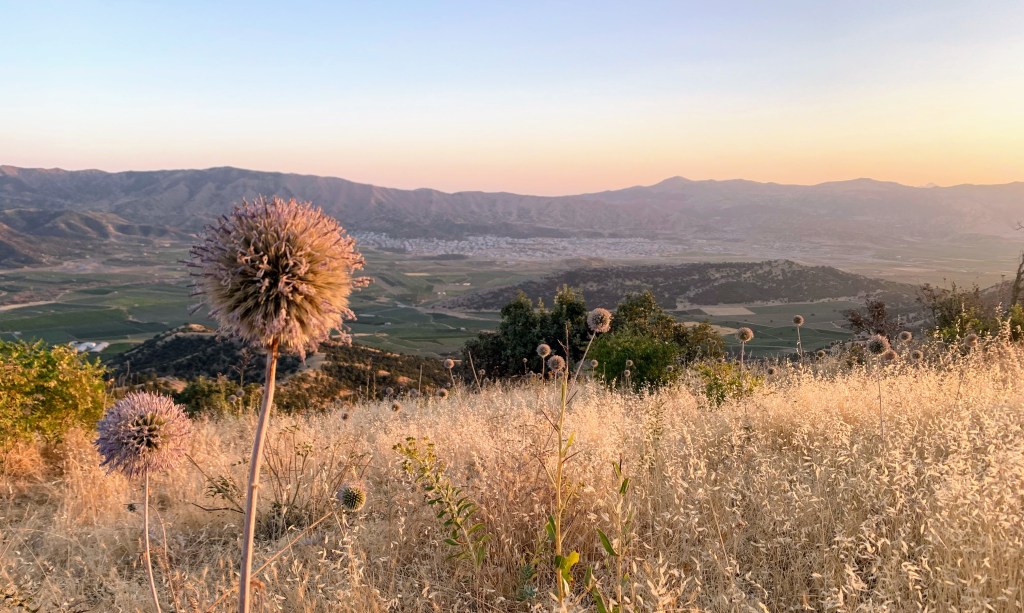
It was on a trip to Underhill village where I first learned that thistles are edible. It was late summer. The mountains had turned brown from the summer heat. But they were not completely colorless. Amazingly, certain hard-scrabble plants chose the height of these rainless months to bloom. Their colors were not the bright shades of spring, like the gold and white of the small narcissus flowers or the blood-red poppies. No, they were much more subtle – pale violets, aloe greens, dusty yellows. Late summer in the high desert was a different theme, and brought with it its own unique color scheme. I was reminded of Lilias Trotter, the missionary artist to Algeria who would comment on God’s artistry in pairing understated colors together in the Sahara, an environment where bright shades would come across as gaudy and ill-fitting.
Our guide was Zoey*, a longtime friend of my wife’s. Zoey was very proud of the village lore she had inherited and delighted to teach us things like how to make village cuisine, how to handle farm animals, and how to eat what grew wild on the mountainsides. This is an entire category of food in our local culture, one that to us initially looks like eating weeds. I remember once being on a spring picnic and observing an older couple as they pulled out knives and began to cut the grasses next to their picnic blanket, popping them into their mouths and chewing like a pair of happy elderly goats. Before long they had cut a decent-sized swathe out of the hillside behind their blanket, and, satisfied, lain down for a nap. There seem to be dozens of edible grasses, herbs, and other small plants that grow wild on the slopes of our corner of Central Asia. And a skilled local will be able to snack on the bounty of the mountains on any given picnic or day of shepherding on the slopes.
Zoey was taking us to an ancient swimming hole tucked into a nearby valley where Zoroastrians, Jews, Christians, and Muslims had all once lived side by side. We were descending a dusty trail when Zoey motioned for us to pay attention. Grabbing two flat rocks, she snapped off the head of a nearby thistle, a spiky ball still partially covered in tiny violet flowers. Setting it on one of the rocks on the ground, she then proceeded to use the other rock to smash the sharp spikes off of the core of the bud. What emerged was a cream-colored ball, pock-marked like the center of a dandelion when you’ve blown all the wispy things off, and about the size of a marble. She gave it to us to eat and proceeded to harvest several more.
The thistle core had a nutty taste, similar to the flavor of an almond, but with grassy notes. I had the sense that if it were roasted and salted, it could make for quite the yummy snack. As I munched, I looked around the dry hillsides. Thistles were everywhere, growing wild and swaying in the wind. I thought to myself that this was very useful knowledge if one ever found themselves on the run in the mountains, as so many generations of local freedom fighters had once been forced to do. In a season where the green grasses of spring and fruits like loquats were all gone, yet it was too early for pomegranates or olives, it was good to know the humble thistle could provide some sustenance if necessary.
I enjoyed thinking about the curious nature of this plant. Here was something that grew wild and needed no tending. It matured in the worst part of the summer heat. It armed itself with fiercely sharp spikes. And yet a secret edible treasure was hidden in the middle of its imposing crown. Apparently, even in a world overrun with thorns, common grace means that some of these thorns can provide food for the needy. And though the knowledge of edible wild plants is increasingly an obscure field of study, they are still out there, growing and blooming just in case. How very kind of the creator to populate our world with so many thousands of these small acts of care.
Several years later I was out driving in the mountains with some teammates and local believers. We had come to see a waterfall, but it was a drought year and it had unfortunately all but dried up. I did find some baby toads in the mud to bring back for my kids, but for a while our crew just wandered around in the rocks trying to figure out what we should do now, with Mr. Talent* guiltily trying to explain how yet another outing he had planned had gone awry. We were several hours into the mountains, it was getting toward supper time, and we were starting to get hungry. As it was once again late summer, I noticed all the spiky balls poking up out of the dry grass. My edible mountainside lessons from Underhill village suddenly came back to me.
“Hey guys! Anyone want a snack?” I said as I started gingerly plucking off the heads of several thistles by the side of the road. I looked around for some good rocks to serve as my hammer and anvil. Rocks are never hard to come by in the stony limestone terrain of that region, so I soon had my own setup going similar to what Zoey had once showed us. The foreigners with me were perplexed, but to my surprise, so were all of the local guys.
“They’re thistles, we can eat these!” I said, expecting nods of comprehension from the local men. But these were city boys, and apparently the gap between village knowledge and city folk was wider than I had expected. True, eighty five percent of our people group now live in the cities and only fifteen percent in the villages, the direct opposite of forty years ago. A lot of traditional knowledge was bound to be lost in this kind of huge demographic shift. But I was still surprised that I was the only one in the group who didn’t seem weirded out by the concept of eating a thistle nut.
I beat the barbs off of a small pile of thistle cores and popped one in my mouth, and once again enjoyed the nutty, grassy flavor. But my audience of skeptics was a hard crowd to win over. In the end, only one TCK and one local brother was willing to try my wilderness snack. The reviews were mixed, but not entirely bad. And I consoled myself that if any of these brothers did ever find themselves stuck in the mountains without food, perhaps they would remember, as I had remembered through Zoey, that they could indeed eat the spiky painful plants growing wild all over the mountainsides.
The same goes for you, dear reader. Should you ever happen to be stranded in a Central Asian wilderness, or other similar terrain where thistles grow wild (Scotland?), know that with the aid of a couple good rocks you too can eat the hillsides.
Mr. Talent* had been on Mark* and me for a long time about going on an outing with him. A soldier with a retired four-star general for a father, our local friend kept laughing and telling us he had a surprise for us. Even though we weren’t quite sure what to make of all this, Mark and I knew that going would mean a lot to Mr. Talent, a new believer at the time. So, after a considerable amount of nagging, we finally got it on the calendar.
The day began by driving out of the city into a valley to the north, past the military academy where Mr. Talent had studied instead of going to university. Shortly after passing the academy, we pulled off the road for an early lunch at a large restaurant.
“Alright, I wanted you to try the kebabs at this place. They are exceptional! … and well-price too.” he said as our vehicle crunched into the gravel parking lot. There were many other military-looking men walking in or already seated at the tables. The thick black mustaches of the seated men were bouncing as they chewed, and they repeatedly made half-standing movement, raising their right hands to greet other men they knew who were entering. Several men did this for Mr. Talent, and he responded in kind with his right hand raised toward each of them, phrases such as “My lord, my soul, my elder brother,” effortlessly flowing off his tongue in rapid-fire succession.
“Aha,” I thought to myself, “This must be his surprise.” After all, Mr. Talent and Mark shared a mutual passion for excellent food, especially local kebab. Mark had even structured Mr. Talent’s early discipleship around a weekly local restaurant crawl. Study a chapter of John during the week. Meet up at a new restaurant each week to discuss it. Not a bad strategy, as far as discipleship plans go. Together they were becoming quite the authority on the local restaurant scene. Mr. Talent must have wanted to introduce us to one of his favorite places outside the city, a regular haunt of his academy days.
But Mr. Talent knew what I was thinking as we sat down and sipped the customary appetizer of creamy mushroom soup. “Just so you know, this is not my surprise. Just wait, you’ll see. It’s going to be fun.”
As was my custom when eating out with Mark and Mr. Talent, I let them pick my entree for me. When accompanying two such food aficionados, I had learned the benefits of trusting their expertise. And once again I wasn’t disappointed. The spicy kebab they ordered for me was indeed delicious – a rich and savory mixture of ground lamb, spices, and hot green peppers. I sprinkled the kebab with some salty and sour spice ate it in the local fashion, by pinching a bit of meat in a small piece of hot flatbread, and shoving both together into my mouth.
Over lunch we discussed Mr. Talent’s reading of the book of John and fielded some of his questions about theology and Christian living. He hadn’t been a believer for that long, but he was growing, realizing more and more of what it practically meant to be part of a tiny minority of Jesus-followers in a society dominated by Islam. I was glad to see his passion growing, and his willingness to speak about it so openly with us in a public setting.
Eventually we drank our respective cups of post-meal chai, rose to wash the kebab smell off our hands, fought over who would pay the bill (Mr. Talent forcefully insisting on paying the whole thing), and made our way back out to the car.
After a short drive through the foothills, Mr. Talent seemed to find the place he was looking for. We pulled off the side of the road into a yellow field flanked by low brown hills, Mr. Talent looking at us with a mischievous grin.
“Now for my surprise!”
He moved to the back of his car and opened up the trunk, pulling out an AK-47 and several empty glass bottles.
“Surprise! Ever shot one of these before? We are going to do some target practice,” he laughed, enjoying our uncertain expressions.
“Don’t worry!” he continued, “I used to come out here all the time to practice shooting. No one will bother us. I wanted to see if your aim is as bad as I think it is. Ha!”
I didn’t grow up with guns, but the adventurous part of me didn’t want to pass up the opportunity to try shooting a Kalashnikov, the most popular rifle in the world – favorite of terrorists and freedom fighters everywhere. Allegedly, you can even predict conflict in a given region solely by the price of an AK-47 on the black market.
Mr. Talent walked twenty paces or so into the field, setting up one of the green glass bottles on a small stump.
“That should do it,” he said, as he walked back to us. “And make sure someone films each of us shooting. I need proof to show your wives!”
So we began, each shooting several rounds in turn, attempting to hit the little glass bottle. It proved to be much harder than Mark and I were expecting. I had heard once that AK-47’s are notorious for the bullet following an unpredictable curving path after it’s shot, but even accounting for that, something seemed to be off. Even Mr. Talent – a trained soldier – was not hitting the bottle. And while I have little faith in my marksmanship, I felt that this time around I was shooting even worse than usual. We moved the target considerably closer, but continued to fail to make contact. We had almost used all our bullets when Mr. Talent finally hit the first bottle, glass shards shattering in a bright satisfying sound.
“There it is!” he shouted, “But I think something must really be off with this rifle’s sight. I knew you guys would be bad, but I’m never this bad of a shot. Yes, must be the sight… maybe my brother messed with it. Okay, one last shot for each of us!”
We had just finished our final shots (missing again) when we noticed two vehicles pulling off the road and driving toward us across the dusty field. I noticed, suddenly alarmed, that each was a tan military Land Cruiser truck, their beds full of armed soldiers. They pulled to a stop close to us, sending dust clouds wafting past us. All the soldiers hopped out of the truck. Their commander, wearing sunglasses, walked over to us.
“You are to come with us to the local security station. Nearby villagers reported a bunch of illegal shooting coming from this field. Clearly, we have found the culprits.” He said this looking unimpressed, staring at Mr. Talent, the AK-47 still in his hands.”
Mr. Talent was incredulous. “I have shot here many times in the past. What do you mean, illegal shooting? Since when did this become illegal? Was it that house far away over there? I’ll show them illegal shooting!”
“Sir, it became illegal when terrorists nearly took over our country a couple years ago, remember? Many laws about firearms have been tightened since then,” the commander said, still looking nonplussed.
“But I’m a soldier! Look at my ID. Surely it’s not a problem for me to do target practice in an empty area like this? With respect, what are we coming to in this country?”
The officer continued to hold his ground, and Mr. Talent kept getting more and more animated. “Do you know who my father is? This is shameful, I tell you! And I have these Americans here with me and all. Shameful!”
I grimaced, not sure how these armed men would respond to Mr. Talent playing his various cards. And would the mention of Americans help, or make our situation worse? At least we could all plead ignorance and hope that they would go easy on us. Though unavoidable, finding out for the first time about a law by breaking it is not one of my favorite cross-cultural experiences, though it has happened many, many times.
The officer was finished listening to Mr. Talent’s protestations. He held up a hand, indicating that he had had enough. “Get in your car now and follow us to the station. We’ll figure out there what to do with you.”
So we piled back in our vehicle and followed the trucks of armed men down the road to a small cement building, painted orange-ish tan. The country’s and regional flags flew from its flat rooftop. In its driveway was another tan Land Cruiser, this one with a mounted machine gun in its bed.
We were escorted inside. Mark and I sat in the reception room, a typical room of uncomfortable gaudy couches that lined the walls and faced the large desk of the station’s commanding officer. Mr. Talent was ushered into a back room, already back at his animated references to his father and insistence that we had done no wrong.
Soon the commanding officer of the security station walked in. He was a heavyset man, a veteran of past guerilla campaigns against the former dictator. He wore a suspicious look, and I wondered if he was a little worried that his men had arrested some CIA agents. Mark, built like a linebacker, can sometimes give this impression. But I am far too skinny and history-nerd looking for most to worry too much about if I’m a spy or not – unless they’re the sort that say, “Well, that’s just what a good spy would look like, isn’t it? Unassuming, just what you wouldn’t expect, eh?”
The commander looked back and forth at Mark and me, trying to put the pieces together. Eventually we started talking, beginning in English according to the speak-English-to-the-men-with-guns security practice most of us had adopted by that point. But the commander’s English was atrocious, so we quickly switched to the local language. This helped things a great deal as we were able to explain ourselves more fully. And soon the commander seemed more at ease, complementing our knowledge of the language, ordering chai for us, and adopting the posture of a man who has to rebuke some teenagers, but doesn’t really want to because he quietly finds their prank amusing.
“We can’t have people randomly shooting guns anymore. It frightens the villagers, you know. What with the close call we had with those terrorists. They thought you were radical Islamists! Good thing they couldn’t tell from a distance you were Americans either. Definitely would have reported you as CIA. Either way, dangerous for you.”
Mark and I nodded empathetically, trying to look appropriately sobered by our misdeeds.
“Where did you learn your English, sir? It’s very good.” said Mark. I’m pretty sure I impulsively shot him a look of confusion and surprise. The commander’s English was many things, but it was definitely not very good. Mark was apparently trying to butter him up in hopes of making our release quicker. The commander, for his part, looked charmed, and started going on about the inadequacies of his English education. I had never seen Mark, the straight-talking linebacker, adopt this tactic before, and made a note to tease him about it later.
Soon another soldier came in the room and handed a phone to the commander. It was Mr. Talent’s father, the four star general. We listened in on the commander’s side of the conversation.
“Peace to you, respected one. Is your son Mr. Talent? … He is, huh? … Well, you know he was illegally shooting guns in a village field… yes… with some Americans too… yes… We rounded them up… Not the same since the terrorists came, no, new laws and such… I see… well, I suppose because of our long friendship… yes, understood… kids these days… yes, of course, I am at your service… We’ll release them right way… Yes, my elder brother… my lord… respected one… God be with you, God protect you, you are my eyes, goodbye, goodbye, farewell, goodbye, bye now.
The commander finished his long chain of phone farewell pleasantries and hung up, motioning for the soldier to bring Mr. Talent back into our room. Mr. Talent’s dad had indeed bailed us out, leveraging his prestige to get us a welcome exception. Everyone was relaxed now and even exchanging contact info. The commander was asking about English classes and the soldiers wanted to get some selfies with us.
“You are all free to go now,” the commander said, “Is there anything else we can do for you?”
“Well, sir,” I asked, smiling, “I wonder if it would be OK to have your men handcuff us just for a minute, just so we can get a picture. You know, for the wives. If we really did get arrested today then we should go all the way, you know, make it official with photographic proof and all. Might make for some fun reactions.”
The soldiers laughed, thinking this was a great idea. But then someone mentioned how this kind of thing tends to end up on Facebook and Instagram, and might then lead to awkward conversations with superiors, and ultimately they decided against it.
“It was worth an ask,” I shrugged, grinning at Mark and Mr. Talent.
We said our warm farewells to the soldiers and the commander, and promised to visit again if we were ever in the neighborhood. Then we headed off down the valley for some mountain roads that Mr. Talent wanted to show us.
“So,” I said once we were back in the car. “That was some surprise, brother. I knew it would be exciting, but getting arrested! You have outdone yourself.”
Mr. Talent laughed. “Oh no! Don’t say that! That was not my surprise. Don’t think that will always happen if you accept my invitations – getting arrested, ha! No, I plan fun stuff! I’m a fun guy! That was… well, thankfully my dad bailed us out… if not… well, anyway, what a shame though, what are we coming to around here? Can’t even shoot a gun in an empty field anymore…”
And with that we sped off into the mountains. We had avoided getting arrested for illegal shooting. Now, I quickly realized, the next step of surviving Mr. Talent’s surprise was going to be avoiding puking kebab all over his nice car. The man was driving like he was in a Formula One race, whipping around hairpin turns and gunning the acceleration.
“OK,” I thought to myself, clamping my eyes shut. “Maybe I’ll wait a while before taking Mr. Talent up on any more of his surprises.”
My local friends in Central Asia really believe in authority. We could generalize and say that most Eastern cultures lean this way. They view society as hierarchical and they understand each tier of authority going up the social pyramid to be both necessary and worthy of great respect. They can teach us a lot about honoring authority. However, they also hold very strongly to the view that some kinds of tasks or service are not only below a leader’s dignity, but even shameful for him. Leadership is to be honored and supplied with its privileges. However, leaders are not to bring shame on themselves or their community by stooping to do the dirtiest, most menial jobs. Humble service is for those on the bottom, not those on the top.
My Western culture, on the other hand, is thick with anti-authoritarian feeling. Authority and hierarchy are often viewed through the crude lens of oppressor/oppressed. Westerners want to believe that the true nature of society is flat and egalitarian. Hierarchical leadership is to be done away with when possible, and only tolerated when necessary. The real thing, the West feels, is for us all to treat one another as equals and for no one to feel that they are above the most basic, even dirty, work. In Western society, we express these values by sometimes mocking our leaders (keeps them in their place) and by often glamorizing the work of the little guy. Even in the Church, the teaching of mutual service can be wielded in such a way as to deny the goodness of authority.
Interestingly, in John 13, Jesus honors authority while also transforming that authority through humble service. In doing so, he holds two things together that we tend to drive apart.
[12] When he had washed their feet and put on his outer garments and resumed his place, he said to them, “Do you understand what I have done to you? [13] You call me Teacher and Lord, and you are right, for so I am. [14] If I then, your Lord and Teacher, have washed your feet, you also ought to wash one another’s feet. [15] For I have given you an example, that you also should do just as I have done to you. [16] Truly, truly, I say to you, a servant is not greater than his master, nor is a messenger greater than the one who sent him.
John 13:12-16
Notice how Jesus says in verse 13 that his disciples are right to call him teacher and Lord. Jesus, by washing his disciples’ feet, is not doing away with the hierarchical relationship that exists between himself and his disciples. They are right to honor and respect him as their leader, and he does not want them to lose sight of this. However, he has just done something positively scandalous for a Jewish religious leader of the first century – he has washed his disciples’ feet. This was a job not only reserved for slaves, but for gentile slaves. Jesus, the respected authority, humbled (even shamed?) himself and did one of the dirtiest, most dishonorable tasks of all. Then in verses 14 and 15 he tells his disciples that he wants them to serve one another in this same way. Here Jesus models and commands something that breaks the leadership paradigms of all fallen cultures: servant leadership.
This passage serves up a rebuke to both the East and the West. The East is rebuked for its penchant to privilege leaders so that they exist to be served, rather than to serve. Pride and entitlement in leaders is called out, but interestingly, not their role. This is where the West then gets rebuked. Leaders and their roles are still to be respected. The values of humble servant leadership do not negate the reality or the goodness of a world full of hierarchies. Jesus does not support some eventual Christian future where the priesthood of all believers means leadership is no longer necessary nor honored.
The balance that Jesus models so well for us is one in which leaders are honored, but they respond to this honoring by embracing sacrificial and costly service. This service in turn generates more respect, and that respect spurs on more lowly service, in a dance of sorts of mutual submission. Ancient Roman patrons were known not to address their clients as such, but as “friends,” meaning equals. But Christian leaders are called to go even further than this, not merely using different titles to communicate that they are gracious patrons, but embracing work that actually puts them lower than their followers.
What might this kind of lowering look like? In the West, it might mean staff pastors sometimes helping out with different tasks that are commonly delegated to the interns or to volunteers, similar to how in Andrew Peterson’s Wingfeather Saga, the high king of Anniera was known to often go out and work the totato fields alongside the farmers. In Central Asia, it might mean a pastor refusing the seat of honor, and instead sitting closer to the door, or helping to clear the dishes from the floor after a meal is finished. Yes, the leaders of the church need to be free from waiting tables in order to focus on the ministry of the word and prayer, but this shouldn’t mean a complete separation from the kinds of service that would be our equivalent to foot washing.
“For I have given you an example, that you also should do just as I have done for you” (Jn 13:15)
True leaders should be honored while also engaging in service that is viewed as below them – yes, as even shameful.









 Entrusted to the Dirt