The Traditional Bathhouse

My first friend in Central Asia, Hama*, was an eclectic fellow. He was a jaded wedding keyboardist who had lived for a number of years in the UK. This made him relatively progressive in relation to his culture. However, he still retained a deep appreciation for some of the most traditional places and experiences in the bazaar, things that most of his peers were distancing themselves from in their quest to be more modern.

For example, Hama was always ready to take me to eat a traditional dish eaten in the middle of the night, called “Head and Foot,” which could in some ways be compared to the Scottish dish called haggis. The base of Head and Foot is spiced rice sewn up in a sheep’s stomach, boiled in a broth made from the sheep’s head and feet. Sides include tongue, brain, and marrow. I usually just stuck with just the stomach rice and the broth. Paired with fresh flatbread this was a little greasy, but not bad. One intern who decided to eat all the sides as well, and record it for social media, ended up in the hospital. To be fair to the local cuisine, it was the middle of the night and it was his first time and he had also insisted on smoking a Cuban cigar immediately after eating brain and marrow. It may have been this peculiar combination of factors that did him in. As for the locals, the younger generation are starting to turn up their nose at Head and Foot, though the more traditional types still love the stuff. One incident several years ago involved a group of disappointed customers shooting up a Head and Foot restaurant with AK-47s because by 2 am they had already sold out.

But Hama was raised in one of the oldest bazaar neighborhoods, and something about things like Head and Foot spoke to his sense of where he came from. Perhaps it was his years living in Europe that awakened this appreciation in him. Or, like me, he was simply an old soul who found himself strangely drawn to the old ways, as if searching there for a hidden joy and wisdom that is almost out of our reach.

After finishing Head and Foot, the proper order of experience was to have a cup or two of sugary black chai, then to head to the traditional bathhouse. As far as I can tell, these bathhouses have their roots in old Roman culture, which eventually led to them spreading across North Africa, the Middle East, and Central Asia, remaining well-used there even when bathing became unpopular in medieval Europe. The most well-known of these distant Roman descendants would be the Turkish bath, but similar types of bathhouses are spread all over the region. In previous generations they served a very important public function: providing an accessible place where locals could get unlimited hot water and get deeply clean.

It’s only been in the last twenty years or so that hot running water at home became common for most of my peers in our corner of Central Asia. Before that, locals relied on visiting the gender-segregated bathhouses to bathe once or a couple times a week. Those as young as their mid-thirties grew up singing a song in grade school that went, “Today is Thursday; How wonderful; We go to the bathhouse!; Grab the soap; It’s on the window sill like someone sticking out his tongue at us.”

Even now the bathhouse provides a more reliable source of piping hot water than most homes, given the unreliability of government electricity. After Hama introduced me to the bathhouse in the fall of 2007, I found myself a frequent customer there that winter, the coldest the city had seen in forty years. With next to no electricity, frozen pipes, and ice-cold cement walls at home, the bathhouse was one of the only places in the city I could actually get warm – and take as long a shower as I liked. The mostly older locals eyed this skinny nineteen-year-old American peculiarly, but eventually got used to me, nodding in understanding at our mutual appreciation for endless hot water in the dead of winter.

The bathhouses of our area are typically made up of three rooms. First, you enter the reception area where the proprietor’s desk is, in a room with cement or plaster bench seating lining the walls. On top of this bench would be carpeting, and up on the wall lockers and hooks. Lots of natural light streams into this first room from upper windows. This room is a pleasant temperature and is designed for rest, drinking chai, and changing. To enter the second room, you need to be changed into your towel and to be wearing the provided toilet shoes. This second tiled room is warmer and contains some showers and an open floor area where an employee gives somewhat violent back massages for a small fee. The third room is the hottest. This room is heated by fire constantly burning underneath the floor, the hottest point being a raised octagonal platform in the center. Lining the walls are small sink areas built into the floor, each with a tap for hot and cold, a metal bowl for pouring the water over your head and body, and a small cement stool to sit on.

Those in the third room can sit at one of the sink areas to wash, stretch out on a part of the hot tile floor, or pace or exercise to work up a healthy sweat. The violent massage man will also aggressively scrub your back here, again for a small fee. Traditionally, most would be completely naked in this room, but undergarment-wearing patrons are now also very common. Most bathhouses also include some private shower rooms in addition to the open bigger room.

In addition to the blessedly hot rooms and water in the dead of winter, I always enjoyed the bathhouse for the reset of sorts I felt physically from the inundation of hot steam and water, contrasted when needed with bowls of cold. I also have fond memories of sitting with Hama in the rest room afterward, contentedly sipping chai and having good conversation. As other workers in Central Asia have found, the traditional bathhouse can be a place very conducive to friendship and spiritual conversation.

The bathhouse also gave me a picture that will forever be etched into my mind’s eye. I’ve never seen anyone scrub as long or as intensely as those older Central Asian men in the third room. At times it seemed as if they were trying to rub their skin off completely – as if they were even trying to get deep down and scrub their soul. Methodically, intensely, even desperately, they would scrub and rinse and scrub and rinse, using copious amounts of the old olive oil soap bars, over and over and over again. As I came to learn more about the nature of Islam, the image of these old men, ceaselessly scrubbing and yet never satisfied, came to serve as a metaphor for the desperation of those trapped in a works righteousness system. Lacking a way to wash the soul, Islam and other man-made religions rely on external cleansing. And yet the consciences of adherents have moments – or places – where the superficiality of this external “purity” takes over, and like Eustace the dragon, they claw at themselves, physically or emotionally, trying in futility to get another layer of scales off.

Those old men would likely have witnessed war, genocide, honor killings, wife-beatings, sexual and physical abuse, betrayal, slander, greed, and hypocrisy. They may have been victims, or they may have taken part in many of these acts of darkness, leading to an ever-lingering odor of guilt and shame. No wonder they scrubbed the way they did, almost trance-like, trying, consciously or unconsciously, to maybe this time find some way to clean the heart. All in vain. No bathhouse can ever bring the cleansing the mosque has also failed to provide.

There’s only one who is pure enough to clean the soul. He starts from the inside out, sovereignly reaching into our souls with his purity and miraculously making the unclean clean. We also use water, yes, even an immersion in it, but not as a means to become clean, but as a sign that he has already made us so. There is only one source of true cleansing for these old Central Asian men, for all of us. They must hear of Christ.

It is an amazing thing to step out of the dark Central Asian winter into the warmth and endless hot water of the traditional bathhouse. It is even more amazing to step out of the dark freezing hell of this present age and into the warmth, cleansing, and salvation provided by faith in Christ. There we will also find the water endless – even eternal.

*names changed for security

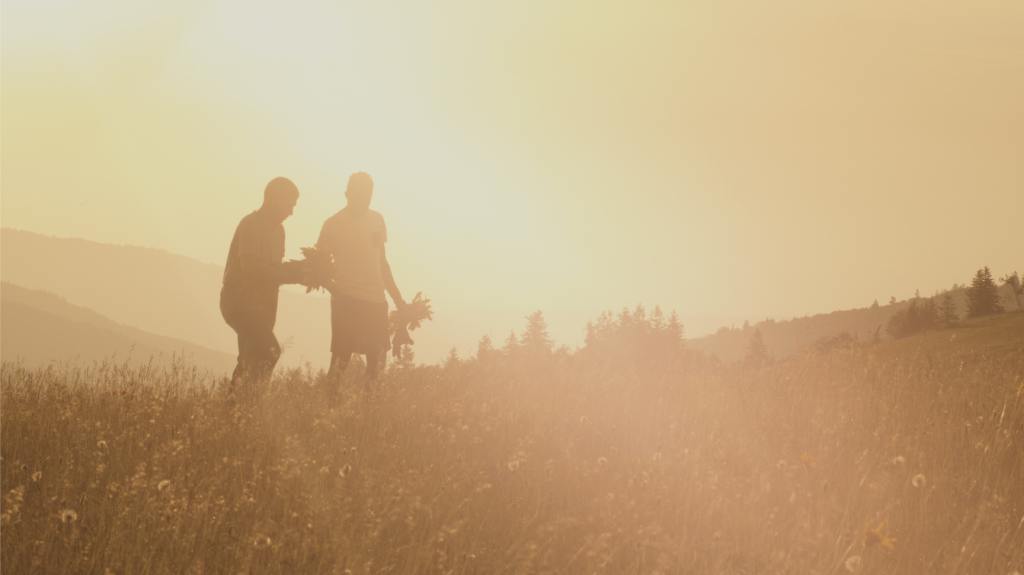
Photo by engin akyurt on Unsplash

Ancient Indian Christians

A stone cross in Kerala from the 600s bearing a Middle Persian inscription

No evidence exists for an apostolic mission to Kerala [S India]. However, considerable evidence shows that diplomatic relations, as well as a flourishing maritime trade, existed between the Roman Empire and the west coast of India. Thanks to knowledge of the monsoon winds, ships could cross the Indian Ocean between Egypt and Cranganore, called Muziris by the Romans, in less than two months. Pliny the Elder referred to Muziris as ‘primium emporium Indiae’ – the first port of India – and Strabo (63 BCE – 21 CE) reported that, every year, 120 ships linked the two continents together. The discovery of 2300 Roman coins from the period from 123 BCE to 117 CE testifies to the significance of this trading relationship.

The first historical witness to an autonomous Christian community in Kerala may be Pantaenus, who, according to Eusebius and Jerome, was sent by his bishop between 180 and 190 from Alexandria to India, where he encountered Christians. A century later Bishop David of Basra, mentioned above, traveled to India around 295/300, establishing the first official contact between the Thomas Christians of South India and the Church of the East. Then, around 345, one Bishop Joseph of Edessa – who, at the council of Nicaea, had signed as ‘bishop of all the churches of Persia and of greater India’ – visited Kerala.

Baumer, The Church of the East, p.26

Photo by Wikimedia Commons

Mercenary Dan

“I’m gonna invite you guys over for burgers, like I said. I make a mean American burger. But uh… well, you know how kids are always finding stuff?”

“Sure, they do find all kinds of things,” I responded into the phone, not sure what my friend was getting at.

“Well, I lost a hand grenade somewhere in my apartment. Don’t worry though. I duct-taped the pin so it’s not dangerous. But all the same, I’d hate for your kids to find it under the couch or something, you know?”

“Yeah, uh, that makes sense,” I responded, trying to sound normal.

How do you lose a hand grenade? Then again, I reminded myself that my friend Dan* was a mercenary. Everyone misplaces items from the office every now and then. Apparently mercenaries misplace hand grenades.

There are really only a few types of Westerners you run into in our corner of Central Asia. There are the missionaries, like us. The kids, collared shirts, and kind manners are usually dead giveaways here – as well as any proficiency in local language. Then there are some foreigners who are there only for business or adventure, but these tend to be a pretty questionable crew who can’t help but stick out by their awkward and sometimes scandalous conduct in the local culture. There are also the security contractors, the mercenaries. These former military types have their own dead giveaways. Cargo pants, scruffy facial hair, sunglasses, large muscles, and a kind of gnarled weathered look that comes from spending a lot of lot of time in the sun and in the dust.

The cumulative picture of this small foreign community is a bizarre one. Foreigners in Central Asia tend to eye one another warily from a distance, not sure whether they should interact, suspicious by default of what the other is doing in this desert on the other side of the world. One writer compared these expat dynamics to the desert moon of Tatooine in the Star Wars galaxy. Sure, there are some good guys scattered here and there. But most outsiders who end up in our corner of Central Asia are running from something, or are some kind of bounty hunter.

Dan and I met while I was out on a date with my wife at a local mall. He and his wife were at the same mall, spotted us as fellow foreigners, and asked us about the very restaurant that we were going to. Unlike most other expats, Dan didn’t seem standoffish at all. Instead, he was rather forward, even asking if they could join us for dinner. A split-second pivot from my wife and me had our date night quickly turn into an evangelistic opportunity with these new friends who seemed desperate for connection. Pro tip: date nights are hard to come by on the mission field, so only attempt this kind of move if you are absolutely sure you’ll be able to make up for it soon.

We sat down to dinner and began learning about their story. Originally from Portugal, Dan had been a gun-for-hire all over the world and had seen some truly terrible things. A serious injury landed him in Scandinavia, where his future wife nursed him back to health. They had been in our city for less than a year. Dan was working for a leader of one of the local militias, and his wife had gotten a job at an international school.

“I am the only person in the country with a license to open-carry a RPG!” Dan quickly let me know, proudly showing me the license itself. I was legitimately impressed.

As we talked, I learned that Dan swore like a sailor, was very proud of his Catholic military heritage, but really only believed in the power of weapons and the goodness of animals. He hated most people. But for some reason he liked me, and we began a unique friendship. Dan would tell me horrific stories of battle on behalf of corporations in African jungles. I would spiral the conversation in toward the gospel. Dan would eventually catch on, “How did you get me to talk about this again?” he would ask, squinting his eyes at me as if I were enacting some sneaky plan.

Dan would try to convince me that I would only be safe if I was packing adequate firepower. “I get it. You’re a Christian, you don’t want to kill people. How about a good shotgun? You wouldn’t have to kill them, just maim them with bird-shot! I can get you a real nice one at a great price.” I would shake my head and try to convince him that knowing the local language and culture and relying on local friends could get me safely into places Dan could never get into with his weapons. And that ultimately I was in Central Asia under God’s protection.

We got to share the gospel several times with Dan and his wife, including the time we facilitated a small wedding for them in the living room of the international church pastor. Turns out Scandinavian common law marriage is not recognized in Islamic societies that demand a certificate from an approved religious official. They were going to have to live separately, so we threw together a small ceremony for them and used it as another chance to point them to Jesus.

This meant a lot to Dan. And during the next security crisis he was sure to call me up to assure me that he had various options for armored convoys at a great price should our friends in another city need to evacuate. Then later on in the same crisis, he called me from the front lines, telling me that the news media was lying. Open warfare was taking place a couple hours from us, bodies were in the streets, in spite of the international media claims that it was just a “coordinated training exercise.” Now it was my turn to be grateful to Dan for alerting us to what was really happening when our own government and media were lying and trying to cover things up.

“Dan,” I asked him at one point. “There’s a little airstrip outside of town. If things got really bad and the airport were shut down, could you manage to hire some kind of Russian cargo plane to come in and evacuate us?”

“No,” Dan said. “I couldn’t do that… couldn’t do Russian, that is. I could get you an Emirati one though. But that’ll cost you. No friendship discounts there, ha!”

Eventually, though not surprisingly, Dan got kicked out of the country. Anyone with an open-carry license for a RPG is bound to get into serious trouble sooner or later. At the time of his departure Dan hadn’t yet professed faith in Christ. To my knowledge, he still hasn’t. He is one of many friends (though admittedly one of the more colorful ones) that God brought across our path for a short time and that we tried to share faithfully with. Even with our focus of reaching our Central Asian friends, we’ve never wanted to turn a blind eye to the gospel opportunities with others that may come about. Even if those opportunities are with those we never imagined we’d become friends with – like Catholic burger-cooking mercenaries.

Dan never found the grenade. We never had those burgers he promised. But given the strange way our paths crossed, I have a lot of hope that wherever he ends up God will bring him more believing friends who keep spiraling the conversation back to the gospel. And I pray that even mercenary Dan, who hates most people and has seen so much death, will one day be transformed.

*name changed for security

Photo by Sven Verweij on Unsplash

In Need of a Harvest Collective

The first neighborhood my family lived in when we moved to Central Asia had two names, the formal name and the name everyone used. I first came upon the formal name when I learned to read the street signs (which everyone ignored). It was not a word I heard anyone using, nor was it a term every local was familiar with. Eventually, I found a friend who was able to translate it for me. Even then I realized that there was no direct English equivalent. This is true of many individual words when learning a new language – you can translate them with a descriptive phrase but not with an individual equivalent word. In fact, releasing the assumption that every word must have a direct translation is an important step in the language learning process.

The name of the neighborhood translated to something like “harvest collective.” It was a village term, hence some of my city friends not knowing it. The villages in our corner of Central Asia are wise enough to know that no household can handle harvest time all on their own. Or perhaps wise enough to know that even if they can, they really shouldn’t. So, there is a rotation, a harvest collective, when on an appointed day the whole village shows up in a specific household’s field in order to provide them with the needed manpower and motivation to gather in the crops.

I liked the concept as soon as I heard of it. It reminded me of our newborn days when I realized that my young wife and I really couldn’t handle that season of postpartum and exhaustion on our own – and yet the very way society around us was structured encouraged isolation and often prevented receiving help from extended family or community. I remembered when our oldest two were toddlers and the never-ending household work my wife struggled to get to unless another mom in our community group came over to lend a hand. Or more recently, as most of my peers have become home owners, hearing about the difficulty these dads are having in fixing up their homes on their own.

While healthy churches in the West and community group structures are providing an avenue for some of this kind of collective help to happen organically (and praise God for this), my sense is that more robust structure and schedule is needed in order to push back against the overwhelming isolating tendencies of life in the individualistic West. We may have good and godly intentions to help that struggling young mom or that busy working dad, but those intentions may need an actual structure in order to translate into reality. Or to provide the kind of help that is less a one-off and actually serves for the long-term.

The idea would be for healthy church communities to borrow some cultural wisdom and implement “harvest collective” structures, where they recognize the kinds of labor a household can’t or shouldn’t do alone, and seek to regularly share that labor together. For example, a group of six men from the same church agree to become a collective together. One Saturday a month they agree to all show up at one man’s house in order to help him make some solid headway on his repair or renovation projects. That would mean twice a year each man is receiving help from five other brothers. Even if only for one day, that kind of help could go a long way. Young moms struggling with loneliness, fatigue, and the never-ending needs at home could set up a collective where they are regularly showing up to help one another, helping with not only the labor but also with the discouragement so prevalent in that season.

Westerners faced with this idea might feel an internal objection along the lines of “but we’re supposed to be able to handle this stuff on our own.” Yes, that is the overwhelming message communicated by Western culture, one which we have ingested from our youth. And it comes with a quiet side of shame for those who wrestle with why they can’t seem to figure it out – which happens to be the majority. An honest look at the loneliness, overwork, and rates of depression in Western culture just might indicate that we have some structural problems that require creative structural solutions. Non-Westerners might respond with, “But that’s the job of the extended family.” Yes, the extended family has played this role in many parts of the world. Yet the world is rapidly urbanizing, and with that comes the breakdown of the extended family’s ability to provide the same kind help it has in the past. Even more important than this is the fact that the Church is supposed to be the household of God, the new extended family for those kicked out of theirs because of their faith – or for those raised in a culture in which only a shell of the extended family remains. My Central Asian friends are the former. Many of my friends in the West are the latter. I would not be surprised if this kind of a group even lent the church an evangelistic power. “Wow, look at how those Christians take care of each other in the areas I feel so very alone in.”

The expressions may look very different than I have suggested here, but I believe the principle is sound. Like Central Asian villagers, believers would be wise to collectively serve one another in those kinds of labor which a single household can’t or shouldn’t be allowed to handle on its own. In societies that relentlessly drive towards an individualistic life, this will require intentional structures. And some humility to ask for help in ares the culture says we should be able to handle on our own.

After all, it’s not like the harvest collective in Central Asian culture has been there forever. At some point some exhausted farmer was probably sitting around drinking fermented yogurt water with his buddies and blurted out an honest confession that the harvest was simply too much for him and his kids to handle. At which point his fellow villagers must have come up with a wise plan. The kind of plan which just may be due for a revival of sorts.

Photo by Mathieu Bigard on Unsplash

A Song of Welcome

“The Welcome” by David Benjamin Blower

This is a simple but beautiful song based on two verses from Romans about believers’ love and welcome for one another.

Owe no one anything, except to love each other, for the one who loves another has fulfilled the law.

Romans 13:8

Therefore welcome one another as Christ has welcomed you, for the glory of God.

Romans 15:7

On Getting Your Kids to Stay in Bed

Some things are truly universal. Like kids that won’t stay in bed when it’s time to sleep, but repeatedly get up for drinks, bathroom breaks, random questions, stomach aches located in their elbows, etc. This aspect of children’s nature seems to be present no matter what culture you are looking at, usually accompanied by the raised eyebrows and sagging hopes of weary parents.

Cultures around the world have developed various strategies for dealing with this problem. Until recent times, it seems like one of the most common strategies has been to use the fear of some kind of monster as a method to keep those relentless kiddos in their beds. A child’s imagination is a powerful thing. And they are dependent on their parents for their primary understanding of reality. So it makes sense that some kind of bogeyman-by-night would be an effective tool to enforce bed times, a sort of evil cousin of the tooth fairy or Santa Klaus. Even more powerful would be if you could tie said creature to some kind of sound in the real world to add some “evidence” backing up this parental ruse.

In our corner of Central Asia, the creature of nightmares in fact turns out to be basically a giant rolling pin. Traditional roofs are made of packed mud and are flat. The way these roofs stay waterproof is by means of a large cylindrical stone, about the size of a big fire extinguisher, with a hole through its middle by which it’s fastened to a long wooden handle. After a rain, a man of the household would go up on the roof and use the Roof Roller to keep the mud roof compact, hence keeping it waterproof for the next rain. The sound of the Roof Roller as it is pushed and dragged across the roof would echo down into the house itself, providing the material needed to strengthen the grown ups’ sleep enforcement method.

“Can you hear the Roof Roller? It is on our roof, very close now. It eats children who do not go to sleep when their parents tell them to!”

The effect on the little ones is not hard to imagine. The crazy thing is that generations of children that grew up traumatized by fear of being eaten by the Roof Roller would go on to eventually be enlightened (“It’s… just a rolling pin?!”), then repeat the same method with their children, finding it quite funny, even. Humans are strange creatures.

It’s only in this generation, the first to be raised mostly with concrete roofs, that children are no longer terrified of the Roof Roller. Unfortunately, parents now have swung so far from the practice of their ancestors that they no longer enforce any bed time at all. They are amazed that our kids mostly obey us when it’s time for bed and only emerge from their blankets a few times for the things they “forgot” during the bedtime process. The most popular method of local child discipline currently is basically a form of anarchy – or you could call it kindergarchy* – where Central Asian toddlers are free to stay up as long as they want, drinking chai, screaming, and watching YouTube, until they eventually fall over, overtaken by sleep at last. At which point their relieved parents pick them up to plop them on their respective floor mattress. Given this philosophy, it’s not surprising that locals are having fewer and fewer children. Most of my peers grew up with large families, often having enough siblings to field a full soccer/football team. Young, shell-shocked families now are stopping at only one or two.

Needless to say, if your kids are having trouble staying in bed, I would not recommend scarring them with tales like those of the Roof Roller. Nor letting them run wild until they collapse from exhaustion at 2 a.m. There are better ways. How about some wise boundaries and kind, but firm enforcement over thousands of consecutive nights? It’s not easy, but in the end it is easier than what comes of children raised with no boundaries, or those raised by fear of bogeys and Roof Rollers.

Discipline your son, and he will give you rest; he will give delight to your heart.

Proverbs 29:17

*meaning rule by children, a truly terrifying state of affairs

Photo by Hasan Almasi on Unsplash

A Proverb On Betrayal

When the axe handle was a branch of our own, we have come to the destruction of our home.

Local Oral Tradition

This local proverb speaks of betrayal from a group member using the imagery of an axe cutting down a tree, when the handle of the axe is, in a perverse turn, shaped from a branch of that same tree. This is actually pretty good imagery for what betrayal feels like. This saying also acknowledges the great fear and destruction likely to come upon a family when betrayed by one of its own. It is one kind of danger to be attacked by outsiders. It is another thing altogether to have the attack come from within. Anyone in ministry who’s ever dealt with a wolf among the sheep knows this danger, and likely shudders when recalling it.

Tragically, our focus Central Asian people group has quite the history of betrayal and treachery. It is one of the besetting sins of the culture that will need to be weeded out by the new gospel culture established by the Church. In the meantime, it is one of the thorniest factors often preventing churches from taking root. It’s hard to keep a group going when group members are regularly tempted to sell one another out for money, influence, or other personal advantage. The presence of actual spies – regardless of who they are working for – really doesn’t help either.

I’m not a huge fan of the “Why didn’t I learn this in seminary?” complaint. Seminary isn’t designed to cover every specific problem that might crop up in ministry. However, I will say that those heading into ministry could certainly use more training in how to deal with betrayal of the church – a practical theology of wolves, as it were. At least as Westerners, we are so optimistic and believe-the-best in our bearing that we can get caught woefully unprepared when a divider and traitor emerges. Betrayal from within doesn’t have to mean “the destruction of our home” as the proverb says, but if we pretend it won’t happen to us we greatly increase the chances of this indeed being the outcome.

When faced with a traitor, we have the great advantage of having Jesus’ example as he was betrayed by one of his closest followers. The presence of Judas, and Jesus’ interesting toleration of him, helps us know that betrayal is not only to be expected, but can be overcome and even used in God’s glorious plans. The church in Ephesus is also a helpful case study of dealing with wolves (Acts 20, Rev 2). If we let these examples inform our expectations of ministry, that will help. They can steady us in the great fear and disorientation caused if a betrayal occurs. And keep hope alive that no matter the level of destruction caused, treachery will not have the last word. The tree, as it were, may be cut down by the axe, but its downed fruit may just plant an orchard.

Photo by HamZa NOUASRIA on Unsplash

As Slow As It Takes

When we came to the field we thought that we were already on the slow track when it came to leadership development. Many popular missions methodologies advocate handing over significant authority to new believers very quickly, within a matter of weeks or months. Some even have unbelievers facilitating and leading Bible studies. These methods teach that the upfront direct leadership of the missionaries keep the local church planting work from multiplying and keep it dependent on the expert outsider. So, the direct involvement of the foreigner is kept to an absolute minimum, and leadership responsibility is handed over as quickly as possible. What of the biblical qualifications for elders/overseers/pastors? Often a new title is used to skirt these requirements, such as “house church leader.” It’s true, Paul never explicitly says that a house church leader/facilitator/trainer can’t be a new convert. Alas, play with language enough and you can get around just about any otherwise clear verse of scripture.

In this kind of atmosphere, we knew that we were in the minority with our conviction that we needed to spend three to four years pouring into local men before they would be ready to lead. This conviction came out of the desire to be faithful to leadership standards laid out in 1st Timothy 3 and Titus 1. They also came out of ministry experience in our own culture where it really took two to three years to truly know a man’s character. We added on a year or so to account for the difficulty of “seeing” character through a foreign language and culture. Our context in Central Asia had also already experienced several waves of church planting implosions. One dynamic that was present in all of them was local leaders who were given position and authority apparently before their character could handle it. The Central Asian tendency toward domineering leadership combined with a Western missionary culture terrified of being paternalistic and the toxic brew that resulted poisoned many a promising church plant. We came to believe that three to four years would be necessary to push back against this tendency toward domineering leadership and to model instead a humble, servant leadership. If we were viewed as paternalistic by other Westerners, then so be it.

The fascinating thing is that even our slow track was not nearly slow enough. A couple years ago I heard a Central Asian pastor from a nearby country being interviewed. He was speaking of the tendency Western missionaries have of giving a church planter salary to local believers way too quickly, and in a way that sidesteps the local church that might already exist and may have important insight into why that brother is not in a position of leadership yet. This pastor spoke of the slow labor of love it is to see a Central Asian new believer mature to a point where they can handle leadership in the local church.

“In our years of ministry here, we have seen it takes about seven years for a new believer to be ready to lead,” he said.

Then he continued, smiling, “It took Jesus three and a half years with his disciples (and they were still a mess). Why should we in Central Asia be surprised if it takes us twice as long as it took Jesus?”

This pastor’s experience and logic stuck with me and I began interacting with veteran workers and other faithful pastors from Central Asia and the Middle East on this question of timing. What I found was a general agreement among long-term workers (usually those who had experienced a church plant implosion or two) on the wisdom of this kind of seven-year perspective. The response from local pastors was even more vehement.

“Yes! Foreign workers always appoint men as pastors and leaders who are not ready! This is damaging the church severely. Please take the time necessary, perhaps seven years or even longer, to make sure these men are faithful.”

This feedback fits with our own experience in our local church plant. By three to four years in, the men who came to faith out of Islam were indeed growing tremendously in their biblical knowledge and even in their ministry ability. But it was the character piece that kept emerging as a red flag. Tragic immaturity in interpersonal conflict, a willingness to lie when convenient, a buckling under persecution, a tendency to excuse certain cultural sins – these sorts of issues kept putting the pause button on our team discussions about moving these brothers into more leadership.

We could see these things because we were interacting with these brothers in their local language and involved with them in a life-on-life discipleship. Had we taken a more hands-off approach (non-residential, not in the mother tongue, Westerner not leading) advocated by much of missiology, we would have been unable to see these character issues clearly. And we would have appointed these men as pastors or given them pastoral authority, perhaps without the official title. As so often happens, we would have promoted a man in the “potential leader” category to the “qualified leader” category prematurely. And we would have put him in an extremely dangerous position.

Instead, we learned that for the sake of the church, we needed to go twice as slow. Has this been frustrating and discouraging at times? Absolutely. Many of us cross-cultural church planters are more gifted as evangelists and starters and find ourselves now in temporary pastor-shepherd roles that feel a lot like two-to-three-years for a decade. But what else is to be done? Shall we continue to take shortcuts around the biblical requirements for a leader’s character so that we can get back to the ministry we feel more gifted at? Should we continue the pattern of appointing men who are not ready, only to see their lives implode and their churches fall apart? What of the pressing demands of lostness around us? Can this kind of time-consuming investment in the local church be justified?

We must be willing to go as slow as necessary in order to see faithful local leaders raised up. We can only do this by trusting God with the timing, the adjusted expectations, and the weight of the lostness around us. We need to remember that the existence and health of Christ’s church is not in opposition to his plan to reach all peoples. In fact, the healthy local church is God’s means of reaching all peoples. Or are we imposing our own arbitrary timelines on God’s plan to reach a people group? The promise, after all, is for a believing remnant from each people in eternity, not that we will saturate a people group with the good news in our own generation. Should we aim for gospel saturation? By all means, but not as a promise and not at the expense of laying solid foundations for the local church. To do so would be to try to fight a war and to ignore the need for supply lines. As those who study warfare say, amateurs talk strategy, professionals talk logistics. An army is not judged by its ability to make a strong initial attack, but by its ability to sustain that attack until victory is achieved. And that involves a lot of less-than-exciting long-term planning, training, and preparation.

It may take a minimum of seven years to see faithful leaders raised up in Central Asia. It may take less, or more, in another unreached region. Are we willing to surrender our own expectations and dreams to see faithful men entrusted with the truth? May we not only be willing to go fast for the kingdom when necessary, but also to go slow, as slow as it takes.

Photo by Bogdan Costin on Unsplash

Sovereign Over Schizophrenia

Fifteen years ago he was the most gifted evangelist in the city. A passionate, funny, and winsome young man who almost single-handedly filled a house church with new believers, mostly other Central Asian young men. Adam* had come to faith after a discouraged house church pastor had shared the gospel with him in a tea house. That night he’d had a dream where Jesus handed him a white stone with something written on it (he had not yet read Revelation 2:17 at this point). Adam and this house church pastor would go on to reach dozens of other locals together. Adam was the persuasive gatherer, and the pastor the articulate shepherd-teacher.

During my gap year in Central Asia, Adam and I became fast friends, and even brothers. We talked of someday working together to see the gospel spread like wildfire in the region, then settling down as old men in his ancestral village, with our families living next door to one another.

Then I returned to the US to finish university. Adam fled to the UK, claiming death threats and persecution. I wrote a letter to a judge vouching for Adam’s story and his faith, and he was granted asylum status. We stayed in touch off and on during my seven years in the US, but it eventually became clear that he was not doing well. The love of the world and the heady freedoms and prejudices of life in the West began to choke out his faith. For a few years he ran hard after girlfriends, weed, and worldly success. Even from a distance I could tell that he wasn’t gathering regularly with other believers, despite his evasive answers. I chewed on the idea of visiting him in the UK in order to try and influence him back toward spiritual health. But it never materialized.

Eventually I moved back to Central Asia and got back in touch with Adam. At this point I started to notice that something was very wrong with the way that Adam was interpreting reality. He started regularly speaking of being watched, followed, and foiled by secretive government plans designed to keep him from achieving his full potential. He spoke of being someone with the ability to overthrow governments, to lead revolutions if he were only given the chance. And because of this, he suspected that secret agents were all around him, drugging his coffee and trying to drive him insane or cause him to give up on his destiny. Most Central Asians are vulnerable to conspiracy theories, but this was different. This was not just claiming that Israel created ISIS for its own schemes, but rather the kind of beliefs that were starting to make my friend deeply dysfunctional in his daily relationships.

During this time he never denied his faith, and when I would press him strongly he would admit that deep down he still clung to Jesus as his only hope. But it was clear to me that his version of reality had shoved Jesus far into the periphery. I remember a number of conversations where things got pretty heated as I called him on his abandonment of Jesus, and on his abandonment of his brothers. But these conversations never had their desired effect. Over time I noticed that any time we got close to an area where he might feel guilt or shame, the conspiracy talk would come out and take over the conversation.

Eager to help my friend, I tried to connect him with a solid church in the UK. This failed, so I worked to get him back to Central Asia, hoping that face-to-face believing community would help him recover and heal. By borrowing money and calling in favors from strangers and his few remaining friends, Adam eventually returned to his hometown in Central Asia. This return, however, did not have the effect I had hoped for. I’ve seen few with reverse culture shock as bad as Adam had it. For a time, he positively hated everything about his native culture and city. And the locals in turn mocked him and viewed him suspiciously.

My attempts to have him rejoin a family of believers failed also. Adam freaked people out. He had forgotten how to conduct himself respectably in his own culture and then as soon as the conspiracy talk came out people wanted nothing more to do with him. He wore a haunted look of bewilderment in his eyes, a mischievous smile, and a scraggly beard. His jaw regularly locked and tensed and he was losing teeth. This appearance didn’t help matters. He further confused people by telling them that he was actually an American, not a local at all.

My pleas with other believers to help him mostly fell on deaf ears or were met with apologies for not feeling like he was safe enough to have around. It began to dawn on me that Adam wasn’t healthy enough to be a part of a church made up of those from his own culture. He just kept using, burning, and offending the people that I introduced him to. Maybe he could find a home in an international church? Yet even there it became clear he wouldn’t be able to stabilize enough to find the community I was sure he needed.

Even around my own family, he had no discernment about what was not appropriate to talk about around our small children. I remember pleading with him to cut out all the dangerous political talk against the local authorities if he wanted to be able to hang out with my family. In a society where people are disappeared or assassinated for speaking out against the ruling politicians, I couldn’t afford for my family to be collateral damage for his subversive talk. Finally I had to make the decision that he and I could only meet outside the home, one on one.

All of my attempts to help Adam distinguish reality from the reality of his own mind’s making came to naught. The more I pressed directly to help him see he was believing lies, the more he doubled down on his own private reality. Even the indirect approach, where I didn’t push back against his perceptions, only worked until he felt guilt or shame, or until another conflict with his family would send him spiraling. I was one of his last friends left, and the yet the costs of our friendship were mounting. I had a church planting role to be faithful to, and I could precious afford the time it took to walk with a friend with this level of need and mental illness. This was especially so because it needed to be time spent isolated from other believers.

Eventually, we learned that Adam was most likely suffering from paranoid schizophrenia, a diagnosis which if correct meant that there was very little we could do for him. His reality was one in which he was always tracked, always outmaneuvered, always kept down from achieving his destined greatness. No matter what I tried, I couldn’t help him to step outside this mindset, to step back from this view of reality and examine it to see if it was true or not. It was his mind’s experience and I learned what many others before me have also experienced – that it is next to impossible to convince someone that their experiences are sometimes not actually real.

We continued praying for Adam’s healing for years. Sometimes he would come around and seem to be doing better. Other times we wouldn’t communicate for months on end, usually following a hard conversation where I felt like I was losing my friend for good. After a Christmas Eve dinner this past year that went about as well as could be expected, Adam and I didn’t see each other for ten months. I never intended it to go that long. I knew that I was one of his only friends left. But Adam seemed to be beyond my reach, and I was no longer sure that my friendship was indeed helping. I was also tired of the sadness in my heart caused by the degeneration of my friend and brother.

We ran into each other several weeks ago at a hole-in-the-wall kebab place in the bazaar. It was a little awkward, but I was genuinely happy to see him again and asked him if we could hang out soon. I needed to share with him the news that we were leaving the country for some time for medical needs. So we arranged a time to meet up. I went into the meeting expecting the same dynamics – the grandstanding, the talk of big plans, the triggered defensiveness. I had no idea I was about to witness a remarkable answer to prayer.

I met Adam near a park and we walked together into a neighborhood with lots of hip cafes and restaurants. Adam wanted to introduce me to a new sandwich shop, one where he claimed to have had an amazing meal of avocado toast. While I found this amusing (just how did the cliche Millennial avocado toast manage to make it all the way over here?), I went along with Adam. His mental illness had never impaired his skill at finding new food and coffee joints that were, in fact, excellent.

It was while we were standing at the counter, waiting on our sandwiches, that Adam started telling me about how things were much better for him now. I listened, prepping myself for the grandiose plans I expected Adam to share with me next. Instead, he told me he had had a breakdown about a month previous, something he claimed was a psychotic episode. Very dark thoughts of self harm had led to him walking to a coffeeshop to calm down. Then, while drinking an americano he’d started feeling a strange sensation crawling up the back of his brain. His brain started feeling like it was tingling and fizzing all around, and this feeling continued for an entire week. Afterward, he had sought out counsel from a neurologist, had done some research, and was suddenly able to see his mental illness as such for the first time ever.

I started leaning in as Adam shared this story with me. This was different. He was actually able to use one part of his mind to step back and view the other part of his mind, observing its patterns of paranoia and knowing that they weren’t ultimately true. He had never been able to do this before, at least not for the previous 7 years.

As my avocado toast arrived (he was right, it was delicious), Adam kept sharing with me about his new-found self-awareness. He had quit coffee since he realized it had become his substitute for weed and had greatly aggravated his paranoia. He could now see how so many of his grand plans and feared conspiracies were only his mind’s strategies for dealing with deep shame. He was even content to take the trash out for his mom, knowing that even if he lacked the opportunity to do bigger things, something as small as that was still valuable and significant. He was back in a rhythm of daily prayer, telling me that it was only the love of Christ that had sustained him through his long exile from reality. He asked my forgiveness for sometimes believing that I was part of the grand conspiracy against him.

I finished my avocado toast, amazed at what I was hearing. Could I dare hope that God had at last answered prayer and provided some measure of healing to my friend’s mind? Does it ever happen that people with paranoid schizophrenia come back from the brink this side of the future resurrection? Yet it seemed undeniable. Whatever had happened to his mind when it fizzed and popped for a week, Adam was now able to see reality in a clearer way – and to notice the unhealthy pull of his other reality. The sandwich shop had messed up his order, and Adam told me that he noticed his brain wanting him to believe that it had been on purpose, just another part of the plan to foil him at every turn, to keep him down. But remarkably, he had noticed this and had successfully pushed back against that narrative, instead choosing to believe reality, that the mistaken order had been just that – an honest mistake.

Adam and I talked for another hour or so. I encouraged him to gently try to reenter believing community. I decided to take a risk and invite him to my son’s birthday party the next day. Many of the local and foreign believers would be there. I was eager to see if Adam would behave differently in that kind of a group setting than he would have previously. Adam agreed to come. He was eager to bring my wife a gift in recognition for all the food and coffee she had made for him when he was still trapped “in his shell,” as he put it.

Adam came to the party and didn’t freak anyone out. He actually made a lot of people smile and laugh and I caught glimpses of the old Adam, one of my best friends, the most gifted evangelist in the city. It’s not that there isn’t still a strangeness to him. A decade of severe mental illness will leave its scars. But unbelievable as it seems, somehow he has been pulled back from the brink, and God has given him back his mind. I shook my head as I saw him exchanging numbers with other men at the party. I prayed that the change would be lasting, and that healing would continue. Perhaps Adam will once again be an active member of a local church, sharing the gospel in the tea houses, inviting others to follow Jesus with him. Perhaps he will be of sound mind enough so as to be a healthy member again of a spiritual family. That would be a stunning answer to prayer. Even though we shortly afterward left the country and he was on his own, Adam reached out for the info and attended the international church service this past weekend.

I know God doesn’t always bring healing in this life to those facing severe mental illness. Many genuine believers even will be overtaken by the fog before seeing the face of Jesus at their appointed time of death brings sudden light and wholeness. But I feel as if I have just witnessed one of those instances where God reverses the natural order of things. My friend’s paranoid schizophrenia, his partial living in a reality that is not real, has been suddenly robbed of its power and control over his mind. I don’t understand how it happened, but I rejoice nonetheless.

Don’t stop praying for those that you love who are lost in the fog of mental illness. Even as they become risky to be around, work to keep the lines of communication open, if possible. I have just witnessed a brother I had nearly given up on supernaturally rescued, a friend restored. Oh, how I wish it had happened sooner, not right before a long separation like this. Yet I am simply astounded at what God has done for my friend. May our faith be strengthened that he is sovereign – even over schizophrenia.

*names changed for security

Photo by Mario Heller on Unsplash

Broken Bodies, Better Infrastructure

We just traveled back to the US for a medical leave. Once again, when crossing worlds from Central Asia to the States I was struck by a peculiar flipping of the condition of bodies and infrastructure. I wanted to write about it while the contrast is still fresh to my eyes, knowing that sometime in these first weeks I will lose that ability to notice the stark contrasts as my immediate surroundings register in my brain as the new normal.

For an interesting experiment, ask those who are newly visiting or moved to your area what jumps out at them, what their senses and mind can’t help noticing. It’s a reliable way to get fresh perspective on your immediate surroundings – surroundings your mind has already lost some ability to “see” as they have become the proverbial water the fish is surrounded by.

In short, when traveling from Central Asia to the West, the bodies get more broken, while the infrastructure gets less so.

The shift in infrastructure happens quickly. Most of the building supplies and goods available in our corner of Central Asia are a lower level of goods made in Asia for export to the developing world. You have goods made in China for the West. Then you have goods made in China for places like Central Asia. These are not the same. Disposable plates crumble into your kebab, headphones bought in the bazaar last a week and zap your ears with electric current, playground equipment cracks and warps. While Central Asian culture cares more for a certain sheen when it comes to its infrastructure – such as shiny door knobs and fancy ceiling panels – shortcuts in quality mean things fall apart remarkably quickly. One starts longing for solid everyday things – like toilet seats – that would actually last for decades. Yes, the quality of toilet seats does indeed have serious implications, and is one area where you very much want to get the Made-in-China-for-the-West variety.

Essentially, the infrastructure gets firmer as you transit through the Middle East to the West, getting broader, thicker, and simply less easily broken, culminating upon arrival in the US where even the luggage carts look like they have been working out, compared to their frail foreign cousins. You may catch yourself admiring a metal fence and wondering about the foresight of those willing to spend so much money on something so solid. Buy once, cry once, as a wise American deacon once said to me.

The human bodies seem to move in the opposite direction. In general, the population of Central Asia is on the younger side. The “baby boom” peak of our local area are those born in 1990. The diet is also significantly healthier. Fresh fruits and veggies are cheap and a central part of the local diet. As are fresh yogurt and pickled veggies, full of good probiotics. This seems to balance out all the bread, oily rice, and sugary chai locals consume on a daily basis. While some of the younger generation is being raised on fast food and beginning to develop obesity, most of the population would be in healthier weight ranges. Fathers and Grandpas typically have a bit of a stomach, good for resting their chai saucer on. Mothers and grandmas end up naturally a little heavier as they age, bearing children and caring tirelessly for the household. In short, bodies develop and age in a way that has been typical for much of human history.

However, moving Westward means moving into a world where the bodies are significantly more broken. Weight and diet are a big part of this (why are fresh veggies so crazy expensive in Western societies?), but are not the only one. It seems like a strange disrespect for the body accompanies the West’s public infatuation with model-standard physicality. When you’ve lived outside North America and reenter, it’s not unusual to be hit with a sense that something is deeply wrong with our body culture when getting on that first plane with other Americans, or when being hollered at by that first wave of TSA agents. It’s as if in the West we either worship our bodies and fight to preserve their youth for as long as we can, or we come to neglect and hate them. I myself have struggled with a spiritual form of this neglect, believing for many years that I could ignore the body if I was sacrificing it for ministry. My struggle is easier to hide than many of my fellow Westerners, since I atrophy when I neglect my health, rather than putting on weight. But we share in the same root malady. Something about the Western experience has caused us to believe we are no longer actually embodied.

Along with this, the West is also aging. The average traveler in American airports is at least middle-aged, if not older. There are very few children in Western airports. And those that you see are usually those of immigrant families from other parts of the globe. Even flight attendants and airport staff have a different posture toward children, with those of Central Asian or Middle Eastern culture being far more likely to happily accommodate the needs of those with little ones, whereas Western staff are not unlikely to find such families an inconvenience. It goes without saying that older bodies are more broken bodies, although this is a more natural brokenness, as opposed to that caused by the Western lifestyle.

The bodies get more broken, while the infrastructure gets less so. I notice these things not really knowing what they fully mean. But for a student of culture, the path toward understanding significance starts with observation, and then a long-term chewing on those observations until clarity suddenly drops. At the very least, noticing these weaknesses of culture keep us from an unhealthy pride in either one. Every watered valley has its jackal, as one of our local proverbs wisely says. Post-fall, our brokenness will manifest not only on the individual level, but also on a scale culture-wide. This should sober us and keep us from both culture despising and culture worship.

There may be cultures that have the moral capacity in this age to care for the physical body as well as well as the quality of the things we build around us to serve the body. Unfortunately, these things seem to currently be a trade-off of sorts. For now, it’s for the Church to seek to model this kind of stewardship, strangers and exiles though we are. For though the temporary physical things of this world will pass away, we are still to plant gardens in our Babylon. We do this freely, knowing that we have a city, and bodies, that are coming and that will last forever. Long after the finest body – or luggage cart – has turned to dust.

Photo by Grimur Grimsson on Unsplash