A Practical and Powerful Bible Tool For Every Christian With a Smartphone

There are certain tools and resources that have passed the longevity test. These tools have proven useful, not just for a season, but for the long-term. I want to recommend just such a tool today.

The Compare feature on Youversion’s Bible app is the kind of tool I have used countless times over the last seven years in order to read scripture side by side with speakers of other languages. This Bible app doesn’t just provide scripture free of charge in 1,950 languages (Which is a stunning thing in itself. Can you imagine Tyndale’s reaction if he knew we had Bible access like this?) But it allows a reader to work through an entire passage in multiple languages side by side, with the texts parallel to one another on the screen of your smart phone or tablet. In our multilingual world, this is an extremely practical tool for Christians eager to share the truth of Scripture.

You can use this feature if you are sharing the gospel with someone from another ethnic or language background and want to make sure the individual verses you are sharing are clear. Instead of only showing your friend a verse in English, you can at the same time be showing it to them in their mother tongue (And in this way also know that you are indeed showing them the verse you mean to). Or, you can use this tool in a Bible study with others as you work through a broader passage, one parallel verse at a time, again, having two or more languages in front of you on your phones’ screens for the sake of clarity and understanding – both yours and theirs.

I have also used this feature to continue growing in my knowledge of other languages. Since I’m very familiar with the text of the Bible in English, it’s an easy way to learn new vocab and grammar in another language. And I’ve recommended this practice to many of my English students as a way to expose them to the Bible while they strengthen their English skills, one parallel verse or passage at a time.

This kind of practice not only helps with language acquisition, but also with language retention. Like our physical muscles, our languages need a little bit of regular exercise in order to not atrophy. A few Bible verses a day keeps that language’s part of the brain online in a surprising way. In this vein, whenever I listen to a sermon I have the Bible app’s Compare feature open in front of me for this very purpose. I’ve found the act of code-switching between Bible languages during a sermon helpful both for the insights as well as the questions that emerge.

What if you are aware of a Bible translation that exists, but it’s not included in the 1,950 languages currently on the app? Youversion provides a form for it to be added (Click My Language is Not Listed on the drop down menu and they’ll get back to you). Several years ago I filled out the request form, asking that the trade language translation I grew up with in Melanesia be added to the app. To my surprise, after a few months, there it was. I could now read the Bible in English, my Melanesian trade language, and my focus Central Asian language side by side. This is a true gift because it means that even if I’m the only one in Central Asia who speaks that particular Melanesian tongue, I can not only keep my knowledge of it alive, but even be edified by the Word while doing so.

I was recently speaking with a missionary friend who didn’t know of this tool, so I wanted to put it out there in case it might serve others who are involved in sharing truth across language barriers. For so many, the realities of immigration now mean that even without leaving our home nations we have neighbors, community businessmen, and fellow classmates from other nations. Few immigrants and refugees ever have anyone from their host nation ask genuine questions about the language they spoke growing up. And many speakers of other languages have no idea that the Bible has been translated into their language. This then can be a great way to invite someone into reading God’s word. Ask about their mother tongue, show them that you have a Bible in their language on your phone, ask them if they’d like to have it on their phone also, then invite them if they’d like to meet up another time for coffee or tea to read some together.

Our team in Central Asia has been able to “distribute” dozens upon dozens of Bibles in this way, with some of them being downloaded the very first time we meet someone and get into a spiritual conversation with them. For long-term or short-term teams, or for any Christian eager to share the Bible with others, this really is a tremendous tool for getting scripture into people’s hands, and for reading it side-by-side.

If you want to use this Compare feature, here are the steps:

  1. Dowload the Youversion Bible app from the App Store or Google Play.
  2. Set up a free account on the app.
  3. Click the Bible button on the menu at the bottom of the screen.
  4. At the top of the screen, choose the passage and English translation. This version will be your default until you change it.
  5. Tap on a verse to select it.
  6. Click on the Compare button from the menu that will pop up when you tap on the verse.
  7. At this point, only the selected English verse will appear on the screen. Click on the Add Version button at the bottom of the screen.
  8. Click on the Language button at the top of the screen in order to select versions in other languages.
  9. Click the magnifying glass button at the top of the screen to search the 1,950 languages.
  10. Tap the language you want.
  11. On the next screen, tap on that language a second time in order to add it to the Compare page.
  12. You should now see the verse you selected in your chosen languages side by side on the screen. Click on the Next Verse or Previous Verse buttons to navigate through the chapter.

I hope you find this tool as practical and powerful as I have. And to the team at Youversion, my sincerest thanks.


Why Americans Don’t Trust Sad People

Americans don’t trust sad people. Daniel Nayeri makes this insightful observation in his hilarious and heartbreaking memoir, Everything Sad is Untrue. As an Iranian refugee, it makes sense that Nayeri would notice this. Because in the Middle East and Central Asia, the opposite tends to be true. They don’t trust people who are overly happy or optimistic.

This tendency to trust (or not) tends to be reflected in which kind of stories end up being most popular. For a story to be truly great, most Westerners want a happy ending. The good guy almost always wins in the end. But Central Asians call for a tragic ending in order for a story to achieve true greatness. The Western movies my Central Asian friends like the most are Titanic (where Jack dies of hypothermia), Braveheart (where William Wallace from disembowelment and beheading), and Forrest Gump (Where Jenny dies of AIDS). As for movies made in Central Asia? Dark endings. Almost all of them. I think I’ve only ever seen one with a happy ending.

This orientation toward tragedy vs. comedy seems to reflect the deep-down worldview beliefs of each culture – what each feels is most true about real life. Westerners really believe deep down that life will have a happy ending, that if we just believe and try hard enough, everything’s going to be alright. Central Asians really believe that no matter how good things get, it’s all going to end in tragedy, just as it always has.

Even our histories tend to strengthen these worldview narratives. Think of the meteoric rise of the power of the Christian West over the last 500 years. Then consider the incredible decline of the power of the Islamic Middle East and Central Asia. 1,000 years ago, the centers of global wealth and culture were not cities like London and New York, but Baghdad and Samarkand. Perhaps back then the Europeans would have been the pessimists, and the citizens of the Silk Road those who believed in rosy endings.

When you meet someone whose bearing contradicts the primary narrative of your culture, you tend to distrust them. This is because they seem to be out of touch with reality. Many a Western aid worker arrives in Central Asia bright-eyed and bushy-tailed, believing that with just a little bit of money and some fresh ideas transformation can be a simple thing. Meanwhile, locals just shake their heads at this naive foreigner, knowing that for all their frenetic activity these Western plans will be about as effective as a dirt clod thrown at a passing tank. I have had countless conversations with my friends and students in Central Asia where I’ve been dumbfounded by their lack of belief in the possibility of change, while they in turn are dumbfounded that I actually believe real change is possible.

The West, for its part, and especially America, traditionally believes in the inevitability of progress. And we are deeply committed to the belief that things really will work out for those who work hard enough. Successful people function as our prophets and idols, the ones who confirm for us what we already believe – that the story of life ends in happiness. So we find ourselves uncomfortable with sad people, with those whose lives seems to be a relentless movement from one season of suffering to the next. We don’t trust them to be prophets of the way things really are. We don’t want to.

Biblically, both cultures are wrong, and both cultures are right. The ending of history will indeed be good – yes, as good even as resurrection. But resurrection is impossible unless preceded by death. It’s got to all die before it can all come back to life. Creation must groan, and painfully so, before the revealing of the sons of God. As such, Proverbs and Ecclesiastes go hand in hand. The wheat and the tares grow together. Suffering and death are inevitable. Hell is real. But eternal life is also inevitable for those who entrust themselves to the one who suffered and died – and now lives forever.

Paul speaks of us as being a people who are “sorrowful, yet always rejoicing.” This means that Christians are those who can be fully awake to the grief and suffering of life, and those who can also be fully awake to the joy and delight of it. This means that a Christian who is shaped by the Bible’s view of reality is one who can be trusted by both kinds of cultures, the optimistic West and the pessimistic East. We know the depths of sadness. So we are not dismissed as naive. But we also know the heights of true hope and joy. So we are not dismissed as fatalists. We are, in one sense, Western and Central Asian at the same time. Or at least we should be.

And yet I find myself very lopsided. I have some idea of what it means to be always rejoicing. But what might it mean to be always sorrowful? And can it be that faithfulness in this age actually involves both at the same time? What might that look like when it boils down to things like daily spiritual disciplines, church services, and our “How’s it going?” conversations with other believers? I at least still have a ways to go in learning how to faithfully lament, not just with my mind, but also with my heart and emotions. I still have a hard time trusting sad people, in spite of spending half my life in cultures where grief and sadness are far more acceptable than here in the US.

Yet I have tasted aspects of this at funerals, when laughter comes easily during stories told of a departed loved one. Or at weddings or concerts, where joy and beauty are so strong they lead to tears. I felt it yesterday at a poetry recitation at my kids’ school. The kind of joy that makes you serious, as Lewis once put it. Joy and sadness intermingled, and something that feels so very right about this.

Americans might not trust sad people. And Central Asians might not trust happy ones. But believers from both worlds have come to trust a man of sorrows who is also the embodiment of purest joy. He holds both perfectly together at the same time, always able to weep with those who weep and to rejoice with those who rejoice. He does this authentically, with no whiplash or disjointedness. He can show us how to laugh and cry at the same time, welcoming both with hearts that are somehow more whole for their embrace of these seemingly-opposite postures.

As we draw near to him the promise is that we will become like him. And that will make us also those that sinners come to trust, whatever their cultural bias. Not because we are so impressive, but because we are the ones who are the most real, those who walk in the truest story. One where grief and joy also walk, hand-in-hand.

Photo by Danie Franco on Unsplash

The White Martyrdom

…by century’s end Isidore was building a real library in Seville, which consisted of about fifteen presses (or book cabinets), containing perhaps some four hundred bound codices, an amazing number for the time. The only other continental library known to us in this period was in Calabria [S. Italy] and the fate of this library is lost in the blood and smoke of the sixth century. Gregory of Tours wrote this sad epitaph on sixth-century literacy: “In these times when the practice of letters declines, no, rather perishes in the cities of Gaul, there has been found no scholar trained in ordered composition to present in prose or verse a picture of the things which have befallen.”

Ireland, at peace and furiously copying, thus stood in the position of becoming Europe’s publisher. But the pagan Saxon settlements of southern England had cut Ireland off from easy commerce with the continent. While Rome and its ancient empire faded from memory and a new, illiterate Europe rose on its ruins, a vibrant, literary culture was blooming in secret along its Celtic fringe. It needed only one step more to close the circle, which would reconnect Europe to its own past by way of scribal Ireland.

Columcille provided that step. By stepping into the coracle that bore him beyond the horizon, he entered the Irish pantheon of heroes who had done immortal deeds against impossible odds. As he sailed off that morning, he was doing the hardest thing an Irishman could do, a much harder than than giving up his life: he was leaving Ireland. If the Green Martyrdom had failed, here was a martyrdom that was surely the equal of the Red; and henceforth, all who followed Columcille’s lead were called to the White Martyrdom, they who sailed into the white sky of morning, into the unknown, never to return.

In this way, the Irish monastic tradition began to spread beyond Ireland.

Cahill, How the Irish Saved Civilization, pp. 183-184

When the civilizations which Christians have made their homes begin to collapse, look to the fringes. God is often at work there, and just may use the most unexpected peoples and places to restore the light to lands once bright, now overrun by darkness.

Photo by Jay Tran on Unsplash

Timely Provision of an Unlikely Kind

Every parent knows of the dicey situations you might find yourself in when you’re away from home and your kid has a clothing crisis. Here I recall walking down the sidewalk in Queens, New York, carrying my one-and-a-half-year-old. It’s a freezing December evening, and she is swaddled up in her mom’s Middle Eastern scarf. But apart from that she’s only wearing a diaper. This is because she had an epic blowout while we were eating at a Turkish restaurant with a friend. And while we had an extra diaper, we did not have extra clothes. So after dinner, we shuffled back to the hotel as quickly as we could, hoping the meanface worn by most passersby was just typical New York, and not because our daughter’s bare chubby legs were sticking out into the winter wind.

I was helping change my youngest son into his pajamas the other day when I was reminded of yet another similar incident. While lending this bedtime assistance, I saw that my son was wearing a pair of blue briefs with a bright red, yellow, and green band. On the band is a repeated pattern of the word Wonderful and a black print of what is clearly a cannabis leaf.

“Hey love, we still have the marijuana undies?” I called to my wife down the hall.

“Yep! Hand-me-downs,” she replied, matter-of-factly.

These particular briefs had actually belonged to my son’s older sister, though this is no fault of her own. Well, not entirely.

At some point your kids start desiring to pack for themselves when the family goes on trips. This will eventually be a wonderful thing, I’m sure. But for a good number of years it introduces just as much trouble as any potential time it might save.

It was about a year ago that we found ourselves packing for a team retreat at a mountain lake town. Our previous team-building sessions with some new teammates had been sabotaged by local ministry crises, so we were going to try again, but this time we planned to get out of town to make the interruptions at least a little less likely. There’s almost no acceptable reason for not answering your phone in our local culture, but one of the few exceptions to this tyrannical rule is if you are out of the city. So, we packed up and drove an hour through the mountains to a nice lakeside hotel. We were all looking forward to a few days of encouragement, getting to know one another better, and some measure of rest. Even the biggest dust storm in decades didn’t dampen our spirits.

After the first evening of sessions, our family arrived back at our room. The plan was for each of the kids to get a quick shower before bed. Well, somewhere in the course of this process my wife discovered that our daughter had forgotten to pack any undergarments. In spite of her best packing intentions, our daughter had simply forgotten to pack any of this crucial form of clothing. My wife and I both deflated when my she told me the bad news. It was now 9 p.m. and neither of us wanted to head out into the dusty night to problem-solve this kind of issue at the end of a day of travel and meetings. We just wanted to get the kids in bed and get some rest ourselves.

But maybe, just maybe, some of the stores in the little tourist town’s bazaar would still be open and have something that could work. We decided I should try to go hunt down some children’s undergarments. If I found some, then I wouldn’t have to make the drive down to our city and back the next day and miss a half day of the retreat. We remembered passing a few women’s clothing stores as we drove through the bazaar, but it was a very small town with a marketplace that focused mostly on swimming and picnic supplies for tourists. I figured I had maybe a 50/50 chance of accomplishing my mission.

Girding up my loins, I drove down the mountain road to the little town and began weaving my car systematically through the streets of the small bazaar. Most of the stores were closed, with the exception of tea houses, shawarma shops, and alcohol stores. I had just about given up hope when I made it to the very last street. One narrow closet of a store remained to be checked.

Proclaiming my peace upon the store attendant, I entered and did a quick scan. Hair dryers, makeup, adult pajama sets, and other similar items filled the shelves from floor to ceiling. These were good signs. I tried to look casual as I made my way to the very back of the store. And there I spotted a thing of glory. A dusty bin on the floor full of a random assortment of kids briefs.

“There it is!” I said to my self in the local language, much more loudly than I had been meaning to. As other missionaries can attest, there is a special kind of victorious joy that floods one’s soul when the very item you have been searching for is suddenly found in the bowels of a foreign market. Providence cares for us in many ways, and these oh-so-practical provisions in unexpected places certainly count as one of them.

However, I soon I realized that the trick would be finding something the right size. Most of these undergarments were for apparently massive children and my daughter was a very skinny seven-year-old at the time. After I had picked through the entire dusty box, I found three pair that would have to do. One was neutral, and probably too big. Two seemed to be a better size. Of these two, one was clearly for girls, and illustrated with flowers and goofy Asian cartoon characters. Passable, I thought to myself. And the third pair, which was the one I was most confident would actually fit, was none other than the pair of boys’ Rastafarian-themed underwear which I have described above.

I squatted on the dirty tile floor of the shop considering the best path forward. Was I a bad dad for considering buying my child an undergarment emblazoned with cannabis leaves, self-proclaimed as Wonderful? However, since they might be the only ones that truly fit, the more practical side of me soon won out. Clean undies trump many things. I would get my daughter at least two pair that should fit, and if any uncomfortable questions are raised about the nature of said plant emblazoned on its band, we could always use it as a teachable moment. It’s never too early for a little Christian worldview formation, right?

Having made my decision, I couldn’t not spend a moment chewing on certain unanswerable questions. Who in their right mind had decided to design such a garment for kids? Why had their supervisor at the clothing factory approved this idea? What country and continent had this pair of briefs originally come from? Jamaica? And what kind of strange and Wonderful journey had brought them to this dusty bin in an obscure mountain town in Central Asia? Alas, there are no answers to questions such as these, so I rose, attempted to purchase them with a nonchalant demeanor, and stepped back out into the hazy night air.

Much relieved to have actually found something, I celebrated by buying myself a late night chicken shawarma sandwich (to be consumed immediately), and some Snickers bars (to be consumed in the hotel room). It may have been a needle in a haystack, but by the grace of God I had found something passable at the very last store I could have checked. Our children would be fully clothed. The team retreat was saved.

I definitely had to stifle a laugh the other day when I realized that these marijuana undies had made it all the way to America with us. The many adventures of the traveling cannabis underpants continue. Indeed, they are being put to good use as a hand-me-down for a missionary kid, so they have found a noble use in the end, despite their murky beginnings.

“What is real missionary life like?” many ask. Well, there are the days when you find someone divinely prepared to hear the gospel message. And those are good days. And then there are the days when all you can find is some cannabis-themed underwear for your kids when they’ve forgotten to pack any of their own. And those are good days too. Turns out the small graces of laughter and timely provision can be a mighty thing amidst the many ups and downs of missionary life.

No, I will not scoff at the timely gift of even these pagan underpants – but yes, I will laugh. And someday, when they’re old enough, I think our kids will too.

Photo by David Gabrić on Unsplash

*Just in case it isn’t clear, I would like to say that I do not support the recreational use of cannabis plant/marijuana for Christians or anyone. Though I hear it was used to make some decent parachutes during WWII.

Donkeys, Fireballs, and Other Near-Death Experiences

Balaam wasn’t saved by an angel. He was saved from an angel. This reversal of the expected formula is made even stranger in that his repeated deliverer is a donkey – one who can not only see the invisible angel, but who can also speak. And Balaam, at least for his first two near-death experiences, was utterly ignorant of the fact that he was being delivered from death by means of his remarkable long-eared servant (Numbers 22).

This is so often the way it goes. Death misses us by a hair and we are completely unaware of it, or at least unaware of what was going on behind the scenes once we do realize the great danger we just escaped. Just the other day we found a copperhead coiled up at the bottom of a rock we had been climbing and sitting on. I and several of my kids had apparently stepped around and right over him, busy admiring the view beyond of a Virginia river valley, taking pictures and peering over the cliff edge, completely unaware that the far greater danger was coiled up at our toes.

What had directed our feet so that they never stepped on the poisonous snake? What had directed the snake so that he stayed still, opting for freezing rather than fighting? Had it all been normal providence, aligning our days and choices just so in order to turn a potentially deadly encounter into a merely interesting one? Or was there direct involvement in that moment, a little nudge to the four-year-old’s foot by an invisible protector here, a word of warning inaudibly spoken to the snake there? Traditional Christian culture has angels invisibly intervening for us on the regular, saving us from calamity just in the nick of time, and often without us ever being aware.

If such guardians do function in this way, perhaps one activity in eternity will be watching one another’s Your Many Near-Deaths: Greatest Hits compilations. I can see it now, chilling with Darius* and Reza* in my room in the Father’s house as we watch one particular nail-biting act of deliverance. They rise to their feet, hand on their heads, yelling, “Bro!!! That was so close! How did you not die?! Look at you, just sitting there, sipping your chai like a complete donkey!”

Occasionally we do realize that something was definitely amiss in a given near-scrape. Something potentially deadly has happened, yet we were rescued, unharmed, in a way that doesn’t completely make sense. People don’t act they way they normally would. Train schedules are inexplicably off. For some reason we make a choice that we would not typically make. Natural elements behave abnormally. Fireballs burn an arc around us yet leave us completely alone.

One year ago I almost blew myself up in our kitchen. I did manage to blow up the kitchen, especially the stove. But I escaped unscathed, with the exception of some jumpiness every time I lit a gas burner for the next six months.

It all went back to to the difficulty of staying warm during the worst part of our Central Asian winters. The nights up in our mountain area often go below freezing, and the government makes its most severe cuts to the electricity during this season also. Two winters ago also proved to be one of the coldest snaps in decades. Add to the cold and the lack of electricity a natural gas shortage as well. All this meant not enough electricity to heat water for showers, dwindling supplies of LPG for cooking and portable heating, and one very cold family who couldn’t stop coughing. As a dad, I decided that it was time to pursue the nuclear option, something I had been chewing on for many a cold Central Asian winter.

With the help of a partner church, we purchased a 3,000 liter LPG tank for our roof and got a gas-powered water heater, a couple of LPG fireplace-type heaters, and all the necessary piping installed. This would mean that even if we had no electricity for days on end, we would have constant hot water, heating for at least two rooms during the day, and gas for cooking and hot drinks. The local workmen who installed all of this for us in the worst part of winter were great guys, and they even showed me what to do if the huge tank ever ran out. Conveniently, I could attach one of our smaller fifteen liter tanks to the gas lines and – voila – have gas in the lines until I could get the big one refilled. But, they stressed, it’s not good to let the tank completely empty. Refill it at twenty percent.

Well, Central Asia being what it is, the next few months were full of lots of ministry drama and various crises, and the big gas tank on our roof ran out without me noticing. It was late at night when this happened. My kids were already asleep and my wife was reading in our bedroom. I recalled what the workmen had told me several months before about how to temporarily refill the gas lines. So I went out back, attached a hose and nozzle to one of our small grill-style LPG tanks, and hooked it up to the house gas lines. But before I turned it on I made sure all the gas appliances were shut off. The gas nozzle I was using was one I was less familiar with, the kind that twisted open rather than a simple on/off lever. Figuring I needed to fill up many meters of lines for this to work, I turned the nozzle as far open as it could go, and heard a loud hiss as the gas rushed into the lines. So far, so good.

But as soon as I walked back inside I knew that something was not right. Another hissing sound was coming from the kitchen. I ran into the kitchen and could tell that gas was rushing out of the front right burner of the stove. I was confused. The burner was not on. But I figured that I’d better make sure. I made a panicky attempt to turn the burners off, forgetting that this stove had an electric lighter function. And in trying to make sure the burner was off, I accidentally triggered the lighter function. That’s when it happened.

A fireball filled the kitchen. Warm air wrapped around me, a shock wave hit my eardrums and rocked me backward, and the entire house shook. When this had passed I saw that the stove was on fire. What had been the front right burner area was now a geyser of flame, smoke, and melting plastic. Somehow I had the presence of mind to run outside and shut off the valve connecting the small LPG tank the the lines.

I ran back inside and was intercepted by my wife who has just run into the kitchen, wide-eyed. She thought our city was being bombed. I must have mumbled some kind of explanation to her that no, it was me. No enemies or terrorists bombing. I had managed to bomb the kitchen.

The next most important thing was to shut off the valve from the pipes to the stove and to grab the fire extinguisher. Both of these were back against the wall, right next to the side of the stove that was on fire. Not the best place for a fire extinguisher, I thought to myself as I strategized how to safely get past the flames. I managed to do it by draping a dish cloth over my head, ducking past the flaming corner, and shutting off the gas line. I also grabbed the fire extinguisher while I was down there and soon the stove and most of the kitchen was covered in a fine grey dust.

My wife went and grabbed the vacuum while I stood there, shocked and surveying the damage. What had gone wrong? Did I turn up the pressure too high on the unfamiliar nozzle? Did some kind of safety mechanism in the stove break, allowing gas to rush out when the burner wasn’t on? This was when I figured out that it was me who had lit the fireball by means of the lighter function in my haste to make sure the burners were actually off.

“Do I still have my eyebrows?” I asked my wife as she walked back in. I was very surprised when she answered in the affirmative. I had learned from friends in Melanesia that when facing down a fireball, the eyebrows usually don’t make it. I looked down for the first time at the hair on my arm and hands. Not singed at all. My clothes weren’t either. Wait, the tips of my thermal socks were crispy. And all around me, a semicircle was melted into the grey kitchen carpet. Other parts of the kitchen also evidenced contact with the explosion. Strangely, the exposed part of the trash bag had reversed itself, wrapping itself up tight around the lid of the bin when it had previously been wrapped over the sides.

We spent the next hour or so cleaning up all the extinguisher dust, and marveling that nothing worse had happened. What accounted for the fact that I was almost untouched by the giant fireball? Why had the carpet all around me melted while even my hair had gone unsinged? Was I protected by the normal flow of providence, or had there been some kind of abnormal intervention which stood between me and the flames? Is that even a valid distinction to make?

It’s unlikely I’ll ever know the answers to these questions in this life. “The secret things belong to the Lord,” as it says in Deuteronomy 29:29. And included in those secret things are many of the workings of providence in both our tragedies and our deliverances. No, unlike Balaam, ours is not usually to see behind the curtain when it comes to our close calls, but to learn from them and to be grateful for them. There’s wisdom there – like how not to nearly blow yourself up next time your LPG tank is empty. And gratitude – like prayers of thanks for the only real loss being a melted stove, and for the surprising bonus of not even one melted eyebrow.

Balaam was saved from an angel by a donkey. Could I have been saved by an angel from the consequences of being a donkey? Perhaps. A few more seconds of that gas rushing out and it could have been a much bigger bomb. But however it went down in the invisible realm, I am thankful for God’s kindness to me when I almost blew myself up a year ago. As I am thankful for his protection this week with the copperhead – and for all those other times that I don’t even know about, included on my tape of Your Many Near Deaths: Greatest Hits.

*Names changed for security

Photo via Wikimedia Commons

A Proverb on the Rewards of Work

Work!

It’s a chicken.

Local Oral Tradition (NASB-style translation)

or…

Don’t be shirkin’ to work hard,

Get a chicken as reward.

Local Oral Tradition (The Message-style translation)

This local proverb is a very short rhyming couplet, making up only two words in total. The first part is a one-word command to work, the second part is a one-word statement about the reward of work – in this case, earning a chicken (Our local language can smash the noun, the article, and the be verb into one word.) My first attempt above at rendering it into English is a wooden, direct translation, but it loses its rhyme and its meaning is obscure. The second attempt, more of a paraphrase, keeps some rhyme but also adds a number of words to spell out what’s implied in the original. Such are the choices presented to those who attempt to translate from one tongue to another. There are very few direct one-to-one translations of words, never mind structure, and getting over this expectation is an important step for any language learner.

Another local proverb gets at a similar meaning. It goes, “A tired hand on a full belly.” Both of these sayings speak to the crucial connection between work and food so common for most humans throughout history. Work hard, get food. Slack off, go hungry. Of course, food here is representative of all good results that come from hard work, and also of those lost if one embraces laziness. This is a lesson many a dad has attempted to get through to his children. “Boys are born with a lazy bone,” one friend once said to me while we talked about trying to parent our sons well.

Solomon may have been the second wisest human to ever live, but he was still a dad. A recent read-through of proverbs at bedtime devotions with my kids (ten verses at a time) seemed to hit on this theme almost every night. “Whoever works his land will have plenty of bread, but he who follows worthless pursuits lacks sense” (Proverbs 12:11).

Hard work results in chickens (or bread). Solomon agrees with our peoples’ ancestral proverb. Or, rather, they agree with Solomon. This is how the universe works. Ignore this wisdom and you won’t get any chickens, bread, gas money, etc. Follow it and you may have tired hands, but they will rest on a belly full of good food, maybe even some kantaki.

Photo by Max Kleinen on Unsplash

Not Forever, Yet Still Meaningful

“Make sure they know their commitment doesn’t have to be forever to be meaningful.”

I recently shared this tip with a friend who was struggling to build a core team for a new church plant in eastern Kentucky. He had another informational meeting coming up, and since I wouldn’t be able to make it, I was eager for those at the meeting to be free from the false choice of a never-or-forever commitment to living and serving in the mountain town chosen for the church plant.

Many tend to view a commitment to missions or church planting as a life calling to a certain place or people group. And for some, it is. Church history says that Timothy eventually settled in Ephesus, ministering there until he was martyred as an old man. Patrick gave his life to Ireland. But for Paul and others who were part of his apostolic band, several months or years here and there seemed to be the norm.

For lead church planters, there is an important distinction to understand between the planter-pastor calling and what can be called an apostolic planter calling. Planter-pastors aim to plant a church and then to pastor it for the long-term. For those who are called to an apostolic planter ministry, their leadership over the church plant is meant to be temporary from the beginning, and they aim to go on planting other churches. These planters have a gifting that echoes that of Paul, where churches are started and then handed over to long-term elders, and it’s in this sense that I’m using the term apostolic, without here getting into the debates about whether there is an actual apostolic gifting or office for the church today.

Having been involved with both North American and cross-cultural church planting, it’s curious to note that the planter-pastor approach is the dominant model and assumption for North American church plants, while the apostolic planter model is the dominant model and assumption for planting churches cross-culturally. The conversations tend to be very different in these two spheres of church planting regarding what is necessary for a church plant to be successful. Preaching is a great example of this. For North American church plants, a strong gift of preaching is held up to be absolutely necessary. But for cross-cultural church-planting, preaching is often downplayed or even jettisoned altogether. Given these drastic differences, there needs to be more cross-pollination between missionary planters overseas and church planters in North America who are planting in their own language and in near-culture contexts. This is necessary so that neither are stuck in their own echo chambers. But that is a separate post.

What I want to focus on today is that just as some lead church planters are called to a life commitment and others to give a much shorter time, so the members of a church planting team can also be called to either kind of commitment. But perhaps because the planter-pastor model is the dominant one in North America, those considering joining a core team of this kind of church plant tend to assume they are being asked to commit decades to the church plant and focus city. This is, understandably, a very big ask. So it’s no wonder that many church planters heading to hard places in North America have a difficult time recruiting a team.

Yes, some will be called and gifted with a life-long commitment to a new church plant and new city. But this kind of long-term calling will not be the case for everyone, and is not necessary in order for team members to make a meaningful contribution to the church plant. The mid-term category for missionaries serves as a helpful example here. Many will go overseas for one to three years and then return to their home countries. Not only is this a very formative time for them, it can also be a crucial support for the long-termers on the ground. And eternally-significant ministry can take place in that kind of time frame as well. Gospel seeds can be sown and friends can come to faith and discipled. Churches can even be established.

If this is the case overseas, why would it not be the case when church planting team members will be ministering in their own language and in a near culture? While studying the local culture will still be important, this kind of church planting has the massive advantage of the team, from day one, already being fluent in the local language – with the exception of some local slang and idioms, of course. This is still just enough ignorance to be dangerous, but you can’t get away from every possibility of risk and embarrassment in this kind of service. Nor would you want to, since everybody ends up more humble and happy when they can laugh at themselves. 

Calling for mid-term length commitments, say one to five years, might not only free up more people to commit, but could also keep them from unnecessary shame and disorientation when they are a number of years in and are burnt out, or simply need to transition to a setting that’s healthier for their family. Being in a season ourselves where our family’s health raises a lot of questions about our future in Central Asia, it can be profoundly disorienting to rethink the next several decades when we had thought the path before us was more or less clear. Whether overseas or in city church plants in North America, many families end up needing to make significant moves somewhere in the five to ten year range. This often has to do with kids getting older, the costs of serving in a hard place piling up, and some kind of natural human cycle where we get restless and tend to lose hope of real change actually happening in this particular range of years (check out the most common years for divorces to take place). Rather than recruiting all teammates with a decades-long vision, there may be some wisdom in anticipating these dynamics and calling for shorter commitments as well. That way, even if someone decides it’s time to transition after their five years are up, this is a chance for celebrating their faithfulness, rather than an unexpected blow to the team that yet another member of the core team is leaving.

There are downsides to calling for midterm commitments. Investing in midterm teammates can take a long time, so it’s a blow when all that investment feels like it’s leaving after only a few short years – and then you have to do it all over again with someone new. That kind of turnover on a team can be discouraging and heavy. Wisdom is needed to make sure this is actually paying off. But when we remember that we are not just investing in these teammates for what they can do for the work, but we are investing in them as fellow brothers and sisters in Christ, those who will go on to serve elsewhere, then we can better bear these costs. We might not see as much return on the investment as we had hoped for in our local work, but we can trust that all faithful sowing will eventually bear fruit, both in the person themself as well as in the future churches they are a part of.

Starting something new is a tricky thing. This is just as true of churches as it is of anything else. There is a very subjective sense of momentum and growing stability that can make all the difference in others buying into the vision and taking the risk to join a church plant. Given this fragile dynamic, the simple presence of a few more faithful people can make all the difference in the early years. For those unsure about long-term callings or doubtful that they could in good conscience commit to decades, hearing that they can make a real difference by giving a specific year or three might turn a “No” into a “Yeah, by God’s grace, I think I can do that.”

It may not be forever. But that doesn’t mean means it’s not meaningful. After all, Paul only spent three years in Ephesus, and even less time elsewhere. The choice need not be never-or-forever. A few good years sown in faith as part of a church plant in a hard place may yield more of a harvest than we could ever anticipate. We may not be able to give decades, but could we give a year or two or five? It’s a worthy thing to wrestle with.

Photo by Lukas Allspach on Unsplash

How to Eat a Thistle

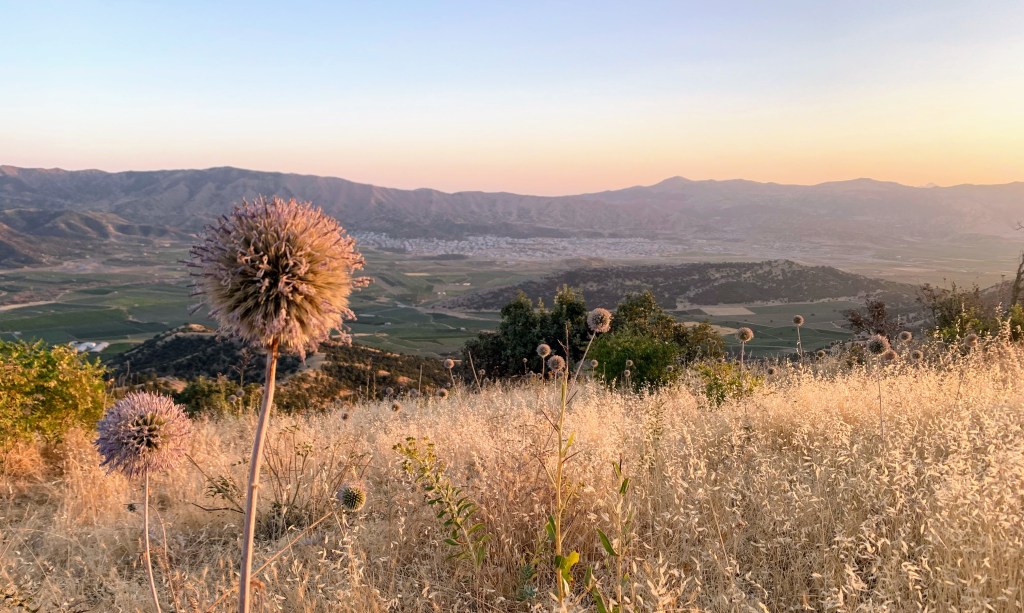
It was on a trip to Underhill village where I first learned that thistles are edible. It was late summer. The mountains had turned brown from the summer heat. But they were not completely colorless. Amazingly, certain hard-scrabble plants chose the height of these rainless months to bloom. Their colors were not the bright shades of spring, like the gold and white of the small narcissus flowers or the blood-red poppies. No, they were much more subtle – pale violets, aloe greens, dusty yellows. Late summer in the high desert was a different theme, and brought with it its own unique color scheme. I was reminded of Lilias Trotter, the missionary artist to Algeria who would comment on God’s artistry in pairing understated colors together in the Sahara, an environment where bright shades would come across as gaudy and ill-fitting.

Our guide was Zoey*, a longtime friend of my wife’s. Zoey was very proud of the village lore she had inherited and delighted to teach us things like how to make village cuisine, how to handle farm animals, and how to eat what grew wild on the mountainsides. This is an entire category of food in our local culture, one that to us initially looks like eating weeds. I remember once being on a spring picnic and observing an older couple as they pulled out knives and began to cut the grasses next to their picnic blanket, popping them into their mouths and chewing like a pair of happy elderly goats. Before long they had cut a decent-sized swathe out of the hillside behind their blanket, and, satisfied, lain down for a nap. There seem to be dozens of edible grasses, herbs, and other small plants that grow wild on the slopes of our corner of Central Asia. And a skilled local will be able to snack on the bounty of the mountains on any given picnic or day of shepherding on the slopes.

Zoey was taking us to an ancient swimming hole tucked into a nearby valley where Zoroastrians, Jews, Christians, and Muslims had all once lived side by side. We were descending a dusty trail when Zoey motioned for us to pay attention. Grabbing two flat rocks, she snapped off the head of a nearby thistle, a spiky ball still partially covered in tiny violet flowers. Setting it on one of the rocks on the ground, she then proceeded to use the other rock to smash the sharp spikes off of the core of the bud. What emerged was a cream-colored ball, pock-marked like the center of a dandelion when you’ve blown all the wispy things off, and about the size of a marble. She gave it to us to eat and proceeded to harvest several more.

The thistle core had a nutty taste, similar to the flavor of an almond, but with grassy notes. I had the sense that if it were roasted and salted, it could make for quite the yummy snack. As I munched, I looked around the dry hillsides. Thistles were everywhere, growing wild and swaying in the wind. I thought to myself that this was very useful knowledge if one ever found themselves on the run in the mountains, as so many generations of local freedom fighters had once been forced to do. In a season where the green grasses of spring and fruits like loquats were all gone, yet it was too early for pomegranates or olives, it was good to know the humble thistle could provide some sustenance if necessary.

I enjoyed thinking about the curious nature of this plant. Here was something that grew wild and needed no tending. It matured in the worst part of the summer heat. It armed itself with fiercely sharp spikes. And yet a secret edible treasure was hidden in the middle of its imposing crown. Apparently, even in a world overrun with thorns, common grace means that some of these thorns can provide food for the needy. And though the knowledge of edible wild plants is increasingly an obscure field of study, they are still out there, growing and blooming just in case. How very kind of the creator to populate our world with so many thousands of these small acts of care.

Several years later I was out driving in the mountains with some teammates and local believers. We had come to see a waterfall, but it was a drought year and it had unfortunately all but dried up. I did find some baby toads in the mud to bring back for my kids, but for a while our crew just wandered around in the rocks trying to figure out what we should do now, with Mr. Talent* guiltily trying to explain how yet another outing he had planned had gone awry. We were several hours into the mountains, it was getting toward supper time, and we were starting to get hungry. As it was once again late summer, I noticed all the spiky balls poking up out of the dry grass. My edible mountainside lessons from Underhill village suddenly came back to me.

“Hey guys! Anyone want a snack?” I said as I started gingerly plucking off the heads of several thistles by the side of the road. I looked around for some good rocks to serve as my hammer and anvil. Rocks are never hard to come by in the stony limestone terrain of that region, so I soon had my own setup going similar to what Zoey had once showed us. The foreigners with me were perplexed, but to my surprise, so were all of the local guys.

“They’re thistles, we can eat these!” I said, expecting nods of comprehension from the local men. But these were city boys, and apparently the gap between village knowledge and city folk was wider than I had expected. True, eighty five percent of our people group now live in the cities and only fifteen percent in the villages, the direct opposite of forty years ago. A lot of traditional knowledge was bound to be lost in this kind of huge demographic shift. But I was still surprised that I was the only one in the group who didn’t seem weirded out by the concept of eating a thistle nut.

I beat the barbs off of a small pile of thistle cores and popped one in my mouth, and once again enjoyed the nutty, grassy flavor. But my audience of skeptics was a hard crowd to win over. In the end, only one TCK and one local brother was willing to try my wilderness snack. The reviews were mixed, but not entirely bad. And I consoled myself that if any of these brothers did ever find themselves stuck in the mountains without food, perhaps they would remember, as I had remembered through Zoey, that they could indeed eat the spiky painful plants growing wild all over the mountainsides.

The same goes for you, dear reader. Should you ever happen to be stranded in a Central Asian wilderness, or other similar terrain where thistles grow wild (Scotland?), know that with the aid of a couple good rocks you too can eat the hillsides.

*names changed for security

A Poem Laughing at Satan and Death Arguing

Ephrem the Syrian writes this poem as a fictional argument between Satan and Death, where each bicker about who is strongest. Ephrem, like many in church history, advocates laughing at our spiritual enemies as one important piece of spiritual warfare. Martin Luther agrees, “The best way to drive out the devil, if he will not yield to texts of Scripture, is to jeer and flout him, for he cannot bear scorn.” This poem is a call to confidently laugh today at evil, thereby echoing the victorious laughter of the coming resurrection.

Nisibene Hymns, no. 52

I heard Satan and death loudly disputing
which was the strongest of the two amongst men. 

Refrain: Praise to You, Son of the Shepherd of all, who has saved his flock
                from the hidden wolves, the Evil One and Death, who had swallowed it up. 

Death has shown his power in that he conquers all men,  
Satan has shown his guile in that he makes all men sin. 

Death: Only those who want to, O Evil One, listen to you,
             but to me they come, whether they will it or not. 

Satan: You just employ brute force, O Death,
            whereas I use traps and cunning snares. 

Death: Listen, Evil One, a cunning man can break your yoke,
             but there is none who can escape from mine.   

Satan: You, Death, exercise your strength on the sick,
            but I am the stronger with those who are well. 

Death: The Evil One has no control over the person who reviles him,
             but all who have cursed me, in the past or now, still come to me. 

Satan: You, Death, received your power from God,
            but when I make men sin I do it without any outside help. 

Death: You, Evil One, lay snares like a coward,
             but I use my power like a king. 

Satan: You are too stupid, Death, to recognize how great I am,
            seeing that I can capture free will.

Death: You, Evil One, go around like a hooligan,
             whereas I am like a lion, fearlessly crushing my prey. 

Satan: You have no one who serves or worships you, O Death, 
            but me, kings honor with sacrifices, like a god. 

Death: But many address Death as a benefactor, 
             whereas no one ever has or shall call on you as such, O Evil One. 

Satan: Do you not realize, Death, how many 
            call on me in one way or another, and offer me libations? 

Death: Your name is hated, Satan, you cannot remedy it;
             everyone curses your name. Hide your shame. 

Satan: Your ear is dull, Death, for you fail to hear
            how everyone howls out against you. Go, hide yourself. 

Death: I go open-faced among creation, and do not use deceit like you:
            you do not pass a single night without some kind of deceit. 

Satan: You have not found a better lot for all your truth:
            men hate you just as much as they do me. 

Death: Everyone fears me as a master, 
             but you they hate as the evil one. 

Satan: People hate your name and your deeds, O Death;
            my name may be hated, but my pleasures are loved. 

Death: Your sweet taste ends in setting the teeth on edge:
             remorse always accompanies those pleasures of yours. 

Satan: Sheol is hated for there is no chance of remorse there:
            it is a pit which swallows up and suppresses every impulse. 

Death: Sheol is a whirlpool, and everyone who falls in it is resurrected,
             but sin is hated because it cuts off a man's hope. 

Satan: Although it grieves me, I allow for repentance;
            You cut off a sinner's hopes if he dies in his sins. 

Death: With you his hope was cut off long ago; 
             if you had never made him sin, he would have made a good end. 

Chorus: Blessed is he who set the accursed slaves against each other
              so that we can laugh at them just as they laughed at us. 

Our laughing at them now, my brethren, is a pledge 
that we will again be able to laugh, at the resurrection. 

-Ephrem the Syrian, translated by Brock, The Harp of the Spirit: Poems of Saint Ephrem the Syrian, p. 104-107

Photo by Godfrey Nyangechi on Unsplash

The Unexpected Beauty of Babel

The events which took place at Babel most definitely fall into the category of judgment. Genesis eleven describes how the early peoples of the earth all shared one language. And contrary to God’s desires, they did not spread out and fill the earth, but decided they would band together, build a city in the land of Shinar, and construct a tower to challenge the heavens. In this way, they would “make a name” for themselves. You don’t have to be from an honor-shame culture to understand that making a name for yourself essentially means working to build up your own honor and reputation. It was pride, pure human pride – and that accelerated because everyone knew the same words, the same language.

God, not in the least threatened by this little rebellion, comes down to see what the residents of this city of Babel are up to. There’s some rich irony in the text here – the tower builders are not nearly as high up as they think they are. After seeing how the linguistic unity is enabling their prideful building campaign, God decides to instantly scramble their languages by means of a miraculous act of judgment. Once this has been accomplished, everything falls apart. Faced with mass communication confusion, the building of the city stops and the peoples end up spreading out over the face of the earth after all. Their dispersion is largely involuntary, a forced obedience of sorts thrust upon them by their dysfunctional language situation. Babel was judgment. Judgment for human pride. Judgment for neglecting the creation mandate to go forth, multiply, and fill the earth.

Yet Babel was not only an act of judgment. It was also an act of creation. Creation through judgment. Apparently, when God acted, dozens of languages burst into existence instantly and then began to live and move and have stories and descendants of their own. These languages would be the first ancestors of the language families in our world today, with language families meaning simply groups of related languages. For example, English, Latin, Farsi, and Hindi all come from the Indo-European family of languages. While Arabic, Hebrew, and Aramaic come from a different family, the Semitic. However, while languages within a given family are clearly related to one another, separate language families don’t seem to share any common descent. Historical linguists can try to reconstruct ancient languages like Proto-Indo-European and Proto-Semitic, but they can’t seem to find any links suggesting these early languages emerged from a common ancestor. Similar to the problem facing speciation in Darwinian evolution, what seems to emerge from the data is not one connected tree from which all the descendants are traced back to a single ancestor, but rather a forest of trees that seem to have been there at the beginning. Like subspecies, languages branch back toward these early independent trunks, but not further, posing a great mystery for historical linguists. Christians of course have a good answer. We believe in a humanity created in the image of a speaking God, and in Babel, the source of this world’s incredible language diversity.

It’s curious to note that the result of this judgment – a world of linguistic diversity – is never promised to disappear. The restoration of all things does not seem to include a future where we are restored to being a monolingual species. Revelation 5:9 and 7:9 instead suggest that noticeable language differences are actually preserved in eternity. John can tell that the great multitude before the throne is made up of those from every tongue. “After this I looked, and behold, a great multitude that no one could number, from every nation, from all tribes and peoples and languages, standing before the throne and before the Lamb, clothed in white robes, with palm branches in their hands, and crying out with a loud voice, ‘Salvation belongs to our God who sits on the throne and to the Lamb!'” (Revelation 7:9, 10). Our unique languages don’t seem to melt away into some heavenly tongue, like cast off vestiges of a divided past. Rather, God’s plan from the beginning seems to be the redemption of humanity’s diverse languages, a restoration where they are finally free to perfectly glorify God in a great multilingual choir of the saints.

We see hints of this plan in God’s choice to reveal the Scriptures in multiple languages: Hebrew, Aramaic, and Greek. At various points in history, these multiple fallen languages are given the honor of being the vehicle by which God reveals his eternal word. Even Persian gets a bunch of loan words in the Bible. Then, when the Spirit comes at Pentecost, what does he choose to do? To empower the apostles to preach and worship in the foreign languages of pilgrims who had come to the feast from dozens of far-flung lands. Put together with the visions of Revelation, the picture we get is that both at the birth and at the final destination of the Church, the many languages of the world do not fade away to be replaced by some heavenly tongue, or some chosen earthly tongue like Hebrew. No, instead we see the languages of the nations transformed, employed in the praise of God.

It seems as if, as he so often does, God has chosen to bring beauty through judgment, a greater grace and glory than would have existed had the judgment never taken place. After all, this is the logic of the cross and salvation history. Yes, judgment falls. Yet amazingly God’s grace shines even brighter for it. Should we be surprised that God delights to also do this with the arc of language history? It reminds me of how God gave a king to Israel in 1st Samuel chapter eight. Being granted a monarch was a judgment, a consequence of Israel wanting to be like all the other nations, and their rejection of God as king. And yet we know that God’s plan was, through this rebellion, to raise up David – and eventually the eternal son of David. God’s forever king for his people was the plan from the beginning. And yet an initial hint of this mystery’s unveiling was a story of human failure, and divine judgment.

What might God be up to in his plan to redeem the languages of Babel and their many descendants? Here I’m helped to remember the limitations of a single language. Languages are good, wonderful even, but they are limited. Everyone who has learned another language has experienced the frustration of a perfectly descriptive term existing in one tongue, but not in another. In my home we have terms from Melanesia as well as from Central Asia that have made their way into our daily household English. This is because English lacks a word for those particular situations or feelings. If languages are thus limited to describe everyday realities, then how much more limited are they to describe eternal realities? To describe the Godhead?

In Greek, and my adopted Central Asian language, God can be called Lord Heart-Knower (Acts 1:24), and yet this title simply doesn’t work in my mother tongue, English. On the other hand, English has so many wonderfully-succinct terms for God’s attributes like omniscient and omnipresent and omnipotent that require multiple words – or even a whole sentence – to communicate in many other languages. Alas, as with the sons of Adam, so every language has also fallen short of the glory of God. No, when it comes to the task of glorifying the Trinity for all eternity, a single language was apparently not enough. Rather, God seems to have desired thousands of them, all working together to leverage their unique strengths and beauty for his eternal praise – and the enjoyment of his people.

For surely languages will also be redeemed and preserved for the sake of our enjoyment. While polyglots delight in the freedom that comes from being able to speak and think in a dozen different ways, even my four-year-old cracks up when a good pun is made (and scripture is full of witty puns and wordplay). Language was created for our enjoyment, and even in this broken age we get small tastes of the fun that is coming to us beyond the resurrection. Perhaps in eternity the Spirit will give us a supernatural ability to speak and understand all languages, in a sort of permanent Pentecost. Or, perhaps we will use the time provided by eternity (plus a resurrected mind) to learn all of the many tongues spoken by our brothers and sisters. We simply don’t know yet. I tend to hope we’ll get to learn them the old-fashioned way, maybe a little easier, but still getting to make funny mistakes.

What we do know is that God wanted a universe with thousands of unique languages. And so, even though Babel is a reminder of human pride and God’s just judgment, it is also the start of something which will ultimately become an amazing tapestry reflecting God’s glory. There are eternal upsides to the shattering of humanity’s united language. In Babel there is beauty, unexpected, but even more wonderful for it.

Photo via Wikimedia Commons.