Who Stepped in The Baptism Cake?

Manuel* was ready to be baptized. And since it was late Spring, the church opted to plan a baptism picnic. From where we were living, a short trip into the mountains would take us to a nice lake area created by a large dam. This is a favorite picnic area for locals since the lake and the river proceeding from the dam mean opportunities for swimming and even the occasional rental jet-ski. Hence why it can also be a good fit for baptisms. Some readers may recall that this is the same area where once, during the worst dust storm in decades, we had to buy our kids marijuana-themed underpants.

Beforehand, the women had divided the food responsibilities amongst themselves. My wife was assigned the unenviable task of bringing what in the local language is called the “sweety,” i.e. the cake. Now, locals tend to prefer cakes that look like they are on their way to prom but taste like cardboard. We Westerners don’t care as much about how fancy the cake looks, but we like it to have lots of delicious icing, which locals say makes it way too sweet. This is a bit confusing to us since they like to eat baklava with Coke, which we find way too sweet. In any case, turns out the happy middle ground is sweet-ish desserts like banana bread, carrot cake, and other breads/cakes of this genre. So, my wife had made a carrot cake of this variety (with no icing) in a large glass casserole dish. It was stashed in the back of our family’s Kia SUV, along with some other food and picnic supplies.

As usual, we all met up at a gas station on the edge of town in order to buy any needed supplies and to rearrange the food and passengers in whatever vehicles we had. In all of the mixing and matching, Patty* and her teenage daughter ended up with us, and this somehow meant that our two young kids were asked to clamber up into our vehicle through the back hatch of the SUV. This had them climbing over the food. So, of course, one of them stepped directly in the middle of the baptism cake. The cake had been covered in a layer of plastic wrap, but the imprint of a little foot in the middle of the cake was unmistakable. Oh well, we thought, we’ll deal with that later. It was now almost lunch time and we still had an hour’s drive ahead of us.

To find a good baptism location, we’d need to consider several factors. First, the water would need to be deep enough, slow enough, and easy enough to get in and out of. Second, the spot would need to be both private enough and public enough for a Christian baptism in a context of moderate Islamic persecution. Third, its picnic potential would need to satisfy the majority of the locals – who by then we’d learned love to argue ad nauseam about the pros and cons of various picnic locations. American men pride themselves on their superior opinions about barbecuing, road trip methodology, thermostat settings, and the like. Central Asian men pride themselves on their superior opinions about being able to find the perfect picnic spot.

The first location that we drove to was a picnic house of sorts right up alongside the river. It had been vouched for by Mr. Talent* as an ideal location. Next to the small house, there was a large covered cement veranda for the picnic meal, complete with metal stairs that led down into the current. But one look over the railing down at the fast-moving water had Manuel shaking his head. Like most locals, Manuel was not a great swimmer – and that current was fast and strong, freezing, several feet deep, and running over slick rocks. Even though I had grown up swimming in the rivers of Melanesia, I also wasn’t confident that it would be safe to put a big man like Manuel under the water in a place like that.

Much debate ensued with Mr. Talent vigorously defending his chosen location. At last, we all decided to pile back in the vehicles to go to a spot that Frank* claimed had nice and slow-flowing water and lots of greenery. By now it was past lunchtime. Another fifteen minutes of driving brought us to the picnic spot that Frank suggested. It seemed to have been some kind of smaller river created by an overflow pipe from the dam. It also seemed like it had been very popular this season because it was trashed. Watermelon rinds, flies, sunflower seed shells, and evidence of hookah smoking were everywhere. The water itself was slow enough, but it was quite dirty, even stagnant. The whole place smelled of rotten eggs, plus there was no longer any good ground for our picnic mats that had not yet been trampled into mud. Once again, heated debate ensued.

By this time, Patty was starving. Patty, a foodie and quite the impressive chef herself, decided that it was no longer logical for her and her daughter to wait for these men to make up their minds. She needed to eat something. So, she opened up the back of our vehicle to start rummaging through the food. This is when Patty made a noise and held up the cake to show it to us. To our great frustration, we saw that there were now two little footprints in the baptism cake. We assumed this would make the cake inedible, but while we lectured our offspring about watching where they were stepping, Patty simply grabbed a disposable fork and started eating the cake directly from the dish – though carefully avoiding the areas with the little footprints.

At some point, Manuel spoke up, telling the crowd of haggling and gesticulating men that he had a spot that he knew at the upper part of the lake which would do just fine, at least for the baptism. Everyone seemed good to defer to the actual person getting baptized, so a decision was made that a smaller group of us men would drive up to this spot. Once we were finished the dunking we would all meet back at the original location that Mr. Talent had chosen. The women greeted this news with nonplussed expressions. The kids were starting to lose it, it was getting hot, and all of us were getting hungry. Patty and her daughter, for their part, were hiding behind our vehicle, making good work of the baptism cake.

Thankfully, this third baptism location seemed like it would work. The water of the lake was warm, still, and deep enough. The only issue was the depth of the mud. As you stepped into the water, your feet sank down into many inches of brown muck which sent little chocolate clouds billowing up around you. I double-checked with Manuel that this really was okay. But he insisted that this would do just fine. So, one of the local brothers and I waded out and flanked Manuel in waste-deep water. We asked him the baptism questions, then, based on his profession of faith, together put him under the water in the name of the Father, the Son, and the Holy Spirit. He came up out of that muddy water beaming with joy. I was reminded that, imperfect though our day had been, baptism is still an amazing thing.

We were a happy vehicle driving back down to the picnic house, where we knew hours of drinking chai, eating skewered meat, singing worship songs, and fellowshipping awaited us. To my great amazement, when we arrived, my wife and Patty were passing out little cubes of baptism cake. I raised my eyebrows and gave my wife a questioning look.

“There was a little bit left between the footprints and what Patty had scarfed down,” she said, “so we just cut around those parts.”

I stared down suspiciously at my little chunk of “sweety” that had been through so much already that day.

“Just eat it,” my wife said with a sly smile. “Nobody has to know.”

So I did. I ate my little piece of baptism cake. And it was downright tasty.

We will be fully funded and headed back to the field when 42 more friends become monthly or annual supporters. If you would like to join our support team, reach out here. Many thanks!

For my list of recommended books and travel gear, click here.

Photos are from Unsplash.com

*Names have been changed for security

A Proverb on the Tongue and Mental Health

If the tongue allows, the mind relaxes.

local oral tradition

This local proverb focuses on the connection between how we use our tongues and our experience (or lack thereof) of a mind at peace. Essentially, look at someone who runs their mouth, gossips, and lies, and you will find a person whose mind (and life) knows very little peace. But chances are very good that someone who knows how to control their tongue is also someone who knows some measure of rest and inner calm. This is just as true of the Central Asian bazaar as it is of Twitter and Facebook feuds.

The wisdom literature of the Bible has much to say in this regard. Consider Psalm 34,

[11] Come, O children, listen to me;
I will teach you the fear of the LORD.
[12] What man is there who desires life
and loves many days, that he may see good?
[13] Keep your tongue from evil
and your lips from speaking deceit.
[14] Turn away from evil and do good;
seek peace and pursue it.

If you desire life, to see good, to have a mind and heart at peace, then the use of your tongue (including your keyboard) needs to be top priority.

What local oral tradition does not say is how someone can find the power necessary to actually tame the tongue, something that James 3:8 says is humanly impossible. As is so often the case, traditional wisdom knows the goal, but not the means. Believers, however, know this is only possible through the use of another’s tongue, another’s all-powerful saving word. When he has “brought us forth by the word of truth, that we should be a kind of firstfruits of his creatures,” (James 1:18) then – and only then – will be have tongues truly tamed and minds truly relaxed.

We will be fully funded and headed back to the field when 42 more friends become monthly or annual supporters. If you would like to join our support team, reach out here. Many thanks!

For my list of recommended books and travel gear, click here.

Photos are from Unsplash.com

The Psalms’ Quiet Case For Musical Diversity

“But do we have any precedent in the Bible for incorporating diverse styles of worship?”

The question was an unexpected one. One reason plural leadership is so good is because invariably one elder will come up with a question no one else is thinking of. The rest of us were just assuming that it was right and good to expand our church’s styles of musical worship to better reflect our diverse congregation. It seemed to fit with the Revelation 7:9 vision and with the fact that the New Testament advocates generally for Psalms, hymns, and spiritual songs (Col 3:16), but otherwise seems to leave the details of musical worship up to the wisdom of the local churches – assemblies which were no longer just Jewish, but were fast becoming also Greek, Roman, Scythian, Persian, etc.

The question got me thinking. How much of a case is there in the Bible for the practice of incorporating diverse styles of music in the regular worship of our churches? After percolating on this for a number of years, I’ve become more and more convinced that a quiet but convincing biblical case can be built that God delights in receiving worship in the many musical styles of the world, just as he delights in receiving worship in the many languages and cultures of the world. And that this case can be built from the hymnal of Israel and the early church – the Psalms. This case is built on the history and context of the Psalms, as well as on the nature of music itself.

When it comes to its nature, music is much like language or culture; namely, like a cloud. Music does not sit still. It cannot. It’s always slowly changing and moving, shifting and developing in ways that clearly reflect where it’s been yet defy even the most skillful predictions of where it’s going next. With music, just add time and you will inevitably get substantive changes in method and style. Seeking to ‘freeze’ a musical tradition as that which truly represents a people is just as futile as trying to ‘freeze’ a language. You can protest all you like, but they will go on changing. They are clouds, after all, not mountains. Their nature is a moving one.

This is where the history and the context of the Psalms come in. We are told that Moses is the author of Psalm 90, which would make it the earliest psalm that we have. Moses was likely living and writing around 1400 BC. Of course, the most famous psalmist is King David, writing 400 years after Moses, around 1000 BC. Yet other psalms are attributed to Hezekiah (Ps 46-48), who was living around 700 BC, 300 years after David. The latest psalm seems to be Psalm 137, “By the rivers of Babylon,” which clearly speaks of the Judean exile to Babylon which took place in the 500s. That means there’s a span of roughly 900 years between the writing of the earliest and the latest Psalm.

That’s a lot of time for a given musical tradition to undergo all kinds of natural internal development. Were you to time travel, you’d likely recognize some elements of the music of the Judean exiles all the way back in the music of Moses. But Moses – were he to travel with you to Babylon – would probably be a little offended at what had become of his beloved Hebrew musical tradition. This is because the changes would have been considerable, perhaps as great as if he were encountering the music of a foreign nation.

Add to this the fact that musical style, again, like language and culture, does not exist in a vacuum. Musical styles borrow from one another, just as languages borrow vocab from their neighbors. Instruments and melodies get adopted from one culture to another at perhaps an even faster rate than words since music itself has a quality that seems able to transcend other natural differences. This is why it’s sometimes been labeled “the universal language.” This means that whatever musical traditions Abraham’s household brought with them from Ur probably picked up Canaanite/Hittite influences in the several generations that passed until Joseph’s time. After this, 400 years of Egyptian sojourn and slavery would have made its own significant imprint on the musical style of the Hebrews by the time Moses got to writing the first psalm. Once back in the promised land, another 400 years of musical mingling in Canaan brings us to the time of David. And the centuries of monarchy would have had their own cross-pollination. Finally, it’s not far-fetched to assume that Jewish music would have been influenced dramatically during the exile. Just remember what happened to the Hebrew language.

So, when the Psalter is finally finished in its current form, post-exile, the Psalms represent roughly 1,000 years of the natural diversity that emerges within one musical tradition – as well as the added diversity of external influence from at least Mesopotamian, Canaanite, and Egyptian musical styles. The finalized Psalter, before its melodies were lost, would not have been a ‘pure’ representation of the Jewish ethnic musical style. Instead, it would have been a collection of songs that represented a Jewish synthesis, one representing a long absorption of melodies and styles from many centuries, geographies, and cultures.

Perhaps a Jew in exile singing the Psalms of David would feel similar to how we feel when singing O Come O Come Emmanuel, one of the oldest melodies that we still sing in Evangelical churches. The song’s lyrics are in fact much older, but the earliest record of its current melody comes from France, about 600 years ago. Hum the melody of this song to yourself and notice how it seems to be from a different world. That’s because it is from a different world. It may be a familiar part of our Western European Christian tradition, but every time we sing it we are singing a song from a very different time and culture. For an even older tune, listen to a song from 1700 years ago, Phos Hilaron. Then compare these old melodies with the music of today. Even if you cut out the warp-speed mutations that happened to music in the 20th century, it’s stunning how diverse music can be in one religious tradition.

What’s my point? Essentially, the Psalms are evidence that the songbook of the people of God was one that originally contained a rich diversity of musical styles. We can know this because of the nature of music and because of the history and context of the Psalms themselves. Apparently, God ordained that his people, for centuries, sing diverse melodies, some of which would not have felt like the stirring tunes of their particular generation, but rather the music of other peoples and other centuries. In this, we have a quiet case for using diverse musical styles in our churches.

This really matters, though we don’t typically feel how much it matters until we are ourselves a minority worshipping in the melodies of other cultures and lands. One of our African American pastors recently stood up and shared, in tears, how much it ministered to his soul that our church choir had sung a song from the black gospel tradition when the Anglo-Irish melodies of our reformed circles are our more standard fare. Back in Central Asia, we once took the melody from one of the most requested local worship songs and wrote new English lyrics to it so that it could be sung in the international church where we were members. Since then it has become a favorite song of the church’s many members who are from a Muslim background. We should want to serve the diverse members of our churches with melodies that help the words reach their souls – and those are often melodies from the musical traditions that they grew up with.

This is why it can be so hard for the majority culture of a given church to incorporate diverse musical styles in its worship. Because the melodies the church typically sings are from their culture and tradition, the majority already feel the sweet union of the words and the melodies down in their bones. It can take a while for them to realize that for those from other musical traditions, that double encouragement is not necessarily taking place. But in the Psalms there seems to be precedent for both – singing the melodies that feel like the songs of your people and singing the melodies that feel like you are being transported to a foreign land.

Here it must be said that it is indeed possible to be edified by singing the songs of another people, another culture, another century. It takes time and growth, yes, but it can happen, and it is healthy to learn how to be fed with melodies from the distant past as well as with others that just don’t hit your heart in that way (yet). Keep singing them and meditating on the truth they contain. You may be surprised at what happens to you as those foreign-seeming melodies slowly inch closer and closer to your heart. Just as a deep view of church history and a broad view of the global church serve to strengthen the believer’s head, so equivalent Christian music may serve to expand his heart.

Do we have any precedent in the Bible for incorporating diverse styles of worship in our services? I say yes, and not just in the New Testament. Even in the Old, we see that one style and culture of music is not sufficient for the worship and delight of God. Instead, he quietly included 1,000 years of musical diversity in his Psalter long before he sent the New Testament Church out to write and sing new hymns and spiritual songs to the ends of the earth. The New Testament posture toward musical worship that we’ll see in full bloom in heaven (and even now is flourishing) had its first budding in the Psalter. In it we can see the shoots of both freedom and tradition, service to others as well as room for our own souls to drink deep.

So then, sing to the lord a new song, sing to the Lord, all the earth (Ps 96)! Sing an old song too. And while you’re at it, for the sake of that refugee in your service, sing a foreign one as well.

We will be fully funded and headed back to the field when 34 more friends become monthly or annual supporters. If you would like to join our support team, reach out here. Many thanks!

For my list of recommended books and travel gear, click here.

Photos are from Unsplash.com

The Queen of Snakes

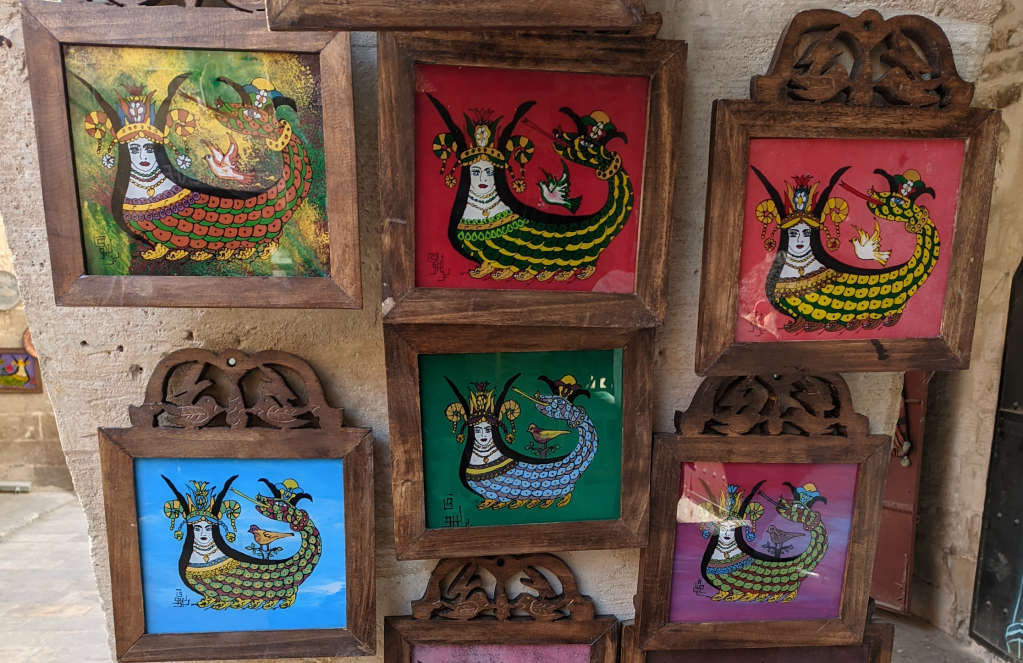
The first time I remember noticing her was when visiting local museums. The exhibits that showed what the inside of local houses used to look like regularly featured wooden chests. Inside these colorfully painted chests were usually blankets and cushions for guests. But on the outside of the chests were mirror fragments – and a painting of a strange woman-snake hybrid. I’ve also seen her hung up on walls as part of a tapestry or framed painting. In the local languages, she is called the Queen of Snakes. And I’m beginning to suspect that she has played a dark role in the historical beliefs of our people group.

The Queen of Snakes was never quite prominent enough for me to pay her much attention. Far more prominent were the evil eye pendants that seemed to show up everywhere. But listening to the Haunted Cosmos podcast got me thinking more deeply about the folk mythology of our people. Turns out there are some disturbing similarities between the Queen of Snakes and the strategies the enemy has used to deceive the nations from the very beginning. First, the story.

The tale of the Queen of Snakes often begins with a young man who is hunting for honey in caves. While exploring deep in a cave, he comes across a massive snake-like creature that has the body and head of a snake on one end and the torso and head of a woman on the other. He is terrified, but the creature tells him that she is not evil, but benevolent. She says that she is able to give him secret knowledge. The young man decides to stay with her and they eventually fall in love. After a long season of happiness, the young man must return to the city. But the Queen of Snakes warns him to tell no one about her, and that living with her has changed him. Now, if his skin gets wet, it will appear as the scaly skin of a snake.

After the young man returns to the city, the king becomes deathly ill. His viziers tell him that the only thing that can save him now is if he can eat the flesh of the mythical Queen of Snakes. No one, however, knows how to find her. But they do know that water can expose anyone who has been in her presence. So, the soldiers of the king go around pouring water on all the citizens of the city. Eventually, they find the young man when his skin betrays him. Under torture, he reveals the location of the Queen of Snakes.

The king’s men then bring the Queen of Snakes to the city. Right before they kill and cook her so that the king can eat her flesh and live, she gives a warning. She says that anyone who eats her head will be poisoned and will die. But if anyone eats her tail (presumably the snake head, but some allege it’s the other way around), they will live. The king, of course, orders that the Queen of Snakes be killed and cooked so that he can eat the tail. The young man, despairing in the death of his lover, eats flesh from the head. But it was a trick. In reality, the tail contained the poison while the head contained secret knowledge from time immemorial. The king dies, but the young man becomes the wisest man in the land and a great sheikh.

Okay, so this is a weird and creepy story. But is that all it is? How has the story of the Queen of Snakes affected the day-to-day spiritual practices of our people group? Well, more research here is needed. But this is what I’ve been able to figure out so far.

First, the image of the Queen of Snakes is believed to bring good luck and protection in general. This follows the theme from the story that she was a source of hidden wisdom. More specifically, the Snake Queen’s image has been used as a talisman to ward off sickness. This makes sense given the power of the Queen of Snakes in the story to provide healing. But the image of the Queen of Snakes has also been used to promote fertility. A picture of her is a very important part of a woman’s dowry – and that picture is then hung in the bridal chamber. In summary, the grandparents of my Central Asian friends believe that the talisman of this chimera provides protection, good fortune, wisdom, and fertility. And they want to make sure that this image is looking down on the marriage bed.

Yep, this sounds Satanic. First, there’s the twisting of the image of the serpent so that what is naturally repulsive and the enemy of the woman is instead believed to be a benevolent being. The most common position on the internet regarding the Snake Queen has her functioning as a symbol and even a patron saint of sorts for the women of our region. Second, there’s the whole theme of secret knowledge that this being promises. A friendly serpent being that offers hidden knowledge gives off some pretty serious Genesis 3 vibes.

But this is not the only way in which the lore around this creature is attempting to usurp power that belongs to God alone. The Queen of Snakes is also held up as giver and restorer of life. She gives fertility and she gives healing. And how does she do this? Well, in the story you have to eat her flesh. Some versions of the story even have successive serpentine offspring incarnating the Queen of Snakes after each of her deaths, meaning that she also possesses the key to new birth and immortality.

Now, in a disturbing – though honestly predictable – twist, the image of the Queen of Snakes has been adopted by LGBTQ activists in our region to promote their agenda.

Once we are back on the ground I need to do more research to see how this demonic element of folk religion is actually functioning among our people group. I need to ask my friends and their sisters, “What do you believe about the Queen of Snakes – and what did your grandma believe such that she put pictures of her up in even the most intimate parts of the home?” But even from the little bit that I know already, certain steps for local believers seem clear.

First, get rid of any Queen of Snakes images that you might have in your house. Sure, it might make your great aunt upset if you burn that talisman painting she gave you, but you really should chuck it – even if it’s only out of an abundance of caution. Yes, the presence of the Holy Spirit protects believers, but this shouldn’t make us cocky. In the mysteries of the spiritual realm, sometimes even objects can be used by the enemy to cause some serious trouble. You may be immune, but Christian history and common sense would indicate that you really don’t want something like that in your house while you’ve got kids who haven’t yet come to faith. Take dominion over your space, and just like Hama and Tara who took down their Islamic paraphernalia during the saga of plastic Jesus, get rid of the snake woman too.

Second, no longer believe and speak of the Queen of Snakes as some benevolent pro-woman character that’s a positive part of your heritage. All the evidence indicates that there’s at least some level of demonic deception involved in this creature. Christians will need a new posture toward this part of their traditional folk art.

Third, proclaim that the things the Queen of Snakes claims power to do are the territory of God alone. He alone is protector, healer, giver of children, and source of true wisdom. In all of these areas, the Queen of Snakes was a liar, a deceiver, and a usurper.

Finally, celebrate the victory that Christ has accomplished over not just Islam, but also over all the dark things of folk religion that clutter up the metaphorical basement of your worldview. Christ “disarmed the rulers and authorities and put them to open shame, by triumphing over them in him” (Col 2:15). When Jesus on the cross crushed the head of the serpent’s seed, he also crushed the power of the Queen of Snakes. Through the open proclamation of that good news in your language, she will no longer able to deceive you, your grandma, or your future bride. And that is very good news.

We will be fully funded and headed back to the field when 43 more friends become monthly or annual supporters. If you would like to join our support team, reach out here. Many thanks!

For my list of recommended books and travel gear, click here.

Photo by Wikimedia Commons

Indigenous Church or International Church?

This video from the Great Commission Council seeks to clarify the difference between an indigenous church and an international church. For many contexts around the world, it shouldn’t be an either/or, but a both/and. Healthy international churches and indigenous churches can work together to see a city reached. The difference is that one ministers in the indigenous language and culture and the other ministers in a globally or regionally dominant language and culture (such as English).

It is of crucial importance that both kinds of assemblies aim to fulfill the New Testament’s vision for a local church. International churches need to watch out for how transience and a “lowest common denominator for the sake of unity” posture can keep them from becoming healthy churches that exhibit all twelve needed characteristics. Indigenous churches likewise need to watch out for how local culture will be a barrier to their growth into full maturity.

We will be fully funded and headed back to the field when 43 more friends become monthly or annual supporters. If you would like to join our support team, reach out here. Many thanks!

For my list of recommended books and travel gear, click here.

First Dates and Fire Alarms

I seem to have a lot of stories to tell about fires. There was that time I blew up our kitchen. Then the time when our electric box decided to self-immolate at 2 am. This story, however, is only incidentally about fire, especially since there actually was no fire. It was a false alarm. No, this story is really about my first date with the girl who would one day become my wife. There is a fire alarm which plays a prominent part in how things go down. But we’ll get to that in due time.

True, we didn’t call our first date a ‘date’ per se. I had enough sense about me to leave that title out of it and to let things proceed in the category of ‘open secret.’ Every culture has this category somewhere or other in their interpersonal interactions. And since my wife and I are Westerners, we stayed true to our people and used this category at the beginning of our relationship in order to decrease awkwardness and to protect an easy out for either party involved, should that turn out to be needed. In this way, I was also trying not to be like some of the other guys who were serenading girls on campus with Calvinistic hymns and telling them far too much about their intentions, far too soon. I knew that the girl I was interested in had had her fair share of that sort of pursuit, so my hope was to keep things very casual, low-pressure, and in good taste.

Instead, I chose to ask her, tongue-in-cheek, if she’d be up for getting tea together and talking some more about the Holy Spirit. Yes, it was still very much a cheesy Bible college invitation, but not one without context. See, I had only recently returned from a gap year in the Middle East. And some pretty wild things had happened during that year. Friends had had dreams about Bible verses they’d never read, one woman was miraculously healed, I had narrowly survived a car bomb, and multiple friends had left Islam and risked everything to follow Jesus. I had become a cautious continuationist the year before that while a freshman at John Piper’s church. But even if that theological shift hadn’t taken place, the things I had seen the Holy Spirit do right in front of my eyes in the Middle East had left me convinced that the Spirit was more actively involved in day-to-day life and ministry than I had previously counted on. All of it left me eager to talk with other believers about what I had seen, and also about what they had seen and were learning.

The strange thing was, I initially had the hardest time finding other Bible college students who wanted to discuss these things in good faith. Sure, people wanted to debate theological positions. But very few seemed interested in conversations about how God was working overseas and what in the world it meant for us to practically ‘be being filled with the Spirit’ in our day-to-day walks with Jesus. Some were more interested in smoking pipes and playing board games. One guy I remember wanted to argue with me that it was not possible that God was sending dreams to Muslims. Another guy maintained that the Great Commission was actually fulfilled by the original Apostles, so modern missions was basically unnecessary. This latter student waxed eloquent about this while inconveniently sitting between me and the pretty missions major that I had been hoping to get a chance to talk with.

At last, an opportunity came to talk with this girl. I had been told by close mutual friends that she had grown up in a sort of ‘Bapticostal’ background and had a heart to work among Muslim women. I had noticed from afar that she was a keen thinker who didn’t engage in the sort of theological banter that was often more like a competition of intellectual prowess than a genuine conversation. Now, lest you get the wrong idea about the school I went to, I have not seen this sort of culture among the undergrads to be the norm over the years. I think I just kept running into the wrong guys or simply found myself among a very peculiar crop of students who loved to talk theology, but didn’t really want to talk about Jesus as if he were a real person involved in our lives. Don’t get me wrong. I loved to talk about theology – just not when it seemed like a decapitated head whose body had gone AWOL. My friends had risked their lives for Jesus in the Middle East. This stuff mattered.

A friend had set up an early morning prayer meeting for the nations. And it was right after this that I found myself having breakfast in the cafeteria and finally able to have a good conversation with the girl I had been hoping to connect with for several months. To my great joy, she seemed engaged and just as relieved as I was by the tenor of our conversation. We had to rush off to class but I felt that, at last, I had a good and non-creepy opportunity to pursue further conversation.

For her part, rather than being put off by my follow-up message about tea and conversation about the Holy Spirit, it made her smile. We made a plan to meet at her dormitory on a Saturday afternoon. From there, we would walk to the nearest off-campus coffee shop, a small Heine Bros. Coffee on Frankfort Avenue.

It was a pleasantly warm October afternoon when I found myself walking up the steep hill on the back side of the SBTS campus, heading to the girls’ dormitory. As I slowly made my way up the hill, I told myself to be calm and to keep things fun, casual, and low-key. I was nervous since this was my first time asking a girl out for conversation like this in quite some time. But how bad could it be? She and I would just take a simple walk to a coffee shop, talk, sip tea, and get to know one other. Hopefully, we could at least build a new friendship without any of the unnecessary college rumors or drama.

But as I came to the top of the hill I was met with a terrifying sight. Seated in the parking lot between me and the dormitory door was what amounted to a sea of young women. It seemed that every single college girl who lived on campus was there, sitting on the ground. There had to be sixty or seventy of them – and every single head turned to stare at me as I cautiously approached the edge of their giant half circle.

Thoroughly confused and feeling my face cycling through various shades and temperatures, I frantically scanned the mass of sitting women to see if I could spot the girl I was supposed to be going out with. The following moments were probably only a few seconds long, but what it actually felt like was perhaps put best by Gandalf the White: “Darkness took me, and I strayed out of thought and time. The stars wheeled overhead and every day was as long as a life age of the earth.”

What was this, some kind of intimidation technique? Did the girls at this school have some kind of wolf pack agreement with one another that when a new guy asked one out for coffee, the sisterhood must make a show of intimidating force? I mean, I knew that the girl I was interested in was well-known, well-liked, and well-respected on campus. Everyone seemed to know her. The terrors of a third culture kid who has stumbled upon some unknown context in their home culture – and doesn’t know what it means and what the rules are – were fast taking over.

At last, my date-not-date turned her head and recognized me. It seemed that she had been the only girl in the crowd who had not noticed me walking up. She stood up. Now, we were two lonely towers standing as it were in a great field of undergraduates, staring up at us like so many wide-eyed sunflowers.

“Hi,” I said, awkwardly.

“Hi,” she said, just as awkwardly.

The two of us stood there. Sixty or seventy college girls squinted up at me, then squinted up at her.

“What’s going on?” I asked, motioning around at all of the girls sitting on the pavement.

“Fire alarm,” she said.

“Oh,” I said. “There was a fire?”

“No,” she said. “False alarm.”

“Oh.”

I’m pretty sure at this point that I could no longer see, that I had gone utterly snow blind from embarrassment. Somewhere, a bird chirped. One of the girls cleared her throat.

“Well… uh… you ready to go?” I asked.

“Yeah. Let’s go.”

She picked her way through the crowd and the two of us walked away, trying desperately to make small talk – and trying in vain not to feel sixty or seventy pairs of eyes boring into the back of our heads. Whatever hopes I’d had for our little outing to be casual, cool, and low-key were by this point completely dashed. Everyone would now know that that new guy who had been in the Middle East or something had taken their beloved friend and classmate out for a date. Welp, at least it wasn’t some sort of intentional intimidation. The unintentional kind was rough enough.

As you can imagine, from there our don’t-call-it-a-date could only get better. By the time we had made it to the coffee shop, we had recovered our ability to converse like normal human beings. We both ordered tea. I got an unusually smoky black tea called Trans-Siberian something. It reminded me of Melanesian sweet potato cooked over the fire. I think she ordered something fruity and herbal. Then for the next couple of hours, we walked up and down Frankfort Avenue, talking and sipping our tea, interrupted every now and then by the trains that roared by on the other side of the street.

I did most of the talking, telling her story after story. I kept waiting for her to jump in. I found out later that she kept waiting for me to stop talking. I was able to pick up that she was not only a good listener but also sharp and humble. As any returned missionary will testify, a part of my soul was so refreshed that she actually wanted to hear stories of the gospel breaking through overseas.

Most importantly, she clearly had a heart to know Jesus more. We learned that we were in similar places in terms of our spiritual journey, though having approached from different directions – that place being somewhere in the intersection of missions and reformed theology and a spiritual dry patch and a desire to know more of the Holy Spirit. She told me that she had seen an emphasis on spiritual gifts abused in some of the churches she’d grown up in and that she was trying to make sense of those experiences in light of the rich theology she was encountering in class every day. She too wanted to speak more about these things but in contexts safe from the kind of theological smackdowns that could sometimes typify those conversations among students on campus.

Having survived the initial deluge of awkwardness, there were no more overpowering emotions that night. We both came away glad we had met up, intrigued, and hoping for more conversation. It seemed that at the very least, we had both found a friend we could confide in, someone else who was not interested in theology for its own sake, but because of the one it might reveal. Someone else who couldn’t help but come a little more alive when hearing some good Jesus stories.

So, we kept on talking. And the rest is history. We’ve now been married for thirteen winding and wonderful years.

It’s fun to think back on that sunny October afternoon and to tell the story of our first pseudo-date. But man, as they say in Central Asia – mud of the earth be upon my head. That fire alarm. What a way to start your first date.

We will be fully funded and headed back to the field when 43 more friends become monthly or annual supporters. If you would like to join our support team, reach out here. Many thanks!

For my list of recommended books and travel gear, click here.

Photos are from Unsplash.com

The Upsides of Fundraising

Fundraising. Support raising. Partnership development. Whatever you call it, it’s hard work. To raise all of your own support requires countless hours given to conversations, texts, calls, emails, posts, meetings, and presentations, stretched out over months. It involves weeks where you scratch your head because nothing seems to be working and other weeks where supporters seem to materialize ex nihilo. It can all feel like one big mysterious emotional roller coaster. So, it makes sense why so many Christians immediately rule out an exciting role as soon as they hear that it requires support raising.

But there are also upsides to Christian fundraising that are not often spoken of. And since my family is currently in the thick of it, we have front-row seats to these upsides. Namely, support raising leads to new and renewed Christian friendships – and through this to joy, lots of it.

Something remarkable happens when Christians give their money joyfully and without compulsion to free up another Christian for ministry. Through this simple transaction, both people end up closer to one another. This is easy to understand when it comes to the one being supported. Unless the supported worker has fallen into entitlement, the natural response of the new heart is amazement, gratitude, and joy that other believers would not only give to their local churches, but on top of that also give to their ministry. For any of us who know what it is to labor for a daily wage in this world of thorns, we naturally hold those in our hearts who include us in their sacrificial giving. You could even make the case that the entire book of Philippians is simply the overflow of Paul’s heart for his loyal, happy, broke Macedonian supporters.

But how does supporting someone else lead to increased joy and affection in the heart of the giver? Well, like Jesus says, “Where your treasure is, there will your heart be also” (Matt 6:21). Our hearts follow our money. So, when believers invest their money in the labor of Christian workers, they are also investing with them a part of their hearts. Authors like Randy Alcorn have often said that if one wants to grow their affections for missions, for protecting the unborn, for combating human trafficking, then one of the most practical things they can do is give their money to believers and organizations that work in these areas. Of course, for this to work, this giving should be something that we see and feel, something that doesn’t always happen in this age of automatic payments and disposable income.

In this multiplication of joy, in this movement of the supporter and the supported toward one another, we see one aspect of the created goodness of money. Yes, the love of money is a root of all kinds of evil (1 Tim 6:10), but money itself is not bad, nor even neutral. Money is part of God’s good created order. And one piece of evidence for that is that it strengthens the love, friendship, and joy between believers when one of them supports the other.

What a joy it has been to revive old friendships through our own process of fundraising as we seek to return to the field. What a joy it’s been to get to know other believers really for the first time, or to meet with acquaintances about support and to leave that meeting knowing that we have now become friends. I have had so much fun visiting churches and small groups – because of our support needs – and while there soaking in the evidence of God’s grace so apparent in these communities that I don’t get to be a regular member of. Yes, I’m here to share about our ministry and partnership needs. But I’m really here because of joy – joy that comes through new and renewed friendships, and which I also receive when you help me afford my family’s groceries and international health insurance.

That being said, Jesus says those who support us are actually getting the better deal, “It’s more blessed to give than to receive” (Acts 20:35). Our supporters are going to come out of this with even more joy than we are.

But perhaps one of the most remarkable things about Christian fundraising is that it is not only, nor even primarily, about our joy now. It’s about our joy in eternity. It’s about resurrection. That’s really the main point of Jesus’ teachings about money (Matt 6:20). By giving sacrificially, and by calling others to give, we are investing in one another’s rewards in heaven. When we exchange our temporary treasure for the sake of kingdom advance, we are somehow increasing one another’s joy, glory, and authority in the world to come. What an opportunity. Rich friendships and joy now – and rewards eternal.

One of the most tragic things about the church in Central Asia is that it does not yet know of these joys. At least in our area, local believers have largely not grown into regular, sacrificial giving. Most believe that as members of a church, they are clients, not patrons, and therefore they should be receiving financial support from the church, not the other way around. Because of this, they are massively missing out. Long-term, we want our work to move the needle in this area so that Central Asians might also know the joys of the early Macedonian believers, who gave even out of their poverty. Their joy and friendships now could be so much richer, along with their lives in the coming resurrection. There are some pretty big worldview issues to overcome here, but our sense is that once they get a taste of this joy, there will be no going back.

Fundraising gets a bad rap. Yes, it’s hard, even tedious work. But it is really an opportunity for deep Christian friendship and joy. It is an opportunity to increase one another’s eternal joy. If any Christian workers out there are struggling in your fundraising, or if you are dreading stepping into a role that requires support raising, take heart. There are some serious upsides – upsides that make all the hard work worth it.

And if any believers out there are lacking in friendships or struggling with discouragement, then look to how you’re using your treasure. It may be the secret to joy, and lots of it.

We will be fully funded and headed back to the field when 44 more friends become monthly or annual supporters. If you would like to join our support team, reach out here. Many thanks!

For my list of recommended books and travel gear, click here.

Photos are from Unsplash.com

An Intruder in Asia

But Rome was an intruder in Asia, like Greece before it. The Romans were only accidentally, not intrinsically, Asian, despite the legends of their origin in Homeric Troy as recounted in Virgil’s Aeneid. In fact, the Roman policy toward its holdings in Asia was to break off western Asia from the land mass of the continent and absorb it into the sea-centered Western world of the Mediterranean. To Roman eyes, Asia Minor, Syria, and Palestine were the eastern shores of the Great Sea. To the Parthians, however, these same lands were the western edge of Asia and belonged to Persia. The first seven centuries of church history, therefore, unfolded within the wider context of an imperial conflict between Persia and Rome that set East against West in mortal battle for control of what is now misleadingly called the Middle East.

Moffett, A History of Christianity in Asia, vol. 1, p. 6

When Westerners think of the world of the New Testament, they tend to think of Rome as the undisputed superpower of the world. A more accurate view would be to view Rome as the great Western power in constant rivalry with Persia, the great power to the East. Rome and Persia were regularly battling over the Middle East, and New Testament cities like Antioch often paid the price.

Because Christianity emerged in this context of overlap between East and West, it’s just as inaccurate to claim Christianity as an Eastern religion as it is to claim it is Western. It is both. It was birthed and thrived in the great tug of war between Rome and Persia. Cyrus and Caesar both played their role in preparing the world for the spread of the good news.

We will be fully funded and headed back to the field when 44 more friends become monthly or annual supporters. If you would like to join our support team, reach out here. Many thanks!

For my list of recommended books and travel gear, click here.

Photos are from Unsplash.com

How Do You Know Me?

When an outsider unexpectedly knows the culture and language, Central Asian locals tend to respond with astonishment. But not only astonishment. There’s also delight. The kind of delight that comes from being truly seen by someone when you least expect it. In fact, most people can’t help but respond in this shocked and happy way. After all, God delights to be known. And as those made in his image, some part of our core simply lights up when we are unexpectedly recognized, surprisingly understood, really known by another. And when that other is an outsider, a foreigner, then this can create quite the opening.

I’ve not always known what to make of this dynamic, but I’ve experienced it countless times. In fact, I’ve relied on the power of this kind of encounter over and over again in order to enter into relationships or spiritual conversations with others. I love this approach because the other person tends to feel so honored when I can drop one of their people’s proverbs, when I have heard of their people’s story, when I actually know something, anything, about the things they hold dear. Often, this builds such goodwill (especially with marginalized peoples) that an openness to friendship is soon to follow after. But is there anywhere in the Bible where we see this kind of missionary dynamic taking place? Do we have any precedent for “honor-shocking” others through knowledge of them that we are not supposed to naturally have?

This week I was reminded of Jesus’ calling of Nathaniel in John 1. Philip brings a skeptical Nathanael to Jesus, and their unusual interaction goes like this:

[47] Jesus saw Nathanael coming toward him and said of him, “Behold, an Israelite indeed, in whom there is no deceit!” [48] Nathanael said to him, “How do you know me?” Jesus answered him, “Before Philip called you, when you were under the fig tree, I saw you.” [49] Nathanael answered him, “Rabbi, you are the Son of God! You are the King of Israel!” [50] Jesus answered him, “Because I said to you, ‘I saw you under the fig tree,’ do you believe? You will see greater things than these.” [51] And he said to him, “Truly, truly, I say to you, you will see heaven opened, and the angels of God ascending and descending on the Son of Man.” (John 1:47-51, ESV)

Jesus is able to miraculously know Nathanael, that he is “an Israelite indeed, in whom there is no deceit.” Nathaniel is taken aback by this, as we can see from his response, “How do you know me?” This Jesus knew Nathanael’s character when he shouldn’t have naturally been able to do so. He somehow knows that Nathanael is a true Israelite, one who has no time for pretend Messiahs, one who is genuinely seeking the kingdom of God. A proud man might get puffed up by being complimented like this in the presence of others. But Nathanael seems to be a grounded believer, a man who is humble and therefore simply honest about what he is and what he is not. When Jesus pegs him accurately like this, he has not puffed him up with pride, he has caught his attention.

But there’s more. Jesus drops another bomb. “Before Philip called you, when you were under the fig tree, I saw you.” This is all the proof that formerly skeptical Nathanael needs. He’s suddenly undone. Jesus – impossibly – saw him when he was sitting under the fig tree, even before Philip came to recruit him. We are not given any information about what was happening under that fig tree. Perhaps he was praying, pouring out his heart to God. Perhaps he was discouraged, watching some preening Pharisees or a troop of Roman soldiers harassing his countrymen. We simply don’t know. But when he is not only known by Jesus but also seen by him from afar, that is enough for Nathanael. He knows that he has found the true Messiah.

I love Jesus’ response. Essentially, “If you believed with a little sign like that, then just wait, it’s going to get way more convincing.”

Now, in terms of takeaways, our primary response to this text should be to join Nathanael in amazement and faith. Jesus knows and sees his people in a miraculous way that proves that he is the true Messiah, the Son of God we have all been waiting for. What amazing good news. Everyone in this life may fail to know and see us as we desire to be known and seen. But our savior satisfies this deep craving of our souls.

This is primarily a Christological text, not a missionary one. However, that does not mean it has no application for missional Christians today. Jesus is our example. And just as a Christian doctor can employ natural medicine to point the lost to Jesus the Great Physician, so a missionary can employ natural curiosity and study of a people in order to point the lost to the one who knows them infinitely better than they know themselves. Our ability to know and see the lost may not be miraculous, it may be far downstream from that of Jesus, but that doesn’t mean it is not spiritual. If it is motivated by the gospel and by love, then it is still a sign – albeit a small one – that those employing it have found the true Messiah.

Another way to think of the power of deeply knowing and seeing a people is to compare it to the New Testament gift of prophecy. Paul’s logic in 1st Corinthians 14 is that if prophecy was functioning accurately in Corinth, then unbelievers would enter, have the secrets of their hearts disclosed, and fall down proclaiming that God was truly among them. As with Jesus and Nathanael in John 1, knowledge of a person that is more than natural leads to a heart undone, to the recognition that God is truly involved here.

Great. So Jesus and Early Church Christians can miraculously know the secrets of others’ hearts. How does that help normal Christians and missionaries like us 2,000 years later? Well, as it turns out, even Christians and missionaries who do not have (or even believe in) the gift of prophecy can still achieve a certain kind of supernatural sight and knowledge – and thereby witness the power of honor-shocking the lost by knowing them more than you should. This ability is not supernatural in the means by which it is carried out – curiosity, questions, study, testing. No, these are the same tools also used by pagan students of culture and anthropologists. But it is supernatural because of its source – the love and faith that drive this kind of hunger to truly see and know a people that others might not even know exist.

I remember being a college freshman in Minneapolis, involved in some English conversation practice with Somali refugees. As one of my students, Uncle Abdi, shuffled in from the downtown winter wasteland and into the warm lobby, I decided to try to say good morning to him in Somali – “Subakh wanaagsaan!” It’s hard to describe the qualitative change that came over that older refugee’s face. His eyes lit up, he broke out in a huge grin, and he came over to give me one of the warmest handshakes I’ve ever received. All because this scrawny white kid made a bungled attempt to learn a greeting of his people. Even in that tiny gesture, Uncle Abdi felt seen and known. And if he’d had enough English for me to get into spiritual conversation with him, I’m confident he would have let me share more than he would have otherwise.

Sometimes we reformed types get confused and think that a passion to study culture and contextualize well is somehow opposed to bold proclamation of the gospel. “We don’t contextualize, we preach the gospel!” as I once heard it put. After many years now of observing the reactions of friends like Uncle Abdi, I’ve come to believe that going deep in language and culture is one of the boldest moves we can make in preaching the gospel. When you start the relationship by demonstrating sight and knowledge of a people or person that you should not naturally have, you are doing something that is downright powerful in the spiritual realm. Like an artillery bombardment that precedes an infantry charge, truly knowing and seeing someone can clear a path for you to bring in the message that will then overrun the defenses.

Faithful evangelism and the deep study of language and culture need not be enemies. Instead, we can commit ourselves to a lovingly deep study of our people, knowing that this sight and knowledge is often the means the Spirit uses to grab their attention. “How do you know that about me/us? Nobody knows that. Nobody takes the time to see us like that. No foreigner knows that insider idiom. What has made you invest so much to learn about us like this?” The answer, of course, can take the conversation right to Jesus.

Yes, sometimes this can backfire. There is the occasional person who simply freaks out, believing that you work for the CIA because you are way too informed. Others get alarmed because they want to keep you in the dark about certain things and now they know that’s not going to be as easy as they had hoped. Some dominant people groups or those heavily influenced by ‘woke’ ideologies have arrived at the point where they feel like you’re being condescending if you too eagerly seek to learn all about them. Wisdom is needed to know when and how to do this well. But for most peoples of the world, and especially for those who have been oppressed or marginalized, they are going to feel nothing but honored by these kinds of efforts.

As with Jesus, truly knowing and seeing someone is often just the beginning when it comes to powerfully commending the gospel. Just wait until they encounter the community of the local church! That being said, it can be a very powerful way to start.

“How Do You Know Me?”

When the friends and neighbors of Christians and missionaries start asking this question of Nathanael’s more often, we’ll know that we are on the right track. Our king truly sees and knows those he seeks. When we seek to know and see others as he does, even if all we have are natural tools empowered by love, then we are bound to find more out there who are like Nathaniel – Israelites indeed.

We will be fully funded and headed back to the field when 44 more friends become monthly or annual supporters. If you would like to join our support team, reach out here. Many thanks!

For my list of recommended books and travel gear, click here.

Photos are from Unsplash.com

The Red Snapper Fishing Disaster

In the summer before my seventh-grade year, we went on vacation down to the Melanesian coast with some of our longtime family friends. They were missionaries also and had known us way back during our first term on the field when my dad was still alive. He and Uncle Joe had become fast friends, in part because of their shared experience of being in the US Marine Corps. They also hit it off because both were extroverted leaders who were always up for a good laugh or an adventure. Even after my dad passed away, Uncle Joe always honored that friendship by looking out for me and my brothers. He and my dad were examples of how the Marine commitment to Semper Fi is only deepened when those Marines are followers of Christ.

Note: missionary kids tend to call the other adult missionaries “aunt” and “uncle” rather than using other titles. Whatever the origin of this practice, it’s now a global thing and part of missionary culture everywhere. Since adult missionaries are not in fact biological aunts and uncles, this can lead to some temporary confusion among the kiddos, as it did when each of my kids got old enough to work it out. “Dad, why do we have so many aunts and uncles?”

Anyway, as a twelve-year-old I found myself the youngest member of our two-family convoy, happily descending 4,000 feet on switchback roads to the sugarcane fields and the tropical beaches beyond. Uncle Joe had promised to take us boys on a night fishing expedition – and I was excited. I had never been night fishing on the ocean before, and this was likely to be a lot of fun.

The night finally came when we had planned to do the midnight fishing. Our two families enjoyed dinner together, with each of us kids eating generous amounts of beef burrito. Only five of us would go fishing together: Uncle Joe, his seventeen-year-old daughter, my two older brothers, and me. My mom, quite the adventurer herself, was a little envious that she didn’t get to come.

Our group set out from the beach cabins where we were staying, full of anticipation. But as is so often the case in island culture, the plans Uncle Joe thought were set in stone with locals were not exactly understood as such by those same locals. So, when we drove to the home of the boat owner and pilot, he was nowhere to be found.

In the age before cell phones, this meant we had to wait a long time until he showed up. At last, he appeared. But then he informed us that there was no gas for the boat. So, we waited another hour or so until gas could be procured. After that, he also told us that he didn’t have an anchor. Yet another long process of borrowing an anchor from someone else led to even more delay.

Even though we had all lived in Melanesia for a long time, culture clashes like this between the plan-oriented Westerners and the take-it-as-it-comes locals still came up on the regular. These sorts of misunderstandings would years later contribute to me and my friends being chased down a mountain by a tribal war party. But on that summer night, it just meant that we sat for a couple of hours in the humid evening air, bored, and wishing we had brought more burritos. But at last, we had a boat, a pilot, gas for the boat, and an anchor. Now the adventure could begin.

Our vessel was what is known as a banana boat. This is a long open fiberglass vessel with several benches spanning its width, propelled by one outboard motor on the back. Along with outrigger canoes, it’s a pretty standard craft for local fishermen who make their living from the abundance of the coral reefs and tropical seas in that part of the world.

We all piled into the boat, five of us Westerners and three local men. Almost as soon as we got onto the water, a light, warm rain started. We couldn’t see any stars due to the thick clouds that had rolled in – not a good sign. Then, the wind picked up, which meant the waves quickly became too choppy for us to stay in place over the reef. A few initial fishing attempts only produced some small bait fish, which were tossed into the boat to flop around on the floor for a disturbingly long time.

Things were not off to a great start, but Uncle Joe was on a mission. He commanded the boat’s pilot to make for deeper seas. At about this point, we started to regret the burritos. As our banana boat bounced off one wave and then another, first, one of my older brothers lost his supper over the side. Then, the other followed suit. From the churning of my stomach, I knew that I would not be far behind them. I tried my best to keep my supper down, but it was in vain. Dutifully following birth order, I puked as well. At least we might draw some more fish this way.

After a little while we finally come to a stop and the men were attempting to fish again, this time in deeper water. Uncle Joe’s daughter, for her part, was laughing at us weak-bellied boys. She appeared to be fine. Suddenly, one of the men had a bite. It seemed to be something sizable. He fought with whatever it was on the other end of the line and steadily reeled it in. All at once, it seemed to give up the fight. We understood what had happened once he fully reeled in his line. On it was the massive head of a fish that looked like a red snapper (The only reason we knew this was because of the ridiculous Weird Al movie, UHF, and its Wheel of Fish scene). But the rest of the fish’s body was gone. It had been bitten clean off on the way up, likely by a barracuda. The disappointed fisherman unhooked the decapitated fish head and unceremoniously tossed it into the bottom of the boat, right down by our feet. There it lay, staring into oblivion, surrounded by the still flailing and gasping bait fish.

At this point, my brothers and I started round two of blessing the ocean in birth order with regurgitated burrito. We realized that night that we each have distinctive styles of throwing up. My oldest brother seemed to be the most normal-sounding. Overall, he had pretty balanced heaving noises. The middle brother sounded like he was either giving birth or dying. I’m sure that he was in pain, but he was also quite painful to listen to. As for me, they claimed I had a very strange style. I didn’t seem to heave or grunt, but merely opened my mouth and closed it in a very nonchalant fashion. Allegedly, it sounded like someone turning a tap on full blast, then turning it off – or like someone pouring a gallon of milk onto a cement floor. That’s gross, A.W., move on already from the puking styles.

We felt miserable. But at least Uncle Joe’s daughter had joined us in our misery. No longer snickering, she was in the back by the motor trying to throw up as discreetly as she could. Worn out though we were, we still felt the justice in this. By now, the rain and storm had picked up and we were starting to shiver. My oldest brother gave me his jacket (a very good big brother thing to do, by the way). But it wasn’t long before we were all soaked and the growing puddles in the bottom of the boat were breathing fresh life into the flip-flopping bait fish.

It was now past midnight. Uncle Joe was at the helm, laughing in the rain and thunder, like some kind of Viking giving out orders, telling us all to steady on and be men. But even the locals were starting to get grumpy. It was a terrible night for fishing, even for men of their skill. Still, we soldiered on, taunted by the staring decapitated head of the red snapper – and the evil barracuda who had denied us our one good catch.

The last thing I remember is curling up on one of the hard benches, drenched and exhausted, and trying to get some sleep. I remember seeing my middle brother curled up in a puddle in the bottom of the boat, seemingly in a glazed staring contest with the red snapper. Why is he trying to sleep in that puddle? I wondered to myself. Somehow, I drifted off into a strange sleep.

We made it back to the beach cabins after 2 am. Once my mom heard what had happened, her envy at not being able to come quickly turned to relief. She and the other ladies who had stayed behind had a lovely evening – and still held down their burrito supper. Out of us Westerners in the fishing party, Uncle Joe was the only one able to pull off that kind of feat of iron stomach.

I was just messaging with Uncle Joe the other day, telling him that my brothers and I were recently laughing about our epic night fishing trip. “What an adventure that was!” I told him.

“Adventure? It was a disaster!” wrote back Uncle Joe.

Indeed, it was a disaster, for us humans anyway. Other than some bait fish and that red snapper’s head, we hadn’t caught a thing.

But I imagine there were at least a few fish who had a good night. Certainly, those who enjoyed the doomed burritos. And of course, one very happy barracuda.

We will be fully funded and headed back to the field when 45 more friends become monthly or annual supporters. If you would like to join our support team, reach out here. Many thanks!

For my list of recommended books and travel gear, click here.

Photos are from Unsplash.com