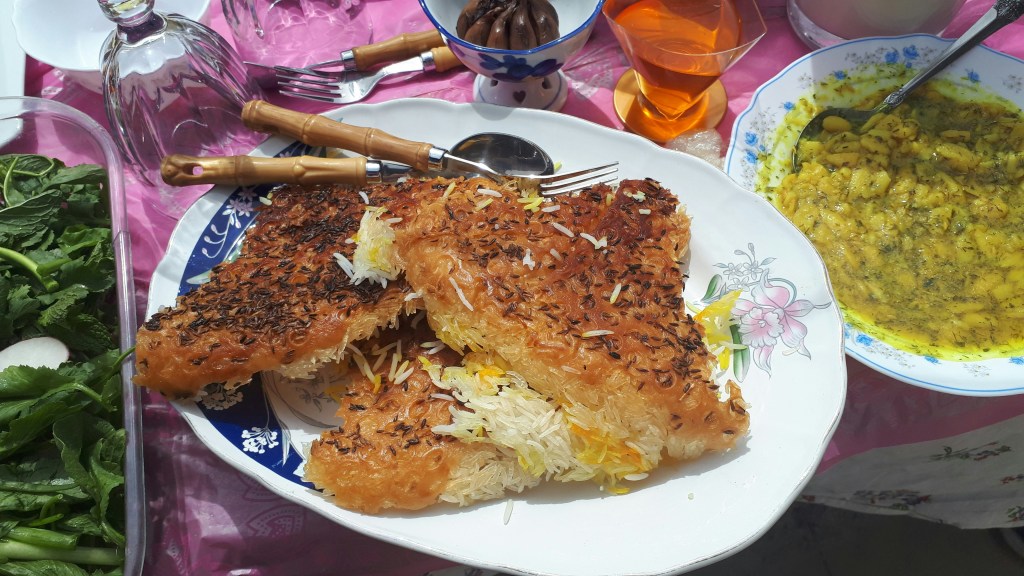
I’ve long wondered how our Central Asian people group fuels such energy and excitement for hospitality. Most households are genuinely excited when guests show up, even when they turn up unannounced. The household springs into action with warm machine-gun-fire blessings of welcome proclaimed and standing handshakes, hands on hearts, or kisses on cheeks all around. Quickly and energetically, guests are ushered into the hosting room, where they are given the best seats, quickly offered cold water, hot chai, snacks, and – if the hosts can succeed in their persuasion – an elaborate meal. And the hosts will then keep pushing to see just how far they can convince their guests to accept even more hospitality. They’ll offer showers, naps, follow-up meals, and even spending the night – offering their own pajamas to shut down our attempts to excuse ourselves by saying that we didn’t pack for the night.
Now, I’ve been watching our focus people group closely for many years. The overwhelming majority of these offers are genuine. Every once in a while, I’ll catch an acquaintance making an honorable but hypothetical offer, and I can tell his heart isn’t in it. But the vast majority of the time, the offers are made with what is honestly a perplexing depth of delight. Yes, all cultures know that, in the end, it is rewarding to host others well. But this level of hospitality takes a lot of work and money. It’s costly and tiring and, frankly, unsustainable unless you’ve got relatives around to help out. So, how is it possible for humans to be this motivated to show hospitality?
For a long time, it has seemed that there’s been something going on beneath the surface that could explain this incredible hosting energy. At last, I think we’ve found it.
Turns out our local friends are raised to believe that guests are concrete evidence that God cares for you. There’s a local proverb that states, “Guests are God’s guests.” This means that guests are, in fact, blessings sent to a home by God himself – and evidence that more blessings lie in store. Local culture from ancient times has taught that guests are proof that God remembers you, cares for you, and wants to bless you. By sacrificing to show lavish hospitality, a family responds to God’s gift and puts itself even more in the way of God’s blessings, as it were.
Locals believe that extravagant hospitality is a sort of spiritual investment. It is God giving them an opportunity to pour themselves out for others. And if they are found faithful to care for others as if they were more important than themselves, then God will see, remember them, and provide for their needs. This is why they light up when you tell them you’re coming to visit them. You’ve just told them that God remembers them – and wants to bless them.
What a glorious instinct to have at the center of a fallen culture. How merciful of God to allow this kind of hospitality to still burn bright, even after centuries of Islam choking out so many other areas of common grace.
This is not how Western culture has raised most of us, even those of us from hospitable families. But what has struck me is that this is how many mature believers in the West come to feel about giving sacrificially of their money. As Christians learn to give generously to the local church and to the poor, believing that God is indeed a great rewarder, we give lavishly of our finances, even beyond what others consider wise. We learn from experience and by testing God’s promises that this kind of giving is a surefire way to deeper joys and experiences of God’s provision. Opportunities to give are, in a sense, evidence that God cares for us, that he wants to fill our lives with his joy and provision – and with eternal rewards to boot. Western Christianity has its weaknesses, yes, but when it comes to generosity, it is often exemplary. If you doubt me on this, ask believers from other parts of the world.
However, the Central Asian church is, to put it mildly, anemic when it comes to giving. Believers will often give a small token amount to save face, but balk at suggestions that they should risk something as radical as ten percent or even more of their income. No, they believe, it’s the job of the Western church to fund the churches and believers here with their endless flow of funds. This unfortunate sort of entitlement mindset is often present. And it has meant that there are no self-supporting local churches that I know of in our country of service at all.
I firmly believe that until our local friends learn how to give sacrificially to the church, they will be lacking certain kinds of spiritual power and joy. Why does our people group seem so hardened, so good at killing church plants? Why do the churches that exist seem so riven with gossip and division? Perhaps because most believers refuse to risk trusting God with their money. The Christian life is full of asymmetrical causes and effects like this. Obedience in one area unlocks joy and grace for obedience in other areas, even if at first glance they seem unrelated. If we want to see this land flooded with the light of the gospel, the locals are going to have to learn how to give.
Much is at stake. So what is to be done to help local believers understand the positively stunning promises of God’s word when it comes to giving generously? Having now better understood their motivations that empower radical hospitality, I think we should start drawing on these same motivations to also empower giving. Essentially, the category for sacrificial giving already exists, and deeply so, within local culture. For believers, then, who are empowered by even deeper gospel motivations, it just needs to be expanded to include supporting the local church and missions financially. This might mean shifting how we talk about giving, such that we use more hospitality-specific vocabulary. It certainly means using the ‘guests are God’s guests’ mindset as an illustration of how God is calling believers to trust and obey when it comes to giving away their family’s funds.
Tim Keller used to call this kind of thing floating the B doctrines on the A doctrines. Locally, giving money to the church is a B doctrine, something that our Central Asians don’t naturally resonate with. In fact, some find it a bit offensive, given how hard their lives are. But sacrificial Christian hospitality is an A doctrine, something local believers can yes and amen with incredible gusto and experience. By connecting them and showing how the one empowers the other, we ‘float’ the offensive one on the one that already deeply resonates. By doing so, we can help unlock new areas of obedience or belief that were previously no-go zones because of a given culture’s particular brokenness.
While we’re at it, some of this should probably flow the other way as well. We from the Western church could use a renovation of our motivations for hospitality. As I just read this morning, God really does take care of the Shunammite woman in response to her hospitality toward Elisha (2 Kings 4, 8). This woman leapt at the chance to host God’s prophet, seemingly trusting that this guest was an opportunity to put herself in the way of God’s blessing. In response, God graciously gave her a son, and later, her land back. Even more than this, Christ assures us that if we even offer a cup of cold water to another believer, it’s like we’re offering a cup of cold water to Christ himself – an act that will not be forgotten by the great rewarder (Matt 10:42).
I had to remind myself of these things this week, as a single brother struggling with a recent breakup asked to come spend the night with us again. I was already tired, and I knew saying yes would mean a late night of listening and trying to give comfort and counsel. However, I was helped to say yes more from the heart by remembering that this was, in fact, God showing his care for me, that he was giving me an opportunity to serve, and thereby to know more of his joy and provision. It’s more blessed to give than to receive, right?
In this area, we can learn a great deal from our Central Asian friends. Guests really are evidence that God cares for us, that he will take care of us. And now in Christ, more so than we could ever imagine.
If you have been helped or encouraged by the content on this blog, would you consider supporting this writing and our family while we serve in Central Asia? You can give here through the blog or contact me to find out how to give through our organization.
One of the international churches in our region is looking for an associate pastor and our kids’ TCK school is also in need of teachers for the 2026-2027 schoolyear. If you have a good lead, shoot me a note here.
Blogs are not set up well for finding older posts, so I’ve added an alphabetized index of all the story and essay posts I’ve written so far. You can peruse that here
For my list of recommended books and travel gear, click here.
*Names have been changed for security
Photo from Unsplash

 Entrusted to the Dirt